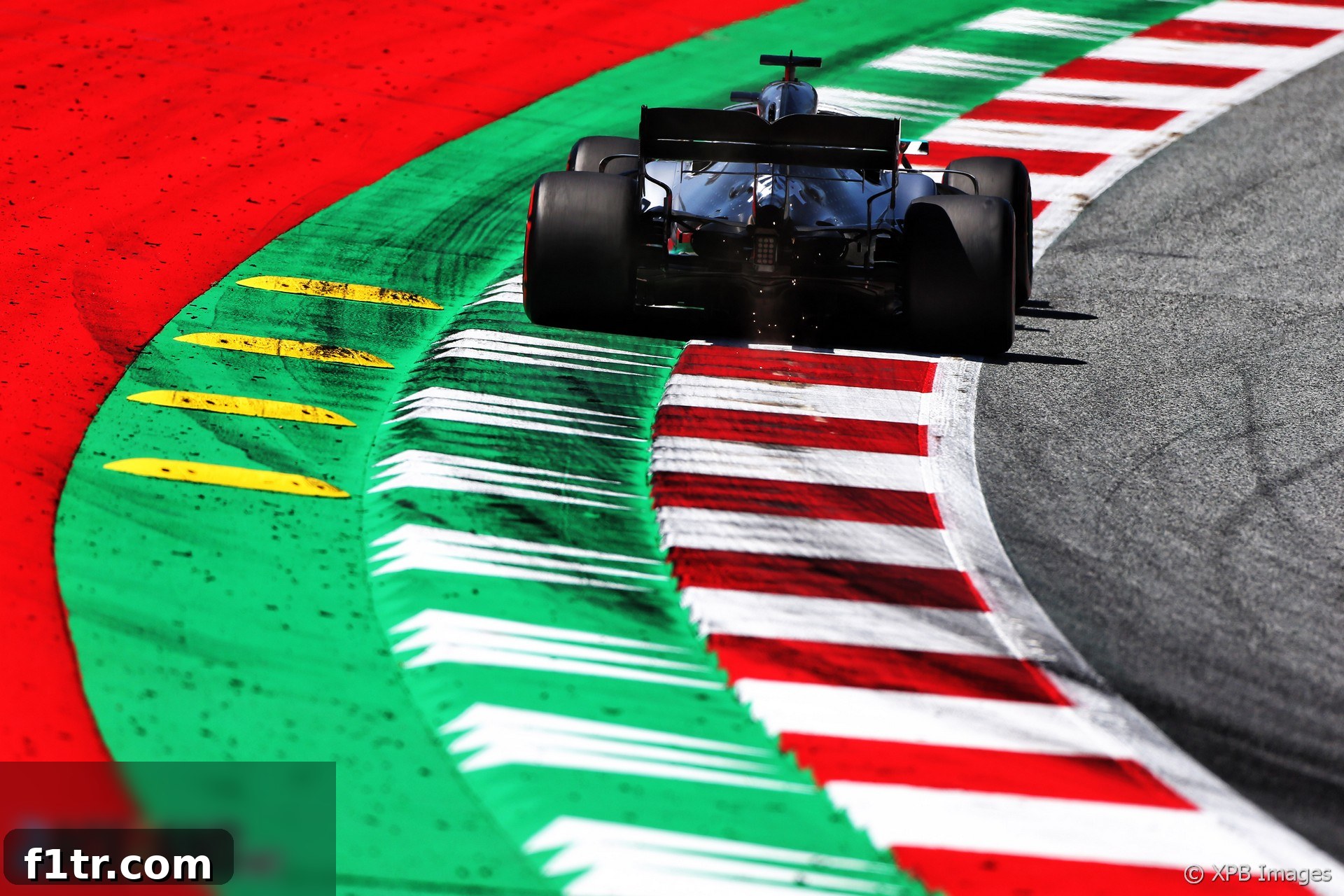
The highly anticipated Austrian Grand Prix weekend roared to life at the Red Bull Ring with Lewis Hamilton and Mercedes leading the charge in the first practice session. However, the session quickly hinted at a fierce battle ahead, as Sebastian Vettel’s Ferrari demonstrated impressive pace, finishing just a tenth of a second behind Hamilton while running on the harder medium compound tyres, signalling Ferrari’s strong potential.
Advert | Become a Supporter & go ad-free
Hamilton Sets the Benchmark as Ferrari Shows Strong Hand
Lewis Hamilton, the five-time world champion, immediately stamped his authority on the Styrian circuit. He posted the fastest lap of the session with a time of 1’04.838. This remarkable effort was only a thousandth of a second quicker than his best time from the same session in the previous year, highlighting his consistent prowess and the finely tuned performance of his Mercedes W10 at this compact track. The Red Bull Ring saw a scorching track temperature of 46 degrees Celsius, a factor that profoundly influenced tyre degradation and overall performance throughout the practice hour.
While Hamilton’s rapid time was achieved on the soft compound Pirelli tyres, the true surprise came from Sebastian Vettel. The Ferrari ace completed his best lap in 1’04.982, positioning him a mere 0.144 seconds adrift of the Mercedes. Crucially, Vettel achieved this impressive time on the medium compound tyres, which are inherently slower than the softs. This performance differential immediately piqued interest, suggesting that Ferrari might possess superior race pace or a more flexible tyre strategy for the weekend, particularly given the challenging hot conditions.
Despite his commanding lead, Hamilton’s session was not without a minor hiccup. He incurred light damage to his front-left wing endplate, a common occurrence at a circuit known for its aggressive kerbs and high-speed demands. This small incident served as an early reminder of the fine margins and precision required to extract maximum performance from these modern Formula 1 cars.
Teammates Face Early Setbacks and Strong Recoveries
Bottas’s Engine Troubles and Resilient Performance
The Mercedes garage experienced a frantic hour leading up to FP1. An oil leak was detected on Valtteri Bottas’s W10 just an hour before the session was scheduled to begin. The team quickly opted to swap his relatively new ‘spec two’ power unit for an older ‘spec one’ example as a precautionary measure. This unexpected engine change meant that Bottas missed the initial thirty minutes of the session, putting him at a significant disadvantage in terms of setup work and track familiarization. Nevertheless, once he joined the action, the Finn wasted no time in demonstrating his capabilities. Like Hamilton, he set his best time on the soft tyres, clocking a 1’04.999 lap, which placed him third overall. Bottas’s recovery to within 0.161 seconds of his teammate and just a breath behind Vettel, despite his limited running, was a testament to his adaptability and the inherent speed of the Mercedes package.
Leclerc Shows Competitive Pace for Ferrari
The second Ferrari of Charles Leclerc also demonstrated strong competitive form, slotting into fourth place on the timing sheets. Leclerc’s best lap of 1’05.141 placed him just over a tenth of a second behind Bottas and comfortably within half a second of Hamilton. This solid showing from both Ferrari drivers, especially considering Vettel’s performance on the medium tyres, indicated that the Italian squad had arrived at the Red Bull Ring with a strong contender. Their early pace suggests they will be key challengers for pole position and race victory, adding another layer of excitement to what promises to be a thrilling weekend.
Red Bull’s Home Challenge and the Midfield Hustle
At their home circuit, the Red Bull Ring, the Red Bull Racing team showed competitive, albeit not dominant, pace. Max Verstappen and Pierre Gasly secured the fifth and sixth fastest times respectively. On this incredibly short, high-speed circuit, where lap times typically hover around 64 seconds, the gaps between cars are often compressed. Verstappen finished within half a second of Hamilton’s leading time, an encouraging sign for the Milton Keynes-based squad who are always looking to perform well in front of their Austrian energy drink owners. Gasly, his teammate, was also in close attendance, just over a tenth of a second behind Verstappen, indicating a reasonable performance from both Red Bull-Honda cars.
The midfield battle was, as expected, incredibly tight and fiercely contested. Carlos Sainz Jnr led the charge for McLaren, delivering an impressive seventh-place finish. Sainz is set to receive a new power unit for this event, which will regrettably incur a grid penalty for Sunday’s race. Despite this impending setback, his strong performance underscores McLaren’s consistent improvements and their determination to solidify their position as leaders of the midfield pack. His teammate, Lando Norris, also had a commendable session, securing tenth place and highlighting the Woking team’s double presence in the top ten. The two McLarens were separated by Daniel Ricciardo in the Renault and Kevin Magnussen for Haas, showcasing the intense competition where every tenth of a second counts.
Other notable performances in the midfield included Romain Grosjean in the second Haas, Daniil Kvyat and Alexander Albon for Toro Rosso, Sergio Perez for Racing Point, and the Alfa Romeo duo of Antonio Giovinazzi and Kimi Räikkönen, all vying for crucial positions.
Hulkenberg Incident Brings Practice to an Early Close
The session came to a premature end with just three minutes remaining due to an incident involving Nico Hulkenberg. The Renault driver, who had posted the 14th-best time, ran wide at Turn 9, making contact with a kerb that resulted in significant damage to the left-hand side of his front wing. The impact scattered debris across the track, necessitating the immediate deployment of red flags to allow marshals to safely clear the circuit. This brought an abrupt end to the practice session, preventing any further flying laps or last-minute setup changes. While a frustrating end for Hulkenberg and Renault, it served as a stark reminder of the precision demanded by the high-speed corners and aggressive kerbing of the Red Bull Ring.
Advert | Become a RaceFans supporter andgo ad-free
Official First Practice Session Results: 2019 Austrian Grand Prix
For a detailed breakdown of all the drivers’ performances, lap times, and the number of laps completed during the opening practice session at the Red Bull Ring, please refer to the comprehensive table below:
| Pos. | No. | Driver | Car | Best lap | Gap | Laps |
|---|---|---|---|---|---|---|
| 1 | 44 | Lewis Hamilton | Mercedes | 1’04.838 | 34 | |
| 2 | 5 | Sebastian Vettel | Ferrari | 1’04.982 | 0.144 | 23 |
| 3 | 77 | Valtteri Bottas | Mercedes | 1’04.999 | 0.161 | 37 |
| 4 | 16 | Charles Leclerc | Ferrari | 1’05.141 | 0.303 | 26 |
| 5 | 33 | Max Verstappen | Red Bull-Honda | 1’05.260 | 0.422 | 30 |
| 6 | 10 | Pierre Gasly | Red Bull-Honda | 1’05.378 | 0.540 | 30 |
| 7 | 55 | Carlos Sainz Jnr | McLaren-Renault | 1’05.502 | 0.664 | 34 |
| 8 | 3 | Daniel Ricciardo | Renault | 1’05.846 | 1.008 | 27 |
| 9 | 20 | Kevin Magnussen | Haas-Ferrari | 1’05.876 | 1.038 | 27 |
| 10 | 4 | Lando Norris | McLaren-Renault | 1’06.125 | 1.287 | 27 |
| 11 | 8 | Romain Grosjean | Haas-Ferrari | 1’06.135 | 1.297 | 20 |
| 12 | 26 | Daniil Kvyat | Toro Rosso-Honda | 1’06.272 | 1.434 | 29 |
| 13 | 23 | Alexander Albon | Toro Rosso-Honda | 1’06.285 | 1.447 | 32 |
| 14 | 27 | Nico Hulkenberg | Renault | 1’06.383 | 1.545 | 30 |
| 15 | 11 | Sergio Perez | Racing Point-Mercedes | 1’06.457 | 1.619 | 36 |
| 16 | 99 | Antonio Giovinazzi | Alfa Romeo-Ferrari | 1’06.708 | 1.870 | 30 |
| 17 | 7 | Kimi Raikkonen | Alfa Romeo-Ferrari | 1’06.729 | 1.891 | 23 |
| 18 | 18 | Lance Stroll | Racing Point-Mercedes | 1’06.756 | 1.918 | 29 |
| 19 | 63 | George Russell | Williams-Mercedes | 1’06.805 | 1.967 | 28 |
| 20 | 88 | Robert Kubica | Williams-Mercedes | 1’07.665 | 2.827 | 28 |
First Practice Visual Gaps: Understanding the Performance Spread
Lewis Hamilton – 1’04.838
+0.144 Sebastian Vettel – 1’04.982
+0.161 Valtteri Bottas – 1’04.999
+0.303 Charles Leclerc – 1’05.141
+0.422 Max Verstappen – 1’05.260
+0.540 Pierre Gasly – 1’05.378
+0.664 Carlos Sainz Jnr – 1’05.502
+1.008 Daniel Ricciardo – 1’05.846
+1.038 Kevin Magnussen – 1’05.876
+1.287 Lando Norris – 1’06.125
+1.297 Romain Grosjean – 1’06.135
+1.434 Daniil Kvyat – 1’06.272
+1.447 Alexander Albon – 1’06.285
+1.545 Nico Hulkenberg – 1’06.383
+1.619 Sergio Perez – 1’06.457
+1.870 Antonio Giovinazzi – 1’06.708
+1.891 Kimi Raikkonen – 1’06.729
+1.918 Lance Stroll – 1’06.756
+1.967 George Russell – 1’06.805
+2.827 Robert Kubica – 1’07.665
Note: Drivers more than ten seconds off the leading pace are omitted from this visual representation for clarity.
Key Takeaways from FP1: Shaping Expectations for the Austrian Grand Prix
The first practice session for the Austrian Grand Prix at the Red Bull Ring has undoubtedly set the stage for an exhilarating weekend of Formula 1 action. While Lewis Hamilton and Mercedes demonstrated their expected front-running pace, the performance of Sebastian Vettel and Ferrari on the medium compound tyres was a significant talking point, strongly suggesting that the Scuderia holds a formidable threat for both qualifying and the race. The intense heat at the circuit emphasized the critical role of tyre management and strategic decision-making throughout the event.
Valtteri Bottas’s admirable recovery from an unexpected engine issue to secure a strong third place highlighted Mercedes’ depth and resilience. Meanwhile, Charles Leclerc’s consistent speed ensured Ferrari’s dual presence at the sharp end of the grid. Red Bull Racing, with Max Verstappen leading their charge at their home venue, remained firmly within striking distance of the top two teams, promising a thrilling three-way battle at the forefront.
In the fiercely competitive midfield, McLaren, spearheaded by Carlos Sainz’s impressive performance despite an impending grid penalty, continued to assert its strong form. Renault, too, showed flashes of pace, although Nico Hulkenberg’s incident served as a stark reminder of the unforgiving nature of the Red Bull Ring. As teams delve deep into the data collected during this session, the focus will intensify on perfecting race setups, understanding long-run tyre degradation characteristics, and strategizing for the crucial qualifying session.
The initial indicators from FP1 strongly suggest a closely contested Austrian Grand Prix, where tyre compound choices, engine performance, and driver precision will be paramount to securing victory. Fans can anticipate an unpredictable and action-packed weekend as the teams fine-tune their machines for the challenges ahead.
Advert | Become a RaceFans supporter andgo ad-free
Explore More from the 2019 Austrian Grand Prix
- 2019 Austrian Grand Prix Star Performers
- Top ten pictures from the 2019 Austrian Grand Prix
- Leclerc denied again as Verstappen’s hard racing gives Red Bull home win
- Six wins and no pole for Verstappen, two poles and no win for Leclerc
- Paddock Diary: Austrian Grand Prix day four
Browse all 2019 Austrian Grand Prix articles