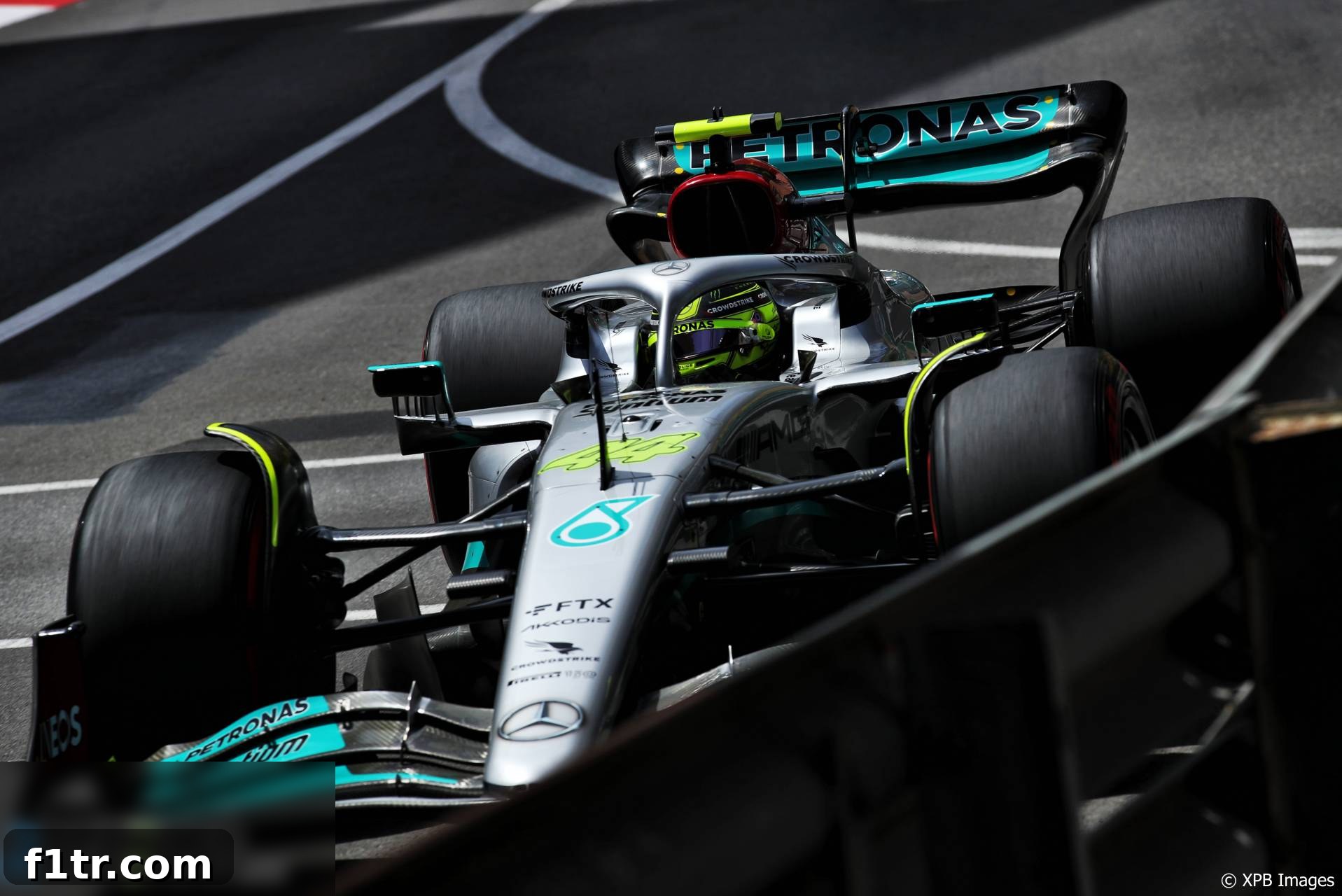
Seven-time Formula 1 world champion Lewis Hamilton expressed significant concern over Mercedes’ performance issues, stating that the handling problems with their W13 car are proving to be far more severe than the team had initially anticipated. His candid remarks came after qualifying a challenging eighth for the prestigious Monaco Grand Prix, a circuit notorious for exposing car weaknesses and demanding absolute precision.
The Silver Arrows entered the Monaco weekend with a degree of trepidation, a sentiment openly shared by Team Principal Toto Wolff. Wolff had previously voiced worries about the W13’s low-speed cornering capabilities, an area he predicted would be a significant vulnerability around the tight, twisty streets of Monte Carlo. This pre-race assessment, unfortunately for Mercedes, proved alarmingly accurate as the weekend unfolded.
During the crucial practice sessions leading up to qualifying, the Mercedes team grappled with intense ‘porpoising’ – the violent bouncing motion of the car at high speeds – and general instability. This phenomenon, which has plagued the W13 since the start of the 2022 season under the new technical regulations, was particularly pronounced on the unforgiving streets of Monaco. The team worked tirelessly overnight, implementing changes that Hamilton acknowledged did seem to alleviate the severity of the bouncing. However, this apparent improvement in ride comfort came at a steep cost: a noticeable lack of outright pace.
The raw performance deficit was starkly evident in qualifying. Neither Lewis Hamilton nor his teammate George Russell could get within seven-tenths of a second of Charles Leclerc, who stormed to pole position for Ferrari. This gap underscored the fundamental issues Mercedes faced, struggling to unlock the potential of their car on a track where mechanical grip and aerodynamic stability are paramount.
Hamilton himself succinctly identified a core aspect of the problem. “We have poor rear downforce,” he explained, elaborating on the car’s imbalanced setup. “Loads of front but nothing on the rear.” This observation points to a critical aerodynamic flaw, where the car generates sufficient downforce at the front axle but lacks the corresponding grip at the rear. On a circuit like Monaco, which features numerous slow-speed corners and requires immense traction for optimal acceleration, such an imbalance is catastrophic for lap time and driver confidence.
Reflecting on the progress, or lack thereof, Hamilton added, “Today it felt better, but we seem to be slower. I don’t know really why. It felt like we improved the car in terms of bouncing but it feels slower.” This paradox highlights the intricate challenges Mercedes engineers faced in fine-tuning the W13. Resolving one issue, such as bouncing, often had unforeseen consequences on another aspect of performance, leaving the team in a difficult position of chasing a constantly moving target.
The veteran driver firmly believes that the car’s inherent struggles over bumps, exacerbated by the notoriously uneven Monaco street circuit, compound their existing difficulties in low-speed handling. Monaco’s unique characteristics, with its ancient road surfaces and rapid elevation changes, act as a magnifying glass for any car’s suspension and aerodynamic limitations. For a car already struggling with aerodynamic stability and a propensity for bouncing, these bumps proved to be a constant impediment.
“We weren’t very good in the low-speed in the last race anyway,” Hamilton recalled, referencing previous rounds of the championship. “In the race it was okay but [not] on a single lap.” This distinction between race pace and qualifying pace is crucial; while the W13 might manage decent race stints with careful tire management, extracting peak performance over a single, flat-out qualifying lap has consistently proven challenging. Monaco, being a track where qualifying position is king, thus presented an existential threat to Mercedes’ weekend aspirations.
He continued, “So [we] anticipated it would be difficult here. I think it’s worse than we anticipated because of the bumps. It’s super bouncy for us everywhere. Slow, medium and high, so challenging.” This comprehensive description paints a clear picture of the W13’s persistent instability across the entire speed range of the Monaco circuit. From the tight hairpin turns requiring maximum mechanical grip to the faster sections demanding aerodynamic poise, the car was a handful, constantly unsettling the drivers and preventing them from attacking the corners with full commitment.
Hamilton’s qualifying session also saw a dramatic end, preventing him from potentially improving his grid slot. As he was embarking on his final flying lap in Q3, the session was abruptly red-flagged due to significant crashes involving Sergio Perez and Carlos Sainz Jnr. These incidents, while unfortunate for the drivers involved, also dashed any remaining hopes Hamilton had of climbing higher up the grid. “I think it wasn’t looking too bad before that but this sort of thing happens,” he remarked philosophically, acknowledging the unpredictable nature of motorsport, particularly in Monaco. “It is what it is.”
The ultimate outcome was a P8 start for Hamilton, one position lower than his qualifying performance in the previous year’s Monaco Grand Prix. This grid position, while not disastrous in some races, carries a particularly grim prognosis for Monaco. The street circuit is famously difficult, almost impossible, for overtaking, with narrow confines and precious few opportunities to make a move stick. Unless external factors come into play, Hamilton holds little hope of significantly improving his position on merit alone.
“You can’t overtake here,” he stated matter-of-factly, summing up the universal truth of racing in Monaco. His primary hope for advancement now rests on the capricious nature of the weather or innovative strategic gambits from the pit wall. “I’m hoping that the weather plays up and it creates opportunities, maybe people do different strategies. It’d be nice to have some luck for once.” A wet race could indeed introduce an element of chaos and unpredictability, potentially shuffling the field and creating openings that would otherwise be non-existent on a dry track. Different tire strategies or well-timed pit stops could also offer a glimmer of hope in the otherwise processional nature of a Monaco race.
Mercedes’ struggles at Monaco underscore the significant hurdles they face in the 2022 Formula 1 season. Having dominated the sport for the better part of a decade, the new technical regulations have fundamentally altered the competitive landscape. The W13’s design, characterized by its unique ‘zero-pod’ concept and the inherent porpoising issues, has placed the team on the back foot. For Lewis Hamilton, a driver accustomed to fighting for pole positions and race victories, these challenges represent a profound test of resilience and adaptation. The team’s engineers are in a desperate race against time to understand and rectify the car’s fundamental limitations, a task made all the more complex by the evolving demands of different circuits.
The Monaco Grand Prix has historically been a barometer for a car’s overall package, demanding a balance of aerodynamic efficiency, mechanical grip, and driver skill. The W13’s performance around this iconic track served as a stark reminder of the ground Mercedes still needs to cover. While P8 is not the desired outcome for a driver of Hamilton’s caliber, the focus now shifts to damage limitation and gathering crucial data that can inform future development. The season is long, but the challenges are immense, and the fight to bring the Mercedes W13 back to its winning ways continues relentlessly, race by race, corner by corner, bump by bump.
2022 Monaco Grand Prix
- Whatever triggered it, Verstappen’s defiance of his own team makes little sense
- Transcript: How Red Bull seized a win that ‘Ferrari looked like they had in the bag’
- Verstappen now has as many poles as Leclerc – but six times as many wins
- Schumacher’s chassis-splitting crash shows effects of rising car weight – Alonso
- Norris still can’t drive McLaren the way he wants to, despite strong results
Browse all 2022 Monaco Grand Prix articles