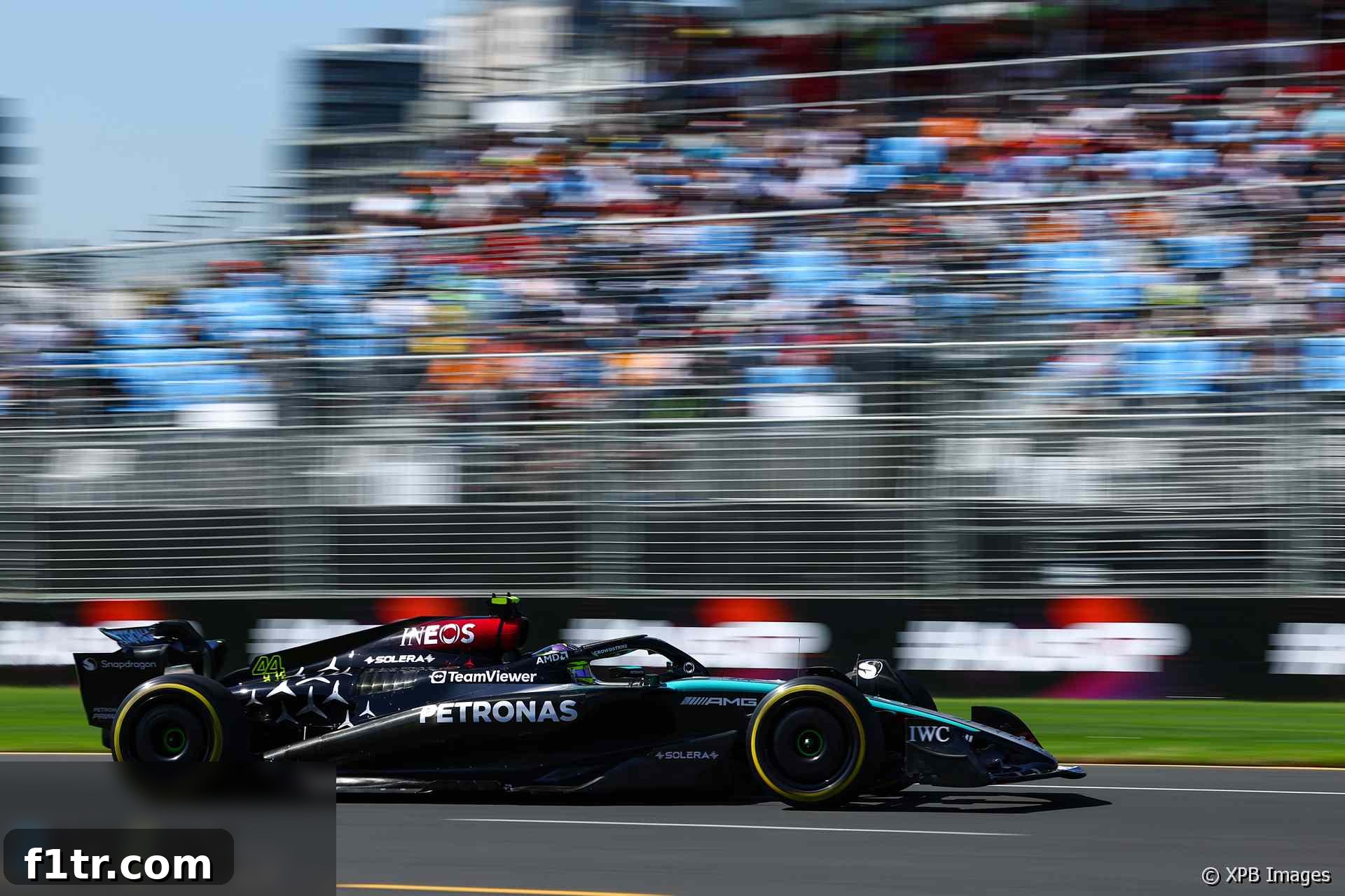
The opening practice sessions for the Australian Grand Prix often set the tone for the weekend, revealing which teams have found their stride and which are grappling with early challenges. For Mercedes-AMG Petronas F1 Team, Friday practice in Melbourne proved to be a mixed bag of fortunes, particularly highlighting a stark contrast in driver experiences. While George Russell managed to extract some promising pace from his W15, a visibly frustrated Lewis Hamilton found himself battling one of the most difficult sessions he’s endured in recent memory, ending up a lowly 18th out of 19 drivers who set representative times.
Advert | Become a Supporter & go ad-free
Hamilton’s struggles were palpable, a sentiment he openly shared with the official F1 channel after the session. “We had one of the worst sessions I probably had for a long time,” he confessed, his tone reflecting deep dissatisfaction with the car’s behavior. This candid admission underscored the significant hurdles Mercedes is facing in unlocking the full potential of their 2024 challenger, the W15. The search for optimal performance has been an ongoing saga for the Silver Arrows since the start of the new ground effect regulations, and Melbourne’s initial outings only added to the complexity.
Mercedes arrived at the iconic Albert Park circuit with a clear agenda: to conduct a series of experimental changes on their cars. The primary objective was to address the persistent handling problems that have plagued them in earlier races, particularly their notorious lack of performance in high-speed corners. Team principal Toto Wolff, usually composed, acknowledged the severity of the situation for Hamilton, admitting that these strategic experiments had “backfired” specifically on the seven-time world champion’s side of the garage. This frank assessment highlighted the risks inherent in aggressive setup changes during a crucial race weekend.
The day began with a glimmer of hope. Hamilton reported that his W15 “felt the best it’s ever felt” during his initial run in the first practice session (FP1). This initial optimism, however, was short-lived. What followed was a rapid decline in performance and driver confidence. “It just got worse and worse. We made some big changes into [second practice], and it was tough,” Hamilton explained, detailing the team’s attempts to course-correct which, unfortunately, only exacerbated his difficulties. Each modification seemed to push the car further away from a stable and predictable operating window, leaving Hamilton fighting the machine rather than the stopwatch.
By the end of the day, the stark reality had set in. Hamilton expressed an unprecedented level of discomfort with his machine. “After that session, I feel the least confident I’ve ever felt with this car,” he declared, a statement that speaks volumes given his extensive career and countless hours behind the wheel of various Formula 1 cars. Despite the overall negativity, he tried to find a silver lining, acknowledging “positives from that [first practice] run that we did,” perhaps indicating specific data points or setup ideas that could still be salvaged from an otherwise disheartening day. His battle against the W15’s unpredictable nature underscores the deep-seated challenges Mercedes continues to face.
The journey for Mercedes in the 2024 season has been characterized by an ongoing battle to tame the W15. The car, designed with ambitious goals to rectify the shortcomings of its predecessors, has proven to be a complex beast to master. The team’s engineering philosophy often involves pushing the boundaries of what’s possible, but sometimes, as witnessed in Melbourne, these aggressive development paths can lead to temporary setbacks. The “backfired” experiments suggest that some of the setup directions taken for Hamilton’s car introduced unforeseen instabilities or simply failed to deliver the intended performance gains, leaving the British driver struggling for grip and balance around the challenging Albert Park layout. This ongoing search for performance stability is a critical factor influencing both drivers’ confidence and overall team morale.
In contrast to Hamilton’s challenging day, his team mate George Russell presented a much more encouraging picture. Russell, who has often shown a remarkable adaptability to difficult cars, managed to be significantly closer to the front-running pace in his W15. “I felt pretty comfortable out there from the beginning,” he stated, indicating a more stable and predictable platform to work with, even if not perfectly optimized. This difference in perception highlights the fine margins in Formula 1 and how individual driving styles can interact uniquely with a car’s characteristics.
Russell elaborated on the iterative development process Mercedes is undergoing. “We’ve made some changes since Saudi and Bahrain. We’re still trying to understand this car further. Every single lap is so valuable, you learn more and more about it and trying to get it into the sweet spot,” he explained. This highlights the intricate dance of data analysis, simulation work, and on-track testing that goes into optimizing a modern F1 car. The subtle adjustments made after the previous two rounds, combined with Russell’s driving style, seemed to resonate better with his car’s setup, allowing him to push closer to the limit without the dramatic drop-off in confidence experienced by Hamilton. This constant evolution is key to unlocking consistent pace over the course of a Grand Prix season.
The synergy between the trackside team and the factory back in Brackley is crucial during a Grand Prix weekend. Russell touched upon this, noting, “Obviously now we have the team back at the factory working on the sim trying to get more performance out of it. So let’s see what tomorrow brings.” This collaborative effort, leveraging advanced simulation tools, is vital for crunching the extensive data gathered during practice and identifying potential solutions for qualifying and the race. The aim is always to find that elusive “sweet spot” – a state where the car’s setup, tire performance, and driver input perfectly align for maximum speed and consistency. The nocturnal efforts of the engineers will undoubtedly shape Mercedes’ prospects for the remainder of the weekend.
Despite his relative comfort, Russell acknowledged there was still more to come. He ended Friday practice 0.674 seconds off the ultimate pace, a gap he felt could have been narrower. “We were pushing the limits and had a few little moment here and there, but all under control in the end,” he recounted. This suggests that while he was extracting a decent level of performance, he was still exploring the absolute boundaries of the W15, which is typical for a Friday session. Finding that ultimate limit without overstepping it is an art, and Russell demonstrated a controlled aggression that could pay dividends as the weekend progresses.
The competitive nature of the 2024 grid was also a point of discussion for Russell. “It seems pretty tight out there. In the first session it was like two tenths splitting 10 cars. FP2 slightly more spread out. I was on course for a really good lap at the end and just had a small problem in the last two corners,” he revealed. This minor error, common when drivers are pushing the absolute limits, prevented him from showing the W15’s full potential in FP2, suggesting that his true pace might have been even closer to the front. The close margins underscore the critical importance of every detail, from driver input to car setup, in a tightly contested Formula 1 season, where even a slight misstep can significantly alter grid positions.
The divergent experiences of Mercedes’ two star drivers in Melbourne raise significant questions for the team heading into Saturday’s crucial qualifying session. While Hamilton’s feedback on his car’s handling was alarming, Russell’s more positive assessment provides some data points for optimism. The challenge for Mercedes engineers will be to understand why the experimental setups worked so poorly for Hamilton and whether there’s a quick fix that can restore his confidence and pace. The difference in their feedback could also highlight inherent sensitivities in the W15’s design, making it a tricky car to set up consistently across different driving styles and track conditions, a puzzle the team has been trying to solve since early 2022.
The Albert Park circuit, known for its mix of high-speed sections and technical corners, demands a balanced car with strong aerodynamic stability. The “high-speed cornering performance” issue that Mercedes has been battling suggests a fundamental problem with how the W15 generates downforce or handles turbulent air at speed. Resolving this isn’t a simple matter of minor adjustments; it often requires a deeper understanding of the car’s aerodynamic platform. The experiments conducted in Australia were likely attempts to gather more data on this specific area, even if the initial outcomes were not favorable for one driver. The team’s long-term goal is to achieve a stable and predictable car that can perform optimally on various track types, a characteristic that has eluded them in recent seasons.
Looking ahead, the team will be working tirelessly overnight, analyzing every byte of telemetry from both cars. The simulation team at the factory will be running countless scenarios, exploring alternative setups and attempting to simulate the changes needed to bring Hamilton’s W15 back into a competitive window. The goal for Saturday’s Free Practice 3 (FP3) will be to implement revised setups that hopefully provide both drivers with a more predictable and confidence-inspiring car ahead of qualifying. The pressure is undoubtedly on Mercedes to turn their Friday struggles into a Saturday recovery, particularly for Hamilton, who will be keen to shake off the “least confident” feeling and rediscover the pace that has defined his illustrious career, and deliver a strong result for the German outfit.
The Australian Grand Prix weekend is still young, and while Friday offered a glimpse into Mercedes’ current challenges, Formula 1 is a sport of constant evolution and rapid problem-solving. The capacity for teams to bounce back from difficult practice sessions is immense, and Mercedes, with its vast resources and engineering prowess, will be determined to do just that. The true test of their understanding of the W15 will come in qualifying, where every tenth of a second counts, and then in Sunday’s race, where consistency and race pace will be paramount. Fans will be watching closely to see if Mercedes can unlock the potential of the W15 and challenge at the front in Melbourne.
Advert | Become a RaceFans supporter andgo ad-free
2024 Australian Grand Prix Insights & Updates
- Alonso calls Australian GP penalty a ‘one-off I’ve had too many of’
- Red Bull saw warning sign of Australian GP brake problem on Saturday – Verstappen
- Failing to punish Alonso would have “opened a can of worms” – Russell
- Leclerc sure “many team principals” are pursuing Sainz for 2025 seat
- “Don’t put me under pressure” – The best unheard team radio from Melbourne
Browse all 2024 Australian Grand Prix articles