In a candid and revealing interview, seven-time Formula 1 World Champion Lewis Hamilton has shed light on the pervasive racism he endured throughout his formative years. This profound early life experience, he explained, became a powerful catalyst, driving his unwavering commitment to championing greater diversity and inclusion within motorsport – a mission he pursues with relentless passion today.
Advert | Become a Supporter & go ad-free
Lewis Hamilton: A Champion’s Journey Through Racism to Reshape F1 Diversity
During an extensive, hour-long discussion with prominent internet personality and purpose coach Jay Shetty, Hamilton delved deeply into the systemic prejudices and personal affronts he faced as a mixed-race child growing up in Britain during the 1980s and 90s. His recounting paints a vivid picture of the challenging environment that shaped his early perspective and ultimately fueled his drive for change.
Early Struggles: The Scars of Childhood Racism and Bullying
Hamilton vividly recalled his school days as “the most probably the most traumatising and most difficult part of my life.” From the tender age of six, he was subjected to relentless bullying. In a school predominantly white, Hamilton was often one of only a handful of children of color, making him a visible target. “Bigger, stronger bullying kids were throwing me around a lot of the time,” he shared, highlighting the physical and emotional toll it took.
The feeling of being an outsider extended even to simple playground activities. “I was always the last picked – when you’re standing in the playground and you’re in the line when they’re picking teams for football, I was always the last one chosen or not even chosen. Even if I was better than somebody else,” he recounted, underscoring the deep sense of exclusion that permeated his early life.
The abuse was not merely physical; it was deeply racialized. Hamilton remembered “constant jabs” and casual racial slurs. He spoke of “things that are thrown at you like bananas,” and hearing people “use the ‘N-word’, just so relaxed.” The term “half-caste” was also frequently hurled at him, leaving him with a profound sense of not belonging, of being an anomaly. “That, for me, was difficult,” he confessed, revealing the lasting emotional impact of such language.
This feeling of being unseen was exacerbated in the classroom. “When you then go into, like, history class and everything you learn in history, there were no people of colour in the history that they were teaching us. So I was thinking, well, where are the people that look like me?” This lack of representation in his education compounded his feelings of isolation and otherness.
Furthermore, Hamilton pointed out the stark racial imbalance within his school: “In my school there was only around maybe six or seven black kids out of 1,200 kids and three of us were put outside the headmaster’s office all the time. The headmaster just had it out for us and particularly for me, I would say.” This systemic bias from authority figures further cemented his perception of being unfairly targeted.
Advert | Become a RaceFans supporter andgo ad-free
Suppressing Emotion and Finding an Outlet in Karting
The profound experiences of racism and bullying created an internal struggle for young Lewis. He found it incredibly difficult to open up to his closest family members, including his father, Anthony, and stepmother, Linda, about what he was enduring. “There were a lot of things that I suppressed because I didn’t feel I could go home and talk to my parents that ‘these kids kept calling me the N-word today’, ‘I got bullied and I got beaten up at school today’ or ‘I wasn’t able to defend myself’.”
This emotional suppression stemmed from a desire to appear strong and resilient, particularly to his father. “I didn’t want my dad to think I was not strong. So if I had tears I would hold them back. If I had emotions, it would be in a quiet place.” Hamilton carried this burden silently, a testament to the internal fortitude he developed at a young age.
His discovery of karting at the age of eight provided an unexpected, yet crucial, release. While it eventually paved his path to becoming the most successful Formula 1 driver in history, its initial significance lay in offering an outlet for his pent-up frustrations. “It wasn’t really ’til I started racing that I was able to channel this emotion that I had into my driving,” Hamilton explained. The track became his sanctuary, a place where he could transform negative emotions into focused determination.
Hamilton also drew inspiration from fictional heroes. “Superman was my favourite, I loved how he fought for the people and I loved how he did the right things and he was a really inspiring character for me. But again, no superhero was of colour. But you can still aspire to be someone if they don’t look like you.” This ability to transcend physical representation in his heroes speaks to his early capacity for abstract thinking and aspiration.
The sensation of donning a racing helmet was transformative for Hamilton. “So I remember going to karate, I remember putting this helmet on and racing, it felt like it was my cloak. My superpowers would come out when I was driving. And I was battling with these kids and I was able to do things that they seemed to not be able to do as well. And that was my love.” This visceral connection to racing provided him with a profound sense of purpose and empowerment, a stark contrast to his vulnerability in school.
The Pivotal Role of Family: Strength, Compassion, and Guidance
Hamilton’s biological parents separated when he was two years old, yet both played crucial roles in his development. He described his father, Anthony, as an “amazing figure” who provided invaluable support and guidance in navigating the numerous challenges he faced.
“One of my best friends, his dad was never there. I know there’s not many people that have separated parents and being shared between parents is not an easy thing: Some days with your mum and some days with your dad.” Hamilton acknowledged the inherent difficulties of a split household but highlighted the unique strengths he drew from each parent. “My mum was the soft, loving parent. That’s where I really I feel like I learned a lot of compassion and empathy. I feel like I get it from her.”
Advert | Become a RaceFans supporter andgo ad-free
His father, Anthony, provided a different, yet equally vital, form of support. “My dad was that kind of stronger rock and also just someone that looked like me and he would say: ‘Do your talking on the track. Don’t be distracted by it. Don’t listen to what they’re saying. Do your driving on the track and show, let’s just be quiet and walk away winners.'” This mantra became a guiding principle for Hamilton, teaching him to channel his frustration and anger into performance, allowing his actions to speak louder than any derogatory words.
Advert | Become a Supporter & go ad-free
Anthony Hamilton’s own life experiences with adversity informed his parenting. “My dad was someone that also faced adversity through his life and he’s like, I want to do everything in my power to create a better life for my kid so they don’t feel or experience the things I have encountered him through my journey.” This intergenerational desire to protect and empower was a profound influence on Lewis.
However, being biracial presented unique challenges in seeking solace. “But I think for me, it was also difficult. I’m biracial, so having a white mother, for example, and a black dad, I knew my dad would understand the racial slurs that are thrown at me, my mum couldn’t understand it. So I couldn’t really speak to my mum about it. She was loving, but she’s never been educated within it. She didn’t know anything about black history and slavery. So it was very difficult. But I had love there, which was the most important thing.” This honest reflection highlights the nuanced complexities of identity and the different forms of understanding and support he received from each parent.
From Personal Struggle to Global Activism: The Black Lives Matter Influence
Today, Lewis Hamilton leverages his immense platform and social media presence to offer encouragement and solidarity to those navigating similar struggles. He understands the profound impact of feeling excluded as a child. “[When you’re] kids, you just want to enjoy yourself, you want to be included. And [when] you’re kind of outcast a little bit, it’s difficult for kids.”
His intention behind every post is deeply personal. “So that’s why today if I’m posting something, I hope that when I do click that button, I hope that it is a positive wave for some of the kids out there that are being distracted by all this stuff that’s going on around the world.” Hamilton aims to be a beacon of hope and support, using his voice to counter negative influences.
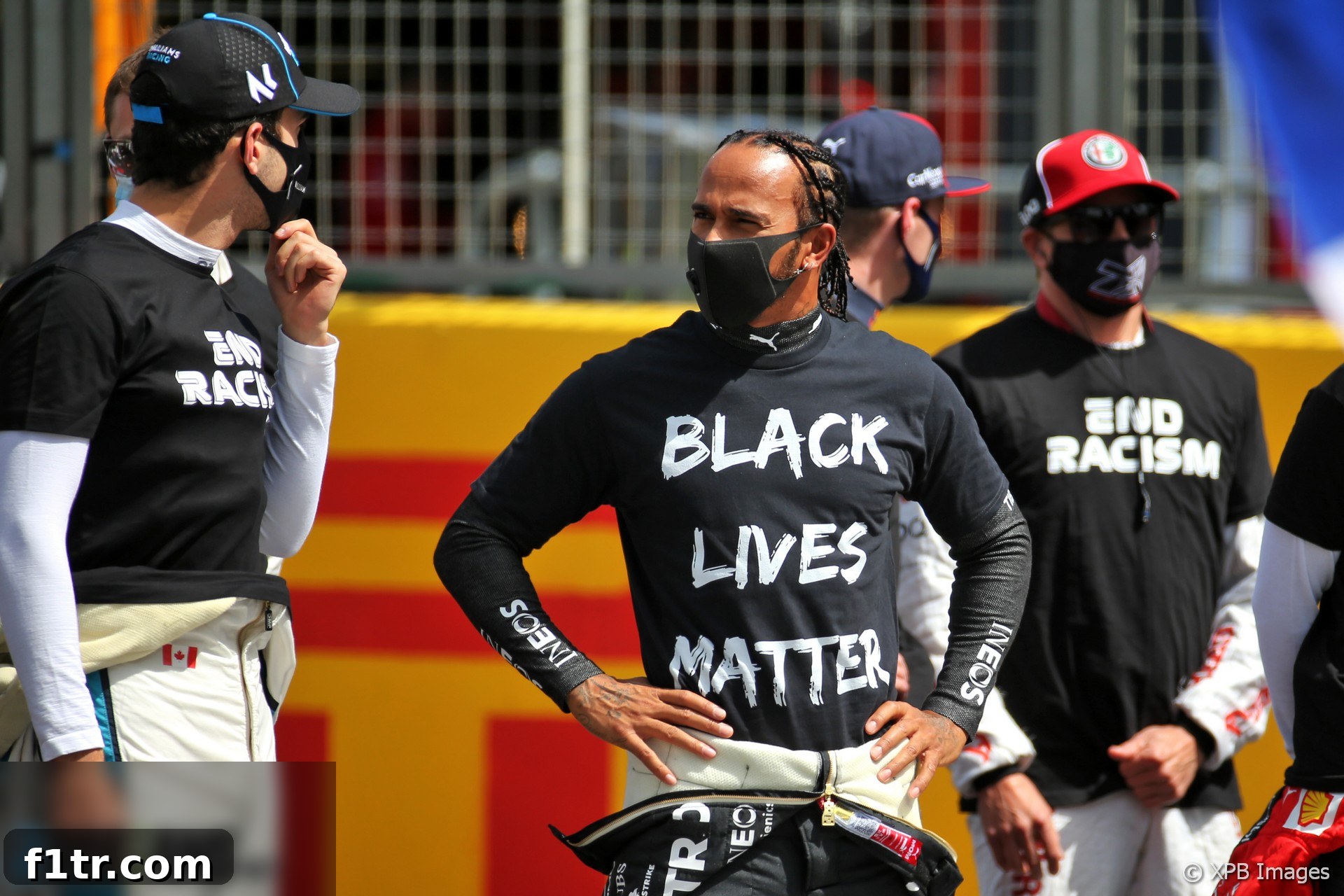
While Hamilton is now embarking on his 17th season in Formula 1, his outspoken advocacy on racial justice issues is a relatively recent development, profoundly influenced by the global Black Lives Matter movement that emerged after the tragic death of George Floyd in May 2020. He expressed deep gratitude for the solidarity shown by fellow drivers who joined him in ‘taking a knee’ before races during the 2020 and 2021 seasons, a powerful visual protest against racial injustice.
Advert | Become a RaceFans supporter andgo ad-free
The Emotional Release of Taking a Knee
“I’ve tried to be create allies, like, in having the difficult conversations with some of them. I’m so grateful for, I’ve had a couple of them that took the knee with me in 2020.” This collective stand marked a turning point, not just for the sport, but for Hamilton personally.
He recounted a deeply personal moment related to this activism: “On that, my dad never let me cry as a kid. He said it was a sign of weakness. ‘Don’t let me ever see you shed a tear’. So I remember just holding back through those difficult times as a kid, holding back most of that stuff. And in 2020, I cried. I hadn’t cried for at least 10 years, maybe more. There was a lot of bottled up stuff that came up that I had not realised, I didn’t even know about suppressing a pain or a feeling.” The Black Lives Matter movement provided an overdue emotional release for decades of suppressed pain.
This moment of vulnerability galvanized his resolve. “I remember kind of being on my knees thinking what is happening in the world? I’ve got to be outspoken, I’ve got to take that chance because if I don’t do it then no one’s going to do it. If I don’t take the knee, if I don’t let people like me know that I care and I hear you and I’m with you and I’m going to do something about it, I’m going to risk it all.” Hamilton made a conscious decision to prioritize his convictions over potential career repercussions. “I don’t care if my partners want to drop me because I don’t to be associated with this narrative. I literally let go of all the fear and that’s why I came so forward with it.”
He hopes his bravery inspires others. “I know it’s not easy for everyone to do that. But I would just want to really try to encourage people out there to be themselves, to speak out if they’ve got a problem, if they see something within their working environment or experiencing something, you’ve got to be outspoken about it. And there’s a right way to do it.”
Ahead of the delayed 2020 season, Hamilton resolved to make a powerful gesture of support for Black Lives Matter, distinguishing it from F1’s broader ‘We Race As One’ campaign, which encompassed a wider range of social issues. He felt compelled to focus specifically on racial justice.
“The first day I was going to take the knee, I remember I didn’t feel like I could tell my team,” he said. “I felt that they wouldn’t understand how important it is for me to do this. So I had my Black Lives Matter shirt hidden and I just wore it out there and I went ahead with it.” This act of independent defiance highlighted his deep personal commitment.
Advert | Become a RaceFans supporter andgo ad-free
He further elaborated on his stance against the generic slogan: “The sport had made all these T shirts [with a] ‘We Race As One’ slogan and they gave these T shirts to everybody. And I was like ‘I’m not wearing that’. That’s not what this is about. And so this is what I’m doing.” Hamilton’s clarity and conviction were unmistakable.
His team’s reaction was one of understanding, despite his initial apprehension. “Afterwards my team were like, if you just told us we could have prepared better. But I had this fear that they would try and stop me, perhaps. But that was just a fear. They’ve been massively supportive through the whole thing.”
Hamilton’s strategic intent behind the gesture was clear: “My hope was that kids would be watching and be like: ‘What is that? Why is he taking the knee? What does that shirt mean? What is going on dad, mum?’ And then the parents being in an awkward position having to explain it, maybe.” He aimed to spark crucial conversations about race and equality in households worldwide.
Driving Change: The Hamilton Commission and Future Vision for F1 Diversity
Building on his activism, Lewis Hamilton established the Hamilton Commission, an initiative that subsequently published a comprehensive report detailing the significant lack of diversity within motorsport. This pioneering work has laid the groundwork for ongoing efforts to promote greater inclusion throughout the industry.
“What was really encouraging for me was when we started really getting into the whole diversity and inclusion, we did the research, out of 2,000 people in the team there’s 3% diversity.” These stark findings underscored the urgency of his mission. “So since then we’ve been on this mission. The team have started new projects. We’ve discovered that the sport generally hires from one group of universities, which is not diverse. And if there are any young black students that go there, they’re twice as unlikely to be hired when they come out compared to their counterparts, and also paid less. So there’s all these things that perhaps people didn’t know.” The Commission’s findings exposed deep-seated systemic issues within F1’s recruitment and retention practices.
“That just was interesting to experience that now. Now we’re working on a diversity charter that all the teams have to be a part of. And it’s not mine, it’s for the sport and it’s to encourage those teams because there’s still not any diversity within, if you look at Ferrari, they have hardly any. Most teams don’t.” Hamilton’s vision is a sport-wide commitment to diversity, ensuring that change permeates every level, not just his own team.
Shifting Perceptions and Inspiring the Next Generation
Hamilton is already witnessing tangible signs of the change he has strived to promote within F1, though he acknowledges much work remains. “When I go back to my team, to the factory, normally our marketing department wasn’t very diverse initially, and I walked in after the pandemic and I started seeing such a more diverse group of people. I was really quite emotional because I was like, oh my God, I’m starting to see change. But you don’t see that on TV.”
This discrepancy between internal progress and external perception highlights the ongoing challenge. “So when I talk to the bosses of the sport, I’m like, there’s all white men and me facing the camera at the start of the race – where are the women? Where are the people of colour.” Hamilton is pushing for visible representation, not just behind the scenes, but prominently displayed for the world to see. “We’ve got to be showing so the young kids are watching and they’re like, ‘oh, there’s a place for me there. I can be there, I can be an engineer, I could be a mechanic or whatever it may be. And even for young girls, I can be a racing driver or an engineer or strategist or whatever’, So representation, is so, so key to inspiring the youth.” For Lewis Hamilton, diversity is not just an ethical imperative; it’s the foundation for unlocking the sport’s full potential and ensuring its future relevance for all.
Advert | Become a RaceFans supporter andgo ad-free
Related: 2023 F1 Season News & Analysis
- FIA president cleared of alleged interference in two 2023 races
- First week viewing figures for new Drive to Survive season fall again
- Max who? Drive to Survive season six prefers its favourite faces
- RaceFans’ complete 2023 season review
- The F1 drivers who pulled off the 10 biggest charges through the field in 2023
Browse all 2023 F1 season articles