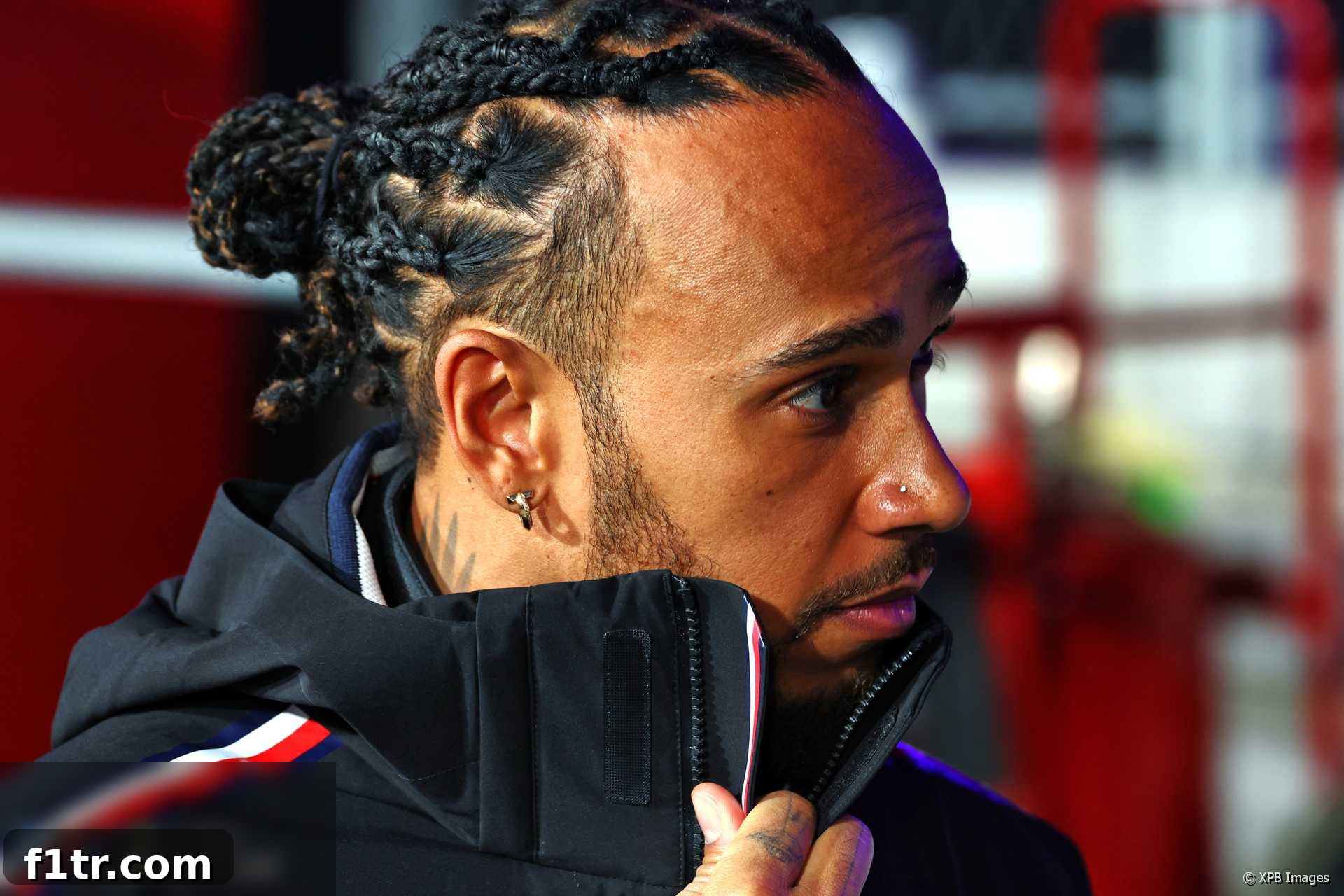
Lewis Hamilton Unveils Raw Emotions After Brazil GP, Prepares for Las Vegas Gauntlet
Seven-time Formula 1 world champion Lewis Hamilton recently shed light on a profoundly candid and somewhat alarming message he broadcast to his Mercedes-AMG F1 team over the radio following a particularly grueling Brazilian Grand Prix. The veteran driver’s words, initially interpreted as a moment of extreme despair, have now been clarified, offering a rare glimpse into the immense pressures and emotional toll of elite-level motorsport.
The Interlagos weekend proved to be an exceptionally challenging one for the Mercedes driver. Hamilton could only salvage a single point, finishing in a distant tenth place. This performance left him a significant six positions and almost half a minute behind his teammate, George Russell, highlighting a fundamental struggle with his W14 challenger.
A “Disaster” in Brazil: Hamilton’s Unfiltered Radio Message
Immediately after crossing the finish line and enduring what he described as a “disaster” of a race, Hamilton’s frustration boiled over. As he made his way back to the pits, his voice crackled over the team radio with a series of poignant remarks that quickly became a talking point across the F1 paddock.
“That’s the worst the car’s ever been,” he stated, a stark assessment from a driver who has experienced countless highs and lows throughout his illustrious career. Yet, even in his disappointment, Hamilton’s class shone through as he extended gratitude to his team: “But thank you for continuing to try. Great job to all the guys at the pit stop.”
However, it was the next line that truly captured attention and sparked concern: “If this is the last time that I get to perform, it’s a shame it wasn’t great, but grateful for you.” These words, delivered with a mix of resignation and appreciation, prompted widespread speculation about Hamilton’s future and mental state.
Clarifying the “Last Time”: A Moment of Intense Frustration
Ahead of the much-anticipated Las Vegas Grand Prix, Hamilton was naturally pressed to elaborate on the meaning behind his striking “if this is the last time” comment. He revealed that in the immediate aftermath of such a torrid weekend, the thought of not returning for the final three rounds of the season had genuinely crossed his mind.
“In the moment, that’s how I felt,” Hamilton explained with characteristic honesty. “I didn’t really want to come back after that weekend.” This raw admission underscores the profound emotional impact of continuous underperformance, especially for a driver accustomed to consistently battling at the front of the grid.
Such feelings, Hamilton believes, are a natural response to the intense environment of Formula 1. “But I think that’s only natural. It’s frustrating when you have a season like this,” he admitted, referencing the challenges faced by Mercedes throughout the campaign. He quickly added a note of determination, stating, “Which I’m pretty sure I won’t have again, or, at least, I’ll work towards not having again.” Despite the momentary lapse into doubt, his fighting spirit remained undimmed: “It wasn’t a great feeling in that moment. But I’m here, I’m standing strong and I’m going to give it absolutely everything for these last few races.” This declaration served as a powerful reminder of the resilience that defines champions.
The Mercedes W14: A Season of Unfulfilled Potential
Hamilton’s frustration in Brazil was not an isolated incident but rather a culmination of a season-long struggle with the Mercedes W14 car. Designed with ambitious but ultimately flawed concepts, the W14 proved to be a temperamental beast, often failing to provide the consistency and performance needed to challenge Red Bull Racing. The car exhibited a narrow operating window, particularly sensitive to track characteristics, ambient temperatures, and tyre management.
Throughout the season, both Hamilton and George Russell grappled with the W14’s unpredictable handling. While glimpses of strong performance were evident at certain circuits, the car often lacked the fundamental balance and aerodynamic efficiency required to maintain a sustained challenge. Hamilton’s comment about it being “the worst the car’s ever been” speaks volumes about the extent of the team’s technical difficulties and the stark contrast to the dominant machinery he once commanded.
Despite relentless development efforts and numerous upgrades, Mercedes found themselves playing catch-up, a position unfamiliar to a team that has historically set the benchmark. The engineering team worked tirelessly to understand and rectify the W14’s shortcomings, but the inherent characteristics of the car proved challenging to overcome fully within a single season. This ongoing battle with the car inevitably weighed heavily on the drivers, pushing their mental and physical limits.
Navigating the Neon Night: Challenges of the Las Vegas Grand Prix
As the F1 circus descended upon Las Vegas for a highly anticipated, inaugural grand prix, Hamilton’s attention quickly shifted from past frustrations to future challenges. The unique nature of the Las Vegas street circuit, with its long straights and fast corners carved through the city’s iconic landscape, presented a new set of hurdles.
Tyre Temperature Woes on the Strip
One of Hamilton’s primary concerns for the Las Vegas event revolved around the cool November night temperatures and their potential impact on tyre performance. Mercedes has historically struggled with generating and maintaining optimal tyre temperature, a critical factor for achieving peak grip and performance. “It’s not going to be great for us,” Hamilton predicted. “We’ve always struggled with tyre temperature, getting temperature in. And then at the hot tracks, overheating and then at [cooler] tracks like this, it will probably be a real challenge. But I think everyone will have that.”
This issue is particularly pronounced on street circuits where the lack of sustained high-speed corners can make it difficult to work energy into the tyres. If the tyres fail to reach their optimal operating window, drivers face a significant reduction in grip, leading to a loss of pace, increased tyre degradation, and a heightened risk of instability. For Mercedes, a team already battling with a sensitive car, this cold track environment posed a considerable threat to their competitiveness.
The Public Road Grip Conundrum
Another significant concern for Hamilton, and indeed many drivers, was the nature of the track surface itself. Being a street circuit, a substantial section of the Las Vegas track is typically open to public traffic. This means the asphalt is not conditioned like a purpose-built race track, often lacking the “rubbering in” process that builds up grip levels. “There’s a section of the track that’s open to the public, which will be messy and there’s no one driving for us,” he noted, anticipating a slick and unpredictable surface.
The absence of prior racing activity on these public roads means a lack of grip-enhancing rubber deposits, leading to a “green” track surface at the start of the weekend. This can make the initial practice sessions particularly treacherous as drivers grapple with low grip, making it difficult to find the limits and push their cars effectively. Hamilton’s wish for support categories was directly tied to this practical problem: “So I wish we had the F1 Academy here this weekend. That’d have been cool.”
While the inaugural Las Vegas Grand Prix did not feature a full roster of support events, two Ferrari Challenge races were scheduled to provide some track activity and help lay down rubber. Looking ahead, F1 Academy is confirmed to join the support roster in 2025, a move that will undoubtedly be welcomed by drivers for its potential to improve track conditions.
The Human Element: Resilience in Elite Sport
Hamilton’s candid confession after Brazil serves as a powerful reminder of the intense psychological demands placed upon athletes at the pinnacle of their sport. Even a seven-time world champion, with an unparalleled track record of success and resilience, can experience moments of profound frustration and doubt. These moments, however, are often what define true champions – not the absence of struggle, but the ability to confront and overcome it.
His commitment to “standing strong” and “giving it absolutely everything” for the remaining races speaks volumes about his character and professional dedication. It highlights the internal battle every top athlete faces when performance falls short of expectations, especially when the machinery beneath them isn’t cooperating. The support from his team, acknowledged in his radio message, also plays a crucial role in navigating these challenging periods.
Looking Ahead: Hamilton’s Enduring Legacy
As Lewis Hamilton continued his journey through what was a challenging season, his reflections on Brazil and his proactive concerns for Las Vegas underscored his unwavering commitment to excellence and his deep understanding of the sport. His ability to articulate his frustrations while simultaneously reaffirming his dedication is a testament to his enduring legacy as not just a phenomenal driver, but also a thoughtful and authentic competitor.
The Formula 1 landscape continues to evolve, with new, spectacular venues like Las Vegas pushing the boundaries of the sport. Yet, at its core, F1 remains a crucible of human and mechanical endeavor, where drivers like Hamilton continue to inspire with their courage, skill, and profound emotional honesty.
This rollercoaster of emotions, from the nadir of Brazil to the hopeful, albeit cautious, anticipation of Las Vegas, encapsulates the very essence of elite motorsport and the extraordinary individuals who compete within it.
Related Articles: Las Vegas Grand Prix Insights
- “Disappointing” Las Vegas GP performance prompts ticketing changes for 2025 race
- Vowles clarifies Colapinto’s claim he was concussed in Las Vegas crash
- Norris lost title because McLaren weren’t competitive enough early on – Stella
- Ferrari are now in their longest-ever championship drought
- F1 “was trying too hard” in first year at Las Vegas – Sainz
Browse all 2024 Las Vegas Grand Prix articles