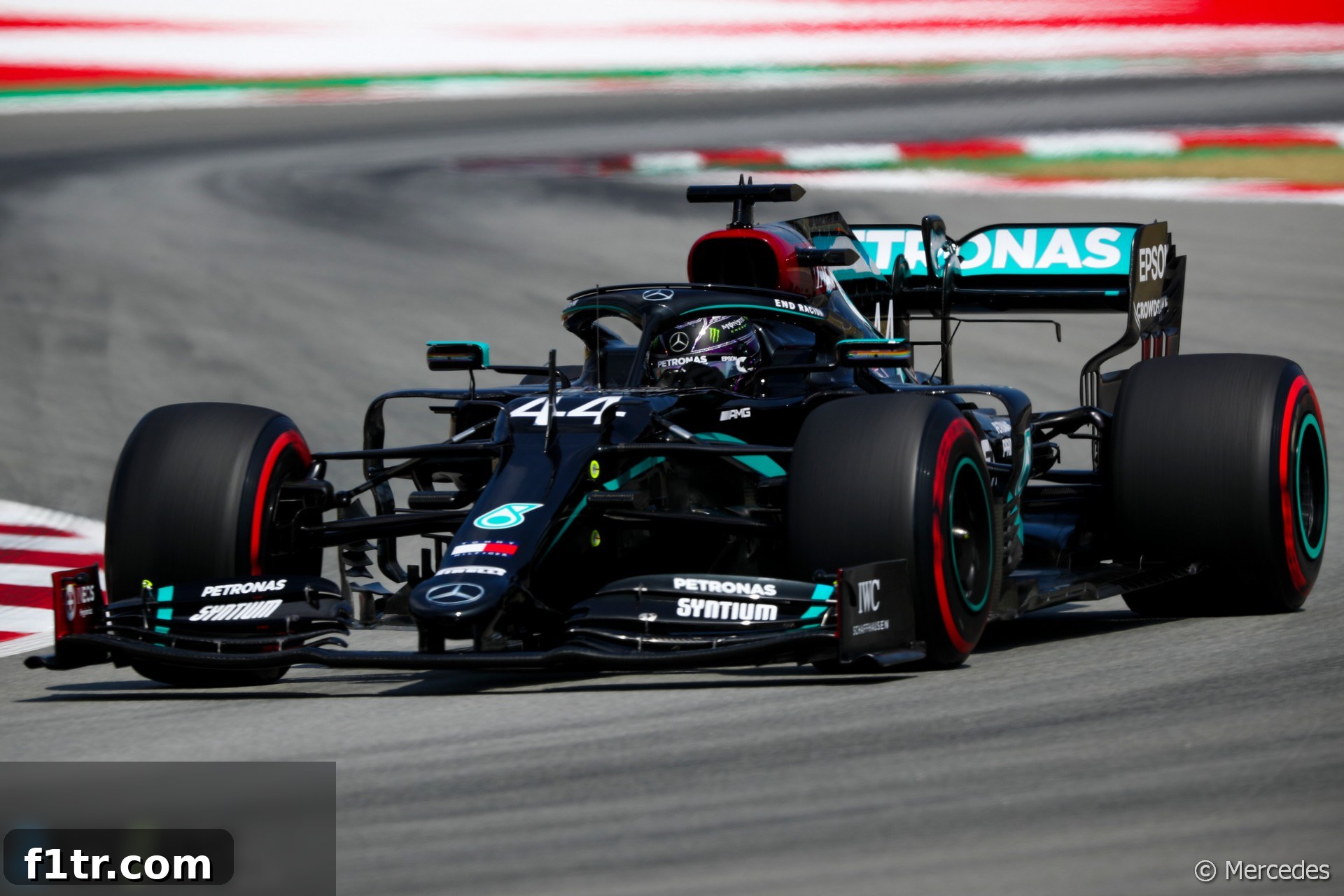
Lewis Hamilton solidified his commanding lead in the 2020 F1 season, securing a masterful fourth victory of the year at the Spanish Grand Prix. The Mercedes driver delivered a flawless performance from pole position, further extending his advantage in the championship standings on a scorching afternoon at the Circuit de Catalunya. This dominant display underscored Mercedes-AMG Petronas’s undeniable superiority, leaving rivals scrambling to keep pace with the Silver Arrows’ relentless march towards another title.
Advert | Become a Supporter & go ad-free
The race in Barcelona, known for its challenging track layout and high tire degradation, proved to be another testament to Hamilton’s exceptional skill and Mercedes’ formidable engineering. From the moment the lights went out, Hamilton controlled the pace, never truly looking threatened. While Max Verstappen in the Red Bull managed to relegate the second Mercedes of Valtteri Bottas to third place with a sharp move at the start, the young Dutchman found himself unable to mount a sustained challenge to Hamilton’s lead. Despite Verstappen’s best efforts to keep the pressure on, Hamilton consistently found an answer, meticulously managing his tires and maintaining a comfortable gap throughout the 66-lap race.
Hamilton’s strategic brilliance and raw pace became evident early in the first stint. Once he truly opened up the throttle, establishing a rhythm that his competitors simply couldn’t match, Verstappen quickly slipped back. The pace difference became so pronounced that Red Bull was forced to bring Verstappen in for his first pit stop earlier than anticipated, a clear sign that their hopes of directly challenging Hamilton for victory were rapidly diminishing. From that pivotal moment, the strategic initiative firmly remained with Mercedes, as Red Bull found themselves reacting rather than dictating terms, effectively ending any realistic prospect of converting their strong start into a race win against the dominant Briton.
For Valtteri Bottas, the Spanish Grand Prix was a story of recovery after a compromised start. Despite qualifying alongside Hamilton on the front row, Bottas got away poorly, momentarily losing positions not only to Max Verstappen but also to the fast-starting Lance Stroll in the Racing Point. While he quickly recovered to re-pass Stroll, the critical loss of track position to Verstappen proved insurmountable for the remainder of the afternoon. Bottas spent a significant portion of the race attempting to close the gap to the Red Bull driver, but the initial deficit, combined with Verstappen’s consistent pace, meant he was never truly in a position to challenge for second. In the closing laps, both Bottas and Hamilton exchanged fastest laps, showcasing the sheer speed of the Mercedes W11. Bottas ultimately made a third pit stop on the penultimate lap, bolting on a fresh set of soft tires specifically to chase the bonus point for the fastest lap, which he successfully secured on the final tour of the circuit, a minor consolation for a challenging weekend.
The strategic nuances of tire management played a significant role for many teams. Both Hamilton and Verstappen opted for a conventional two-stop strategy, which proved to be the optimal approach for managing tire degradation on the demanding Barcelona asphalt. However, Sergio Perez delivered an outstanding performance, employing a bold one-stop strategy that saw him battling for a remarkable ‘on-the-road’ fourth place. His ability to make the medium compound tires last for an extended period was a testament to his smooth driving style and the Racing Point’s gentle nature on its tires. Unfortunately for Perez, his impressive drive was marred by a five-second time penalty incurred for failing to observe blue flags when Hamilton, the race leader, caught up to him. This penalty, imposed for impeding the leading car, ultimately dropped him to fifth place in the final classification, behind his Racing Point teammate Lance Stroll, highlighting the fine margins and strict regulations within Formula 1.
Hamilton’s sheer dominance was perhaps best illustrated by his incredible pace, which saw him lap almost the entire field. The Racing Points, driven by Lance Stroll and Sergio Perez, were the first cars home not on the lead lap, a clear indication of the significant performance gap between the top two teams and the rest of the grid. Hamilton crossed the finish line having lapped every single car except for the second-placed Max Verstappen and his own teammate Valtteri Bottas, further cementing his incredible record at the Circuit de Catalunya, where he secured his fourth consecutive victory, extending his remarkable winning streak at the Spanish venue.
Further down the order, the battle for crucial championship points raged intensely. Home hero Carlos Sainz Jnr put in a spirited drive to claim sixth place for McLaren, rewarding the enthusiastic Spanish fans. Sainz’s performance involved some fierce on-track duels, particularly as he battled past both Alexander Albon of Red Bull and Sebastian Vettel of Ferrari. Albon, experiencing a challenging weekend, made an early and ultimately unsuccessful switch to hard compound tires, which necessitated a second pit stop, costing him valuable track position. In contrast, Sebastian Vettel, demonstrating his experience, made a single pit stop work effectively for Ferrari, bringing his SF1000 home in a respectable seventh place, a relatively positive outcome given Ferrari’s ongoing struggles with performance throughout the 2020 season.
The Ferrari garage, however, did not have an entirely smooth afternoon. Charles Leclerc, Vettel’s teammate, was the race’s sole retirement, adding to a disappointing weekend for the Scuderia. Leclerc’s race came to an abrupt halt after he struck a kerb at the chicane, an impact that subsequently caused an electrical problem within his car and forced his engine to shut down. Although he managed to get the car going again briefly, allowing him to limp back to the pits, the issue proved terminal, leading to his unfortunate retirement from the race, underscoring Ferrari’s technical reliability concerns.
Rounding out the points-paying positions, Pierre Gasly delivered a solid performance for AlphaTauri, securing ninth place with a well-managed race. The young Frenchman held off a determined challenge from Lando Norris in the McLaren, who finished tenth. Norris, always candid on team radio, voiced his complaints about Gasly’s defensive driving tactics in the frantic closing laps, indicating the intensity of the battle for the final championship points. This close-quarters racing for the lower points positions highlighted the competitive nature of the midfield, where every single point can make a significant difference in the constructors’ standings.
Advert | Become a RaceFans supporter andgo ad-free
2020 Spanish Grand Prix: A Dominant Performance and Championship Implications
The 2020 Spanish Grand Prix will be remembered as another chapter in Lewis Hamilton’s relentless pursuit of F1 history. His flawless execution from pole to flag at the Circuit de Catalunya demonstrated not only his exceptional driving talent but also the overwhelming strength of the Mercedes-AMG Petronas package. With this fourth victory of the season, Hamilton significantly widened his lead in the Drivers’ Championship, establishing a formidable advantage that will be challenging for any rival to overcome. The consistent performance of the Mercedes W11, particularly its superior tire management and outright pace, has set a very high bar for the rest of the grid.
Max Verstappen’s second-place finish, while a commendable effort against the dominant Mercedes, underscored the performance deficit Red Bull Racing faced. Despite a strong start and a valiant attempt to stay within striking distance, Verstappen ultimately had to settle for being the “best of the rest.” His result, however, was crucial for Red Bull in the Constructors’ Championship, ensuring they maintained a significant lead over the midfield teams. Valtteri Bottas’s recovery to third, securing the fastest lap point, further solidified Mercedes’ commanding position in the team standings, illustrating their ability to maximize points even when one car has a less-than-perfect start.
The midfield battle proved to be as enthralling as ever. Racing Point’s strong performance, despite Sergio Perez’s penalty, showcased their potential, cementing their position as a leading contender in the tight fight for third place in the constructors’ standings. McLaren, with Carlos Sainz Jr.’s P6 and Lando Norris’s P10, also demonstrated their consistent points-scoring ability. Ferrari, on the other hand, continued to grapple with performance and reliability issues, with Sebastian Vettel salvaging a few points while Charles Leclerc suffered a disappointing retirement. These fluctuating fortunes among the midfield teams promise an exciting battle for positions behind the top two throughout the remainder of the 2020 season.
Looking ahead, the Spanish Grand Prix results reinforced the narrative of Mercedes’ unparalleled dominance. Their strategic prowess, combined with the outright speed and reliability of their car, makes them the team to beat. Hamilton’s relentless form suggests he is on track for yet another championship title, while the efforts of Verstappen and others will focus on capitalizing on any rare missteps by the Silver Arrows. The demanding nature of the Circuit de Catalunya, with its high-speed corners and abrasive surface, provided a true test of car and driver, a test that Lewis Hamilton and Mercedes passed with flying colors. As the season progresses, all eyes will be on whether any team can truly challenge the reigning champions, or if Mercedes will continue their seemingly unstoppable march towards further F1 glory.
- Check back shortly for more in-depth analysis and exclusive driver and team reactions from the 2020 Spanish Grand Prix, as we delve into the key moments and strategic decisions that shaped the race outcome and its implications for the championship battle.