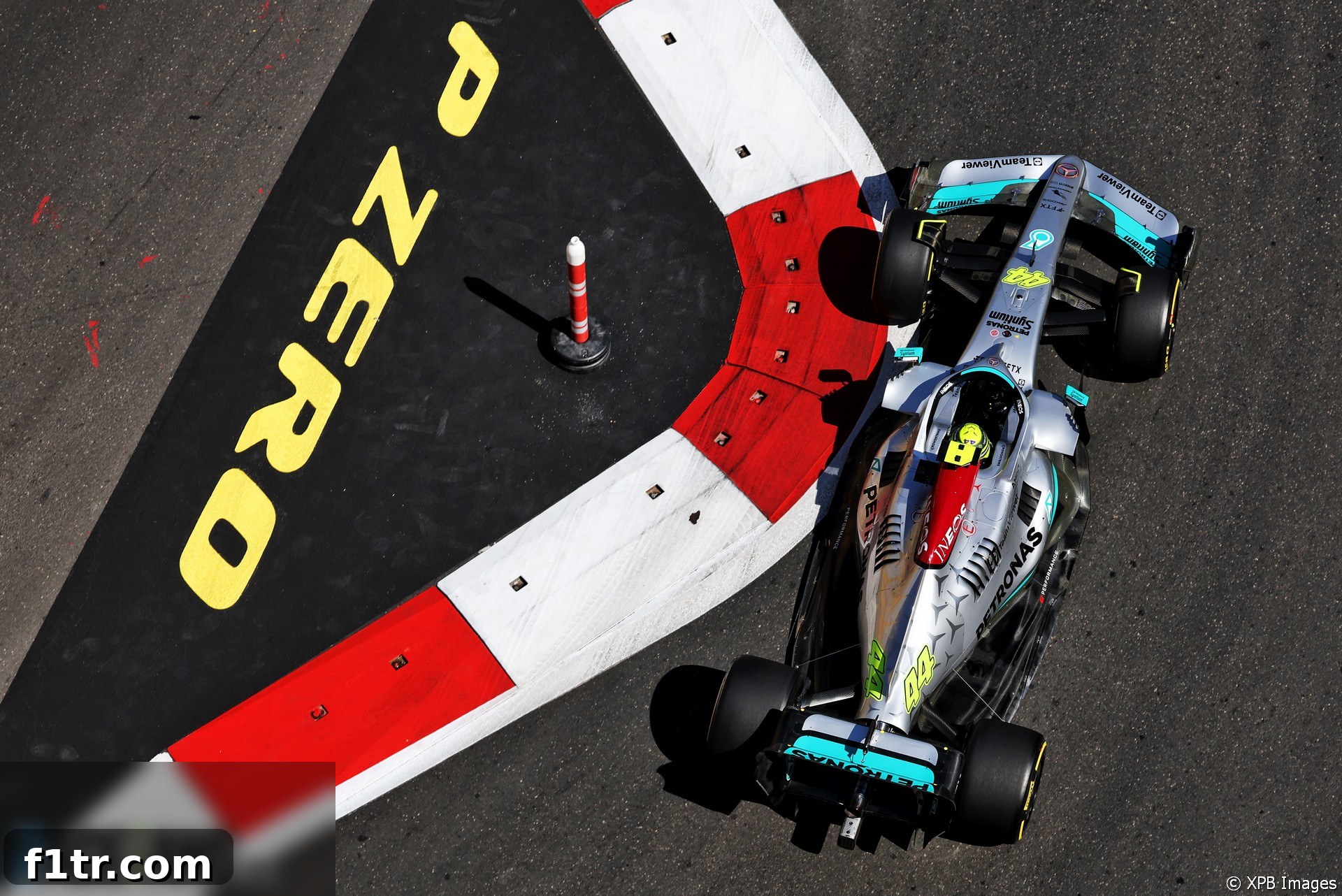
The exhilarating yet demanding Baku City Circuit, renowned for its colossal straights and intricate turns, proved to be a formidable challenge for Mercedes and its star driver, Lewis Hamilton, during practice sessions for the Azerbaijan Grand Prix. Hamilton openly admitted that the relentless porpoising of his Mercedes W13 left him feeling “sore,” highlighting the persistent struggle the team faces with the aerodynamic phenomenon under the new regulations.
Mercedes’ recurrent porpoising issue, where the car oscillates violently at high speeds due to aerodynamic stalling and re-engagement, returned with a vengeance on Baku’s exceptionally long straights. As Hamilton himself explained, “We’re hitting some serious speeds at the end here and it’s bouncing a lot,” a candid admission that underscored the physical toll on drivers and the performance limitations of the car. The seven-time world champion finished practice in a distant 12th place, a clear indicator of the team’s ongoing difficulties.
The situation in Baku bore an unsettling resemblance to the previous round in Monaco, a circuit notorious for its bumpy surface and where Hamilton secured a modest eighth-place finish. “It’s pretty much the same as in the last race, really,” Hamilton observed, summarizing the team’s predicament. “Mostly bouncing.” This consistent struggle across varied track layouts suggests a fundamental challenge in understanding and mitigating the W13’s aerodynamic characteristics, particularly its interaction with ground effect.
In a concerted effort to unlock performance, both Hamilton and his teammate, George Russell, experimented with different car setups during the second practice session. Russell, demonstrating his adaptability and the car’s potential under different configurations, managed to be three-tenths of a second quicker than Hamilton, although still a significant 1.3 seconds off the leading pace. This gap, particularly over Baku’s high-speed sections, is a stark reminder of the monumental task ahead for the Brackley-based outfit.
Hamilton shed light on his experimental approach: “We tried something experimental on my car and it didn’t feel that great to be honest. But at least we tried it and got data on it and now we’ll go through it and hopefully for tomorrow we’ll probably revert back to what we changed.” This willingness to push boundaries and gather crucial data, even if it compromises immediate performance, exemplifies the team’s methodical approach to resolving their complex engineering puzzle. The data gleaned from Hamilton’s setup will be vital in informing subsequent adjustments, illustrating the high-stakes R&D taking place during live race weekends.
The scale of the performance deficit left Hamilton searching for answers. “I just can’t really tell you where 1.6 seconds or 1.3 seconds, whatever, is,” he confessed. “That’s a long way away. A lot of it’s on straights.” This candid assessment highlights the core issue: the car’s inability to translate its theoretical downforce into effective, stable straight-line speed without encountering severe porpoising, which then compromises handling through corners and driver confidence.
George Russell, always pragmatic, echoed Hamilton’s sentiments, admitting that the team “weren’t as competitive as we would have liked” after what he described as a “tricky day” of running. Beyond the porpoising, Mercedes has consistently grappled with a crucial aspect of modern Formula 1: getting their tyres into the optimum operating window on the first lap. This has been a recurring theme throughout the 2022 season, costing them valuable tenths in qualifying and the initial stages of races.
“It’s again a tricky track to get the tyres in the right window,” Russell elaborated, explaining the nuanced challenge. “You see a number of drivers, their fastest laps are coming right at the end of a run, whereas Ferrari and Red Bull seem to be able to turn it on.” This contrast underscores a significant performance differentiator. While other teams can extract maximum grip almost immediately, Mercedes often needs several laps for their tyres to reach optimal temperature and pressure, a deficit that can be fatal in the fiercely competitive world of F1 qualifying.
Russell’s analysis went deeper, touching upon the fundamental performance gap. “But at the moment they just have inherently a faster car than us and we’re doing everything we can to try and catch up.” This blunt assessment highlights the sheer raw pace advantage held by rivals Red Bull and Ferrari, an advantage that cannot be fully attributed to tyre management alone. It speaks to a more profound disparity in aerodynamic efficiency and overall package performance under the new regulations, which were designed to promote closer racing but have so far seen two teams pull away at the front.
Despite the team’s dedicated efforts and the meticulous data analysis, Russell believes that even if Mercedes were able to extract every ounce of performance from their tyres, a complete parity with the leading teams remains out of reach. “We’re definitely not going to fully close that gap,” he stated, a realistic yet sobering outlook.
“They’re just too far ahead,” he concluded, pinpointing the dual nature of their challenge. “So that’s really 50% of our issue. The rest is just the lack of performance we have at the moment.” This powerful statement breaks down Mercedes’ struggle into two key components: half of their deficit stems from fundamental car performance, while the other half is a result of their inability to consistently optimize the package they currently have. This internal reflection underscores the complexity of engineering solutions required, encompassing everything from chassis dynamics to suspension tuning, and aerodynamic stability at various speeds.
The Baku City Circuit, with its unique blend of high-speed sections and a tight, technical inner-city core, mercilessly exposed the Mercedes W13’s inherent weaknesses. The long, flat-out straights, exceeding 300 km/h, amplified the porpoising to an extent that not only impacted performance but also jeopardized driver comfort and potentially safety. Drivers like Hamilton are subjected to immense physical stress from these continuous oscillations, leading to back pain and fatigue, which in turn affect concentration and precision. This raises critical questions about the long-term health implications for drivers and whether the FIA might need to intervene with rule changes to mitigate the problem.
Mercedes’ engineers are working tirelessly to unravel the mysteries of the W13. The transition to ground effect aerodynamics for the 2022 season has proven to be a monumental reset for all teams, but none more so than the previously dominant Mercedes. Their unparalleled success in the hybrid era was built on a deep understanding of previous aerodynamic philosophies, and adapting to the new regulations has presented a steeper learning curve than anticipated. The balance between achieving optimal downforce and preventing porpoising is a delicate one, often requiring compromises in ride height and suspension stiffness that can then impact tyre performance and overall handling.
The experimental setup on Hamilton’s car during practice is a testament to Mercedes’ commitment to innovation and their refusal to concede. Such trials are crucial for data acquisition, even if they don’t immediately yield results. Every sensor reading, every driver feedback note, contributes to a vast pool of information that the engineering teams will meticulously analyze back at the factory. This iterative process of testing, learning, and adapting is the bedrock of Formula 1 development, and for Mercedes, it’s a race against time to catch up with their rivals.
Looking ahead, the Azerbaijan Grand Prix served as another poignant reminder that the road back to championship contention for Mercedes will be long and arduous. While incremental improvements are being made, the fundamental performance gap to Red Bull and Ferrari remains substantial. The Baku weekend highlighted not just the W13’s intrinsic limitations but also the areas where the team needs to refine its operational execution, particularly concerning tyre management. The quest for stability, speed, and optimal tyre performance continues for the Silver Arrows, with every race weekend offering another opportunity to close the gap and reignite their championship aspirations.