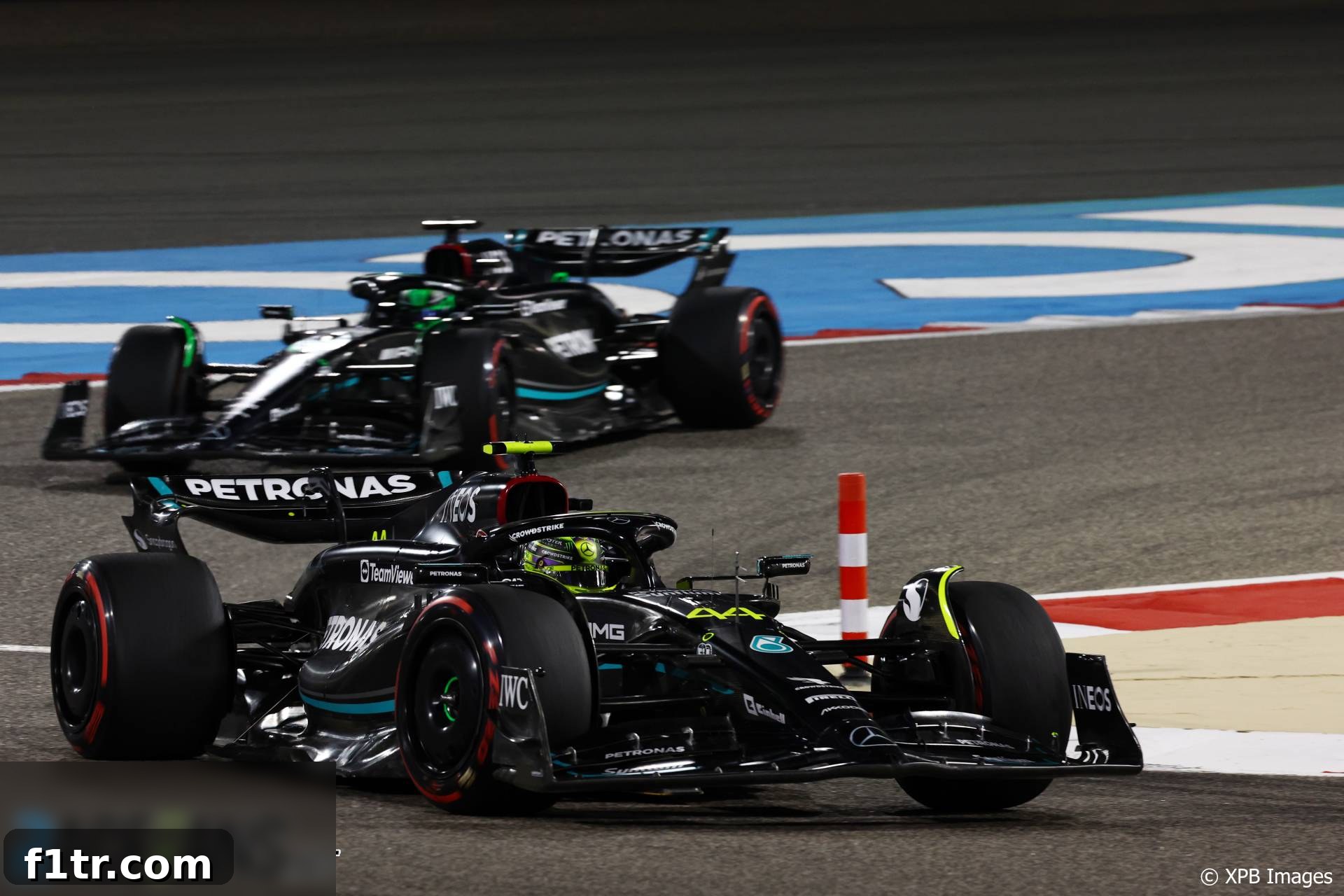
Lewis Hamilton Urges Mercedes to Redefine F1 Car Concept After Bahrain Struggles
Following a challenging start to the 2023 Formula 1 season at the Bahrain Grand Prix, seven-time world champion Lewis Hamilton has emphatically reiterated his belief that Mercedes AMG Petronas must fundamentally alter the design philosophy and underlying concept of their W14 challenger. Finishing a distant fifth in the season opener, Hamilton’s call for a radical rethink underscores the profound difficulties the Brackley-based squad is currently facing in their quest to return to the pinnacle of motorsport.
The sentiment, first hinted at during Friday’s practice sessions, crystallized into a direct demand after Sunday’s race, which saw Red Bull Racing secure a dominant one-two finish. Hamilton’s own performance was overshadowed by rivals, notably being overtaken by Aston Martin’s veteran Fernando Alonso in the latter stages. More concerningly, he was unable to mount a sustained challenge against Carlos Sainz Jnr’s Ferrari, highlighting a significant performance deficit against key competitors.
A Stark Reality Check: “This Isn’t the Right Car”
Speaking to media after the race, Hamilton’s frustration was palpable yet his determination unwavering. “We’ve just got to keep working,” he stated, acknowledging the team’s relentless effort. However, he followed this with a blunt assessment of their current machinery: “We know we’re not where we need to be and we know that this isn’t the right car.” This unequivocal declaration from a driver of Hamilton’s caliber signals a deep-seated issue that goes beyond mere setup tweaks or minor aerodynamic adjustments.
The Grand Prix itself served as a stark reality check for Mercedes. Hamilton found himself struggling for pace throughout, eventually benefiting from Charles Leclerc’s unfortunate retirement from third place due to a power unit problem. Without this turn of events, Hamilton candidly admitted, “There was a Ferrari that would have been ahead of him so we would have really been sixth. The podium was nowhere near.” This observation painted a grim picture of Mercedes’ actual competitive standing, placing them firmly behind Red Bull, Ferrari, and even their customer team, Aston Martin.
The gap to the front-runners was described by Hamilton as “miles away,” a disheartening assessment for a team that has historically set the benchmark for performance and consistency in Formula 1. While a brief period saw him closing on Sainz, the Ferrari ultimately pulled away, reaffirming Mercedes’ position as, in Hamilton’s words, “the fourth-fastest team.” Despite his best efforts, the inherent performance deficiencies of the W14 meant he “just couldn’t hold on to him.”
From Bouncing to Lack of Downforce: Lingering Issues
Addressing the Past, Facing New Challenges
Mercedes entered the 2023 season with renewed hope, aiming to rebound from a disappointing 2022 campaign that yielded just a single victory – a stark contrast to their years of dominance. A primary objective during the off-season was to eradicate the severe “porpoising” phenomenon that plagued their W13 car last year. While Hamilton confirmed that the bouncing issue had indeed been largely addressed, the relief was short-lived. He reported that the W14 otherwise “generally felt the same as last year” in the race, suggesting that merely fixing one problem has exposed other, equally critical deficiencies.
A key area of concern identified by Hamilton is the car’s fundamental lack of downforce. This aerodynamic force, crucial for pushing the car onto the track and enabling higher cornering speeds, appears to be Mercedes’ Achilles’ heel. “We’ve just got to add downforce to the car, we’re just lacking a lot of downforce. So that’s really where the time will come,” Hamilton explained. He emphasized that once more aerodynamic load can be generated across both the front and rear of the car, they will naturally “pick up that pace.”
Strategy Woes and Design Philosophy
Hamilton also alluded to strategic missteps compounded by the car’s limitations. He revealed that during the pre-race strategy briefing, he had voiced concerns about the planned stint lengths, which ultimately proved to be optimistic. “When we did the strategy [briefing] in the morning I told the guys it wasn’t good to go as far [in a stint] as they said it was going to go, and it didn’t,” he recounted. This anecdote highlights the complex interplay between car performance and strategic execution; a car lacking pace and efficiency makes even optimal strategies challenging to implement effectively.
The persistent issues reinforce Hamilton’s overarching demand for a change in concept. In Formula 1, a “car concept” refers to the fundamental design philosophy that dictates the entire aerodynamic and mechanical package. It encompasses everything from the chassis layout to the sidepod design, floor geometry, and suspension kinematics. Mercedes’ unique “zero-pod” concept, which they controversially stuck with for the W14, appears to be inherently limited under the current ground effect regulations, preventing them from achieving the kind of downforce and balance that rivals like Red Bull have mastered. Changing this concept involves a massive undertaking, potentially requiring significant redesigns of core components, a task that often takes many months, if not an entire development cycle.
Aston Martin’s Surge: A Double-Edged Sword for Mercedes
In a twist of irony, one of the standout performances of the Bahrain Grand Prix came from Mercedes’ customer team, Aston Martin. Fernando Alonso’s impressive third-place finish provided a moment of bittersweet reflection for Hamilton. He extended his congratulations to Alonso and the entire Aston Martin team, acknowledging their “amazing job” in securing a podium finish to open their season.
However, Hamilton’s praise was quickly followed by a pointed observation that underscored the depth of Mercedes’ internal struggles. He highlighted the significant technical overlap between the two teams: “So we’ve got work to do because half their car is ours and they do their aero in our wind tunnel. So we’ve got some work to do.” This statement speaks volumes. For a customer team utilizing Mercedes engines and gearbox components, and even sharing their wind tunnel for aerodynamic development, to outperform the factory team suggests that the core aerodynamic concept and integration implemented by Mercedes themselves are fundamentally flawed. It implies that Aston Martin has found a way to extract more performance from shared resources, or their own unique aero solutions are simply superior to what Mercedes has developed for their current W14 package.
The Road Ahead: A Monumental Challenge for the Silver Arrows
The Bahrain Grand Prix has thus set a challenging tone for Mercedes’ 2023 campaign. Lewis Hamilton’s vocal demand for a car concept change places immense pressure on the team’s technical leadership, including Team Principal Toto Wolff and Technical Director Mike Elliott. Implementing such a significant shift mid-season is a monumental task, requiring substantial resources, time, and a clear vision that has thus far eluded them under the new regulations.
The implications extend beyond just technical design. For Hamilton, who is currently in contract negotiations with Mercedes, the competitiveness of the car will undoubtedly play a crucial role in his long-term commitment to the team. A driver of his pedigree craves victories and championships, and a continued struggle for pace could impact his motivation and future decisions.
Mercedes now faces a critical period. They must not only accurately diagnose the root causes of their performance deficit but also swiftly develop and implement solutions that can close the gap to their rivals. The once-dominant Silver Arrows find themselves at a crossroads, needing to rediscover the innovative spirit and engineering prowess that defined their era of success. The rest of the 2023 season will be a testament to their ability to adapt, evolve, and ultimately redefine their approach to Formula 1 car design.
Bringing the F1 news from the source
RaceFans strives to bring its readers news directly from the key players in Formula 1. We are able to do this thanks in part to the generous backing of our RaceFans Supporters.
By contributing £1 per month or £12 per year (or the equivalent in other currencies) you can help cover the costs involved in producing original journalism: Travelling, writing, creating, hosting, contacting and developing.
We have been proudly supported by our readers for over 10 years. If you enjoy our independent coverage, please consider becoming a RaceFans Supporter today. As a bonus, all our Supporters can also browse the site ad-free. Sign up or find out more via the links below:
- Become a RaceFans Supporter
- RaceFans Supporter FAQ
Related Formula 1 Articles
- FIA eases restrictions on F1 car ‘porpoising’ limits
- How 2023 F1 tyre characteristics are impacting driver strategies
- McLaren’s early 2023 struggles: A blend of old and new issues
- Oscar Piastri’s promising, albeit curtailed, F1 debut with McLaren
- Yuki Tsunoda advised to moderate emotional radio communications
Explore all 2023 Bahrain Grand Prix analysis