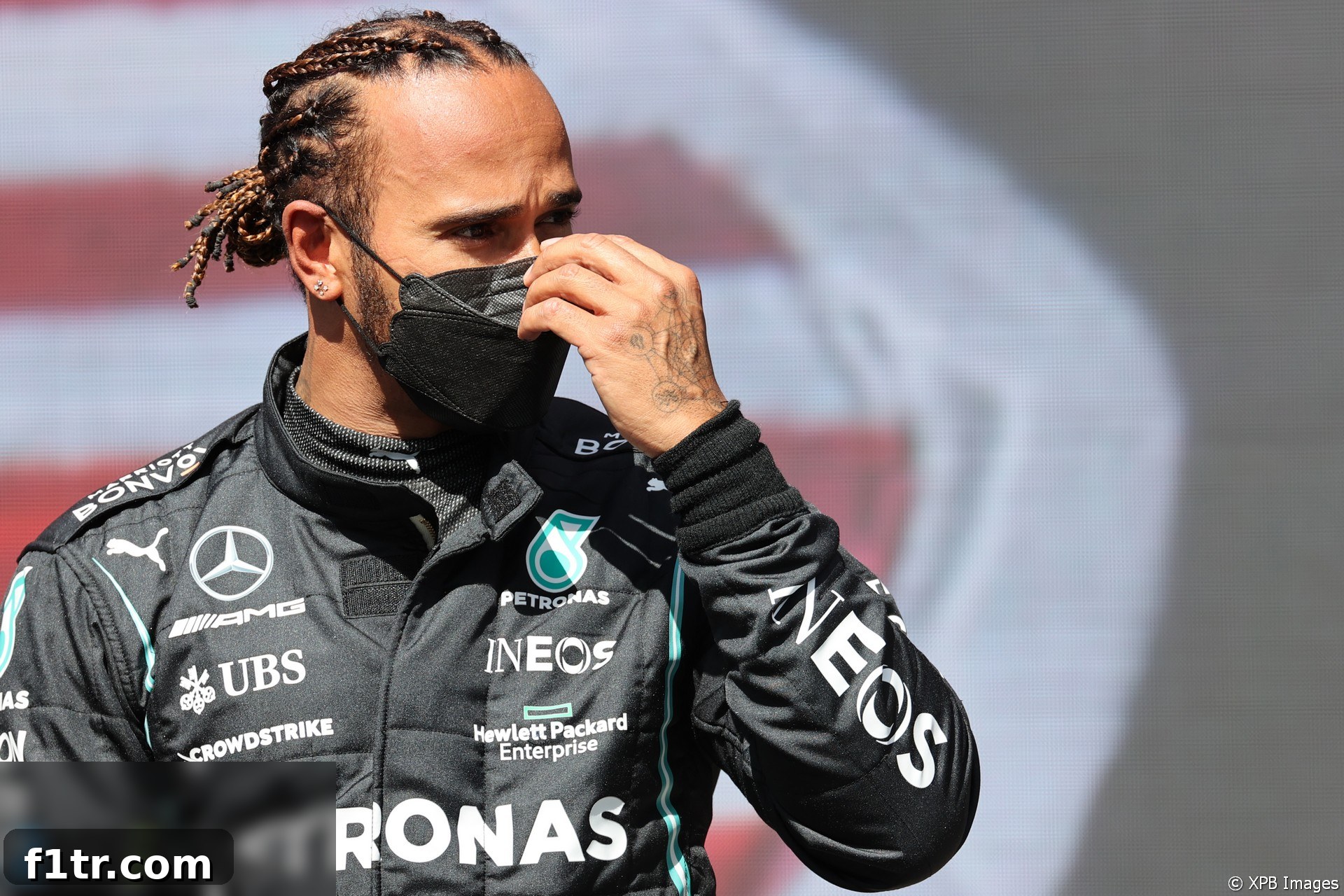
Seven-time Formula 1 World Champion Lewis Hamilton candidly admitted to a challenging and “messy session” during qualifying for the 2021 Portuguese Grand Prix. Despite securing a front-row start, Hamilton narrowly missed out on pole position to his Mercedes teammate, Valtteri Bottas, by an incredibly slim margin of just seven-thousandths of a second. The British driver’s post-qualifying remarks highlighted significant struggles with tyre grip and consistency on the demanding Autódromo do Algarve circuit, suggesting that strategic tyre choices and prevailing track conditions made for a difficult Saturday afternoon for many competitors, not just himself.
Lewis Hamilton Reflects on Challenging Portuguese GP Qualifying: A “Messy Session” and Tyre Frustrations
The qualifying session in Portimão proved to be a nail-biting affair, with the top contenders pushing their machinery to the absolute limit. However, for a driver of Lewis Hamilton’s caliber, securing second place on the grid still came with a degree of dissatisfaction. His comments painted a picture of a driver fighting not only his rivals but also the elements and the characteristics of the circuit and tyres. He expressed that he managed only a single truly “good lap” throughout the entire qualifying hour, a rare admission of imperfection from a driver renowned for his precision and consistency. This unexpected struggle set the stage for a compelling race day, with Hamilton eager to convert his starting position into a victory despite the preceding challenges.
The Intense Battle for Pole: Hamilton vs. Bottas at Portimão
The fight for pole position at the Autódromo do Algarve was a classic intra-team battle between the two Mercedes drivers, Lewis Hamilton and Valtteri Bottas. The excruciatingly small gap of 0.007 seconds underscored the competitive intensity within the reigning constructors’ champions. For Hamilton, accustomed to dominating qualifying, being pipped to pole by his teammate by such a minuscule margin was a clear indicator of the difficulties he faced. This outcome not only provided Bottas with a much-needed morale boost but also highlighted Hamilton’s underlying struggles to extract maximum performance from his W12 car on this particular occasion. The stakes of securing pole are always high in Formula 1, offering a crucial strategic advantage for the start of the race, and Hamilton’s disappointment was palpable despite his usual sportsmanlike demeanor.
Autódromo do Algarve: A Circuit of Unique Challenges
The Autódromo do Algarve, affectionately known as Portimão, is a circuit celebrated for its undulating terrain and challenging layout. However, it also presents unique hurdles for Formula 1 teams and drivers, particularly regarding grip levels. Hamilton specifically cited the windy conditions and the inherently “slippery” nature of the track surface as significant factors contributing to his struggles. “I think for everyone it’s not that easy here,” he noted, acknowledging that the difficulties were widespread across the grid. The circuit’s relatively new asphalt, combined with the often-present Atlantic winds, can make finding the optimal setup and tyre operating window exceptionally tricky, demanding precise driver input and a finely balanced car.
The low grip surface often forces drivers to push harder to generate tyre temperature, which in turn can lead to increased degradation over multiple laps. This delicate balance between generating heat and preserving the rubber is a constant battle, especially in qualifying where every hundredth of a second counts. The challenging characteristics of Portimão mean that drivers must demonstrate exceptional car control and adaptability, making it a true test of skill, even for a seasoned champion like Lewis Hamilton. The unpredictable nature of the circuit added an extra layer of complexity to the 2021 Portuguese Grand Prix qualifying session, making clean, fast laps a rare commodity.
Hamilton’s Struggle for Consistency and Grip
Lewis Hamilton’s frank assessment of his qualifying performance painted a clear picture of an afternoon spent battling internal demons as much as external competitors. He described the session as “quite a messy session, really, for me.” This wasn’t a case of just one difficult moment; instead, Hamilton felt his performance was compromised across multiple segments. “Q1 wasn’t good. Q2 I only had one good lap. I would say in the whole session generally I only had one lap, Q3 was pretty poor.” Such an honest self-critique from a seven-time champion underlines the profound frustration he experienced in trying to string together a consistent series of fast laps. The ability to extract maximum performance consistently is usually a hallmark of Hamilton’s driving, making this candid admission all the more striking.
The difficulty in achieving optimal tyre performance meant that even when Hamilton felt he had done a decent job, the lap times weren’t reflecting his efforts. The quest for grip became the overarching theme of his session. Despite his vast experience and the superior engineering of the Mercedes W12, the conditions at Portimão proved to be a formidable adversary. His struggles with consistency suggest that the car was perhaps not as dialed in as usual, or that the driver was finding it exceptionally hard to adapt to the fluctuating grip levels, which ultimately cost him that crucial fraction of a second needed for pole position.
Tyre Strategy: A Double-Edged Sword for Mercedes
Mercedes’ tyre strategy during qualifying, particularly the reliance on the medium compound tyres, became a significant talking point. In Q2, Hamilton successfully navigated his way into the top 10 using the harder medium compound tyres. This move is typically a strategic masterstroke, aiming to secure a starting tyre for the race that offers greater durability and a longer first stint, potentially providing a strategic advantage over rivals who might start on softer, less durable tyres. Hamilton successfully executed this plan, positioning himself well for Sunday’s Grand Prix.
However, the decision to use medium compound tyres again at the end of Q3 raised questions, even within the Mercedes camp. Both Hamilton and Bottas failed to improve their times on their final runs, leading Hamilton to suspect that “probably wasn’t the right decision at the end.” The hope was that the medium tyres, once up to temperature, would offer consistent performance, but the reality was a lack of peak grip when it mattered most. This highlighted the fine line teams walk in F1 tyre strategy, where the optimal compound can change dramatically based on minute variations in track temperature, wind, and rubber degradation, especially when pushing for the absolute limit in a high-stakes qualifying session.
Pirelli’s Tyre Compounds: The Heart of the Frustration
A significant part of Lewis Hamilton’s frustration stemmed from his firm belief that F1’s sole tyre supplier, Pirelli, had brought compounds that were too hard for the Autódromo do Algarve circuit. “It’s just tricky out there. You see us all having to do multiple laps. The tyres are too hard here so it doesn’t work very well with the surface,” he asserted. This observation resonated with many drivers who were visibly struggling to generate and maintain optimal tyre temperature throughout their flying laps. Harder compounds generally offer greater longevity but require more effort and laps to bring into their ideal operating window, often compromising peak performance.
The need to complete “extra laps to get temperature [up]” meant drivers were constantly managing their tyres, trying to find that elusive sweet spot. This added an extra layer of complexity and physical demand, as successive laps pushed the tyres and the drivers. For Hamilton, this ultimately culminated in a disappointing lack of grip when it was most critical. “At the end, just didn’t have very good grip so I didn’t do the greatest job,” he concluded, attributing his sub-optimal performance directly to the tyre characteristics in conjunction with the track surface.
Hamilton’s comments highlight a recurring theme in modern Formula 1: the critical role of tyres in determining performance. When the tyre compounds are perceived as mismatched with the circuit’s characteristics, it can lead to frustrating sessions for drivers and unpredictable outcomes. The delicate interplay between tyre construction, compound stiffness, track surface, and ambient conditions dictates the level of grip available, profoundly influencing a driver’s ability to extract the maximum from their car. For Hamilton at Portimão, this delicate balance was clearly not in his favor during qualifying.
Implications for the Portuguese Grand Prix Race Day
Starting from second on the grid means Lewis Hamilton still has a strong chance to challenge for victory in the Portuguese Grand Prix. While missing pole is always a blow, the Mercedes W12 has historically shown formidable race pace, often allowing Hamilton to recover from slightly disadvantageous starting positions. His strategic choice of starting on the medium tyres, if effective, could still play a crucial role in the race dynamics, potentially enabling a longer first stint or providing more flexibility compared to rivals on softer compounds. The battle for the lead will undoubtedly be intense, particularly against his teammate Valtteri Bottas, who will be keen to convert his pole position into a win.
Beyond the intra-team battle, the broader context of the 2021 Formula 1 World Championship looms large. Every point is vital in a season where the championship fight is expected to be fiercely contested. A strong result in Portimão would be crucial for Hamilton to maintain his momentum and further solidify his position in the drivers’ standings. The challenging nature of the Autódromo do Algarve also suggests that strategic thinking, pit stop execution, and consistent race pace will be paramount on Sunday.
The grid setup, with Hamilton starting alongside Bottas, promises an electrifying start to the Grand Prix. Despite the frustrations of qualifying, Hamilton’s vast experience and undeniable skill mean he cannot be counted out. He will undoubtedly be analyzing every detail of his qualifying performance and strategizing with his team to ensure a dominant performance on race day, aiming to overcome the challenges he faced on Saturday.
Looking Ahead: Hamilton’s Resolve
Despite the challenges and self-admitted “messy session,” Lewis Hamilton’s focus will now squarely shift to race day. His ability to analyze, adapt, and perform under pressure is legendary, and the minor setback in qualifying will only fuel his determination. The quest for grip and consistency that eluded him on Saturday will be replaced by a focused effort to manage tyres, maximize race pace, and execute an impeccable strategy.
The 2021 Portuguese Grand Prix promises an exciting showdown, with Hamilton poised to fight his way to the top. His honesty about his qualifying struggles only highlights the extreme demands of Formula 1 and underscores the relentless pursuit of perfection that defines his career. All eyes will be on the start lights, anticipating another thrilling chapter in the championship battle.
2021 Portuguese Grand Prix: Related Articles
- Pirelli’s tyre choice for Portuguese GP wasn’t “too hard”, Hamilton concedes
- Who are the top F1 juniors bidding for a grand prix debut in 2022?
- 2021 Portuguese Grand Prix Star Performers
- Race gains encourage Ricciardo after ‘unacceptable’ qualifying performance
- Sainz says top-five finish was possible after first no-score for Ferrari
Browse all 2021 Portuguese Grand Prix articles