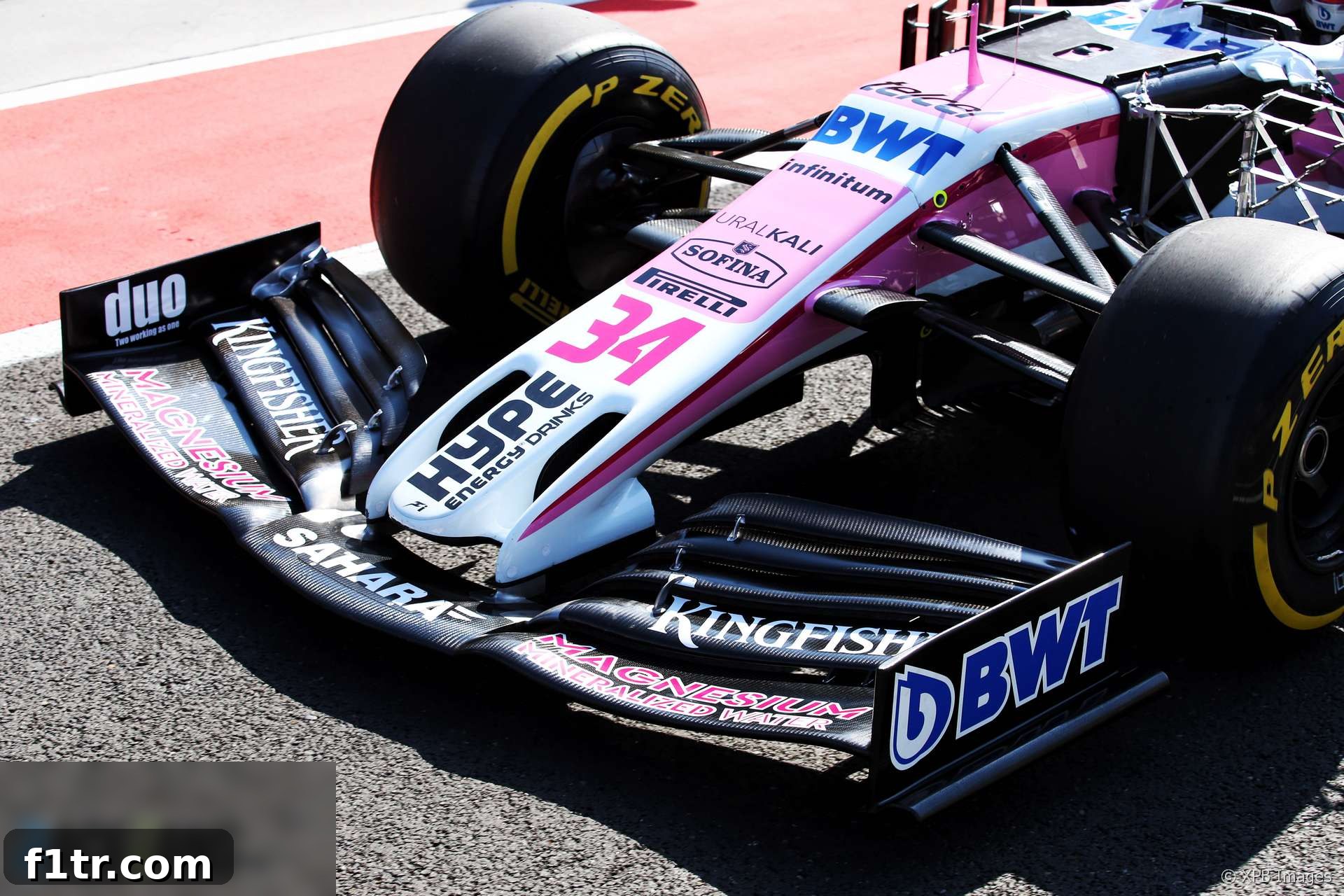
Formula 1’s regulatory landscape is constantly evolving, and a significant shake-up of the front wing rules for the 2019 F1 season was prompted by a pivotal event in September: Haas’s disqualification from the Italian Grand Prix. This incident underscored the critical need for absolute clarity in technical regulations, leading the sport’s governing body, the FIA, to embark on a comprehensive rewrite of these crucial aerodynamic components. The decision reflects a broader commitment to refining competition and ensuring that the spirit of the rules is upheld, leaving minimal room for ambiguity or exploitation.
Following Romain Grosjean’s Haas VF-18 being stripped of its sixth-place finish at Monza, a critical flaw in the car’s floor design came to light. Stewards determined that the front corners of the floor lacked the mandated 50mm radii, failing to comply with technical regulations (even accounting for a permissible 2mm tolerance). This seemingly minor infraction had significant consequences, not only for Haas but for the future direction of Formula 1’s aerodynamic regulations. It highlighted how even slight deviations could lead to competitive advantages and prompted a collective call from teams for greater specificity in the upcoming rules.
At a subsequent meeting of the FIA Technical Working Group, teams reached a unanimous agreement: the new rules, which notably proposed increasing front wing widths to two meters, required revision. The primary objective was to eliminate any potential sources of confusion, grey areas, or loopholes that could emerge from imprecise language. Held at the Heathrow Sofitel, the meeting saw Nikolas Tombazis, the FIA’s head of single-seater matters, commit to undertaking this crucial rewrite for the 2019 regulations. This collaborative approach between the FIA and the teams emphasizes the sport’s dedication to fair play and precise technical governance.
Addressing Aerodynamic Ambiguity: The Drive for Clarity
Teams specifically pushed for more granular detail regarding the dimensions and specifications of the wings. They also advocated for the removal of vague terminology, such as references to “minimal” deviations. Such subjective language, they argued, could inadvertently create loopholes that teams might exploit, leading to disputes and undermining the integrity of the regulations. The collective desire was for a prescriptive rulebook that left no stone unturned, ensuring all participants operated within clearly defined parameters. This pursuit of precision is essential for maintaining competitive balance and preventing expensive legal battles over interpretations.
Romain Grosjean was stripped of sixth place at the 2018 Italian Grand Prix.
Beyond clarifying the wording, the revised rules for 2019 also had a significant performance objective: to eliminate the ‘outwashing’ effect of the then-current front wing designs. Outwashing refers to the phenomenon where front wings push airflow outwards around the front wheels, creating turbulent wake that makes it exceedingly difficult for following cars to maintain aerodynamic grip. This effect is widely believed to be a major contributor to why Formula 1 cars struggle to follow each other closely at high speeds, thereby hindering overtaking and diminishing the excitement of races. By making front wings wider and simplifying their design, the FIA aimed to create a more neutral wake, fostering closer racing and more thrilling on-track action.
The Inherent Challenges of Regulatory Design in F1
The process of drafting new regulations in Formula 1 is fraught with challenges. Nikolas Tombazis himself acknowledged this in May, following the initial announcement of the planned rule changes. He admitted there was an “inherent degree of risk” that any alteration to the rulebook could inadvertently lead to unintended consequences or introduce new loopholes for ingenious teams to exploit. “These are no exception in that regard,” he noted, emphasizing the complexity of predicting every possible design interpretation.
Tombazis further elaborated on the FIA’s meticulous approach: “We cannot ever be completely certain of every single thing teams will do in development. What we’ve tried to do with these rules is to have much more careful wording on some areas of the car to try to avoid any particular loopholes or completely different directions teams could take.” This statement highlights the cat-and-mouse game between regulators and engineers, where every carefully crafted word in the rulebook is scrutinized for potential areas of exploitation. The goal is to close as many of these avenues as possible upfront, ensuring a level playing field and preventing runaway development in areas unintended by the regulations.
Understanding the Original 2019 Front Wing Regulations (Prior to Revision)
The following outlines the 2019 front wing regulations as they were originally published. These detailed specifications served as the initial framework, which subsequently underwent significant revision following the Haas incident to enhance clarity and specificity. Examining these initial rules provides valuable insight into the complexity of F1 aerodynamic design and the strict parameters within which teams must operate. The re-evaluation of these guidelines underscores the FIA’s proactive stance in addressing potential ambiguities and unintended outcomes in the pursuit of fair and exhilarating competition.
3.3.4 Definition of components
This section acts as an organizational framework, clearly categorizing the various elements permitted within the front wing’s defined spatial volume. By compartmentalizing the wing into distinct components, the FIA aims to prevent teams from introducing extraneous or undefined aerodynamic devices, ensuring that all parts serve a specific, approved function.
On each side of the car, the volume described in Article 3.3.3 can only contain the following components:
a) The front wing endplates defined in Article 3.3.5.
b) The front wing profiles defined in Article 3.3.6.
c) A maximum of two front wing strakes as defined in Article 3.3.8.
d) The front wing auxiliary components defined in Article 3.3.9.
3.3.5 Front wing endplates
Front wing endplates are critical for managing airflow around the outer edges of the wing, preventing air from spilling over the tips and optimizing the pressure differential that generates downforce. This section defines their intricate geometry and precise positioning, which are crucial for directing airflow effectively without generating excessive outwash or turbulent wake.
Williams was among the first teams to test a 2019-style front wing.
A mathematical surface (referred to as the “virtual endplate surface”) must be constructed in order to subsequently define the endplate.
The virtual endplate surface must:
a) Lie entirely between 910mm and 950mm from the car centre plane.
b) Extend forwards, rearwards, upwards and downwards in such way as to intersect respectively the forward, rearward, upper and lower bounding surfaces of the volume defined in Article 3.3.3 over its entire length and height.
c) In no place have a normal which subtends an angle greater than 15° to an axis normal to the car centre plane.
d) Produce one single continuous curve, which is entirely visible from side view, when intersected with any lateral or horizontal plane.
The front wing endplate is defined as the bodywork created by the union of two volumes.
The first such volume:
e) Must fully enclose a minimum of 95% of the virtual endplate surface.
f) Over its forward-most 150mm, measured in the longitudinal direction, must in no part be distant more than 10mm from the virtual endplate surface, while over the rest of its volume must in no part be more than 6mm distant from the virtual endplate surface.
g) Is a single volume which contains no apertures and any intersection with any lateral or horizontal plane may only produce a single closed section.
The second such volume:
h) Must have no part which is distant more than 30mm from the virtual endplate surface towards the car centre plane. Any part inboard of the virtual endplate surface must lie in its entirety between 75mm and 85mm above the reference plane.
i) Lies in its entirety between 75mm and 110mm from the reference plane.
j) Is a single volume which contains no apertures or slots.
k) When viewed from below, has a boundary which does not contain any external local concave radius of curvature smaller than 200mm.
Once the two volumes have been defined, a fillet radius of up to 5mm will be permitted where they intersect. Any cross section of the unified volume with a lateral vertical plane should contain only a single closed section.
In order to prevent tyre damage to other cars, the complete endplate, with the exception of parts of the second volume inboard of the virtual endplate surface must be at least 10mm thick (being the minimum distance when measured normal to the surface in any direction) with a 5mm radius applied to all extremities.
In addition, the leading 50mm of this bodywork must be of a prescribed laminate, details of this laminate may be found in the Appendix to the Technical Regulations.
3.3.6 Front wing profiles
These are the primary aerodynamic surfaces of the front wing, responsible for generating downforce and shaping the airflow that passes under and around the car. The regulations impose strict limits on their number, curvature, and interaction to ensure a degree of aerodynamic simplicity and to mitigate aggressive airflow manipulation that could impede following cars.
Front wing profiles are defined as bodywork that is contained in the volume which extends from 250mm to 950mm from the car centre plane, and within the volume defined in Article 3.3.3. They must meet the following criteria:
a) Any intersection of these profiles with any longitudinal vertical plane may contain no more than five closed sections, each of which may contain no concave radius of curvature less than 50mm. The rearmost closed section may have a ‘gurney’ type trim tab fitted to its trailing edge provided no dimension of it exceeds 10mm.
b) For the part of the profiles outboard of a plane that lies 400mm from the car centre plane:
i) The rearmost point of every closed section must be visible when viewed from below.
ii) With the exception of the rearmost closed section, the rearmost point of every closed section must not be visible when viewed from above.
iii) The normal to any point of the profiles’ surface must not subtend an angle greater than 15° to a vertical plane which is normal to the diagonal line described in Article 3.3.3(a).
c) Outboard of a plane that lies 400mm from the car centre plane the minimum distance between adjacent sections at any longitudinal vertical plane must lie between 5mm and 15mm at their closest position.
Minimal exceptions to the above geometrical criteria can occur in areas of transition close to consecutive longitudinal vertical cross sections with a different number of individual profiles. Outboard of a longitudinal plane that lies more than 400mm from the car centre plane, such changes may only be achieved by the bifurcation of a single closed section into two or more closed sections, and the method of construction of this transition is detailed below. The area of transition will be defined by two vertical planes, which are parallel to each other, up to 20mm apart, and form an angle of no more than 20° to the car centre plane. Within this area:
d) The inboard (single) profile surface must be defined over the full span of the transition area in full compliance with Article 3.3.6.
e) The outboard profile (two or more) surfaces must be defined over the full span of the transition area in full compliance with Article 3.3.6, lie entirely within the single profile surface, and share the same overall chord.
f) Once the inboard and outboard profile surfaces have been defined, blending surfaces must be defined to join the profiles together. These surfaces must lie within the volume of the single, inboard profile surface, and entirely within the transition volume. Once these minimal transition surfaces have been defined, the original overlapping surfaces of the inboard and outboard profiles must be trimmed accordingly.
Once the front wing profiles have been defined, they must be trimmed by the virtual endplate surface defined in Article 3.3.5, and the portion of the front wing profiles outboard of that surface must be discarded. Where the front wing profiles intersect the front wing endplate, a maximum fillet radius of 10mm may be applied.
3.3.7 Adjustability of front wing
This section governs the limited adjustability permitted for portions of the front wing. The ability to alter the angle of attack of specific elements is crucial for teams to fine-tune the car’s aerodynamic balance for different tracks and conditions, while maintaining strict control over the extent and method of these adjustments to prevent active aerodynamics during racing.
Once the Front Wing Profiles have been defined in accordance with Article 3.3.6, a portion of up to four of the rearmost profiles may be adjustable in order to trim the front wing aerodynamic load.
For this purpose:
a) The parts of the front wing profiles that are included within the adjustable part must have no degrees of freedom between them.
b) The adjustment may only be a rotation about a fixed axis. The original position of these profiles (as defined in accordance with Article 3.3.6) must be included within the overall range of adjustment. Furthermore, the maximum deviation for any point of these profiles between the uppermost and lowermost angle of adjustment must not exceed 35mm. Minimal exceptions to the geometrical criteria for the wing profiles may be made in the junction between the adjustable and non-adjustable parts, in order to ensure the necessary level of sealing.
For the avoidance of doubt, the adjustment permitted under this Article is only allowed when the car is stationary and by the use of a tool, and in accordance with the Formula 1 Sporting Regulations.
Furthermore, any such variation of incidence maintains compliance with all of the bodywork regulations, with the exception of Articles 3.3.6 (a) and 3.3.6 (b).
3.3.8 Front wing strakes
Strakes are small, often vertical, elements on the front wing that are designed to control and direct airflow, acting as conditioners to optimize performance. This section imposes strict limitations on their number, placement, and dimensions to prevent them from becoming overly complex aerodynamic devices that could contribute to adverse wake effects or provide unfair advantages.
Strakes may be constructed once the front wing profiles have been defined. For each strake, a virtual strake surface must be first defined, which must:
a) Be connected to the non-adjustable part of the front wing profiles.
b) Lie in its entirety between two vertical longitudinal planes, 20mm apart, and between 500mm and 800mm from the car centre plane.
c) Lie entirely between 75mm and 150mm from the reference plane.
d) Not be closer than 50mm in any point to the other such virtual strake surface.
e) In no place have a normal which subtends an angle greater than 10° to an axis normal to the car centre plane.
f) Contain no more than one curve when intersected by any lateral vertical or horizontal plane. In side view, no part of the virtual strake surface may obstruct any other part of it.
Once the virtual strake surface has been defined, the strake itself must:
g) Fully enclose the entire virtual strake surface.
h) In no part lie vertically above the upper surface of the front wing profiles defined in Article 3.3.6.
i) Be no more than 6mm distant from the virtual strake surface, except its rear-most 100mm (measured in the longitudinal direction), where this maximum distance must not exceed 3mm.
Once the actual strake volume has been defined, a fillet radius of up to 5mm will be permitted where this strake volume intersects the individual profiles described in Article 3.3.6.
3.3.9 Front wing auxiliary components
While the primary focus is on aerodynamics, front wings must also house various non-aerodynamic components essential for the car’s operation, structural integrity, or data collection. This section permits specific auxiliary elements, such as brackets and sensors, with precise limitations on their size and form. It also establishes a clear approval process for any additional components, preventing teams from covertly introducing performance-enhancing devices under the guise of “auxiliary” functions.
For mechanical, structural or measurement reasons only, the following components will be permitted in addition to the bodywork defined in Articles 3.3.5, 3.3.6 and 3.3.8:
a) Two brackets which define the pivot axis of the adjustable part of the front wing profile, and allow the necessary movement. These brackets should be no more than 5mm thick, and in no part more than 30mm distant from either the stationary or the adjustable part of the wing profiles. A fillet radius no greater than 2mm will be permitted where these brackets join the two profiles.
b) Slot gap separator brackets between consecutive front wing profiles, provided they are no more than 5mm thick and in no part more than 25mm distant from both of the two profiles they support in relation to each other. A fillet radius no greater than 2mm will be permitted where these brackets join the two profiles.
c) A minimal mechanism with or without a minimal fairing to contain it for the angle adjustment of part of the front wing profiles, as defined in Article 3.3.7.
d) A minimal fairing that contains a single tyre temperature sensor. The dimension of the complete tyre temperature sensor and fairing must be no greater than 30mm wide x 50mm long x 30mm high. A maximum of one sensor and fairing may be positioned on each side of the car, and may be joined to the bodywork defined in Articles 3.3.5 or 3.3.6 with a minimal support.
Should there be a requirement for any additional component to be added, a team must write specifically to the FIA with an explanation, design, and calculated aerodynamic effect, in order to get approval. Such a communication will be circulated to rival teams if deemed to cover a new aspect that had previously not been considered.
Implications for Teams and the Future of F1 Aerodynamics
The FIA’s decision to rewrite these critical front wing regulations underscores the dynamic nature of Formula 1’s technical landscape. For teams, this means a continuous adaptation and re-evaluation of design philosophies. The pursuit of unambiguous rules is not merely about preventing controversy; it’s about fostering an environment where innovation thrives within clearly defined boundaries. By reducing ‘outwashing’ and aiming for a more neutral front wing design, the FIA hopes to shift the aerodynamic focus, encouraging designs that promote following cars and, ultimately, more competitive and exciting racing.
This episode serves as a powerful reminder that every millimeter and every word in the regulations holds immense significance in the high-stakes world of Formula 1. The commitment to clarity, driven by incidents like the Haas disqualification, reflects a continuous effort to perfect the sport’s technical framework. As Formula 1 moves forward, the lessons learned from the 2019 front wing saga will undoubtedly influence future regulation changes, reinforcing the importance of meticulous drafting and proactive revision to maintain the integrity and spectacle of Grand Prix racing.
Related Insights on the 2019 F1 Season
Explore further articles related to the significant 2019 F1 season and its lasting impact:
Crying in the Melbourne car park at 2019 grand prix was my career low – Ocon
McLaren Racing reports reduced £71 million loss in 2019
Kvyat: Hockenheim podium last year was “my biggest achievement” so far
How the FIA’s new encrypted fuel flow meter targets Ferrari’s suspected ‘aliasing’ trick
“He smashed my office door”: 23 must-see moments from ‘Drive to Survive’ season two