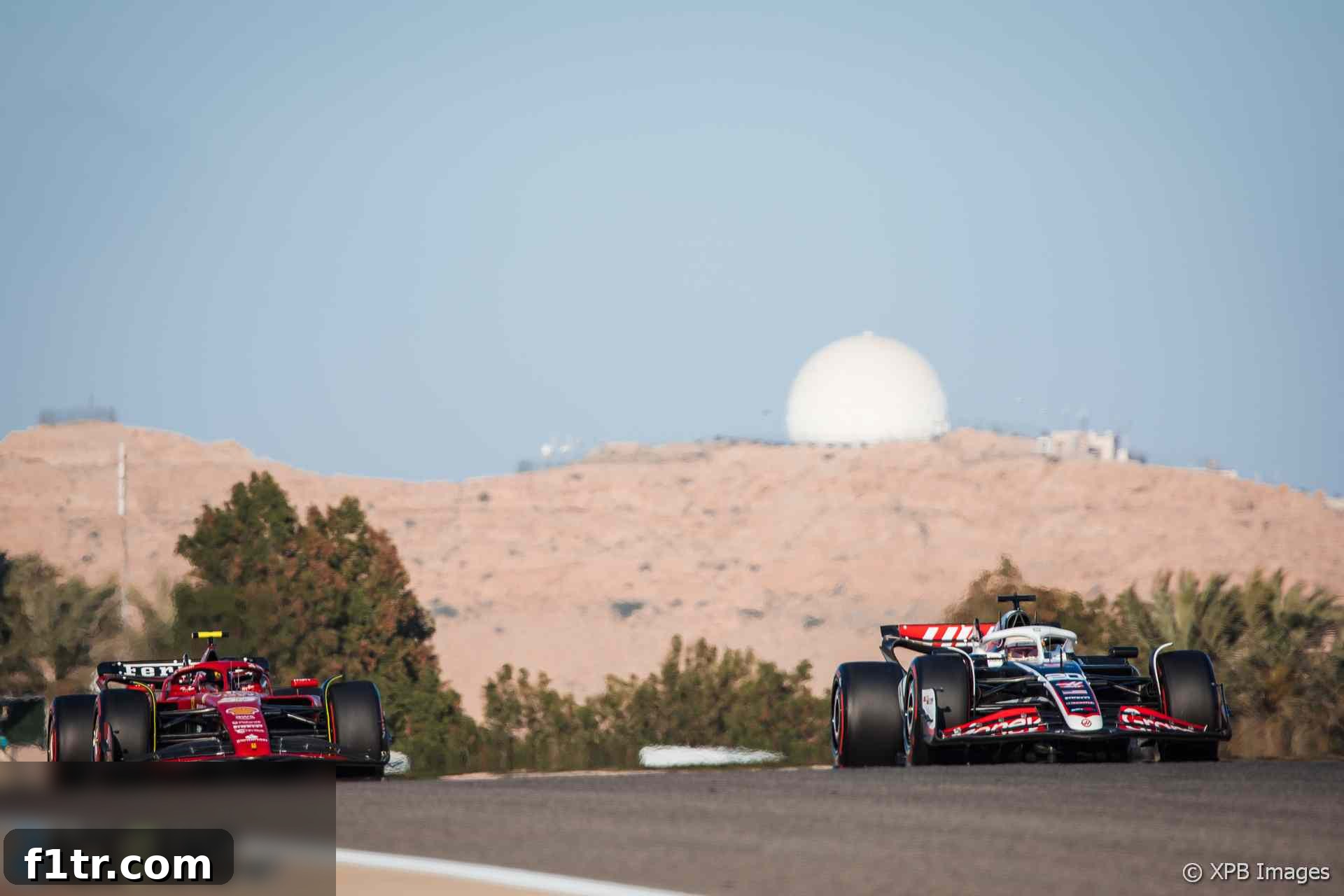
Haas F1 Team Extends Crucial Ferrari Power Unit Partnership Until 2028: A Deep Dive
In a strategic move bolstering its long-term future in Formula 1, the Haas F1 Team has officially announced the extension of its power unit and component supply agreement with Scuderia Ferrari. This pivotal deal ensures that the American outfit will continue to be powered by Ferrari engines and utilize key technical components until at least the end of the 2028 season, prolonging a partnership that has been fundamental to Haas since its debut in the premier motorsport category.
The renewal of this technical alliance is particularly significant as it secures Haas’s engine supply beyond 2026, a year slated to introduce a revolutionary overhaul of Formula 1’s technical regulations. These forthcoming changes, which represent the first major revision to power unit rules since 2014, will usher in a new era of engine technology, emphasizing sustainability and revised performance parameters. For a customer team like Haas, locking in a proven and experienced power unit supplier like Ferrari provides an invaluable foundation amidst such transformative shifts.
A Foundation of Stability: Komatsu Highlights Continuity
Team Principal Ayao Komatsu underscored the profound importance of this extended agreement, emphasizing the stability and continuity it brings to the team’s ongoing development trajectory. “As an organization, we’ve only ever raced with Ferrari power units,” Komatsu stated. “To have that continued stability moving into the next set of power unit regulations is a key part of our ongoing development.” This sentiment reflects the critical role that a consistent technical base plays in F1, where even minor changes can have cascading effects on performance and reliability.
Komatsu further elaborated on the deep-seated relationship between the two entities, which transcends a mere supplier-customer dynamic. “The relationship with Scuderia Ferrari has always been a special one to us – they were instrumental in the genesis of the program back in the early days and have continued to be a valuable technical partner to us throughout the past nine seasons.” This historical context is crucial; Ferrari’s support was instrumental in enabling Gene Haas to establish his team on the F1 grid in 2016, providing not just engines but also a blueprint for operation within the complex F1 ecosystem.
The Genesis of a Partnership: Haas’s Unique Entry into F1
When Haas F1 Team made its debut in 2016, it carved out a unique niche in Formula 1 by adopting a highly collaborative model. Unlike traditional constructors who design and manufacture nearly every component in-house, Haas opted to acquire as many legally permissible parts as possible from an existing team, thereby leveraging the expertise and infrastructure of a seasoned competitor. Scuderia Ferrari, one of F1’s most iconic and successful teams, became this crucial partner. From its inception, Haas has relied on Ferrari for not only its advanced power units but also for essential components such as gearboxes, suspension parts, and even access to Ferrari’s state-of-the-art wind tunnel for aerodynamic development.
This “customer team” model offered Haas a fast track to the grid, allowing them to bypass years of costly research and development typically required for a new entrant. By purchasing non-listed parts (components that teams are not legally required to design themselves), Haas could focus its resources on optimizing aerodynamics and other performance-critical areas, rather than duplicating efforts on established technologies. This pragmatic approach allowed the team to be competitive from the outset, achieving a respectable points finish in its very first race at the Australian Grand Prix.
Navigating the “Ferrari B-Team” Allegations and F1 Regulations
The close nature of the Ferrari-Haas relationship, while strategically advantageous for the American team, did not go without scrutiny. In the years immediately following Haas’s entry into F1, rival teams voiced significant complaints, frequently labeling Gene Haas’s operation as a “Ferrari B-team.” These criticisms stemmed from concerns that the extensive sharing of components and intellectual property provided Haas with an unfair advantage, potentially blurring the lines between what constituted an an independent constructor and a satellite operation.
The core of the dispute revolved around the spirit, if not the letter, of Formula 1’s regulations regarding listed parts and intellectual property sharing. While Haas meticulously operated within the rules, utilizing parts legally available for purchase, competitors argued that the depth of the collaboration undermined the principle of each team being an independent constructor. In response to these debates and to foster a more level playing field, Formula 1 later revised and scaled back the quantity and type of parts teams were permitted to obtain from other competitors. Despite these adjustments, the fundamental framework allowing for the purchase of power units and major non-listed mechanical components remains, enabling partnerships like the one between Haas and Ferrari to thrive.
Performance Trajectory: Highs, Lows, and Current Resurgence
Haas’s tenure in Formula 1 has been a rollercoaster of performance. The team enjoyed its most successful season in 2018, achieving a remarkable fifth place in the Constructors’ Championship. This period saw the team consistently challenging in the midfield, a testament to the effectiveness of their operational model and the strength of their technical package, largely underpinned by Ferrari’s power and components.
However, the subsequent seasons proved more challenging. The team experienced significant setbacks, notably falling to last place in the standings in both 2021 and again last year, battling issues related to aerodynamic performance, budget constraints, and sometimes, engine competitiveness. These lean years tested the resolve of the team and its partnership. Yet, the current season has seen a promising resurgence for Haas. With a stronger start, the team currently sits seventh in the championship standings with 27 points, demonstrating renewed vigor and the potential to climb further up the grid. This upturn highlights the enduring benefits of a stable technical foundation and continuous development efforts, even through difficult periods.
The Future Landscape: Oliver Bearman and Ferrari’s Sole Customer
Looking ahead, the extended partnership takes on additional strategic dimensions. From 2026 onwards, Haas will become Scuderia Ferrari’s sole customer team in Formula 1. This comes as Sauber, currently a Ferrari customer, transitions to become the Audi works F1 team. This shift could potentially deepen the technical collaboration between Haas and Ferrari further, allowing Ferrari to dedicate more focused support and resources to its single customer, which could be a significant advantage for Haas in terms of tailored development and technical assistance.
Adding another layer of intrigue to the future is the recent announcement that Ferrari Driver Academy member Oliver Bearman will join Haas next year. While this is a separate driver deal, it signifies the continued intertwining of personnel and talent development between the two organizations. Bearman, a highly-rated young talent, made an impressive F1 debut as a substitute for Carlos Sainz at Ferrari earlier this season, and his move to Haas further solidifies the links, potentially creating a direct pathway for future Ferrari talent development within the Haas structure.
Beyond the Engine: The Broader Impact of F1 Power Unit Regulations
The 2026 power unit regulations represent a paradigm shift for Formula 1. The new rules are designed to make the sport more sustainable, financially viable, and attractive to new manufacturers, as evidenced by Audi’s upcoming entry. Key changes include an increased reliance on electrical power, the use of 100% sustainable fuels, and a significant reduction in the costly and complex MGU-H component. For teams like Haas, having an established partner like Ferrari, which has vast experience in F1 power unit development and has committed significant resources to the new regulations, is an invaluable asset.
Ferrari’s commitment to F1’s future regulations means that Haas will benefit from cutting-edge technology developed with sustainability and efficiency at its core. This strategic alignment ensures that Haas can focus its internal engineering efforts on optimizing chassis and aerodynamic performance, confident in the knowledge that its power unit is at the forefront of the new F1 era. The long-term nature of this agreement also provides crucial certainty for budget planning and personnel allocation, allowing Haas to invest in its own infrastructure and talent development without the uncertainty of future power unit supply.
Conclusion: A Pillar of Strength for Haas’s F1 Journey
The extension of the power unit and component supply agreement between Haas F1 Team and Scuderia Ferrari until at least 2028 is more than just a renewed contract; it’s a reaffirmation of a deep-rooted partnership that has defined Haas’s presence in Formula 1. For Haas, this deal provides indispensable stability, technical expertise, and a clear path forward as the sport embarks on a new regulatory cycle in 2026. For Ferrari, it consolidates a long-standing commercial and technical relationship, offering benefits ranging from data acquisition to nurturing young talent.
As the Formula 1 landscape continues to evolve with new teams, regulations, and challenges, the continuity offered by this extended alliance will be a critical pillar of strength for the Haas F1 Team. It positions them to not only navigate the complexities of modern F1 but also to build upon their recent resurgence, striving for greater competitiveness and sustained success on the global stage of motorsport.
More from Formula 1
- Verstappen loathes F1’s new generation of cars – but what do his rivals reckon?
- The ‘throwback weekend’ is back in fashion. But it’s a flawed concept – especially for F1
- Is Formula 1’s double race cancellation a blessing in disguise?
- Todt admits Schumacher crashed on purpose – but did it really cost him two titles?
- 25 of the most memorable radio exchanges from the ‘Max and GP show’
Browse all Formula 1 articles