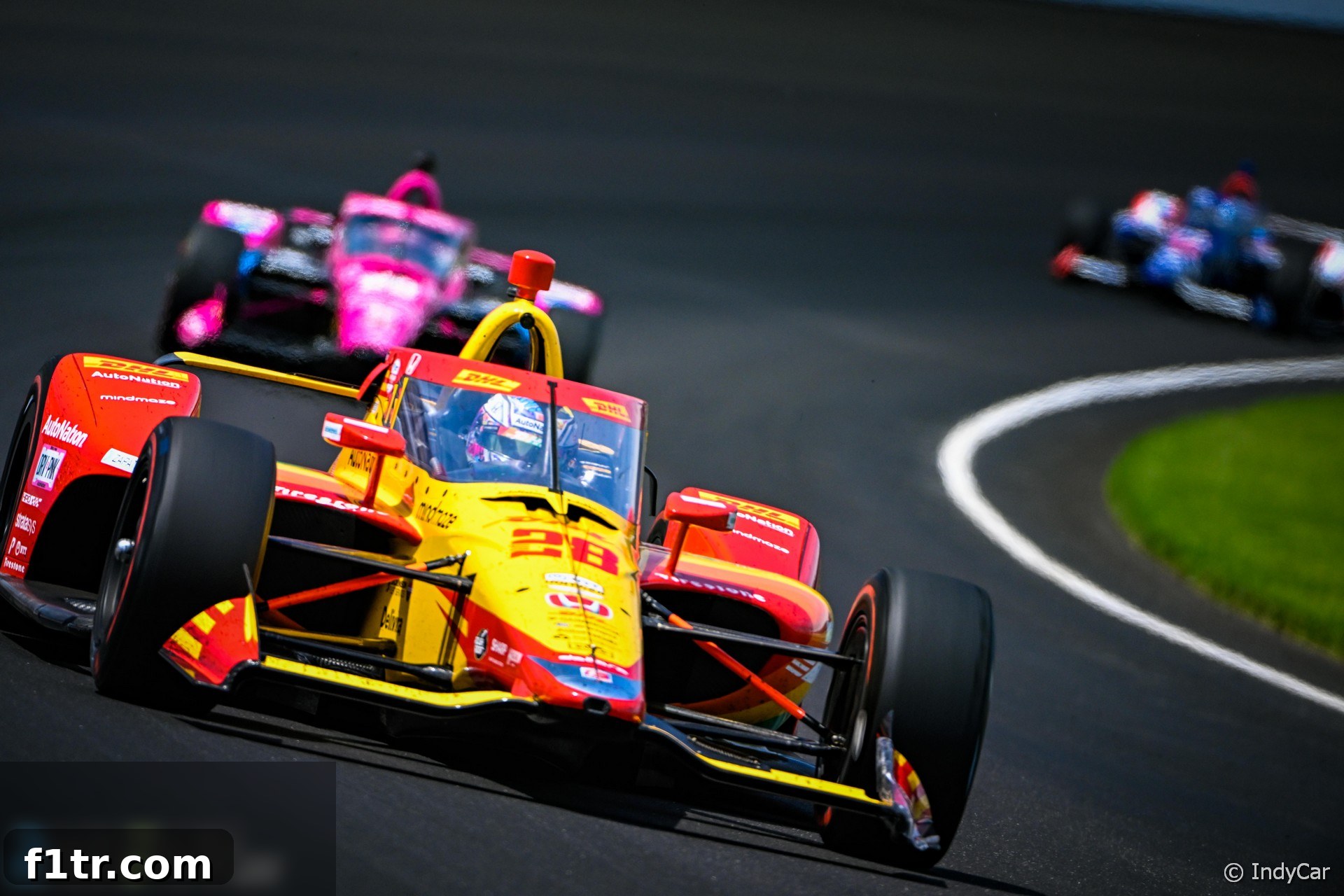
2022 Indy 500 Rookies: A Baptism of Fire at the Brickyard
The 2022 edition of the Indianapolis 500 proved to be a formidable and unforgiving challenge for its rookie class, with all seven newcomers experiencing demanding races to varying degrees. From seasoned motorsport veterans making their highly anticipated oval debuts to promising young talents navigating the treacherous Brickyard for the first time, the iconic 500-mile race tested the limits of every driver, often leading to dramatic conclusions.
Advert | Become a Supporter & Go Ad-Free
Among those facing significant hurdles were the two celebrated ‘super rookies’ – a pair of drivers boasting extensive high-level racing experience before their first competitive starts in this legendary race. Romain Grosjean, a former Formula 1 star, and Jimmie Johnson, a seven-time NASCAR Cup Series champion, both saw their Indy 500 dreams culminate in premature exits due to crashes, starkly highlighting the inherent unpredictability and unforgiving nature of the Indianapolis Motor Speedway.
Romain Grosjean’s Unexpected Spin and Early Exit
Formula 1 veteran Romain Grosjean entered the 2022 Indy 500 with a year of IndyCar experience under his belt, though his prior season primarily focused on road and street courses, complemented by a solitary short oval appearance at Gateway Motorsports Park. His transition to American open-wheel racing had been marked by remarkable pace and adaptability, making him a highly anticipated contender for a strong showing at the 500-mile classic.
Leading up to race day, Grosjean showcased his formidable speed during qualifying, securing the ninth starting position and earning the distinction of being the fastest Indy 500 rookie in the field. He was also the only Andretti Autosport driver to advance to the crucial second day of time trials, a clear testament to his raw pace and the team’s meticulous preparation. However, the race itself brought a different set of intense challenges.
After a promising start, Grosjean found himself engaged in fierce battles outside the top ten, eventually settling into 17th position. His race, however, came to an abrupt and baffling end on lap 106 when he lost control and made heavy contact with the unforgiving wall at Turn Two. Emerging from the infield care centre, a visibly perplexed Grosjean struggled to comprehend the incident. “The car spun,” he shrugged, admitting, “I don’t know why.”
His confusion stemmed from the unexpected nature of the incident, occurring without any apparent warning or precursor. “No warning on that corner, no issue – it was actually really good in one and two. Three and four was a bit more tricky, but in one and two it was pretty good,” he explained, emphasizing the stability he had felt moments before the crash. “I wasn’t expecting anything bad in that corner,” he added, “and obviously I spun without any warning.” Grosjean’s comments underscored the subtle, yet potent, unpredictability of oval racing, where unseen forces like sudden wind gusts can destabilize a car without obvious cause, even for the most experienced drivers accustomed to the absolute limits of grip.
Callum Ilott’s Race Ends with a Double Impact
Romain Grosjean was not the sole Indy rookie with strong Formula 1 ties to be caught out by the notoriously tricky conditions at Turn Two. Callum Ilott, another promising talent who had served as a test driver for F1 teams and demonstrated impressive speed in his burgeoning IndyCar career, also saw his aspirations for a strong finish evaporate at the very same spot. Ilott’s race concluded prematurely on lap 69 when he crashed, initially hitting the outside wall at Turn Two, then skidding further across the track to make a second, significant impact with the inside barrier.
Following a thorough medical check-up, Ilott was released from the care centre, albeit with his right hand and wrist carefully wrapped in bandages, indicating the physical toll of the impact. Reflecting on the incident, he acknowledged the severity of the collision: “It was a bit of a hard hit, and then I hit again on the inside.” Despite the painful injuries, he confirmed his overall well-being: “But, [I’m] all okay, they checked me over and, obviously, a little bit of an issue with the right hand.”
Ilott expressed sincere gratitude for the rapid response of the safety teams and the effectiveness of the SAFER barriers. “Big thanks to the safety team, obviously the safety barrier as well,” he stated. However, his dominant emotion was one of profound regret for his Juncos Hollinger Racing team: “But I’m sorry for the team as well, because it wasn’t running too bad up until then.” His sentiments mirrored those of many drivers who experience early exits, particularly when competitive form suggested a stronger outcome. The consistency of Turn Two as a trouble spot for multiple drivers – including Grosjean, Ilott, and even veteran Rinus VeeKay earlier in the race – underscored the challenging conditions present on race day, particularly the gusty winds that played a significant role in upsetting car balance and making precise driving exceptionally difficult for both seasoned and new competitors.
Advert | Become a RaceFans Supporter andGo Ad-Free
Jimmie Johnson’s Fulfilled Dream and the Rookie of the Year Controversy
The notorious Turn Two claimed yet another high-profile rookie. The other ‘super rookie’ in the field, seven-time NASCAR Cup Series champion Jimmie Johnson, endured a similar fate. Johnson, whose long-held dream was to compete in the Indy 500, had dedicated himself entirely to adapting to open-wheel racing, focusing specifically on oval events in his IndyCar career. Despite his unparalleled success in stock car racing, the unique demands of the Indy 500 proved to be a remarkably steep learning curve, requiring a complete recalibration of his driving style and instincts.
Starting 12th on the grid, Johnson initially showed flashes of promise but gradually found himself fading outside the top 20 as the race wore on. His race tragically ended within a mere six laps of the finish, as he too crashed at Turn Two. This incident was particularly tense and dramatic, as he narrowly avoided collecting his Chip Ganassi Racing teammate, Marcus Ericsson, who was leading the race and ultimately went on to win. Johnson’s crash brought out a red flag, leading to a nail-biting restart and momentarily putting Ericsson’s hard-fought victory chances in jeopardy.
Reflecting on his performance and the late-race crash, Johnson openly lamented the extreme difficulty of making significant progress through the tightly packed field. “Track position was way more important than I thought it would be, and I struggled to really advance through the field,” he admitted, highlighting the tactical challenges of the race. The concluding incident was a bitter pill to swallow: “And then, sadly, the car got away from me at the end of the race, and I had a big crash there in Turn Two.”
Despite the disappointing and abrupt end to his first Indy 500, Johnson maintained that participating in the race was a lifelong ambition fulfilled, a true highlight of his illustrious career. This perspective resonated deeply with the special panel of IndyCar and Indianapolis Motor Speedway officials, alongside esteemed media members, who ultimately voted the 47-year-old as the 2022 Indianapolis 500 Rookie of the Year. “I really loved my experience here, and I’m so happy for Chip Ganassi Racing and Marcus Ericsson, winning the race,” he expressed, showcasing his sportsmanship even after a challenging and emotionally charged day.
However, Johnson’s selection for the prestigious Rookie of the Year award stirred a significant and vocal debate, particularly from Dale Coyne Racing. Their driver, 20-year-old Indy Lights graduate David Malukas, had achieved a remarkable 16th-place finish, making him the undisputed highest-finishing rookie in the entire field. On social media, Dale Coyne Racing quipped: “We all know that David Malukas is the actual Indy 500 Rookie of the Year. Maybe actually finishing the race needs to be part of the criteria.” The provocative message was emphatically punctuated with the hashtag, “Once again we were robbed,” a clear and direct reference to the controversial 2017 decision where Ed Jones, despite finishing third, lost out on the honour to two-time Formula 1 world champion Fernando Alonso, who had also retired from that specific race. This repeated grievance highlighted a lingering dissatisfaction with the award’s selection process, suggesting that race completion and final standing should carry more weight.
David Malukas: The Unsung Rookie Hero of the 2022 Indy 500
While the media spotlight and popular narrative often gravitated towards the ‘super rookies’ with their high-profile backgrounds and established fan bases, David Malukas quietly delivered a performance that earned him widespread respect and, arguably, the moral victory for the best rookie showing. As an Indy Lights graduate, Malukas represented the traditional and meritocratic path to IndyCar, and his debut in the Indy 500 was keenly watched by those who value consistent progression through the racing ladder based on raw talent and perseverance.
After successfully completing his first Indianapolis 500, Malukas conveyed a profound sense of relief, accomplishment, and deep satisfaction. “We finished. We finished the race, it was everything I wanted,” he declared, his voice reflecting the immense pressure lifted. His primary goals for his debut were straightforward yet incredibly challenging for a newcomer: “I wanted to finish, and be the highest finishing rookie, and we achieved both of those things today. I’m very happy.” This pragmatic approach, coupled with his successful execution, stood in stark contrast to the dramatic and often heartbreaking exits of his more experienced rookie counterparts, making his achievement even more noteworthy.
Malukas’s post-race reflections also offered a profound insight into the race’s mystique and inherent unpredictability. “I’ve now realised why people say that this track chooses its winners,” he mused, articulating a sentiment often echoed by seasoned veterans. “Because there’s so many different things that can happen, and everything just needs to go your way for three hours straight. So, there’s a lot of possibilities.” This deep understanding, gained from direct, grueling experience on the track, highlights the incredible mental and physical fortitude required to conquer the Brickyard, where even a slight misstep, an unforeseen mechanical issue, or an unfortunate circumstance can derail a perfectly executed strategy and end a race in an instant.
Despite the inherent challenges, the fiercely competitive nature of the field, and the often-unpredictable flow of the race, Malukas managed to meticulously guide his car to an impressive P16 finish. “Throughout all of it – things definitely didn’t go our way, and we ended up finishing P16,” he acknowledged, hinting at moments of adversity and strategic compromises he and his team undoubtedly overcame. Yet, his self-assessment remained overwhelmingly positive and mature: “Throughout all of it, I’m really happy – I made minimal mistakes from my side, as a rookie.” This calm composure, combined with a solid and consistent result, firmly established Malukas as a talent to watch closely in the IndyCar series, demonstrating the rare blend of skill, maturity, and emotional intelligence essential for long-term success at the elite level of motorsport.
The Unforgiving Nature of Turn Two: A Crucial Lesson for Rookies
The repeated incidents at Turn Two for multiple drivers, especially highly touted rookies like Romain Grosjean, Callum Ilott, and Jimmie Johnson, serve as a stark and painful reminder of the unique challenges presented by the Indianapolis Motor Speedway. Oval racing, particularly at ultra-high-speed venues like IMS, demands a distinct skill set and a profound, intuitive understanding of aerodynamics, tire management, and car behavior that differs significantly from road or street courses. Gusty winds, as prominently experienced during the 2022 race, can unpredictably alter downforce and aerodynamic balance, transforming a seemingly stable car into an unwieldy, dangerous machine in a split second. For rookies, who are still accumulating vital data points, fine-tuning their instincts for drafting in close quarters, managing tire degradation over long runs, and handling severe turbulence in traffic, these volatile conditions amplify the difficulty exponentially. Turn Two, with its specific banking, entry, and exit characteristics, proved to be an especially tricky and unforgiving corner, punishing even the most minor errors with severe, race-ending consequences.
The 2022 Indy 500 rookie class, therefore, provided a compelling and multifaceted narrative of ambition, rapid adaptation, and the brutal reality of motorsport at its pinnacle. Whether it was Grosjean and Ilott grappling with the intricate transition from Formula 1’s surgical precision to IndyCar’s raw power and unique oval nuances, or Johnson striving valiantly to conquer the ‘500’ after an unparalleled NASCAR career, each driver brought a unique story of courage and aspiration. David Malukas, emerging as the highest finisher, underscored the enduring importance of steady progression, meticulous preparation, and consistent performance, proving that sometimes, simply finishing the race without major incident is a profound victory in itself at the Brickyard. The diverse outcomes and learning experiences for these rookies collectively illustrate why the Indianapolis 500 remains one of the most revered, challenging, and unpredictable races in the entire world, a true test of driver, team, and machine against the ultimate oval.
Advert | Become a RaceFans Supporter andGo Ad-Free
Further IndyCar Insights and Related Articles
- IndyCar driver McLaughlin cleared of injury after crashing through barrier at Barber
- Schumacher says his IndyCar feels like ‘an F2 car, just with better tyres’
- IndyCar “way faster than Formula 1” in some corners, says Grosjean
- FIA to award more F1 superlicence points to IndyCar drivers from 2026
- Schumacher to race full-time in IndyCar with RLL in 2026
Browse all IndyCar articles