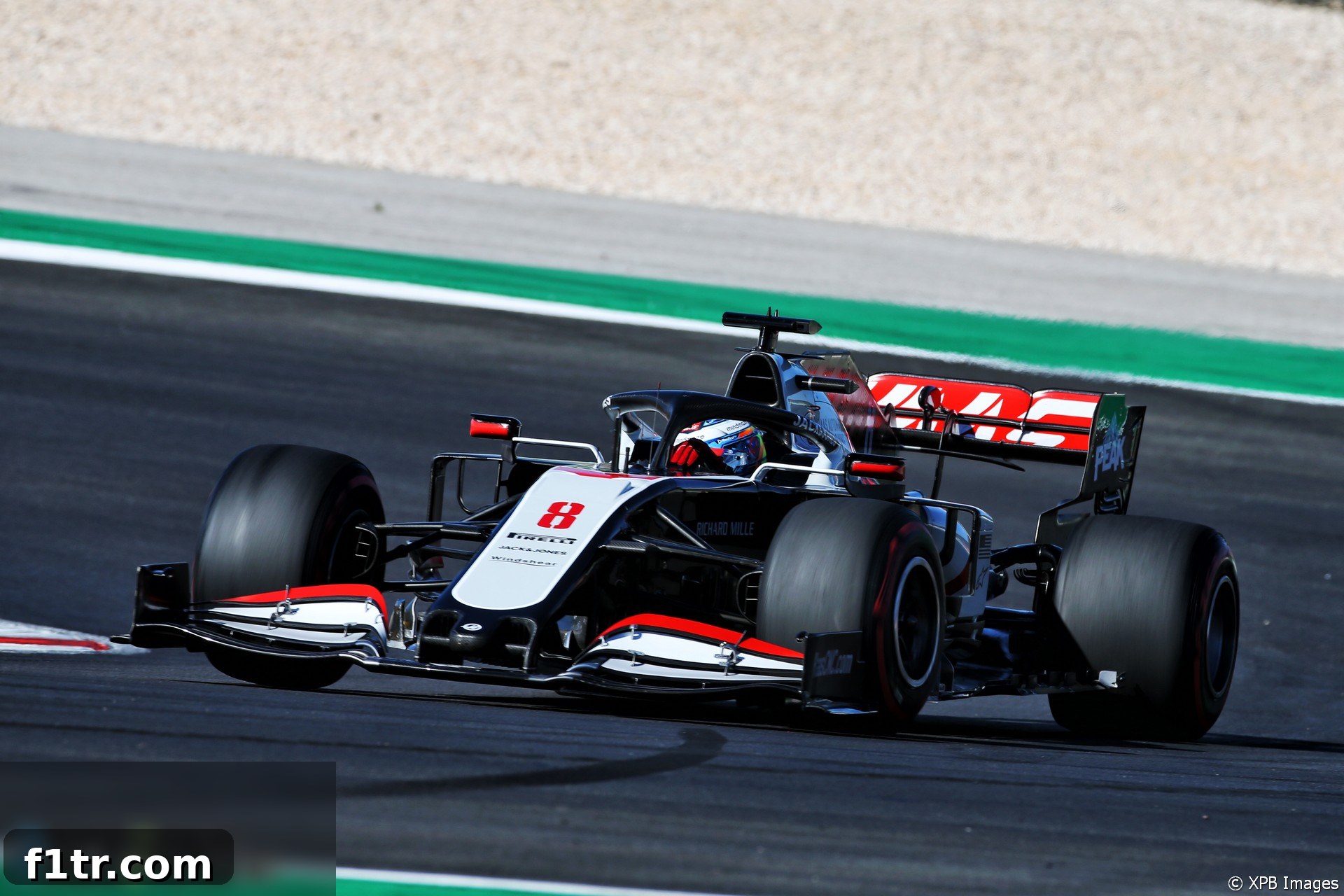
Haas F1 Plagued by Persistent Suspension Overheating: A Deep Dive into Their 2020 Struggles
The 2020 Formula 1 season presented an array of unique challenges, but for the Haas F1 team, one persistent and unresolved technical issue has consistently overshadowed their efforts: a chronic rear suspension overheating problem. Veteran driver Romain Grosjean has candidly spoken out, revealing that this baffling flaw has severely hampered the team’s performance throughout the entire year, leaving them in a perpetual state of uncertainty regarding their car’s unpredictable behaviour on track.
This deep-seated problem reached a critical peak at the Portuguese Grand Prix, where both Haas drivers found themselves eliminated in the first round of qualifying, a stark indicator of the profound difficulties they faced. Grosjean, visibly frustrated, articulated the core of the issue, highlighting how the fluctuating suspension temperatures directly translate into an unstable car platform and, crucially, a wildly inconsistent aerodynamic balance. This technical predicament has transformed race weekends into an exercise in guesswork for the team, severely limiting their ability to extract maximum performance from the VF-20.
Advert | Become a Supporter & go ad-free
The Chronic Suspension Conundrum: An Unyielding Technical Challenge
Romain Grosjean’s recent revelations shed light on a deeply frustrating technical flaw that has dogged the Haas F1 team for the entirety of the 2020 season. At the heart of their performance woes lies a persistent issue with the rear suspension system, which, for reasons still unknown to the engineers, suffers from significant overheating. This thermal instability has far-reaching consequences, primarily manifesting as a constantly shifting ‘platform’ or ride height at the rear of the VF-20 chassis.
The implications of such an issue are profound in the hypersensitive world of Formula 1 aerodynamics. As Grosjean explained, “We’re struggling with the rear suspension overheating, meaning that the platform, the right height, keeps changing at the rear. From one lap to the other we can pick up up to 4% of aero balance.” To put a 4% shift in aerodynamic balance into perspective, it is a monumental change in a sport where even fractions of a percentage point can dictate lap times. This level of variability renders any precise car setup incredibly challenging, if not impossible.
Impact on Driver Confidence and Setup Predictability
For a Formula 1 driver, consistency and predictability from their machinery are paramount. When the car’s behaviour changes drastically from one corner to the next, let alone one lap to the next, it erodes driver confidence and makes pushing the limits an incredibly risky endeavour. Grosjean’s vivid description paints a picture of constant uncertainty: “When it gets hot at the end of third practice you get the ride height and then it cools down – and then you start qualifying with a different one and every lap the rear suspension heats up and the rear ride height changes.” This dynamic means that the car a driver experiences in practice is rarely the same as the one they battle with in qualifying or the race.
This inconsistency directly translates into a crippling disadvantage during qualifying sessions, where every millisecond counts. Drivers are unable to build a reliable understanding of the car’s grip levels and aerodynamic characteristics, forcing them to guess at braking points and cornering speeds. The impact on the engineering team is equally severe. Grosjean expressed sympathy for his race engineer, stating, “I feel for my race engineer because they roll the dice and they decide which flap angle we’re going to go on but we never know where it’s going to end up.” Such a situation transforms the scientific process of F1 setup into a frustrating game of chance, undermining weeks of data analysis and simulation.
The Portuguese Grand Prix: A Magnified Problem
While the overheating suspension has been a season-long companion for Haas, its effects were particularly pronounced and perplexing at the Portuguese Grand Prix. Both Grosjean and his teammate, Kevin Magnussen, found themselves eliminated in Q1, highlighting the severity of the problem at the Portimão circuit. Grosjean noted the increased magnitude of the issue: “Normally we’re struggling a little bit but this weekend the magnitude is quite bigger and we’ve got no idea why.”
The unique undulating topography and challenging corners of the Portimão track may have exacerbated the existing thermal issues, pushing the suspension components to higher temperatures and thus inducing greater ride height variability. This heightened unpredictability meant that the drivers were battling not just the circuit and their competitors, but also an internal struggle with a car that refused to remain consistent. This profound lack of confidence was palpable in Grosjean’s assessment: “The car is never the same from one lap to the others. We’re not very confident for tomorrow and how it’s going to end.” The disparity between Grosjean’s car and Magnussen’s was also noted, with Grosjean’s machine seemingly more susceptible to the issue, reporting a 3% aero balance shift on a long run, which he described as “a fair bit.”
Advert | Become a RaceFans supporter and go ad-free
Team Principal’s Perspective: Guenther Steiner Weighs In
Haas team principal, Guenther Steiner, known for his pragmatic and often blunt assessments, did not shy away from acknowledging the gravity of the suspension overheating dilemma. His comments corroborated Grosjean’s concerns, confirming that the issue has been a persistent thorn in the team’s side since the very beginning of the 2020 campaign. Steiner’s transparency about the team’s struggle to find a definitive solution underscores the complexity of the problem.
“We had this issue since the beginning of the year and it took a few races to understand it,” Steiner revealed. This admission highlights the extensive diagnostic period required in Formula 1 to even pinpoint the root cause of subtle yet impactful technical faults. The team has not been idle; Steiner confirmed that efforts have been made to mitigate the overheating, stating, “We tried a few options to cool the system.” However, the effectiveness of these countermeasures remains questionable, as he added, “I don’t know how much difference it makes.”
Technical Implications and Performance Decline
The persistent suspension overheating and its subsequent impact on ride height and aero balance have a direct correlation with Haas’s overall performance decline in the 2020 season. In an era where aerodynamic efficiency is king, a chassis that constantly alters its aerodynamic profile due to thermal fluctuations is inherently disadvantaged. This instability makes it impossible to consistently hit optimal downforce levels through corners, leading to slower cornering speeds and reduced grip.
Furthermore, the unpredictability generated by the overheating system makes tire management an even more arduous task. When the car’s balance shifts unexpectedly, it can lead to uneven tire wear, localized overheating of the rubber, and a dramatic drop in tire performance over a stint. This forces drivers to manage their pace more conservatively, further compromising their ability to compete with rival teams. The “rolling the dice” approach to car setup, as Grosjean termed it, ultimately means the team cannot optimize the VF-20 for specific track conditions or race strategies, placing them at a significant disadvantage even before the lights go out.
The Search for Solutions: A Continuous Battle
The introduction of new parts at the Portuguese Grand Prix offered a glimmer of hope, but this was quickly extinguished. Steiner confirmed that these attempted fixes had little to no positive impact, reinforcing the baffling nature of the problem. “We brought some new parts to this race and I guess they don’t work as written on the box. So for sure we’ll keep on working on it,” he stated, highlighting the ongoing investigative work. The lack of an immediate solution despite targeted development indicates that the root cause might be deeply embedded within the car’s design or component interaction, requiring a more fundamental rethink.
Finding a resolution to such a complex thermal and mechanical issue is a formidable challenge for any Formula 1 team, particularly for one with limited resources compared to the sport’s front-runners. It demands extensive analysis, simulation, and on-track testing, often involving painstaking trial-and-error. The urgency to find a fix is not just about improving current performance, but also about gathering crucial data and understanding for future car development, especially with significant regulation changes on the horizon.
The Broader Context of Haas’s 2020 Season
The chronic suspension issue is not an isolated incident but rather a significant contributor to what has been a challenging 2020 season for the Haas F1 Team. Operating on a tight budget and facing fierce competition, any major technical flaw can disproportionately impact their ability to score points. The inconsistency stemming from the overheating suspension has made it incredibly difficult for the team to capitalize on any potential opportunities, often leaving them at the back of the grid, as seen at Portimão.
This technical setback compounds other difficulties Haas has faced, including adapting to the nuances of the heavily revised VF-20 chassis and the broader competitive landscape. The ability to extract consistent performance is a cornerstone of success in Formula 1, and without a stable aerodynamic platform, even the most talented drivers and strategic calls can be rendered ineffective. The team’s ongoing struggle with this specific problem illustrates the relentless pressure and engineering demands inherent in top-tier motorsport, where even seemingly minor issues can cascade into season-defining challenges.
Advert | Become a RaceFans supporter and go ad-free
The Road Ahead: Searching for Stability and Performance
As the 2020 F1 season progressed, the Haas F1 team remained locked in an intense battle against an unseen adversary: the unpredictable nature of their own machinery. The inability to fully comprehend and rectify the rear suspension overheating problem continued to cast a long shadow over their race weekends. The persistent shifts in ride height and aerodynamic balance not only compromised their immediate performance but also impacted their long-term development strategies.
The team’s engineers undoubtedly delved into every possible avenue, from material science to component design and airflow management around the suspension elements. The challenge extended beyond merely cooling a hot part; it involved understanding why the heat was accumulating, how it was affecting adjacent systems, and what cascade effects it had on the car’s dynamic behaviour. This intricate problem-solving process underscores the depth of engineering required in Formula 1 and the immense difficulties faced by teams when fundamental car characteristics prove unstable.
For Grosjean and Magnussen, the mental toll of driving an inconsistent car week after week cannot be understated. The constant need to adapt to a changing platform, coupled with the frustration of knowing the car isn’t performing at its theoretical best, adds another layer of complexity to an already demanding sport. Their candid remarks served as a crucial insight into the realities of racing at the sharp end of motorsport, even when battling at the back of the grid.
Ultimately, overcoming such a deeply embedded technical flaw demands resilience, innovative thinking, and a methodical approach. The Haas F1 team’s continued efforts to understand and address the rear suspension overheating problem are a testament to their dedication in the face of adversity. The hope remains that future investigations and design modifications will finally bring the much-needed stability to the VF-20, allowing the drivers to unlock its full potential and bring more consistent performances in the races to come.
2020 Portuguese Grand Prix
Browse all 2020 Portuguese Grand Prix articles