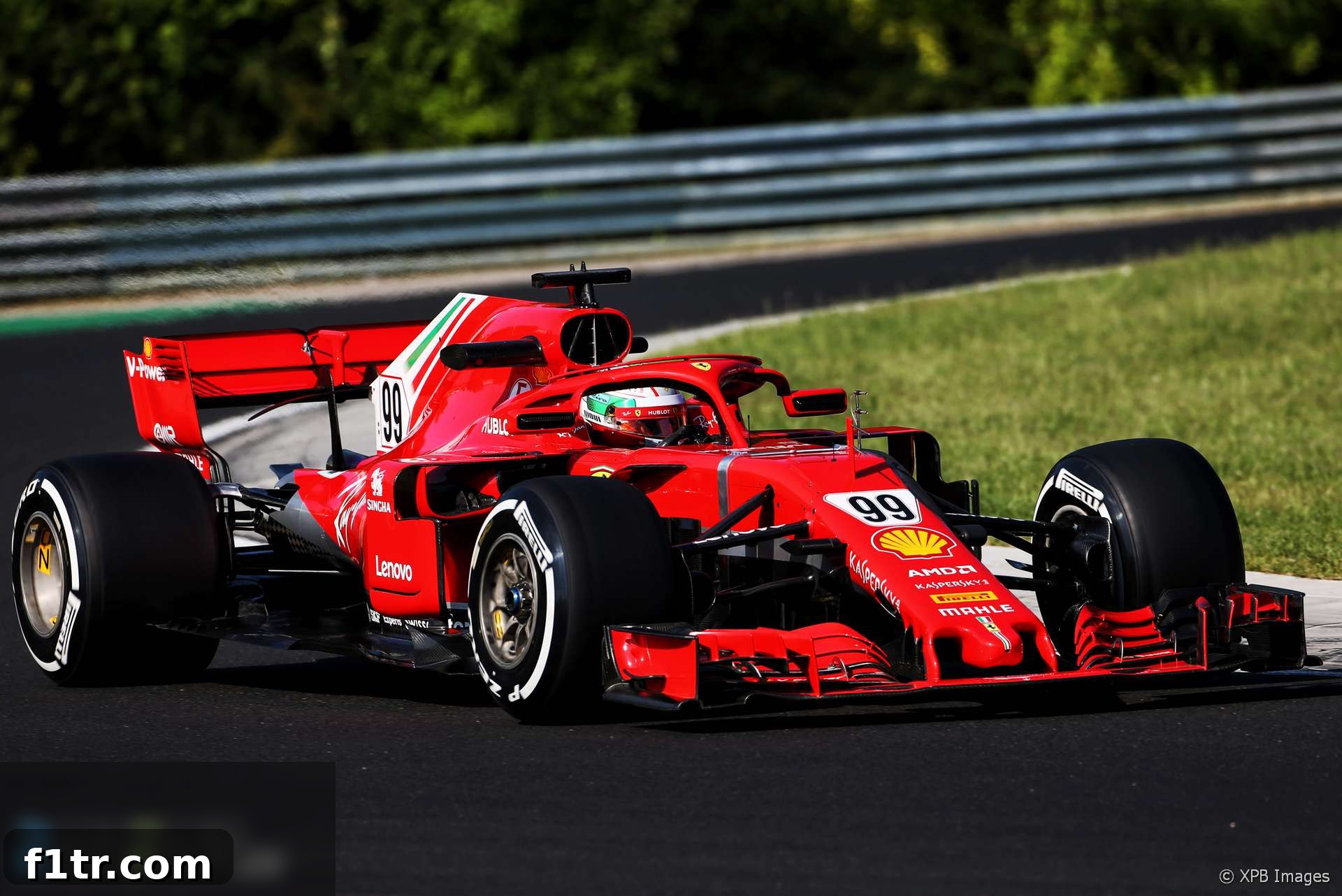
Giovinazzi Lights Up Hungaroring: Ferrari Paces Day One of F1 Testing with Record Lap
The Hungarian Grand Prix circuit, a staple of the Formula 1 calendar, once again played host to high-octane action, though this time away from the glare of a race weekend. Day one of the crucial mid-season F1 test at the Hungaroring saw Antonio Giovinazzi deliver a sensational performance for Ferrari, topping the time sheets by a significant margin. The Italian reserve driver not only led the day but also etched his name into the circuit’s history books, setting the fastest recorded lap to date, underscoring Ferrari’s development prowess and Giovinazzi’s undeniable talent.
Giovinazzi’s Blistering Pace: A New Hungaroring Benchmark
Giovinazzi’s remarkable lap of 1’15.648 was a true highlight of the day. This blistering pace wasn’t just fast; it was over half a second quicker than the best time achieved during the preceding Hungarian Grand Prix weekend. Piloting the formidable Ferrari SF71H, Giovinazzi’s performance demonstrated the raw speed potential of the Maranello machine and the capabilities of the driver behind the wheel. The lap was achieved on Pirelli’s hyper-soft tyres, a compound not allocated for the race weekend, which undoubtedly contributed to the exceptional time. While testing conditions often differ from race conditions – with teams often chasing ultimate pace rather than long-run consistency – Giovinazzi’s 2.5-second advantage over his closest competitor, Marcus Ericsson in the Sauber, provided a clear statement of intent from Ferrari.
This kind of single-lap speed in testing serves multiple purposes. For Ferrari, it’s an affirmation of their car’s aerodynamic and mechanical efficiency, even on a circuit known for its challenging, twisty nature. For Giovinazzi, it’s a golden opportunity to showcase his talent to team principals and potentially secure a full-time F1 seat in the future. His comprehensive program involved a substantial 96 laps, indicating Ferrari was not just seeking headline-grabbing times but also gathering extensive data on various setups and components.
Incidents and the Unpredictable Hungarian Weather
The day was not without its dramas, highlighting the inherent risks and challenges of Formula 1 testing. A red flag brought proceedings to a halt when Sean Gelael, undertaking crucial tyre testing for Pirelli with Toro Rosso, suffered a crash. While details of the incident were limited, any track stoppage can significantly impact a team’s testing schedule, particularly when vital tyre data is being collected for future seasons. Gelael’s extensive lap count of 109 laps, despite the incident, suggests he was able to return to the track after repairs or a car change, continuing Pirelli’s important development work.
Adding another layer of complexity to the day’s operations was the weather. Rain began to fall during the afternoon session, drastically changing track conditions. For many teams focused on performance runs and specific aerodynamic evaluations, the wet track was a setback, preventing them from completing their dry-weather programmes. However, the capricious nature of the weather also presented a unique opportunity. Several teams capitalised on the rain, adapting their plans to conduct valuable running on a wet track. This often overlooked aspect of testing allows teams to fine-tune wet weather setups, evaluate tyre performance in intermediate and full-wet conditions, and gather critical data that could prove invaluable during a rain-affected Grand Prix weekend.
Gearing Up for 2019: Early Development Takes Center Stage
Mid-season tests are not solely about current performance; they are also a crucial battleground for future development. With new technical regulations looming for the 2019 F1 season, several teams dedicated significant track time to evaluating early versions of next year’s components.
Both Force India and Williams were observed running development versions of front wings designed to meet the upcoming regulations. The 2019 rules aim to simplify front wing designs, reducing their aerodynamic complexity with the goal of improving racing by making it easier for cars to follow one another. Testing these early concepts is vital for understanding their real-world impact on airflow, downforce, and overall car balance. This data allows engineers to refine designs long before the final car homologation, potentially gaining a critical advantage over competitors.
Red Bull also committed a substantial portion of their test schedule to 2019 development items. The Austrian team, known for its innovative aerodynamic solutions, would be intensely focused on how the new regulations will impact their design philosophy. Like all participating teams, Red Bull also had access to Pirelli’s development tyres for next season. This collaboration with the sole tyre supplier is paramount, as understanding the characteristics of future tyre compounds is as critical as developing the car itself. Driver feedback on these prototypes helps Pirelli fine-tune their construction and compounds, ensuring the tyres provide the performance and durability expected in the coming season.
Meanwhile, Mercedes suffered a rare setback. Formula Two championship leader George Russell, a highly-touted prospect, endured a significant portion of his test confined to the pit garage due to an unspecified technical problem. This lost track time is a major blow for both Russell, who was looking to gain valuable F1 experience, and Mercedes, who would have had a specific test program for him. In the hyper-competitive world of F1, every minute on track is precious for development and driver evaluation.
It’s worth noting that Haas elected not to participate in this week’s test, likely preferring to focus their resources on preparing for upcoming races or on factory-based development rather than track testing. This strategic decision highlights the diverse approaches teams take to resource allocation throughout a demanding F1 season.
Day 1 Unofficial Test Times – Hungaroring
| Pos. | Car number | Driver | Team | Model | Best time | Gap | Laps |
|---|---|---|---|---|---|---|---|
| 1 | 99 | Antonio Giovinazzi | Ferrari | SF71H | 1’15.648 | 96 | |
| 2 | 9 | Marcus Ericsson | Sauber | C37 | 1’18.155 | 2.507 | 95 |
| 3 | 28 | Brendon Hartley | Toro Rosso | STR13 | 1’19.251 | 3.603 | 126 |
| 4 | 47 | Lando Norris | McLaren | MCL33 | 1’19.294 | 3.646 | 107 |
| 5 | 63 | George Russell | Mercedes | W09 | 1’19.781 | 4.133 | 49 |
| 6 | 3 | Daniel Ricciardo | Red Bull | RB14 | 1’19.854 | 4.206 | 125 |
| 7 | 34 | Nicholas Latifi | Force India | VJM11 | 1’19.994 | 4.346 | 103 |
| 8 | 27 | Nico Hulkenberg | Renault | RS18 | 1’20.826 | 5.178 | 63 |
| 9 | 41 | Oliver Rowland | Williams | FW41 | 1’20.970 | 5.322 | 65 |
| 10 | 28 | Sean Gelael | Toro Rosso | STR13 | 1’21.451 | 5.803 | 109 |
The leaderboard from Day 1 showcases a mixed bag of drivers, from established race winners like Daniel Ricciardo to rising young talents such as Lando Norris and George Russell. The gaps between teams can be deceptive in testing, as each team operates on different fuel loads, tyre compounds, and test programs. Giovinazzi’s lead, while significant, should be viewed in the context of Ferrari likely chasing a headline lap, whereas other teams might have been focusing on long-run data or specific component evaluations. Nevertheless, the sheer pace demonstrated by the Ferrari and its young driver is an exciting prospect for the sport.
Conclusion: A Productive Start to Crucial Testing
Day one of the Hungaroring F1 test proved to be a multifaceted affair, blending headline-grabbing speed with diligent development work. Antonio Giovinazzi’s record-breaking lap for Ferrari was undoubtedly the standout performance, but the real story lies in the intensive preparations being undertaken by teams for both the remainder of the current season and the challenges of 2019. From evaluating new aerodynamic regulations to comprehensive Pirelli tyre testing and providing invaluable track time for young drivers, these mid-season sessions are critical to the relentless pursuit of performance in Formula 1. With another day of testing ahead, teams will be eager to maximise their track time, rain or shine, to gather every last bit of data that could contribute to future success.
Related Articles: 2018 F1 Season Insights
- F1 feared “death knell” for Drive to Survive after Ferrari and Mercedes snub
- McLaren staff told us we were “totally crazy” to take Honda engines in 2018 – Tost
- ‘It doesn’t matter if we start last’: How Red Bull’s junior team aided Honda’s leap forward
- Honda’s jet division helped F1 engineers solve power unit problem
- McLaren Racing losses rise after Honda split
Browse all 2018 F1 season articles