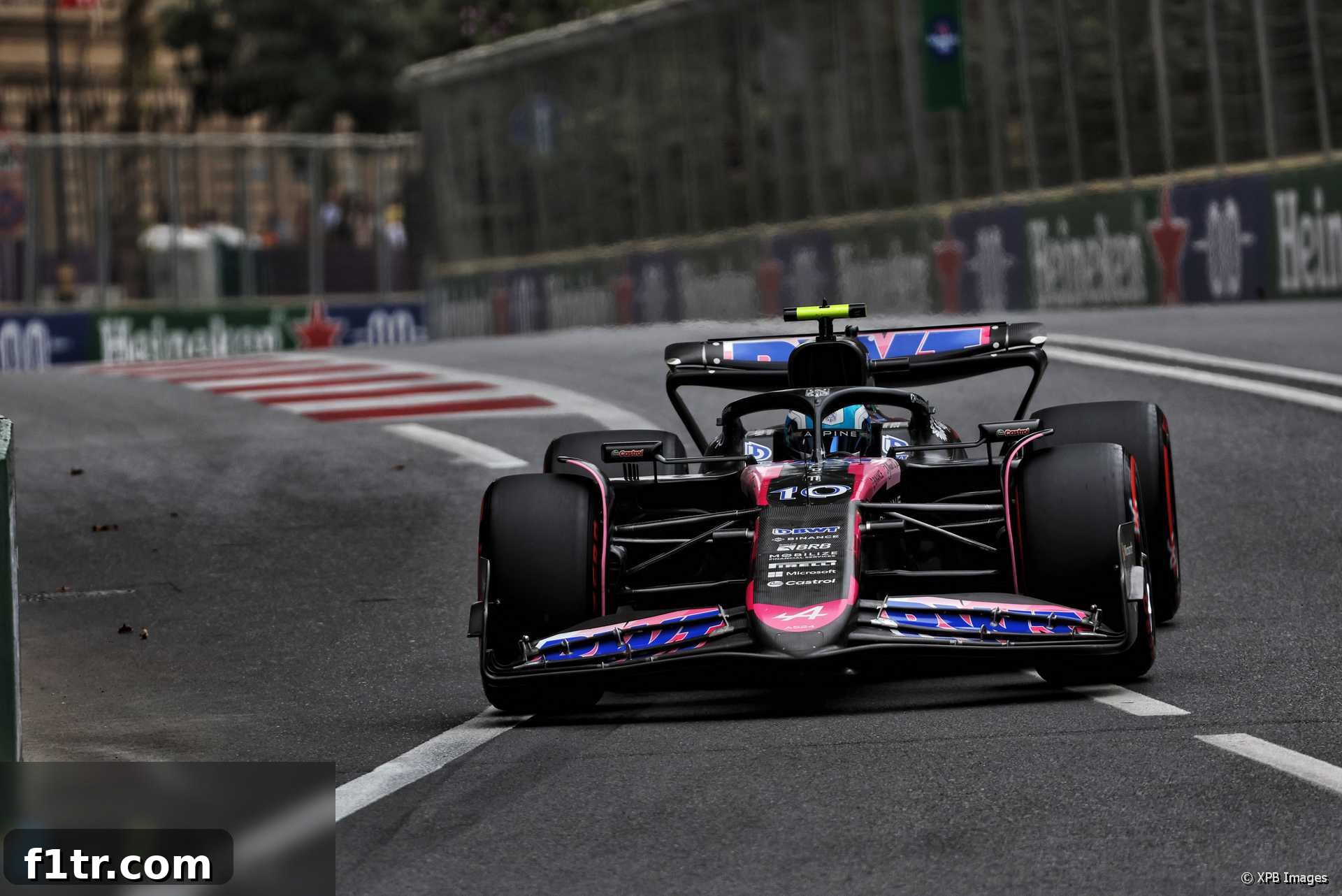
In a significant turn of events that has sent ripples through the Formula 1 paddock, Alpine driver Pierre Gasly has been disqualified from the results of today’s qualifying session. The decision, handed down by the FIA stewards, came after his car was found to be in direct breach of the technical regulations governing instantaneous fuel mass flow. This ruling casts a shadow over Alpine’s weekend, forcing their lead driver to start the race from the very back of the grid, a considerable setback in their pursuit of valuable championship points.
The core of the infringement lies in the sophisticated and tightly controlled fuel systems mandated in modern Formula 1. Teams are strictly prohibited from pumping fuel into their engines at a rate exceeding 100 kilograms per hour. During Gasly’s final flying lap in the second qualifying segment (Q2), telemetry data revealed that his Alpine A524 momentarily surpassed this critical threshold. Gasly, who had shown promising pace to be the only Alpine driver to progress beyond Q1, now faces the daunting task of navigating the field from the rear.
While the disqualification is a severe penalty, the stewards have granted Gasly permission to start the race. He will join Zhou Guanyu, who also faces a back-of-the-grid start due to exceeding his maximum allocation of power unit components. This dual penalty underscores the unforgiving nature of Formula 1 regulations, where even seemingly minor technical deviations can have profound consequences for a driver’s weekend.
Understanding Formula 1’s Stringent Fuel Flow Regulations
The 100 kg/hour instantaneous fuel mass flow limit is one of the most crucial technical regulations in modern Formula 1, introduced primarily to manage engine performance, promote fuel efficiency, and level the playing field in the hybrid era. This regulation is rigorously monitored by the FIA through highly sensitive sensors integrated into each car’s fuel system. These sensors provide real-time data, ensuring compliance at every millisecond of a session.
The reason for such a precise limit is multifaceted. Firstly, it prevents teams from gaining an unfair performance advantage by briefly over-fuelling the engine for bursts of power, particularly during crucial moments like qualifying laps or overtakes. Secondly, it is a cornerstone of the sport’s commitment to efficiency and sustainability, compelling manufacturers to design and develop engines that can deliver maximum power within strict fuel consumption parameters. The “instantaneous” nature of the limit is particularly important; it means that even a fleeting spike above 100 kg/hour, regardless of its duration or impact on overall fuel consumption, constitutes a breach.
Historically, fuel regulations have been a hotbed of innovation and, at times, controversy. The FIA constantly updates its technical directives to close loopholes and ensure absolute adherence. The strictness around fuel flow is a testament to the sport’s desire for fair competition, where engineering prowess is tested within clearly defined boundaries, rather than through exploitative interpretations of the rules. Any deviation, no matter how small or unintentional, is treated with utmost seriousness, safeguarding the integrity of the technical regulations that form the backbone of Formula 1.
The Incident: Alpine’s Technical Fault and the FIA’s Findings
The infringement that led to Pierre Gasly’s disqualification occurred during the high-stakes environment of Q2, specifically on his crucial final flying lap. This is the moment when drivers push their cars and engines to their absolute limits in pursuit of a faster lap time. It was during this intense period that Alpine’s A524 experienced a technical anomaly, causing the fuel mass flow to momentarily exceed the permitted 100 kg/hour limit.
Following the session, Alpine team representatives were summoned by the stewards to explain the breach. They presented their case, attributing the incident to an “unexpected short duration technical fault” that caused the fuel mass flow to spike “greater than expected in a transient fashion.” Crucially, this explanation resonated with the FIA’s technical staff, who agreed with Alpine’s assessment of the cause. This indicates that while a breach occurred, it was not the result of a deliberate attempt to gain an advantage or a fundamental flaw in the car’s design, but rather a momentary system glitch.
Despite the agreed-upon technical fault, the fact of the infringement remained undisputed by the competitor. Alpine acknowledged that the fuel mass flow was indeed above the legal limit at that specific moment. This distinction is vital in F1 regulations: the reason for a breach, while potentially a mitigating factor in some sporting penalties, often does not negate the breach itself when it comes to technical non-compliance. The incident highlights the incredible complexity of modern F1 machinery, where a minor, transient electrical or mechanical fault can immediately trigger a technical rule violation, even when teams operate with the utmost diligence.
Alpine’s Mitigation Arguments and the Stewards’ Unwavering Stance
During the stewards’ hearing, Alpine presented a compelling case for mitigation, arguing that the circumstances surrounding the fuel flow breach warranted a more lenient approach than outright disqualification. Their primary argument was that the technical fault, far from providing a performance benefit, actually resulted in a slower lap time for Pierre Gasly. They were able to demonstrate to the stewards that no performance advantage was obtained at that critical moment, and, in fact, the car’s performance was negatively affected by the anomaly. This forms the basis of many appeals in motorsport – demonstrating a lack of intent or benefit.
Furthermore, Alpine emphasized the rarity of such breaches, stating that it was not part of their strategy and that the scale of the transient spike simply exceeded the safety margin they typically maintain to prevent such infringements. They positioned the incident as an unfortunate, isolated technical glitch rather than a systemic issue or an attempt to circumvent regulations. These arguments aimed to convey good faith and accidental non-compliance, hoping to sway the stewards towards a less severe penalty.
However, the stewards’ decision highlighted the uncompromising nature of Formula 1’s technical regulations. They pointed to Article 1.3.3 of the International Sporting Code, a foundational principle in motorsport, which explicitly states: “If an Automobile is found not to comply with the applicable technical regulations, it shall be no defence to claim that no performance advantage was obtained.” This article establishes a strict liability standard; if the car is non-compliant, the penalty stands, regardless of intent or benefit. This position has been consistently upheld by the International Court of Appeal over many years, creating a clear precedent. Therefore, despite Alpine’s credible explanations and demonstration of no performance gain, the stewards had little choice but to apply the “usual penalty” for a breach of technical regulations: disqualification from the qualifying classification. This strict interpretation reinforces the FIA’s commitment to maintaining a level playing field, where the technical integrity of every car is paramount.
Gasly’s Reaction and the Road Ahead from the Back of the Grid
Prior to the announcement of his disqualification, Pierre Gasly had expressed a sense of positive surprise regarding his qualifying performance, having secured 13th position. Speaking to the official F1 channel, he revealed, “We expected to be 17th and 18th after free practice,” underscoring the challenging nature of the weekend for Alpine and highlighting his own efforts to extract more performance from the car than anticipated. This initial optimism, however, was short-lived as the news of the fuel flow infringement emerged.
Upon learning of his disqualification, Gasly conveyed his disappointment but also demonstrated a professional understanding of the rules. “It is obviously a pity that a minor fuel flow infringement means we are disqualified from the session,” he later commented. He reiterated the struggles Alpine had faced throughout the weekend, describing the car as “tricky all weekend” and noting a general lack of rear grip and excessive sliding. Despite these handling difficulties, Gasly took pride in his performance behind the wheel: “I was very pleased with my laps in qualifying and, even if the result doesn’t look spectacular, it was one of our most complete sessions of the season.” His ability to improve the car’s balance with some changes and push it to P13, even with underlying issues, showcased his driving skill and determination.
Now facing a start from the back of the grid, Gasly’s focus immediately shifted to race strategy. “We will have to stay calm in the race tomorrow and aim to be in the mix at the end,” he stated. He acknowledged the inherent challenges of the circuit for racing, noting, “It’s usually a tough one here for racing and a lot can happen so we will give it our all from the back.” Starting from the rear demands a different approach, requiring careful management of tires, opportunistic overtaking, and often, a degree of luck with safety cars or incidents. For Gasly and Alpine, the race will now be an exercise in damage limitation and a determined effort to salvage any possible points from what has become an unexpectedly difficult weekend.
Broader Implications for Alpine and the FIA’s Stance on Technical Integrity
Pierre Gasly’s disqualification serves as a stark reminder of the uncompromising nature of technical regulations in Formula 1 and carries broader implications for both Alpine and the sport at large. While the immediate consequence is a challenging race day for Gasly starting from the back, the incident also underscores the constant pressure on teams to operate at the absolute limit of performance without ever crossing the line of legality.
For Alpine, this incident, even if caused by a “technical fault,” adds another layer of scrutiny. The team has been working diligently to improve their competitive standing, and such a setback, particularly one that leads to a disqualification, is unwelcome. While the FIA technical staff accepted the team’s explanation of the cause, the principle remains: the car must comply. This incident will undoubtedly lead to an internal review within Alpine to identify the root cause of the transient fuel flow spike and implement robust measures to prevent any recurrence. In a sport where fractions of a second and milligrams of fuel can make a difference, precision engineering and rigorous quality control are non-negotiable.
From the FIA’s perspective, the decision to disqualify Gasly, despite Alpine’s mitigation arguments, reinforces their consistent stance on technical integrity. The governing body maintains a zero-tolerance policy for technical breaches, even unintentional ones, precisely to prevent teams from pushing the boundaries too far or gaining an unfair advantage through subtle design interpretations or transient system anomalies. This adherence to strict liability is crucial for maintaining fair competition and ensuring that all participants operate under the same, clearly defined rules. Precedents from past seasons, where similar technical non-compliances (from floor dimensions to wing flexibility) have led to severe penalties, illustrate the FIA’s unwavering commitment. The integrity of the sport is paramount, and any deviation from the technical rulebook, regardless of its perceived impact on performance or the intent behind it, will be met with the prescribed sanctions. This firm approach ensures that the spectacle of Formula 1 remains a contest of skill, strategy, and engineering within a strictly defined legal framework.
The saga surrounding Pierre Gasly’s disqualification is a potent illustration of the high-stakes environment of Formula 1, where the margins between success and failure, and legality and non-compliance, are incredibly fine. Despite Alpine’s detailed explanation of a transient technical fault and their demonstration that no performance advantage was gained, the FIA’s unwavering application of its technical regulations led to the inevitable consequence: disqualification from qualifying. As Gasly prepares to tackle the race from the back of the grid, his challenge will be immense, yet it also presents an opportunity for a fighting recovery drive. This incident serves as a powerful reminder that in the world of Formula 1, adherence to every rule, no matter how small or technical, is absolute, and the pursuit of performance must always remain within the strict confines of the sport’s comprehensive regulations.