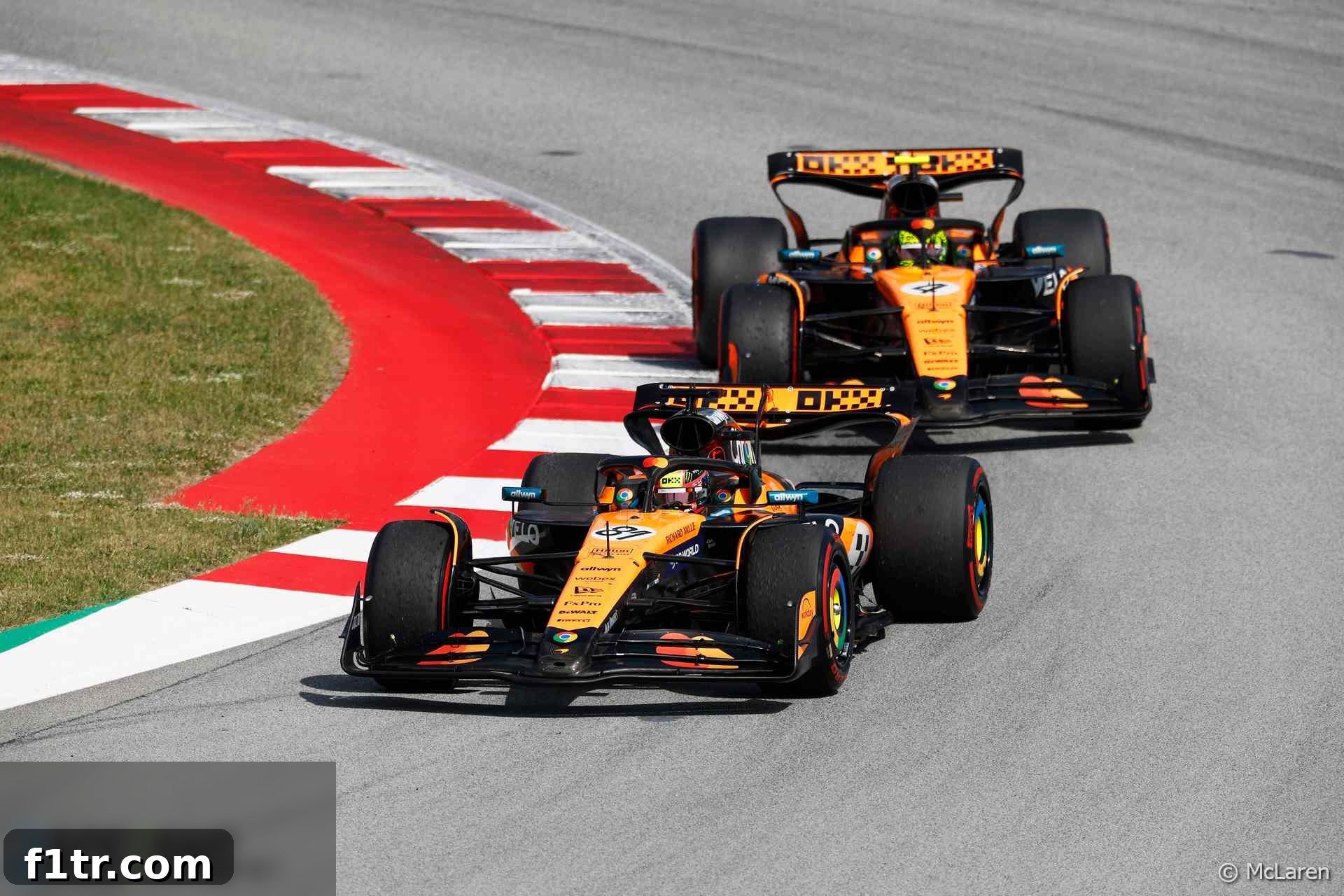
McLaren’s commanding one-two finish at the Spanish Grand Prix has firmly asserted their position at the forefront of Formula 1. This remarkable achievement, with Oscar Piastri leading Lando Norris to a sensational result, underscored the team’s exceptional form and the efficacy of their development trajectory. Lando Norris, speaking after the race at the iconic Circuit de Catalunya, confidently declared that new front wing regulations, introduced just prior to the weekend, had no discernible negative impact on their competitive advantage. This statement served as a direct response to underlying whispers and complaints from rival teams, highlighting McLaren’s robust engineering and adherence to technical guidelines.
Advert | Become a Supporter & go ad-free
The Spanish Grand Prix victory marked McLaren’s third one-two finish of the season, a testament to their consistent performance and the potent synergy between their MCL38 challenger and their talented driver lineup. Piastri and Norris masterfully navigated the race, successfully fending off relentless pressure from Max Verstappen in his Red Bull, showcasing not only raw speed but also strategic brilliance and flawless execution. This strong showing on a technically demanding circuit like Barcelona sends a clear message to the paddock: McLaren is a serious contender for top honors, consistently demonstrating pace and reliability that challenge the established order.
The backdrop to this impressive display was the FIA’s introduction of stricter tests concerning front wing flexibility. These technical directives (TDs) are often implemented to ensure all teams are complying with aerodynamic rules, especially in areas where subtle flexing might provide an illegal performance advantage. Norris didn’t shy away from addressing the context, noting, “There were a lot of complaints about our car, and they introduced this [technical directive] and changed nothing.” This forthright comment not only dismissed any speculation regarding McLaren’s compliance but also subtly highlighted the team’s superior design and engineering. It affirmed that their performance gains were a result of legitimate innovation and meticulous development, not exploits of regulatory loopholes.
Norris further elaborated on the collective effort behind their success, emphasizing the depth of talent within the Woking-based outfit. “The team are doing a very good job,” he stated, acknowledging the competitive landscape of Formula 1. “We have a lot of good competition.” His praise extended to the entire organization: “The team have done a very good job to just give us a good all-round car and the best car on the grid. We’re very proud to be able to go and drive those cars every weekend. So it’s credit to the team that we have to give day-in and day-out.” This sentiment underscores the collaborative spirit and relentless pursuit of excellence that has characterized McLaren’s resurgence. Their commitment to continuous improvement, evidenced by a steady stream of effective upgrades, has transformed them into a championship-caliber team capable of challenging any rival on any circuit.
Advert | Become a RaceFans supporter andgo ad-free
Despite the euphoria of their Spanish triumph and the evident strength of the MCL38, Norris maintains a pragmatic view of the challenges ahead. He acknowledges that McLaren still faces vulnerabilities, particularly in qualifying sessions, where margins are often razor-thin. “There’s still places where we’re vulnerable, especially in qualifying as it gets very close,” he admitted. While the Spanish Grand Prix qualifying saw McLaren secure a significant pole position margin, Norris cautioned against complacency. “Obviously, [Saturday] was the biggest margin of the year, but I think people seem to quickly forget how close the other qualifying sessions have been. They’ve been split by hundredths and thousandths, and there hasn’t been smooth sailing for us in every single one. So, I think that will be the case in future ones.” This keen observation highlights the intense competitive nature of modern Formula 1, where small performance differences can dictate grid positions and, consequently, race outcomes. The pursuit of perfection in every session remains paramount.
Norris’s insights also extended to the evolving dynamics of the competitive field. He believes that McLaren’s rivals have steadily narrowed the performance gap since the early stages of the season. This trend, he suggests, necessitates continued vigilance and unwavering dedication from his team. “It’s clear we have the best car on average and we still seem stronger in the race, though it’s clear that the others are catching up. Our gaps in the race were probably a lot bigger in the beginning of the year than they are now.” This assessment is crucial for McLaren’s strategic planning and development priorities. While their race pace has been a consistent strength, the tightening field means that maintaining this advantage requires constant innovation and diligent refinement of their package.
The F1 season is a relentless technological arms race, and even teams at the pinnacle of performance cannot afford to rest on their laurels. Norris’s warning about competitors catching up serves as a stark reminder of this reality. Teams like Red Bull, Ferrari, and Mercedes are continuously bringing updates and analyzing data to close any performance deficit. The battle for supremacy is often won and lost in the development factories as much as on the track. McLaren’s ability to maintain its “best car on average” status will depend on its capacity to introduce effective upgrades, optimize car setup for diverse circuits, and execute flawless race weekends. “So I do think that our competitors are catching up. But, we just need to keep our heads down and keep working hard,” Norris concluded, encapsulating the team’s forward-looking and determined mindset.
Looking ahead, the remainder of the season promises to be a captivating spectacle. McLaren’s strong performance, validated by victories and consistent podium finishes, positions them as legitimate contenders for both the Drivers’ and Constructors’ Championships. However, the diverse nature of upcoming circuits, each with its unique demands on car performance, aerodynamics, and tire management, will test every team’s adaptability. The technical regulations, particularly those concerning aerodynamics and power units, create a fascinating challenge for engineers, constantly pushing the boundaries of what is possible within the established framework.
The Spanish Grand Prix provided a clear snapshot of McLaren’s current strength and the efficacy of their approach to technical directives. It showcased a team firing on all cylinders, confident in their machinery, and driven by a clear vision for success. While the competition remains fierce and the margin for error minimal, Lando Norris’s measured optimism and recognition of the ongoing development battle signify McLaren’s readiness to meet these challenges head-on. Their journey from a rebuilding phase to a consistent front-running team is a compelling narrative that continues to unfold, promising more thrilling battles and innovative engineering triumphs in the races to come.
Miss nothing from RaceFans
Get a daily email with all our latest stories – and nothing else. No marketing, no ads. Sign up here:
Advert | Become a RaceFans supporter andgo ad-free
Related Articles: 2025 Spanish Grand Prix
- Verstappen: Don’t blame Spanish GP penalty for hitting Russell if I narrowly lose title
- Russell’s radio comments influenced Red Bull’s decision to let him past Verstappen
- Verstappen says he won’t make any changes to his driving to avoid a ban
- ‘No issues’ with Verstappen but ‘it’d be different if he’d taken me out’ – Russell
- Ferrari “don’t want us to talk much” about “massive” Spanish GP problems – Hamilton
Browse all 2025 Spanish Grand Prix articles