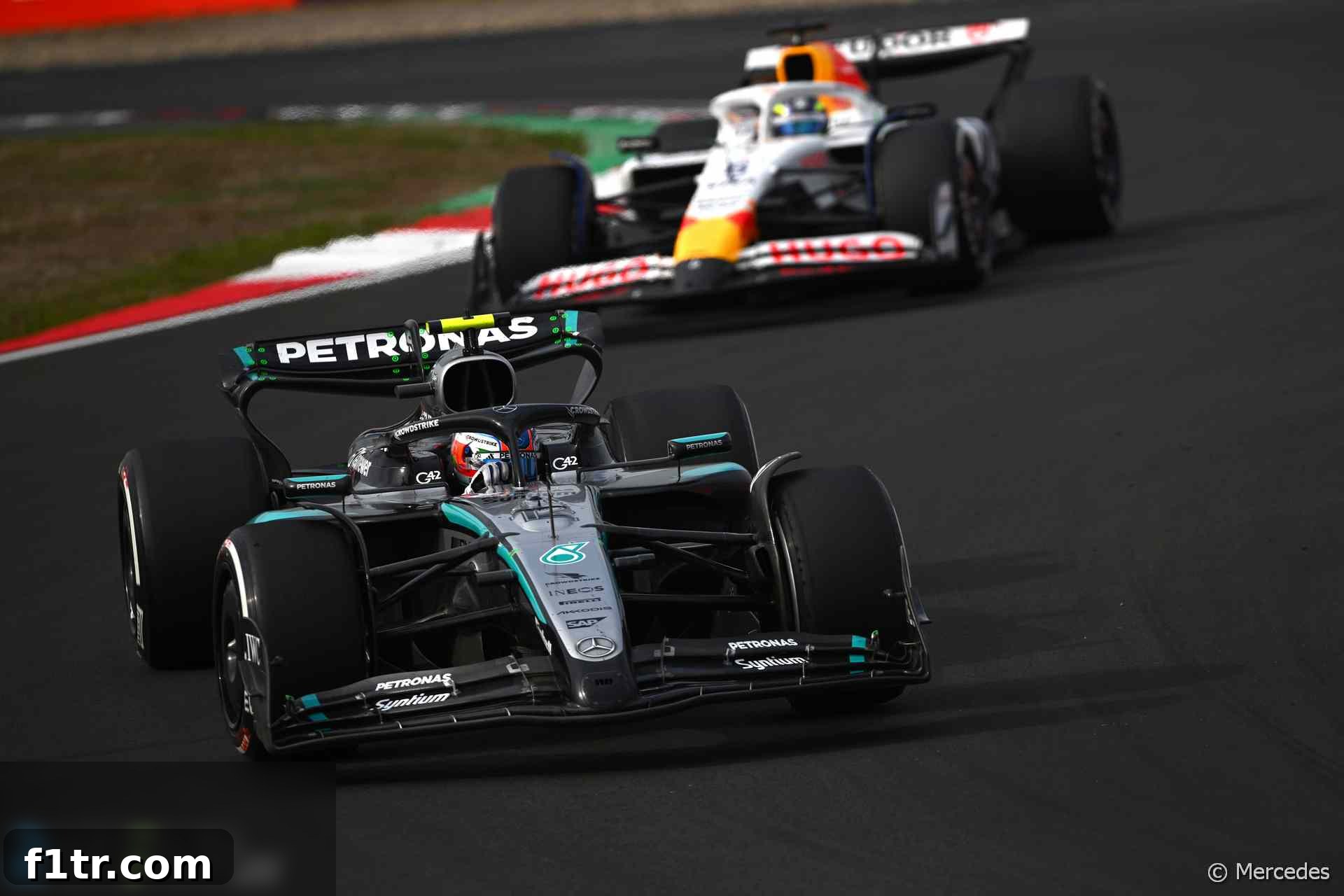
Mercedes Unpacks Severe Impact of Antonelli’s Floor Damage at Chinese Grand Prix
The high-stakes world of Formula 1 often sees races decided not just by driver skill or raw pace, but by unforeseen circumstances and the tiniest margins. Mercedes-AMG Petronas Formula 1 Team recently shed light on one such incident, revealing the profound impact that critical floor damage had on rookie driver Andrea Kimi Antonelli’s performance during the Chinese Grand Prix. This insight underscores the intricate aerodynamic sensitivities of modern F1 machinery and the resilience required from drivers facing unexpected adversity.
The Unavoidable Incident: Debris on Lap 1
The incident unfolded dramatically on the very first lap of the Chinese Grand Prix. Chaos erupted when the Ferrari drivers made contact, leading to debris scattering across the track. Specifically, Charles Leclerc’s car made contact with Lewis Hamilton’s rear tyre, resulting in the breakage of Leclerc’s front wing end plate. This seemingly minor component became a significant hazard for those following closely.
Mercedes’ trackside engineering director, Andrew Shovlin, provided a detailed account of what transpired from the team’s perspective. “What happened was Leclerc had hit Lewis [Hamilton’s] rear tyre and that broke his front wing end plate off,” Shovlin explained in a video released by the team. “Now, Kimi saw that, but he couldn’t avoid it because there were cars either side of him.”
With nowhere to go, Antonelli was forced to drive over the metallic fragments. This unfortunate event led to the debris going underneath his car, causing damage to the delicate yet crucial floor fences. These components, often overlooked by casual observers, are vital to generating the massive downforce that glues F1 cars to the track.
Aerodynamic Devastation: Understanding Floor Damage
In modern Formula 1, the floor of the car is arguably the single most important aerodynamic surface. It generates the vast majority of downforce through what is known as the ‘ground effect.’ The floor, in conjunction with the diffuser, creates a low-pressure area beneath the car, essentially sucking it to the tarmac. Even slight damage to this complex structure can disrupt the meticulously managed airflow, leading to significant performance degradation.
Shovlin confirmed the severity, stating, “So he drove over it and that then went under the car and it damaged the floor fences. And that was costing quite a lot of performance.” Floor fences are vertical elements designed to manage and channel airflow under the car, preventing air from spilling out sideways and maintaining the efficiency of the Venturi tunnels. When these fences are damaged, the carefully optimized airflow patterns are compromised, reducing the ground effect and, consequently, the car’s overall downforce.
The impact of this damage was immediately evident in Antonelli’s lap times. Throughout the race, his pace was consistently several tenths of a second slower than that of his experienced team mate, George Russell. For an F1 car, a deficit of even a few tenths per lap can translate to many seconds over a full race distance, completely altering a driver’s competitive position.
Quantifying the Loss: A Challenging Estimation
Precisely quantifying the performance loss from such an incident is a complex task, especially when it occurs so early in a race. Shovlin elaborated on the difficulties faced by the engineering team. “That [would be] a lot easier to say if you had a number of laps before it happened and then you can look at the loss. But here, when it’s on lap one, you’re having to estimate a bit where he would have been.”
Despite the inherent challenges, Mercedes engineers utilized advanced telemetry and aerodynamic data to make an informed estimate. Their analysis indicated a significant reduction in downforce. “To make that estimation, we can look at the aero data and we could see that we lost something of the order of two to three tenths of a second worth of downforce,” Shovlin revealed.
However, the problem extended beyond a mere reduction in total downforce. The damage did not affect the car uniformly. Instead, it created an imbalance, a far more challenging issue for a driver to contend with. This uneven distribution of aerodynamic force fundamentally altered the car’s handling characteristics.
The Crucial Balance: “No Rear Grip, Mate”
The uneven nature of the downforce loss was quickly communicated by Antonelli himself over the team radio. “You’d have heard Kimi come on the radio relatively early on and say to Bono [race engineer Peter Bonnington], ‘I’ve got no rear grip, mate.’ And what he meant there is that more of the downforce was missing from the rear axle.”
A loss of downforce specifically from the rear axle leads to a significant reduction in rear grip, causing the car to become unstable, particularly in high-speed corners. This manifests as oversteer, where the rear of the car wants to step out more readily. When the rear tyres slide excessively, they quickly overheat, further diminishing their grip and accelerating their degradation. This creates a vicious cycle that makes consistent driving incredibly difficult.
Such an imbalance forces a driver to constantly wrestle with the car, adapting their driving style and lines to compensate for the unpredictable handling. While adjustments can be made during a pit stop, such as altering the front wing angle, Shovlin highlighted the limitations: “But the problem is it can cause quite inconsistent effects when you’ve got damage on a car.”
The unpredictable nature of the handling means that the performance loss isn’t a constant two or three tenths. In certain corners, or under specific cross-wind conditions, the effect could be more pronounced, while in others, it might be less. The car’s balance can shift dramatically, making it an ever-evolving challenge for the driver. Despite these immense difficulties, Antonelli’s composure and skill shone through. “He did a good job to deal with that,” Shovlin praised, acknowledging the remarkable effort of the young rookie.
A Missed Opportunity and Valuable Learning
Despite the significant handicap, Antonelli finished the race in eighth position. He was later promoted to sixth place following the disqualification of both Ferrari drivers, a testament to his perseverance and the team’s strategy. However, Shovlin articulated the underlying frustration stemming from the incident.
“It was frustrating because I think from the pace we’d seen with Kimi this weekend, he should have been fighting with Ferraris, with Max,” Shovlin reflected. The expectation was that Antonelli, given his raw speed demonstrated earlier in the weekend, would have been able to challenge the likes of Charles Leclerc, Carlos Sainz, and even Max Verstappen for a higher position, potentially fourth place.
This missed opportunity was not just about championship points but also about the invaluable experience of racing at the sharp end of the grid. For a young driver embarking on his F1 career, battling with established champions offers an unparalleled learning curve. “It would have been great to see him up there. It’s also great for his learning as an F1 driver to be racing at the front,” Shovlin added.
While acknowledging the “bit of bad luck” for Antonelli, Shovlin concluded on a positive note, emphasizing the rookie’s resilient mindset. “But he’s really positive and looking forward to the rest of the season.” This incident, while challenging, has undoubtedly added a crucial chapter to Antonelli’s development as a Formula 1 driver, showcasing his ability to manage adversity and maintain focus under extreme pressure.
Looking Ahead for Andrea Kimi Antonelli and Mercedes
The Chinese Grand Prix served as a stark reminder of the fine margins in Formula 1 and how quickly fortunes can change. For Andrea Kimi Antonelli, it was a baptism of fire, forcing him to adapt and extract performance from a compromised machine. Mercedes’ transparent explanation provides valuable insight into the engineering complexities and the driver’s role in mitigating damage.
As Antonelli continues his rookie season, experiences like these, though frustrating, are instrumental in forging a robust and adaptable driver. His ability to perform admirably despite such a significant aerodynamic handicap bodes well for his future prospects. The team will undoubtedly be analyzing every detail to understand better how to manage such scenarios, while Antonelli’s positive outlook suggests a determined approach to the challenges ahead. The remainder of the season will be keenly watched as this promising young talent continues to navigate the demanding world of Formula 1.
More from the Chinese Grand Prix
- Norris names China and Canada as biggest missed opportunities this year
- Red Bull reassure Verstappen over ‘when we’ll have a winning car again’ in meeting
- Mercedes explain impact of Antonelli’s floor damage on his Chinese GP performance
- “I gave a lot of lap time away in that first stint”: Verstappen’s full Chinese GP radio
- Stats: Chinese Grand Prix saw most disqualifications in an F1 race for 21 years
Browse all 2025 Chinese Grand Prix articles