Pietro Fittipaldi Apologizes After Multi-Car Chaos at Texas Motor Speedway IndyCar Race
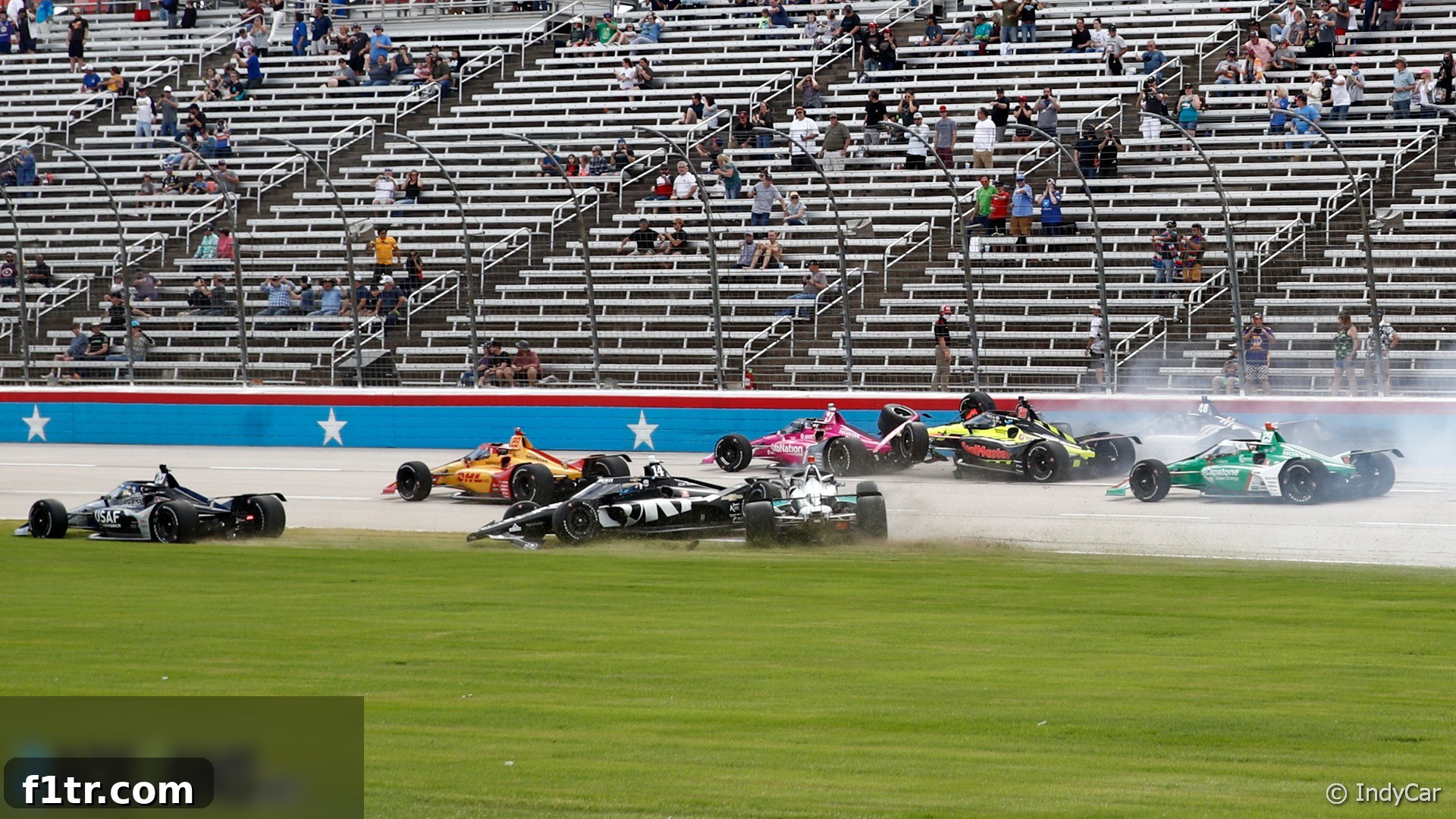
A dramatic and unfortunate start marred today’s NTT IndyCar Series race at Texas Motor Speedway, as a multi-car accident involving six competitors brought out an immediate yellow flag. Rookie driver Pietro Fittipaldi, who was identified as the catalyst for the incident, was quick to issue an apology for the chain reaction that ended the race prematurely for several drivers. The crash highlighted the unforgiving nature of high-speed oval racing and the fine margins that define success and failure in the fiercely competitive championship.
The Unfolding Disaster: A Six-Car Pile-Up on the Opening Lap
The highly anticipated IndyCar event at the challenging Texas Motor Speedway began with immediate and intense drama. As the field roared to life following the start of the race, Pietro Fittipaldi, driving the No. 51 car for Coyne/Rick Ware Racing—a seat he occupies during the series’ oval rounds in place of Romain Grosjean—made contact with the rear of Sebastien Bourdais’ machine. This initial impact, occurring in the tightly packed group of cars, instantly triggered a devastating chain of events.
The incident rapidly escalated as Bourdais’ car was sent spinning, becoming an unpredictable obstacle in the path of oncoming traffic. Among those caught in the ensuing chaos was Alexander Rossi, whose car sustained significant damage, forcing him out of contention. Perhaps the most alarming moment of the crash saw Conor Daly’s car launched into a terrifying series of rolls, showcasing the brutal forces at play in such high-speed collisions. Miraculously, Daly’s car eventually came to a stop upright, and he, along with fellow involved drivers Ed Jones and Dalton Kellet, emerged from their stricken vehicles largely unharmed. While all drivers were cleared with only minor injuries, a testament to the advanced safety features of modern IndyCar chassis and tracks, the collective damage to the cars was substantial, and the race prospects for these six drivers were extinguished within moments of the green flag.
Pietro Fittipaldi’s Account: A Split-Second Decision Gone Wrong
For Pietro Fittipaldi, a promising young driver making only his second start in the championship this season, the incident was a deeply regrettable beginning. Following the crash, a visibly contrite Fittipaldi offered his sincere apologies to the affected drivers and teams, explaining his perspective on how the multi-car accident unfolded. He described a scenario where the cars ahead unexpectedly slowed, leaving him with virtually no room to maneuver or react, particularly given the close quarters of an IndyCar field at speed on an oval.
“The guys ahead of us left a gap so everyone [was] kind of closing up,” Fittipaldi explained, detailing the moments before impact. “Then we got pretty steady. I got a run and I was right behind Seb, within a couple of feet, and then they slowed down. I had nowhere to go.”
He further elaborated on the suddenness of the deceleration and his inability to avoid contact:
“I hit Seb, turned him around and there was a huge accident. I don’t know if the leaders and the middle of the pack they backed up. I got on the brakes, but no time to be able to go anywhere, especially on the outside. I tried but there was nowhere to go really. So it was unfortunate what happened, we had a good car yesterday and wanted to run the whole race here.”
Fittipaldi’s explanation underscores the unique challenges of IndyCar racing on ovals, where drafting and close-pack racing are commonplace. Even the smallest check-up in the front of the field can send ripples through the pack, and with speeds exceeding 200 mph, drivers have only fractions of a second to process information and react. While Fittipaldi took responsibility for his role, his comments highlight the razor-thin margins and the inherent unpredictability that can sometimes lead to such dramatic incidents, particularly at the beginning of a race when drivers are jockeying for position.
Sebastien Bourdais’ Frustration: A Costly Double Blow at Texas
The multi-car incident proved to be a particularly bitter pill for Sebastien Bourdais and his AJ Foyt Racing team. This was the second time in as many days that Bourdais had been eliminated from an IndyCar race due to being hit from behind. Just the previous day, his car suffered extensive damage after an incident involving Josef Newgarden during the first of the two Texas events. This second, consecutive, and equally disheartening early exit compounded the frustration and placed a significant burden on his dedicated crew.
Upon reflection, Bourdais acknowledged Fittipaldi’s apology but didn’t hide his deep disappointment at the repeated misfortune:
“Obviously I didn’t see anything but Pietro apologised for running into the back of us so I’m guessing he just drilled us. There you have it, that’s what set the whole thing in motion.”
While accepting Fittipaldi’s accountability, Bourdais also touched upon the broader context of the field’s behavior, emphasizing the need for drivers to control their cars:
“Clearly it was checking up at the front which at this stage, where we are, we shouldn’t be doing. So I don’t know what was going on at the front. But it’s still not an excuse, same thing as yesterday, when it checks up in front of you, you should be in control of your car and slowing down. It’s a real shame that two days in a row we get drilled and taken out of a race but nothing we can do about it and unfortunately it’s a very expensive couple of days.”
Bourdais’ comments highlight the immense financial and logistical toll such incidents take on a race team. He emphasized the extraordinary efforts of his crew, who had toiled until midnight to meticulously repair his car after yesterday’s damage, only to see their hard work undone before even completing a single green flag lap. The cost of replacing damaged components, the loss of valuable championship points, and the demoralizing effect on team morale are significant challenges that AJ Foyt Racing and the other affected teams now face. The repeated nature of these incidents, particularly when seemingly unavoidable from his perspective, naturally fueled his palpable frustration.
Texas Motor Speedway: A High-Speed Test of Skill and Fortitude
Texas Motor Speedway, often referred to as “The Great American Speedway,” is a formidable 1.5-mile oval located in Fort Worth, Texas. It is renowned for its incredibly high speeds, unique quad-oval layout, and challenging characteristics that demand absolute precision and bravery from IndyCar drivers. The relatively modest banking in certain sections, combined with the immense speeds, often leads to intense, multi-groove racing where cars run in incredibly close proximity. This creates a thrilling spectacle for fans but simultaneously elevates the risk factor for competitors.
The nature of restarts and opening laps on such an oval is inherently fraught with peril. Drivers are aggressively jostling for position, the field is tightly condensed, and the aero wash from multiple cars makes handling difficult. These conditions create a volatile environment where even the slightest error in judgment or an unexpected slowdown can trigger a massive accident. The incident involving Fittipaldi and Bourdais serves as a stark reminder of these inherent dangers and the extraordinary skill, vigilance, and instantaneous decision-making required from every competitor in the NTT IndyCar Series.
Implications for the Drivers and the NTT IndyCar Series Season
For Pietro Fittipaldi, this multi-car crash represents a challenging setback in his limited IndyCar schedule. While his swift apology was commendable, such incidents invariably draw significant scrutiny, particularly for a driver striving to establish a foothold in a championship as competitive as IndyCar. Filling in for the injured Romain Grosjean on oval tracks places him under an additional spotlight, where every performance is critical for his future prospects. Gaining valuable experience, demonstrating consistent pace, and maintaining clean driving are paramount, making this early-race exit a significant blow to his momentum and learning curve.
Sebastien Bourdais, a seasoned veteran with a wealth of experience and multiple victories, faces a different, yet equally frustrating, challenge. Two consecutive DNFs (Did Not Finish) due to circumstances beyond his control not only severely hinder his championship standings but also place a considerable financial and emotional burden on his team, AJ Foyt Racing. The financial implications of repairing two extensively damaged cars in such a short span are substantial for any team, particularly those operating on tighter budgets. Bourdais’ raw frustration is entirely understandable, as these incidents have robbed him of opportunities to showcase his talent and fight for strong results, undermining the team’s hard work and investment.
For Alexander Rossi, Conor Daly, Ed Jones, and Dalton Kellet, the impact of the crash is equally detrimental. Valuable championship points are lost, cars require extensive and costly repairs, and the psychological hurdle of recovering from an early exit in a contact-heavy race can be significant. This incident vividly underscores the unforgiving nature of IndyCar racing, where a season’s trajectory can be dramatically altered by events that unfold in mere seconds, often outside a driver’s immediate control.
The Culture of Apologies and Sportsmanship in Motorsport
Pietro Fittipaldi’s immediate apology is a deeply ingrained and respected aspect of motorsport culture. In a high-stakes, high-pressure environment where emotions run high and careers are on the line, taking responsibility for an on-track incident, even when perceived to be partly influenced by external factors, is a significant gesture of good sportsmanship. Such apologies help to defuse tension, maintain professionalism, and foster mutual respect among competitors. While Sebastien Bourdais clearly felt the sting of repeated misfortune, his acknowledgment of Fittipaldi’s apology underscores this crucial element of racing etiquette, balancing intense competition with underlying camaraderie and respect.
Looking Ahead: Resilience and the Road to Recovery
As the NTT IndyCar Series season continues, all eyes will be on these affected drivers and their respective teams to observe how they rebound from this costly incident. The resilience and dedication of race teams, particularly the mechanics and engineers who work tirelessly behind the scenes, will be thoroughly tested in the coming weeks. For Pietro Fittipaldi, the focus will undoubtedly be on learning from this experience, refining his racecraft, and demonstrating clean, fast, and consistent driving in his subsequent appearances on the oval tracks. For Sebastien Bourdais and the other drivers caught in the incident, the immediate goal will be to put the frustration behind them, rebuild their equipment, and return to the track with renewed determination. Their aim will be to recover lost championship ground and secure the strong results they know they are capable of achieving, proving their mettle in the face of adversity.
NTT IndyCar Series: Where Every Race is a High-Stakes Battle
The NTT IndyCar Series proudly stands as one of the world’s premier open-wheel racing championships, globally celebrated for its incredibly diverse calendar that encompasses thrilling street circuits, challenging road courses, and iconic high-speed ovals like Texas Motor Speedway. The series is renowned for its intense and unparalleled competitiveness, where race victories are frequently decided by mere fractions of a second, and a multitude of drivers are consistently in contention for top honors. This unrelenting level of competition, while undeniably thrilling for fans worldwide, also contributes directly to the high-pressure environment where unfortunate incidents, such as the multi-car crash at Texas Motor Speedway, can regrettably occur. Drivers are constantly pushing the absolute limits of their machines and their own abilities, meaning the margin for error is consistently minuscule, making every race a true and demanding test of skill, courage, strategy, and mental fortitude.
Explore More IndyCar News and Features
Stay comprehensively updated with the very latest developments, captivating stories, and in-depth analysis from the dynamic world of NTT IndyCar Series racing. Delve into our extensive archives to discover detailed race reports, exclusive driver interviews, insightful technical features, and much more.
- IndyCar driver McLaughlin cleared of injury after crashing through barrier at Barber
- Schumacher says his IndyCar feels like ‘an F2 car, just with better tyres’
- IndyCar “way faster than Formula 1” in some corners, says Grosjean
- FIA to award more F1 superlicence points to IndyCar drivers from 2026
- Schumacher to race full-time in IndyCar with RLL in 2026
Browse all IndyCar articles