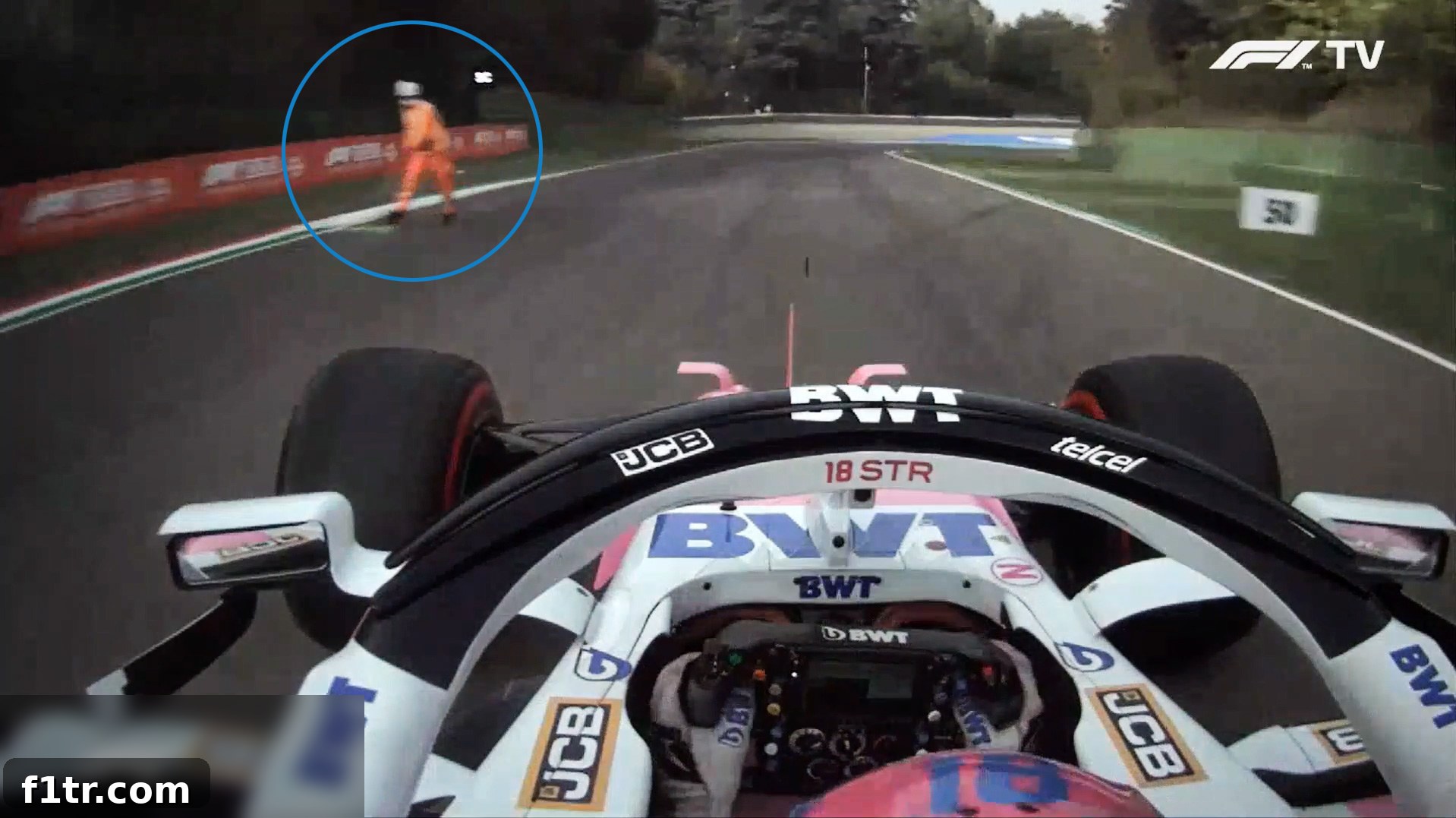
The global motorsport community is once again scrutinizing Formula 1’s safety protocols following a concerning incident during the Emilia Romagna Grand Prix at Imola. Sunday’s race saw several drivers, operating under Safety Car conditions, come perilously close to a group of marshals working trackside. This near-miss has prompted the sport’s governing body, the Fédération Internationale de l’Automobile (FIA), to launch a comprehensive review of existing race procedures to ensure the utmost safety for trackside officials, highlighting the FIA’s unwavering commitment to safety in all aspects of motorsport.
The incident unfolded during a critical phase of the race. Following an on-track incident, the Safety Car was deployed, a standard procedure designed to neutralize the race and allow for debris removal or vehicle recovery. During this period, six drivers—Kimi Raikkonen, Antonio Giovinazzi, Nicholas Latifi, Romain Grosjean, Sebastian Vettel, and Lance Stroll—were released from behind the Safety Car to unlap themselves and rejoin the back of the leading pack. As these drivers accelerated to catch up, they encountered a group of approximately three marshals positioned on or very near the edge of the track, specifically in the approach to the challenging Acqua Minerale section of the circuit. The proximity was alarming, raising immediate concerns about the safety of these essential trackside personnel.
Both Romain Grosjean and Sebastian Vettel, experienced veterans of Formula 1, voiced their immediate apprehension over team radio. Their messages unequivocally described the situation as “dangerous,” underscoring the severity of the perceived risk. Video footage of the incident further compounded these concerns, particularly highlighting Lance Stroll’s passage. As the last of the six drivers to navigate past the marshals, Stroll appeared to do so at a noticeably higher speed compared to the preceding five drivers, intensifying the scrutiny on the incident and the procedural gaps it exposed. Such scenarios, while rare, serve as potent reminders of the inherent dangers that persist in motorsport, particularly when human elements and high-speed machinery intersect under dynamic race conditions.
In response to the growing concerns and the detailed reports of the incident, the FIA has issued a statement confirming that Formula 1 race control is actively evaluating the necessary course of action. The statement, conveyed to major motorsport media outlets, emphasized the FIA’s foundational principle regarding safety: “The safety of the marshals and trackside officials is of the highest priority for the FIA.” This commitment is not merely rhetorical but reflects decades of continuous effort and investment in enhancing safety standards across all FIA-sanctioned events. The governing body affirmed that “Race control was made aware of the issue and is evaluating whether any changes can be made to the procedures currently in place to further protect the marshals and officials and minimise the likelihood of a reoccurrence in the future.” This proactive approach signals a serious intent to not just address the immediate incident but to implement systemic improvements.
This incident at Imola, while specific in its details, is not entirely unprecedented in recent Formula 1 history. A strikingly similar situation arose during a Safety Car period at the prestigious Monaco Grand Prix just last year. In that instance, Sergio Perez narrowly avoided colliding with a pair of marshals after exiting the pit lane. The FIA’s response at the time was primarily focused on reminding marshals about strict protocols: “The FIA responded by issuing a reminder to marshals not to enter a track without the permission of race control.” While that directive was crucial for marshal conduct, the Imola incident suggests a need to also re-examine the procedures that dictate when and how cars are permitted to unlap themselves, especially in areas where trackside personnel might still be present. The evolution from issuing a reminder to marshals to now evaluating broader procedural changes highlights a progressive understanding of shared responsibility for safety.
Understanding the Vital Role of Marshals in Motorsport
Marshals are the unsung heroes of motorsport, forming the backbone of safety and operational efficiency at every race circuit worldwide. These dedicated volunteers provide an invaluable service, often under challenging and dangerous conditions, making the execution of any race meeting possible. Their responsibilities are diverse and critical, ranging from waving essential warning flags to drivers, indicating hazards such as debris or stranded vehicles, to assisting with recovery operations, firefighting, and basic first aid. Without their presence, races simply could not be run safely or effectively. The moments when marshals are on track, actively working to clear hazards or assist in an incident, are arguably the most vulnerable for these individuals. It is precisely during these critical windows that the procedural safeguards must be absolutely watertight, ensuring that high-speed machinery and human lives are never unnecessarily put at risk simultaneously. The commitment of these individuals, often working for passion rather than profit, underscores the moral imperative for the FIA and race organizers to prioritize their safety above all else, embedding robust protocols that anticipate and mitigate all foreseeable risks.
Diving Deeper into Safety Car Procedures and Unlapping
The Safety Car is a fundamental element of modern Formula 1 safety, deployed to neutralize the race when an incident occurs that cannot be safely managed under yellow flags alone. Its primary function is to bunch up the field, allowing marshals to clear debris, recover cars, or repair barriers in a relatively safer environment. Once the track is deemed clear, a specific procedure allows lapped cars to “unlap” themselves. This involves these cars being permitted to pass the Safety Car and the entire field, drive around the circuit at racing speed, and rejoin the back of the queue. The intention behind unlapping is to ensure a fair restart without lapped cars obstructing the leaders, which could otherwise compromise racing and safety dynamics. However, as the Imola incident starkly demonstrated, this procedure carries an inherent risk if the timing and communication are not flawlessly executed. The point at which lapped cars are released often coincides with the final stages of track clearance, meaning marshals might still be completing their duties. The speed differential between the unlapping cars and stationary or slowly moving marshals creates a high-risk scenario that demands meticulous management and clear, unambiguous directives from race control.
Potential Avenues for Procedural Enhancement and Future Safeguards
The FIA’s ongoing evaluation opens the door for significant procedural enhancements that could further fortify marshal safety. Several key areas could be targeted for improvement:
- Refined Communication Protocols: Enhancing real-time communication between Race Control, marshals on the ground, and team strategists is paramount. Advanced radio systems, clear signal protocols, and perhaps even dedicated communication channels for marshal teams could ensure that all parties are instantly aware of the track status and the presence of personnel.
- Stricter Timing for Unlapping: A re-evaluation of when lapped cars are permitted to unlap is critical. Ideally, no cars should be released for unlapping until Race Control has received absolute confirmation that all marshals and their equipment have cleared the track entirely and are safely behind barriers. This might mean a slightly longer Safety Car period, but safety must always trump minor race duration considerations.
- Geofencing and GPS Tracking: Implementing advanced technological solutions such as GPS tracking for marshals and geofencing for hazardous areas could provide Race Control with real-time positional data. This would allow for automated warnings to be issued to drivers if they enter a zone where marshals are present, or conversely, prevent unlapping procedures from commencing if marshals are still detected on track.
- Enhanced Marshal Training and Equipment: While marshals are extensively trained, continuous reinforcement of track awareness, swift exit procedures, and the use of high-visibility personal protective equipment (PPE) is always beneficial. Equipping marshals with personal warning devices or enhanced communication tools could also contribute to their safety.
- Review of Driver Speed During Unlapping: The incident highlighted varying speeds during unlapping. The FIA could explore implementing stricter speed limits for unlapping cars in designated marshal zones, or even mandatory slowing down procedures in specific sectors where marshals are known to operate, regardless of track clearance confirmation.
- Automated Warning Systems for Drivers: Incorporating in-car warning systems that alert drivers to the presence of marshals or specific track conditions could add an additional layer of protection, particularly useful in situations of reduced visibility or high-speed maneuvers.
- Clearer Track Entry and Exit Points for Marshals: Designating and clearly marking safe entry and exit points for marshals, coupled with strict adherence to these points, can minimize unpredictable movements on track.
Formula 1’s Continuous Journey Towards Unparalleled Safety
The incident at Imola, while concerning, serves as another crucial data point in Formula 1’s ongoing and relentless pursuit of unparalleled safety. The sport has an undeniable legacy of tragic accidents, but also a remarkable record of learning from them and implementing revolutionary changes. From the introduction of mandatory HANS devices and the evolution of crash structures, to the controversial yet undeniably effective Halo cockpit protection device, and the continuous advancements in circuit design and barrier technology, F1 has consistently pushed the boundaries of safety. Each incident, including this near-miss with marshals, fuels further innovation and procedural refinement. It underscores the philosophy that safety is not a static state but a dynamic, evolving commitment that requires constant vigilance, adaptation, and proactive measures. The FIA’s swift response and commitment to a thorough review reflect this deep-seated ethos, recognizing that the responsibility for safety extends to every individual involved in the spectacle of Formula 1, from the world champion drivers to the dedicated marshals who volunteer their time and expertise trackside. Ultimately, these reviews are not just about preventing a repeat incident, but about reinforcing the very core values that define modern motorsport: thrilling competition conducted within the safest possible environment for all participants.
Related Reads: Formula 1 Safety and Season Highlights
- Exploring groundbreaking safety innovations in Formula 1 history
- The evolution of marshal safety protocols in top-tier motorsport
- In-depth analysis of Formula 1 Safety Car regulations and their impact
- Key findings from recent FIA safety reviews and their implementations
- Understanding the critical role of track officials in Grand Prix events
Browse all F1 Safety Reviews and related articles