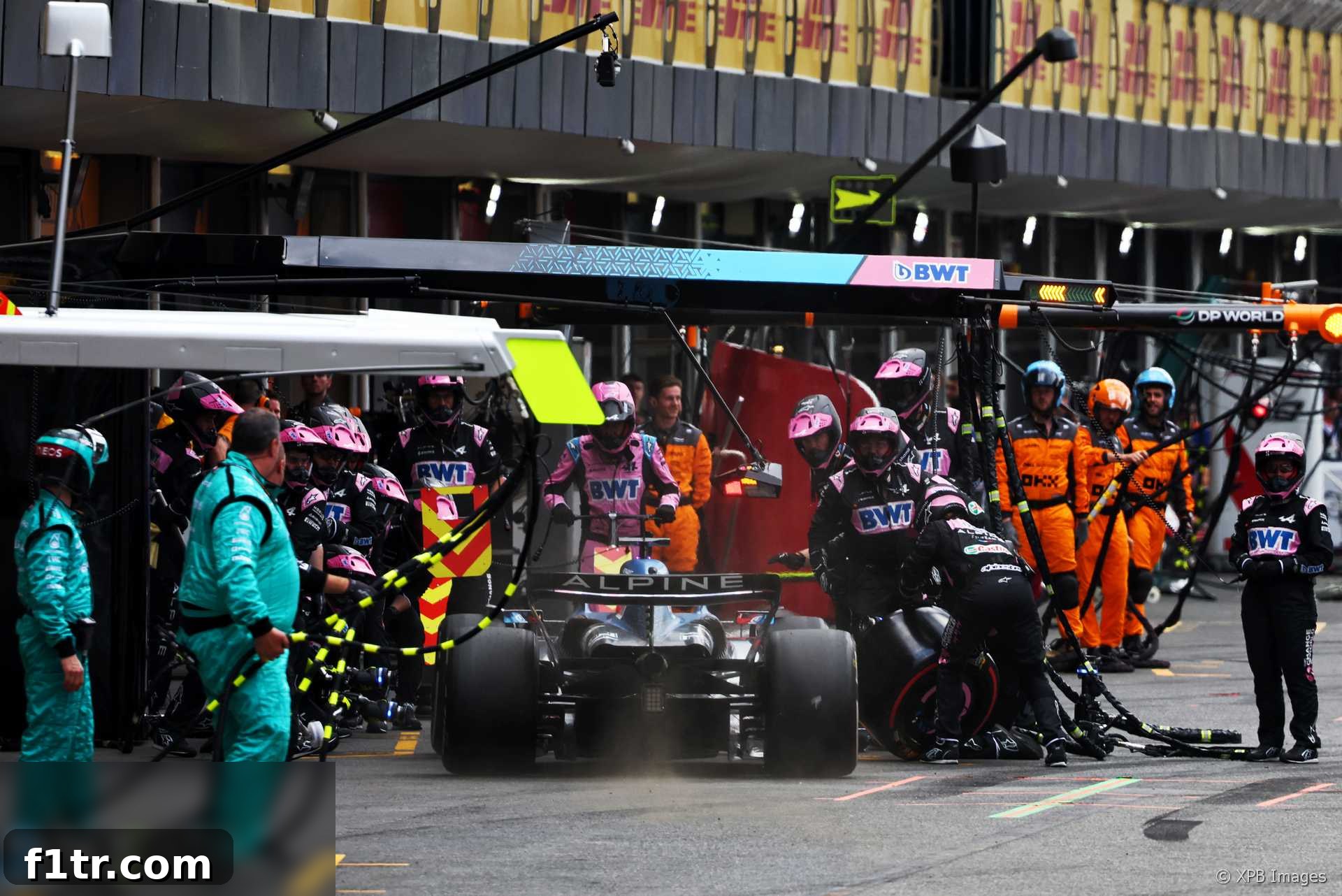
The FIA (Fédération Internationale de l’Automobile) has announced that “immediate steps” will be implemented following a deeply concerning and potentially catastrophic incident in the pit lane during the recent Azerbaijan Grand Prix. The event, which saw Alpine driver Esteban Ocon confront a throng of unauthorized personnel and media as he entered the pits on the very final lap of the race, underscored critical flaws in safety protocols and prompted a swift and thorough review by the sport’s governing body.
The incident unfolded dramatically as Ocon, needing a compulsory late pit stop for fresh tyres, navigated his Alpine A523 into the pit lane. To his astonishment, and to the shock of millions watching worldwide, a large crowd of media representatives and other personnel had already gathered, blocking his path. These individuals were prematurely positioned in anticipation of the traditional parc fermé celebrations and podium ceremony, a routine usually reserved for after all cars have completed their race obligations and the pit lane is officially closed. Fortunately, Ocon’s quick reflexes and powerful braking averted what he himself described as a “big disaster,” preventing any direct contact with the unsuspecting individuals.
The gravity of the situation was not lost on the race stewards, who promptly summoned representatives from the FIA responsible for parc fermé procedures. During the hearing, the FIA officials “expressed their regret at what happened” and gave firm assurances to the stewards that they would undertake “immediate steps” to comprehensively review and revise the existing safety procedures. This review is set to be completed well in advance of the upcoming round of the championship in Miami, emphasizing the urgency with which the FIA is treating this matter.
The stewards’ investigation revealed that “media and other personnel” were granted access to the initial section of the pit lane during the final lap of the race. While acknowledging that “it is not unusual for the representatives to allow such persons into the pit lane just before the end of the race” as part of the preparations for parc fermé and the podium ceremony, they unequivocally stated that “in this case, there was one driver that had to pit in the last lap [Ocon] and this created a very dangerous situation for those that were in the pit lane at the time.” This distinction highlights a critical oversight in communication and timing that nearly led to severe consequences.
Stewards’ Decision and the Imperative of Pit Lane Safety
The Stewards carefully considered the submissions from the FIA representatives and confirmed that the relevant officials had indeed taken measures to establish the parc fermé area. Concurrently, they permitted various media and other personnel to congregate at the start of the pit lane and along the pit wall during the final lap of the race. This occurred while the pit lane remained active and crucially, prior to the final, mandatory pit stop of Esteban Ocon (Car 31).
We noted the precedent that it has not been uncommon for these representatives to grant such access to individuals in the pit lane just before the conclusion of a race, typically in preparation for the parc fermé and subsequent Podium ceremony. However, the unique circumstances of this particular race, with a driver requiring a pit stop on the very last lap, undeniably transformed this customary practice into an exceptionally hazardous scenario for everyone present in the pit lane at that moment. We consider it remarkably fortunate that no serious consequences arose from the events witnessed today. We vehemently underscored that the fundamental requirements for ensuring a safe and orderly event are of paramount importance and must always take precedence above all else.
This critical perspective was acknowledged and accepted by the FIA team. Together, we meticulously reviewed the pertinent procedures and protocols with the FIA representatives in extensive detail. We mandated that they take immediate and decisive steps to re-evaluate and redefine these procedures and protocols in close collaboration with all relevant stakeholders, including Formula One Management (FOM), the competing teams, and the FIA itself, to guarantee with absolute certainty that such a dangerous situation will never recur.
The FIA representatives conveyed their deep regret for the incident and provided us with their unequivocal assurance that these revised protocols would be firmly established and communicated well in advance of the next scheduled event.
The stewards’ findings underscore the delicate balance between logistical efficiency and absolute safety in Formula 1. The pit lane, a hive of intense activity and high-speed maneuvers, is arguably one of the most dangerous areas on any race track. It is precisely for this reason that access is rigorously controlled and procedures are meticulously designed. A Formula 1 car, even at reduced pit lane speeds, carries immense kinetic energy, and a collision with unprotected personnel could lead to catastrophic injuries or fatalities. This incident serves as a stark reminder of the non-negotiable nature of safety in motorsport, especially in an environment where milliseconds and inches can dictate outcomes.
The Critical Importance of Robust Protocols and Communication
The near-miss involving Ocon highlights a critical vulnerability: the potential for miscommunication or misjudgment within an otherwise highly structured environment. While the intention behind allowing media into the pit lane is understandable – to capture the immediate jubilation of victory and the post-race atmosphere – the timing of this access must be impeccably managed. The traditional sight of photographers and camera crews lining the pit wall near the end of a race is a long-standing custom, but this incident proves that such traditions must yield to evolving safety requirements and race-specific scenarios. Modern F1 races are dynamic; unexpected late-race pit stops or safety car periods can dramatically alter the usual flow, making rigid, uncommunicative protocols dangerous.
This incident also raises broader questions about the integration of race control information with parc fermé setup teams. In an era of advanced telemetry and real-time data, ensuring that all relevant personnel are aware of every car’s status and movements, particularly on the final lap, is paramount. The fact that a driver still needing to pit was overlooked in the rush to set up parc fermé points to a systemic breakdown in information sharing. For a sport that prides itself on cutting-edge technology and precision, such an oversight is unacceptable.
Lessons Learned and Future Implications for F1 Safety
The “immediate steps” promised by the FIA will undoubtedly focus on several key areas. Firstly, stricter timing protocols for pit lane access are expected. This could involve a definitive “pit lane closed” signal before any unauthorized personnel are allowed to enter, regardless of the race leader’s position. Secondly, improved communication channels between race control, team strategists, and parc fermé/podium setup teams will be vital. A system where race control can instantly notify all relevant parties about unexpected late-race pit stops or changes in car status is crucial. Thirdly, designated safe zones and clearer demarcation of areas within the pit lane for personnel, separate from the active racing line, may be implemented.
This incident, while alarming, offers a valuable opportunity for Formula 1 to reinforce its commitment to safety, learning from a near-tragedy rather than reacting to an actual one. The collaborative effort involving the FIA, FOM, and the teams is essential to creating comprehensive solutions that are both effective and practical. The sport has an impressive track record of continuous safety improvements, from car design to track layouts, and this challenge, too, will undoubtedly lead to stronger, more resilient protocols. The eyes of the motorsport world will be on Miami, anticipating the concrete changes that will ensure such a dangerous situation never again jeopardizes the safety of drivers or personnel.
The imperative remains clear: the spectacle of Formula 1 must never come at the expense of safety. The Azerbaijan Grand Prix pit lane incident serves as a powerful reminder that vigilance, clear communication, and adaptable protocols are the bedrock upon which the entire sport stands.