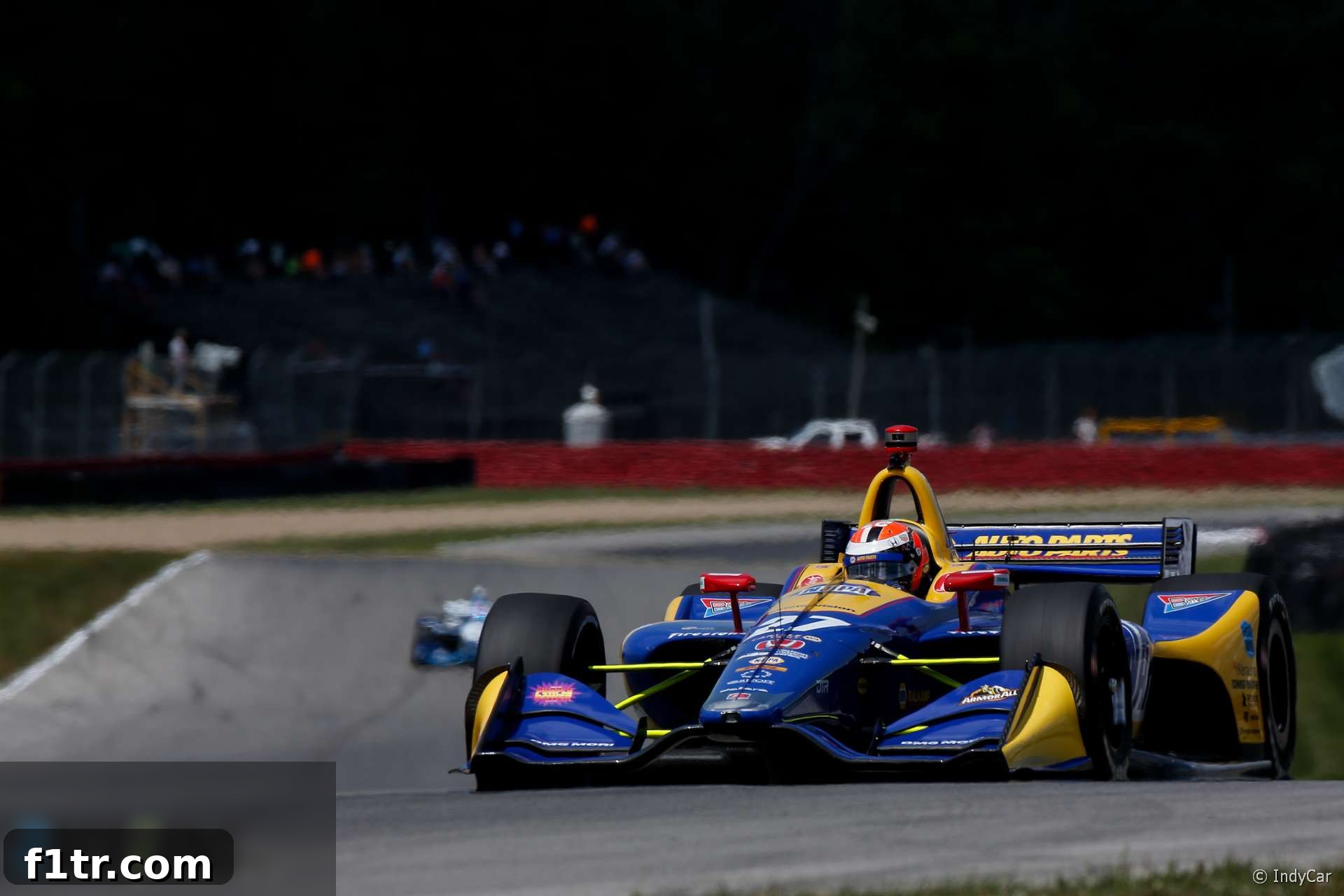
Alexander Rossi Dominates Mid-Ohio with Strategic Brilliance at the 2018 IndyCar Classic
The 2018 Honda Indy 200 at Mid-Ohio will forever be remembered as a masterclass in strategic execution, with Alexander Rossi claiming his second IndyCar victory of the season. Starting from pole position, the Andretti Autosport driver navigated the challenging, undulating road course with unparalleled precision, proving that calculated risks and flawless driving can conquer the fiercest competition. His triumph was a testament to both his skill behind the wheel and his team’s unwavering strategic acumen, allowing him to defy conventional wisdom and emerge victorious on a day when many of his rivals opted for a different approach. Rossi’s victory lap, though ending in a humorous, albeit track-side, mishap, perfectly encapsulated the exhilaration of his dominant performance.
Rossi’s Unconventional Two-Stop Strategy: A Calculated Risk that Paid Off
From the moment the green flag dropped, the Mid-Ohio Sports Car Course presented a stern test for all competitors, demanding both raw pace and tactical brilliance. Alexander Rossi, starting from the coveted pole position, initially lost the lead to Josef Newgarden at the end of the first lap, a brief setback when the leaders encountered traffic. However, this momentary loss of position would prove to be a minor blip in what became a perfectly executed race strategy. While most of his front-running competitors opted for a three-stop race, a more common strategy on the high-degradation Mid-Ohio track, Rossi and the Andretti team courageously committed to a two-stop plan. This bold decision hinged on meticulous tire management and an extended first stint, stretching his initial run to a remarkable lap 29.
The success of Rossi’s two-stop strategy was not just a stroke of luck; it was the result of a deliberate and disciplined approach. Conserving fuel and tires while maintaining a blistering pace is an incredibly difficult balancing act, especially on a demanding circuit like Mid-Ohio. The team’s confidence in his ability to make the tires last, coupled with his supreme car control, allowed them to hold their nerve as other cars pitted around them. This extended first stint provided Rossi with crucial track position and a significant advantage, as he avoided the additional time lost in the pit lane. His ability to consistently extract maximum performance from his Honda-powered machine, without over-stressing the tires, was a defining characteristic of his race, ultimately laying the groundwork for his decisive victory.
Intense Battles and Podium Triumphs: The Fight for Every Position
While Rossi forged ahead with his unique strategy, the battle behind him was fierce and captivating. Emerging as Rossi’s closest contender on a more conventional three-stop strategy was Robert Wickens. Starting from fifth on the grid, Wickens demonstrated impressive consistency and speed throughout the race, expertly managing his own strategy to climb through the field and ultimately secure a well-deserved second place. His performance highlighted the varying approaches teams took to conquer Mid-Ohio and showcased his talent as a formidable force in the IndyCar series, giving Rossi genuine pressure in the closing stages.
The fight for the final podium spot was equally intense, featuring a compelling rivalry between Team Penske teammates Will Power and Josef Newgarden. Despite an early lead and strong pace, Newgarden ultimately finished fourth, a testament to the unpredictable nature of IndyCar racing. Will Power, meanwhile, managed to secure third place, showcasing his characteristic aggression and skill. The race saw Power execute another of his trademark forceful overtaking moves on a competitor, further solidifying his reputation as one of the grid’s most tenacious drivers. The dynamic between the Penske teammates added another layer of intrigue to the race, with both drivers pushing their limits in pursuit of championship points and race honors.
Championship Standings and Unforgettable Comebacks: Scott Dixon and Sebastien Bourdais Shine
The 2018 Honda Indy 200 also had significant implications for the championship battle, with Scott Dixon, the series leader, aiming to limit damage and consolidate his position. Starting from ninth on the grid, Dixon executed a calculated drive, steadily climbing through the field to secure a valuable fifth-place finish. This masterful performance underscored his championship pedigree, demonstrating his ability to extract maximum points even when starting outside the immediate contention for victory. His focus on consistency and minimizing risks proved crucial in maintaining his advantage in the fiercely competitive IndyCar standings, ensuring he left Mid-Ohio still firmly in control of the championship narrative.
However, the most astounding drive of the day arguably belonged to Sebastien Bourdais. After a devastating crash in qualifying relegated him to 24th and last on the grid, Bourdais unleashed a performance nothing short of phenomenal. He scorched through the field with tremendous fashion, demonstrating an incredible combination of raw speed, daring overtakes, and tactical prowess. His relentless charge from the back of the pack was a captivating spectacle, showcasing the true spirit of IndyCar racing. To overcome such a significant grid penalty on a challenging road course like Mid-Ohio speaks volumes about his skill and determination, providing one of the most memorable narratives of the race weekend.
Sebastien Bourdais’s Astounding Climb from Last Place to Sixth
Bourdais’s remarkable ascent culminated in a series of audacious maneuvers, with a particularly daring round-the-outside pass on Ryan Hunter-Reay solidifying his incredible comeback. This move was not just a testament to his bravery but also his precision, executed flawlessly under immense pressure. Finishing an astonishing sixth place from last on the grid is an achievement that few drivers in the history of motorsports can claim, especially in such a competitive series. His drive was a masterclass in aggressive yet controlled racing, providing fans with countless moments of edge-of-the-seat action and proving that sheer willpower and talent can overcome even the most challenging starting positions. His ability to navigate through the dense traffic of the IndyCar field, consistently picking off competitors, solidified his status as one of the sport’s most experienced and tenacious racers.
Mid-Pack Movers and Unfortunate Incidents: The Full Race Narrative
Beyond the podium and the standout drives, the Mid-Ohio race also featured several other notable performances and unfortunate incidents that shaped the overall narrative. Simon Pagenaud, starting a distant 17th on the grid, orchestrated a strong comeback of his own, skillfully maneuvering through the pack to secure a commendable eighth-place finish. This demonstrated the depth of talent within the IndyCar field and the importance of perseverance throughout a grueling race. Joining him in the top 10 were Graham Rahal and Zach Veach, both delivering solid performances that underscored the highly competitive nature of the series and the constant fight for every single point.
Conversely, some drivers experienced a more challenging day. James Hinchcliffe, who started 10th after his own qualifying crash, found himself unable to make significant progress during the race, ultimately slipping to 14th place at the checkered flag. His struggles highlighted the difficulties of recovering lost ground at Mid-Ohio, especially when strategy doesn’t perfectly align. Max Chilton, who had achieved Carlin’s best-yet grid position of sixth, unfortunately, saw his promising start unravel quickly. His race was plagued by misfortune, beginning with a drive-through penalty for tangling with Takuma Sato. This was compounded by a slow pit stop, a consequence of a problem with his front-left wheel – a legacy of his earlier contact with the RLL driver. These setbacks underscore how quickly fortunes can change in IndyCar, transforming a strong qualifying effort into a frustrating race day.
The Demanding Mid-Ohio Sports Car Course: A True Test for IndyCar
The Mid-Ohio Sports Car Course itself played a pivotal role in the drama that unfolded during the 2018 Honda Indy 200. Known for its challenging undulations, tight corners, and fast sweeps, the 2.258-mile road course demands immense precision and stamina from drivers. Its layout makes overtaking a difficult proposition, emphasizing the critical importance of qualifying position and strategic execution. The undulating nature of the track, combined with its limited run-off areas, punishes even the slightest error, adding to the intensity of competition. Tire degradation is also a significant factor at Mid-Ohio, forcing teams to make tough decisions regarding tire compounds and pit stop timing. It’s a circuit that truly tests every aspect of an IndyCar driver’s ability, from managing fuel and tires to executing daring passes in close quarters. This unique blend of characteristics ensures that every race at Mid-Ohio is a captivating display of skill, strategy, and sheer determination.
A Defining Moment in the 2018 IndyCar Season
The 2018 Honda Indy 200 at Mid-Ohio was more than just a race; it was a defining moment in the season, showcasing the unpredictable excitement and strategic depth that makes IndyCar racing so compelling. Alexander Rossi’s victory, born from a daring two-stop strategy and impeccable driving, solidified his status as a championship contender and delivered a memorable performance. The thrilling battles throughout the field, the remarkable comeback of Sebastien Bourdais, and the championship implications for Scott Dixon all contributed to a truly unforgettable event. This race served as a powerful reminder of the raw talent, strategic brilliance, and relentless competition that are the hallmarks of the NTT IndyCar Series, captivating fans and setting the stage for an exhilarating conclusion to the 2018 season.
IndyCar News and Features
- IndyCar driver McLaughlin cleared of injury after crashing through barrier at Barber
- Schumacher says his IndyCar feels like ‘an F2 car, just with better tyres’
- IndyCar “way faster than Formula 1” in some corners, says Grosjean
- FIA to award more F1 superlicence points to IndyCar drivers from 2026
- Schumacher to race full-time in IndyCar with RLL in 2026
Browse all IndyCar articles