Kimi Raikkonen: The Iceman’s Legendary Formula 1 Journey
Kimi Raikkonen, affectionately known as ‘The Iceman’ for his cool demeanor and terse radio communications, officially brought his illustrious Formula 1 career to a close, cementing his status as the most experienced driver in the sport’s history with an astounding 349 race starts. His remarkable journey spanned over two decades, captivating fans worldwide with his raw speed, uncompromising racing style, and unique personality.
Throughout his extensive tenure in the pinnacle of motorsport, Raikkonen amassed an impressive 1,873 championship points, graced the podium 103 times, and clinched 21 Grand Prix victories. A crowning achievement came in 2007 when he delivered Ferrari its most recent Drivers’ World Championship – a testament to his enduring talent and tenacity. Join us as we reflect on the incredible career of Kimi Raikkonen, a true icon of Formula 1, decade by decade, captured in a series of unforgettable moments.
2001: The Rookie Sensation
Kimi Raikkonen’s Formula 1 debut with Sauber in 2001 was nothing short of sensational, immediately hinting at the prodigious talent that lay beneath his calm exterior. The young Finn, who had barely a handful of car races under his belt, was a bold choice by Peter Sauber, yet he quickly proved his worth.
His inaugural race at the Australian Grand Prix saw him secure a point-scoring finish in sixth place, an extraordinary feat for a rookie. When asked about this impressive debut, Raikkonen’s now-legendary response was a characteristically blunt, “there’s still five in front of me.” This candid remark perfectly encapsulated his focus and ambition, traits that would define his entire career.
His immediate impact didn’t go unnoticed by the bigger teams. McLaren, recognizing his immense potential, quickly lined him up as a promising replacement, signaling a rapid ascent to the top tier of the sport. Alongside Nick Heidfeld, Raikkonen contributed significantly to Sauber’s best-ever constructors’ championship finish, proving that his debut season was far from a fluke but a clear indication of a future champion.
2002: McLaren’s New Hope
Moving to McLaren in 2002 marked a significant step up for Raikkonen. He was now part of a front-running team, expected to challenge for wins and championships. The pressure was immense, but Raikkonen, true to his ‘Iceman’ moniker, adapted quickly, demonstrating his mettle against more experienced competitors.
His first season with McLaren saw him secure his first podium finish for the team at the season-opening Australian Grand Prix, finishing in third place. This early success underscored his seamless transition and his ability to extract performance from a top-tier machine. While wins proved elusive in 2002, the foundation for future championship challenges was firmly laid, as Raikkonen consistently showcased his speed and racecraft.
2003: The First Title Charge
The 2003 season saw Kimi Raikkonen emerge as a genuine championship contender. Piloting the McLaren MP4-17D, he battled fiercely against the reigning champion Michael Schumacher in a season that went down to the wire. This year was pivotal, marking his first Grand Prix victory and solidifying his position as one of F1’s elite drivers.
His first victory came at the Malaysian Grand Prix, a dominant performance that announced his arrival at the top. The season was characterized by several dramatic moments, including a notable incident at the German Grand Prix where he was involved in a dramatic crash with Rubens Barrichello at the very start of the race, highlighting the cutthroat nature of championship battles.
Despite his best efforts, which included consistent podium finishes and another win in Hungary, Michael Schumacher ultimately pipped Raikkonen to the 2003 title by a mere two points. It was a heartbreaking end to a phenomenal season, but it underscored Raikkonen’s incredible potential and resilience, proving he had the pace and temperament to compete for the ultimate prize.
2004: A Challenging Season
The 2004 season presented a stark contrast to Raikkonen’s championship challenge of the previous year. McLaren’s MP4-19 chassis proved problematic and unreliable, causing significant headaches for the team and its drivers. Despite these struggles, Raikkonen’s talent shone through, particularly when the car allowed him to compete.
His third year at McLaren began poorly with persistent reliability issues, but Raikkonen eventually managed to extract a solitary, yet magnificent, victory at the Belgian Grand Prix at Spa-Francorchamps. This win was a masterclass in driving, demonstrating his ability to triumph even with a difficult car, and further cemented his reputation as a formidable talent, especially on demanding circuits like Spa.
He also secured a strong second-place finish at the Brazilian Grand Prix, where he shared the podium with his future teammate, Juan-Pablo Montoya, who won the race. Raikkonen’s focus remained typically internal during his celebrations, a characteristic trait that endeared him to many fans, highlighting his singular dedication to racing rather than showmanship.
2005: The Near Miss
The 2005 season saw Raikkonen in a much more competitive McLaren, the MP4-20, which was arguably the fastest car on the grid. However, persistent reliability issues once again plagued his championship bid, preventing him from converting sheer pace into a well-deserved title. Despite this, Raikkonen delivered some of the most spectacular drives of his career, earning him widespread admiration.
He secured multiple victories throughout the year, including a memorable win at the Monaco Grand Prix, showcasing his exceptional skill on street circuits. However, crucial moments, such as retiring while leading at the Nürburgring after a suspension failure, cost him vital points in his title fight against Fernando Alonso. This incident, where he famously drove into the gravel, vividly illustrated the fine margins that define championship campaigns.
Despite Alonso ultimately taking the championship, Raikkonen ended the season with arguably the most memorable win of the year at Suzuka, clinching victory with a breathtaking last-lap overtake. This season, despite the disappointment of not winning the title, cemented Raikkonen’s reputation as a hard charger and a fan favorite.
2006: McLaren Farewell
The 2006 season marked Kimi Raikkonen’s final year with McLaren before his highly anticipated move to Ferrari. It proved to be a win-less season, a frustrating period despite his consistent efforts. The McLaren MP4-21 struggled to match the pace and reliability of its rivals, particularly the resurgent Ferrari and the dominant Renault.
He started the season with a promising third-place finish at the opening round in Bahrain, hinting at potential. However, the rest of the year saw him battling persistent technical issues and a car that wasn’t always competitive. Despite the lack of victories, Raikkonen continued to deliver strong performances, often maximizing the potential of his machinery and keeping his spirits high as he looked forward to a fresh challenge with Ferrari.
2007: World Champion with Ferrari
The 2007 season is etched into Formula 1 folklore as the year Kimi Raikkonen, in his debut season with Ferrari, clinched the Drivers’ World Championship in one of the most dramatic finales in the sport’s history. Moving from McLaren, Raikkonen immediately found pace and comfort in the red car, setting the tone from the very first race.
He kicked off his Ferrari tenure with a spectacular win at the Australian Grand Prix, instantly endearing himself to the Tifosi. The championship battle was an intense three-way fight involving Raikkonen and the McLaren duo of Lewis Hamilton and Fernando Alonso. Two crucial late-season victories, particularly his triumph in China, were instrumental in closing the points gap to his rivals.
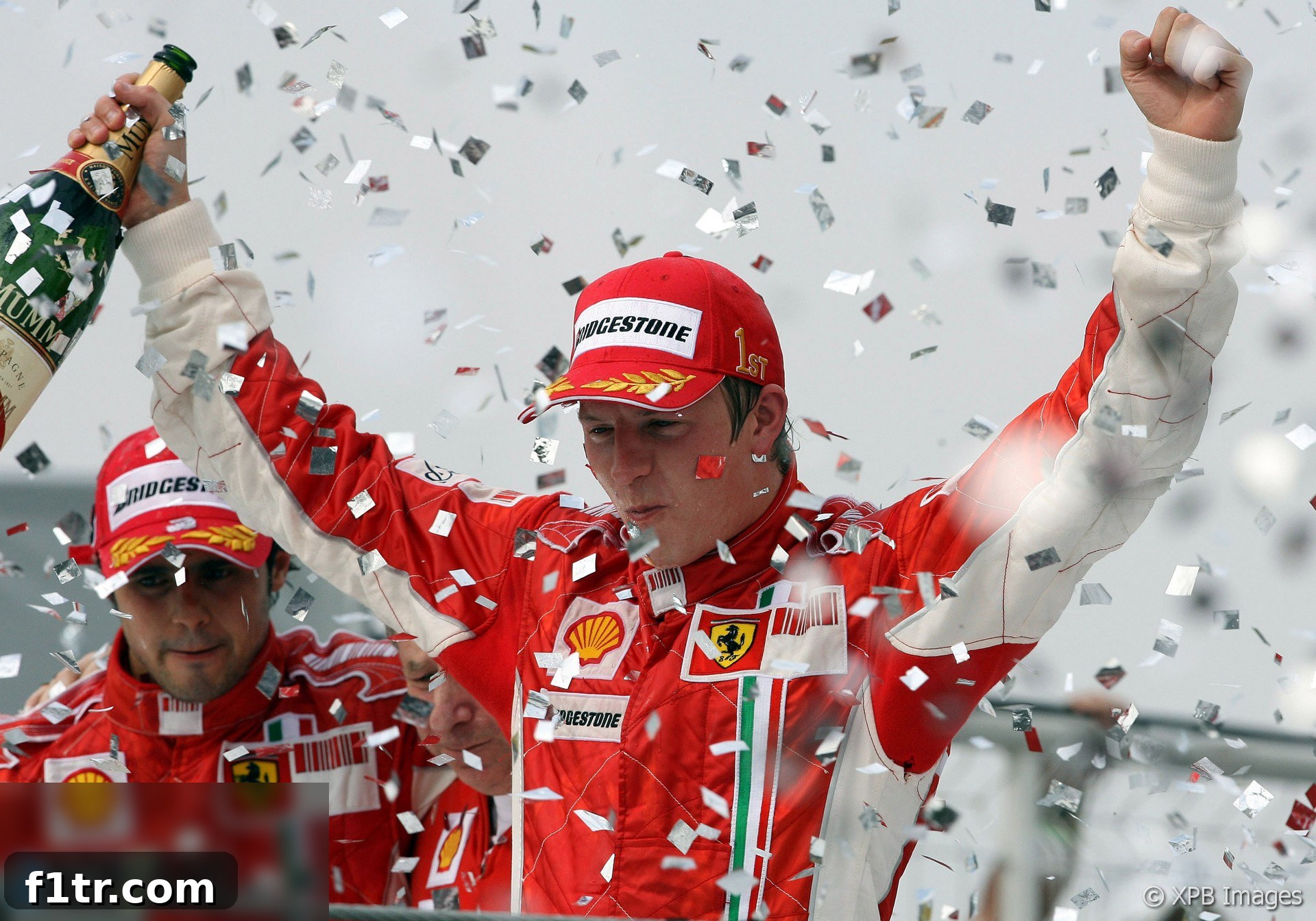
The season culminated in a nail-biting finale at the Brazilian Grand Prix. In a truly dramatic turn of events, Raikkonen crossed the finish line to clinch his first and only World Championship, capitalizing on issues faced by both Hamilton and Alonso. He pipped Hamilton to the title by a single point, a testament to his consistent performance and the team’s strategic brilliance.
The celebrations on the Interlagos podium were legendary, a rare display of genuine emotion from the typically stoic Iceman. This championship win not only fulfilled a long-held ambition but also secured his place in Ferrari’s storied history as their most recent Drivers’ Champion.
2008: Title Defense Challenges
As the reigning world champion, Kimi Raikkonen entered the 2008 season with the formidable task of defending his title. He started the year strongly, securing a victory at the Malaysian Grand Prix, signaling his intent to challenge at the front once again. However, the season proved to be more challenging and inconsistent compared to his championship-winning year.
One of the most memorable and controversial moments of the season for Raikkonen came at the Belgian Grand Prix at Spa-Francorchamps. In a thrilling and contentious battle with future champion Lewis Hamilton, Raikkonen, known for his prowess at Spa, unfortunately hit the wall while pushing for victory. This incident was emblematic of a season where the fine margins often didn’t fall his way, preventing him from mounting a sustained championship challenge.
2009: Ferrari Swansong & First Hiatus
The 2009 season proved to be a challenging one for Ferrari, and by extension, for Kimi Raikkonen. The team struggled with the new aerodynamic regulations, making it difficult to compete at the very front of the grid. Despite the difficulties, Raikkonen still managed to deliver flashes of his brilliance.
One of the season’s enduring anecdotes involves the rain-shortened Malaysian Grand Prix, where Raikkonen, after retiring due to a technical issue, was famously spotted casually enjoying an ice cream in the paddock. This moment perfectly captured his unflappable nature and unique approach to the sport. His sole victory of the season came, fittingly, at Spa, a circuit where he always excelled, further highlighting his mastery of the Belgian track.
After the Abu Dhabi Grand Prix, Raikkonen made the surprising decision to bow out of Formula 1 for two years, pursuing interests in rallying and NASCAR. This temporary departure left fans wondering if they had seen the last of the Iceman in F1, but as history would show, his story in the pinnacle of motorsport was far from over.
2012: The Comeback Kid with Lotus
After a two-year sabbatical, Kimi Raikkonen made a highly anticipated return to Formula 1 in 2012, joining the Lotus F1 Team. Doubts lingered about whether he could regain his previous form, but Raikkonen quickly dispelled them, proving that the ‘Iceman’ still had plenty of fire.
His comeback season was characterized by consistent performances and numerous podium finishes. He quickly re-established himself as a top driver, battling fiercely with seasoned competitors like Mark Webber during races such as the Bahrain Grand Prix. He also challenged Lewis Hamilton for position at the Hungarian Grand Prix, ultimately securing another valuable podium.
The highlight of his return came at the Abu Dhabi Grand Prix, where Raikkonen clinched his first victory since his comeback. This win was iconic, not just for the race itself, but for his memorable and typically blunt radio message to his engineer: “Leave me alone, I know what I’m doing.” It was a moment that perfectly encapsulated his unique charm and reinforced his status as a true F1 legend.
2013: A Strong Start, a Troubled End
Kimi Raikkonen continued his strong form into the 2013 season with Lotus, once again proving his enduring talent. He opened his second year with the team with another impressive victory at the Australian Grand Prix, demonstrating his ability to hit the ground running and perform consistently at the highest level.
The season saw him continue to rack up podium finishes, showcasing his consistent pace and intelligent race management. However, as the season progressed, teammate Romain Grosjean started to push him harder, demonstrating his own development. More significantly, financial difficulties began to plague the cash-strapped Lotus team, leading to a breakdown in relations and unpaid salaries for Raikkonen.
Following a first-lap retirement at the Abu Dhabi Grand Prix and mounting frustration over the team’s financial situation, Raikkonen made the decision not to return to Lotus for the final races of the season, effectively ending his successful second stint with the Enstone-based squad. This marked another dramatic turning point in his career, setting the stage for his next move back to a familiar team.
2014: Ferrari Return & Hybrid Era Struggles
Kimi Raikkonen’s return to Ferrari in 2014 was met with immense anticipation, as fans hoped for a reunion that would rekindle his championship-winning form. However, this year also coincided with the dawn of Formula 1’s V6 turbo-hybrid era, a significant technical shift that brought little cheer for the Scuderia, and particularly for Raikkonen.
The Ferrari F14 T proved difficult to drive, especially for Raikkonen, who struggled to adapt his driving style to the new power units and braking characteristics. He spent just a single year as teammate to Fernando Alonso, a partnership that, while star-studded, did not yield the desired results. Team Principal Marco Mattiacci, who orchestrated his return, was also gone soon after, highlighting the turmoil within the team during this transitional period. Raikkonen’s characteristic frustration with the car’s handling was evident throughout a challenging and often unrewarding season.
2015: Ferrari’s Resurgence, Kimi’s Continued Wait
The 2015 season saw Ferrari return to winning ways with the arrival of Sebastian Vettel, who immediately found success with the SF15-T. While the team celebrated victories, Kimi Raikkonen continued to struggle for consistent performance and outright wins, finding himself playing a supporting role despite glimpses of his old speed.
Despite Ferrari’s improved competitiveness, Raikkonen often found himself battling in the midfield or just off the podium. He came close to victory on a few occasions but was unable to convert them, extending his win drought. His consistent contributions were valuable to the team’s constructors’ championship efforts, but the individual success he craved remained just out of reach.
2016: Consistent Podium Finishes
The 2016 season was a year of greater consistency for Kimi Raikkonen, as he continued to demonstrate strong form and a knack for securing podium finishes. While a victory still eluded him, Raikkonen was often found battling at the sharp end of the grid, showcasing his experience and unwavering determination.
One notable moment was his third-place finish at the Russian Grand Prix in Sochi, a testament to his ability to extract solid results from the Ferrari SF16-H. He continued to be a popular figure in the paddock and with fans, sharing moments like the drivers’ parade with fellow Finnish driver Valtteri Bottas at the Circuit of the Americas (COTA).
The season also had its share of drama, particularly the Brazilian Grand Prix at Interlagos, where torrential rain led to treacherous conditions. Raikkonen was among many drivers who crashed out in the challenging weather, highlighting the unpredictable nature of F1 racing in extreme conditions.
2017: Flashes of Brilliance Amidst Drama
The 2017 season saw Kimi Raikkonen produce some of his strongest performances since his return to Ferrari, often running closely with teammate Sebastian Vettel and demonstrating his undiminished speed. While wins remained elusive, his pace was clearly there, contributing significantly to Ferrari’s championship challenge.
However, the season was also marked by a dramatic and controversial collision at the start of the Singapore Grand Prix. Raikkonen was involved in a multi-car incident with his teammate Sebastian Vettel and Red Bull’s Max Verstappen, an event that significantly impacted Ferrari’s championship aspirations. Despite such setbacks, Raikkonen continued to deliver strong drives, including another podium finish at the Russian Grand Prix in Sochi, proving he “still got it.”
2018: Final Ferrari Victory & Farewell
The 2018 season was a remarkable swansong for Kimi Raikkonen at Ferrari, marking his most competitive year since 2013 and culminating in his 21st and final career victory. This year was a testament to his enduring skill and provided fans with several memorable moments.
He delivered a stunning, record-breaking qualifying lap at Monza, securing pole position and delighting the passionate Tifosi, eventually converting it into a hard-fought podium finish. However, the true highlight came at the United States Grand Prix in Austin, where Raikkonen masterfully held off Lewis Hamilton to secure his first victory in over five years. It was an emotional triumph, proving that the Iceman still had the raw speed and racecraft to win at the highest level.
He followed this with another strong third-place finish at the Mexican Grand Prix, demonstrating his consistent form throughout the latter half of the season. Despite losing his seat at Ferrari for the upcoming year, Raikkonen opted against retirement, instead choosing to return to the team where his F1 journey began, albeit now rebranded as Alfa Romeo, showcasing his passion for racing was still burning bright.
2019: Back to the Roots with Alfa Romeo
In 2019, Kimi Raikkonen made a full-circle return to the team that gave him his Formula 1 debut, albeit now operating under the Alfa Romeo Racing banner. His move back to the Hinwil-based squad was a popular one, seeing the veteran bring his vast experience and technical feedback to a midfield team.
Raikkonen immediately showcased his enduring skill, often dragging the Alfa Romeo to impressive qualifying and race results, scoring valuable points for the team. He was often found battling hard against younger, aggressive drivers, including a notable encounter with Max Verstappen at his beloved Spa circuit. The season also marked his final appearance at the iconic Singapore Grand Prix, a challenging night race that once again tested his endurance and precision.
2020: The Pandemic-Affected Season
The 2020 Formula 1 season was heavily disrupted by the global pandemic, leading to a condensed and unusual race calendar. For Kimi Raikkonen and Alfa Romeo, it was a challenging year, with the team struggling for performance and often finding themselves at the back of a competitive midfield.
Despite the difficulties, Raikkonen continued to apply himself with his characteristic dedication, working to extract every ounce of performance from his Alfa Romeo C39. Moments like practice day at Monza, usually a joyous occasion for Ferrari-powered cars, were indicative of the challenging circumstances faced by the team throughout this unique season. His presence alone brought a sense of calm and experience to a demanding environment.
2021: The Final Dance
The 2021 season marked Kimi Raikkonen’s 19th and final year in Formula 1. Announcing his retirement before the end of the season, the motorsport world prepared to bid farewell to one of its most unique and beloved characters. Throughout his final campaign with Alfa Romeo, Raikkonen continued to show flashes of his enduring speed and racecraft, even with a car that was not consistently competitive.
His final season, however, was not without its challenges. The Portuguese Grand Prix saw an unfortunate retirement following contact with his teammate Antonio Giovinazzi, a rare instance of an on-track incident between the two. As the season drew to a close, the focus shifted to his impending farewell. His final F1 race at the Abu Dhabi Grand Prix ended prematurely due to car trouble, a somewhat anticlimactic end to such an extraordinary career, but one that perhaps fittingly highlighted the mechanical challenges that often punctuated his journey.
Kimi Raikkonen leaves Formula 1 as a true legend, celebrated not just for his World Championship and numerous victories, but for his authentic personality, his unwavering love for racing, and his iconic status as ‘The Iceman.’ His career, marked by incredible highs and frustrating lows, has left an indelible mark on the sport and its millions of fans worldwide, who will surely miss his unique presence on the grid.
2021 F1 season review
- 2021 F1 driver rankings #1: Max Verstappen
- 2021 F1 driver rankings #2: Lewis Hamilton
- 2021 F1 driver rankings #3: Lando Norris
- 2021 F1 driver rankings #4: Charles Leclerc
- 2021 F1 driver rankings #5: Carlos Sainz Jnr
Browse all 2021 F1 season review articles