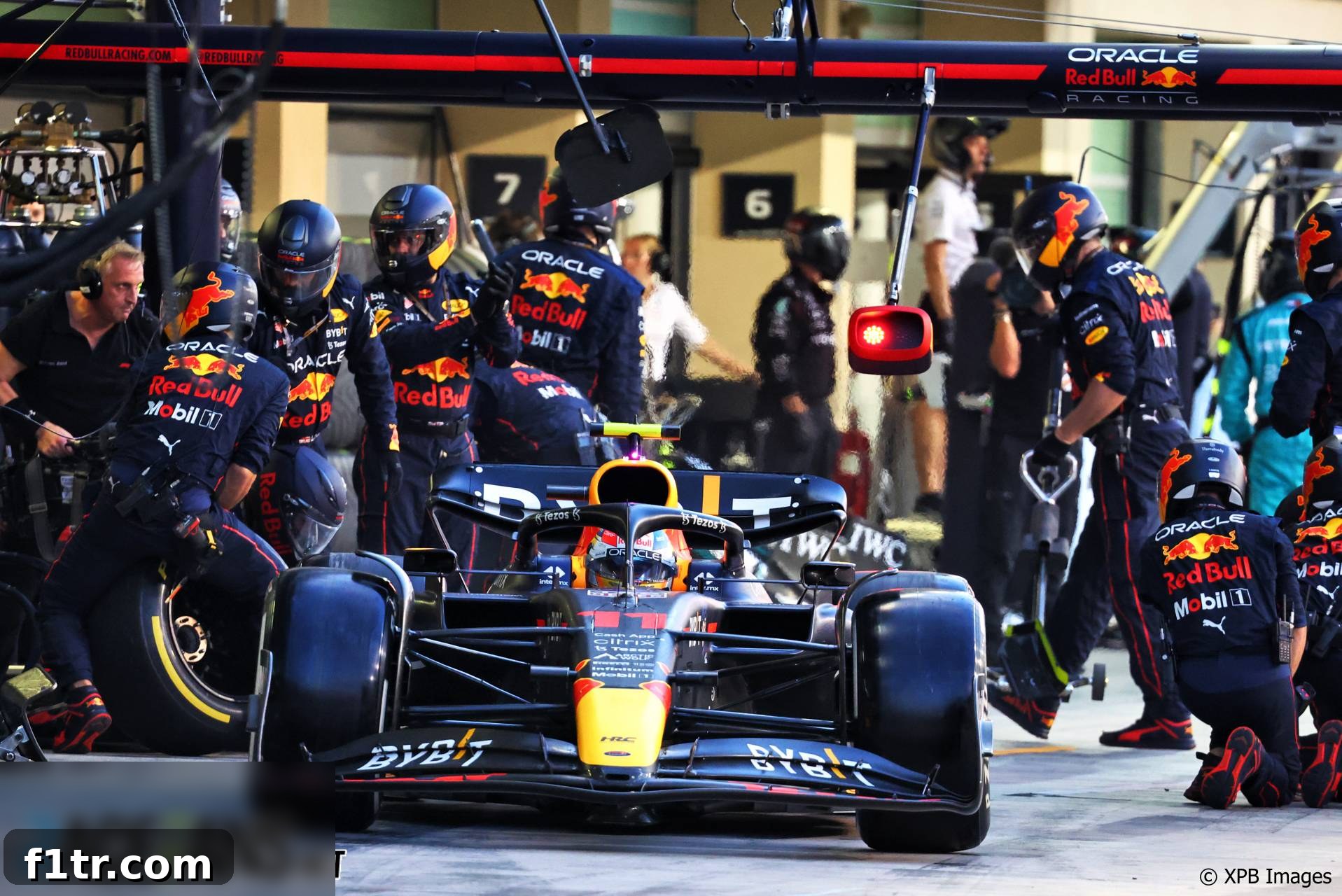
Strategic Masterclass: How Ferrari’s Dummy Pit Stop Outsmarted Red Bull in Abu Dhabi
In the high-stakes climax of the 2022 Formula 1 season at the Abu Dhabi Grand Prix, Ferrari executed a strategic manoeuvre that proved pivotal, not only for securing second place in the race but also clinching the coveted runner-up position in the Drivers’ Championship for Charles Leclerc. Ferrari team principal Mattia Binotto hailed a “dummy” pit stop as the ingenious tactic that successfully drew Sergio Perez into the pits, clearing the path for Leclerc’s one-stop strategy to triumph.
The Yas Marina Circuit often presents a unique challenge for strategists, balancing tyre degradation with track position. On this occasion, Ferrari’s pit wall demonstrated sharp intellect, turning what could have been a disadvantage into a decisive victory. Leclerc’s second-place finish ahead of his Red Bull rival was the direct result of making one fewer pit stop, a feat orchestrated by the deceptive readiness of the Ferrari crew.
Advert | Become a Supporter & go ad-free
The critical moment unfolded as the race passed its halfway point. Sergio Perez, then running in second place, had already made his first pit stop on lap 15. Charles Leclerc, on the other hand, masterfully extended his initial tyre stint for an additional six laps, diligently preserving his rubber and closing the gap to Perez once again. As the Red Bull driver felt the pressure mounting from the charging Ferrari, the Maranello squad initiated their cunning plan.
The Deceptive Manoeuvre: A Pit Stop That Never Was
With Leclerc rapidly gaining on Perez, Ferrari’s strategists decided to play their hand. The pit crew emerged into the pit lane, seemingly preparing for an imminent tyre change for Leclerc. The radio message to Leclerc was clear and concise: “box opposite Perez” – a directive to only pit if Perez himself did not. This calculated public display of intent was designed to provoke a reaction from Red Bull, and it worked flawlessly.
Red Bull, observing Ferrari’s apparent preparation, made the call to bring Perez in for his second stop. This move was made to preempt a potential undercut from Leclerc, where the Ferrari driver would pit for fresh tyres and use their superior grip to gain time on track. However, with Perez committed to the pit lane, Leclerc stayed out, as per Ferrari’s instruction. This single strategic moment redefined the outcome of their battle for second place. Leclerc, with fresher and fewer-lapped tyres than Perez’s second stint had seen, never made that second pit stop, opting instead for a single, extended stint.
In the closing laps of the race, Perez, on newer tyres, did mount a furious comeback, attempting to reel in Leclerc. However, the gap proved insurmountable, with Leclerc crossing the finish line a mere 1.3 seconds ahead of the Red Bull driver. This razor-thin margin underscored the brilliance and precision of Ferrari’s strategy, directly securing Leclerc’s second place in the Abu Dhabi Grand Prix and, crucially, cementing his position as the runner-up in the 2022 Drivers’ World Championship.
Binotto’s Vindication: A Strategy Redeemed
Throughout the 2022 season, Ferrari’s pit strategies had frequently faced intense scrutiny and widespread criticism, with several high-profile errors costing the team valuable points and potential victories. This made the success in Abu Dhabi all the more significant, providing a much-needed boost of confidence for the Maranello outfit. Mattia Binotto, visibly relieved and proud, wasted no time in praising his team’s exemplary performance.
Speaking to media including RaceFans on Sunday, Binotto stated, “Certainly we did the proper job. A dummy pit stop on Red Bull was the right call and I think that overall we made it right. So I’m happy for them, happy for the team.” He further reflected on the external pressures, adding, “I think that when Ferrari is making mistakes there is always a lot of criticism but as well I know that these guys can do very well.” This victory was a testament to the team’s resilience and their ability to perform under immense pressure, proving their strategic capabilities when it mattered most.
Advert | Become a RaceFans supporter andgo ad-free
The Tightrope Walk of Tyre Management and Strategy
Binotto emphasized that the decision between a one-stop and a two-stop strategy was far from straightforward, describing it as a “close call.” The inherent challenges of tyre degradation and management at the Yas Marina circuit were a central theme of the weekend. This difficulty was not exclusive to Ferrari, affecting other top teams like Mercedes and even Red Bull’s Carlos Sainz Jnr who ultimately opted for two stops.
“It was a very difficult weekend for tyre degradation and tyre management,” Binotto explained. “Not only for us, it has been the case for other drivers and it has been the case certainly for Mercedes or Checo. Pushing too hard on the first laps, the risk was to destroy the tyres. So in order to manage it well through the entire stint you have to be very careful at the start. Not only [that], you needed a very good balance of the car itself.” The fine balance between outright pace and preserving the tyre integrity was the key differentiator.
Ferrari dedicated significant effort from Friday practice onwards to fine-tune their car setup, focusing on high-fuel runs and race simulations. This meticulous preparation ensured they had the optimal balance for race day. “If I look at ourselves, what we did is during the weekend, starting from Friday, to put some more effort, some more laps on high-fuel runs, on the race simulations, to make sure that we had the right balance for today. And I think that then today, later in the race, the balance of the car, the drivers’ capability has made the difference overall in terms of stint pace and overall race distance speed,” Binotto elaborated.
He singled out Leclerc for his exceptional driving. “So well done to Charles because he did very well. Carlos had a bit more difficulty as we obviously debrief with him later on, I think it’s more down to the car balance itself, but something we need to understand with him as well.” This highlighted the nuanced differences in driver performance and car characteristics that influenced individual race strategies.
Advert | Become a RaceFans supporter andgo ad-free
Flexibility as a Cornerstone of Success
A crucial aspect of Ferrari’s strategic triumph was their commitment to flexibility, tailoring approaches for each driver based on their unique race circumstances. Binotto stated, “Ferrari remained flexible with the strategies for their two drivers because we knew it would have been in between the one and the two. And the difference would have been the capacity of saving tyres or not, depending on how much you would have been under pressure and the drivers themselves in terms of driving.”
Leclerc, with a slight cushion over the cars behind him, had the luxury of greater tyre conservation, which ultimately allowed him to successfully execute the single-stop strategy. Conversely, Carlos Sainz Jnr found himself under intense pressure from the Mercedes cars early in the race. This forced Ferrari to switch him to a two-stop plan to maintain his competitive edge and manage tyre wear more effectively. “Charles had a bit more margin on the cars behind and could save more the tyres which gave him the benefit to go for the one-stop, while Carlos had been under pressure at the very start of the race with the Mercedes and we had to switch to the two [stop],” Binotto explained.
This dynamic approach highlighted Ferrari’s strategic acumen. “So it was great to see that the team was very flexible, choosing one on one driver, two on the second, to optimise the race result. And I think that certainly the dummy call on the Red Bull was a fantastic call from the pit,” he concluded, reiterating the success of their adaptive planning.
Red Bull’s Perspective: A Necessary Gamble
Despite Ferrari’s jubilant assessment, Red Bull team principal Christian Horner offered a contrasting view, suggesting that Perez was always destined for a two-stop race. According to Horner, the decision to pit Perez when they did was an aggressive, yet necessary, measure to counter the perceived threat from Leclerc. Their data indicated that Perez’s front-right tyre was suffering significantly from graining and opening up, rapidly losing performance.
Horner articulated Red Bull’s rationale: “It was all about the front right tyres just graining and opening up and at that point was dying. You saw then Charles closing and so basically they called to pit to do the opposite to Checo.” He continued, explaining the strategic decision, “We banked the stop, but that then exposed him massively at the end of the stint. So we felt that, as I say, rather than sort of die at the end of it and be a sitting duck, we’d take an attacking strategy.”
Red Bull’s calculation was that staying out longer would inevitably lead to Perez becoming vulnerable with severely degraded tyres, potentially losing even more time and positions. By pitting, they aimed to give him fresh rubber and the chance to attack later in the race, even if it meant sacrificing track position temporarily. However, this strategy was further complicated by various race incidents. During his second stint, Perez voiced frustrations over losing time behind his teammate Max Verstappen at one juncture. He then faced the challenge of overtaking Lewis Hamilton and several backmarkers while desperately pursuing Leclerc, all of which chipped away at his valuable lap time.
Horner acknowledged these mitigating factors, stating, “Maybe if he did manage to make it past Hamilton – ifs, buts and maybes – there’s a couple of backmarkers that didn’t help, but it was so, so close.” Ultimately, despite Red Bull’s proactive measures and Perez’s valiant charge, Ferrari’s strategic play held firm, denying Red Bull a double podium and cementing Leclerc’s championship standing.
Conclusion: The Art of Strategic Chess in F1
The 2022 Abu Dhabi Grand Prix served as a compelling demonstration of the intricate strategic chess match that defines Formula 1. Ferrari’s execution of the “dummy pit stop” was a moment of tactical brilliance, not just securing a crucial race result but also validating their strategic department after a challenging season. It highlighted the importance of psychological warfare on the pit wall, alongside meticulous preparation and flexible in-race decision-making.
While Red Bull defended their decision as a necessary attacking move given Perez’s tyre state, Ferrari’s gamble paid off handsomely, directly influencing the final standings of the Drivers’ Championship. This race will be remembered not only for the high-speed drama on track but also for the quiet, calculated genius that unfolded behind the scenes, proving that in Formula 1, strategy can often be as decisive as raw pace.
Advert | Become a RaceFans supporter andgo ad-free
2022 Abu Dhabi Grand Prix
- Norris dissatisfied with solitary podium finish: “One isn’t enough”
- Verstappen achieves most dominant title win since Vettel in 2013
- Magnussen’s experience makes him ‘positive’ ousted Schumacher can return to F1
- Overtaking still difficult at Yas Marina despite 2021 track changes, say drivers
- Depressing to consider points lost says Gasly after AlphaTauri slump to ninth
Browse all 2022 Abu Dhabi Grand Prix articles