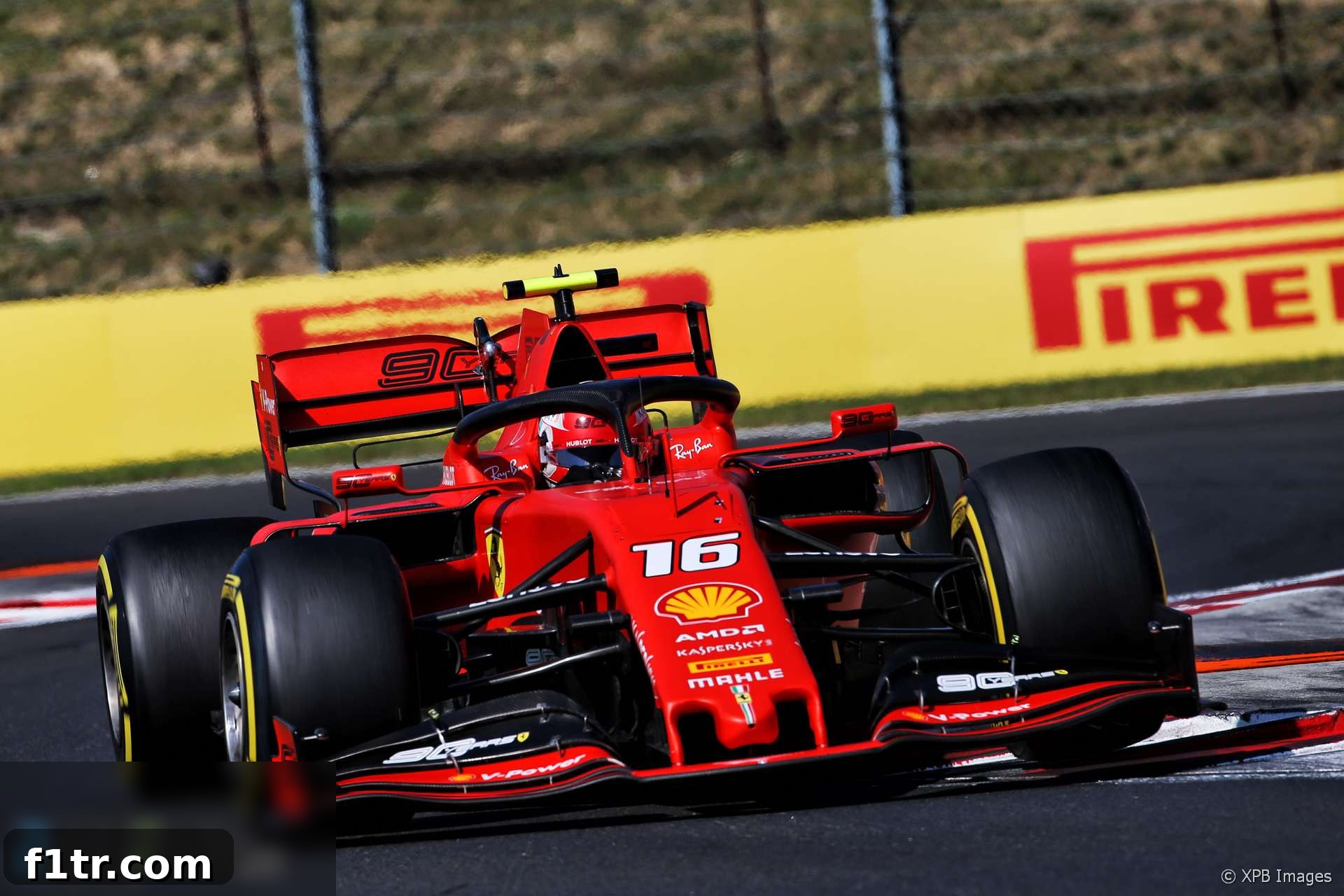
Ferrari’s Hungarian Grand Prix Disappointment: Unpacking the SF90’s Performance Gap
The Hungarian Grand Prix often serves as a crucial barometer for Formula 1 teams, with its tight, twisty layout demanding maximum aerodynamic downforce and exceptional chassis balance. For Scuderia Ferrari, the 2019 edition of the event at the Hungaroring proved to be a stark reality check, as their SF90 challengers, piloted by Sebastian Vettel and Charles Leclerc, finished a staggering minute behind race winner Lewis Hamilton. Despite the significant deficit, both drivers vehemently denied any suggestion of deliberately conserving pace, insisting they pushed their cars to their absolute limits throughout the race.
Drivers Defiant Amidst Performance Gap Accusations
In the aftermath of a challenging race, the questions inevitably arose about Ferrari’s strategy and the perceived lack of outright pace. Charles Leclerc, who ultimately yielded a position to his teammate Vettel in the final laps, stated emphatically, “We were also pushing at the maximum to try to have our best race.” This sentiment was echoed by Sebastian Vettel, who dismissed the notion that the front-running battle between Hamilton and Max Verstappen had artificially inflated their lead due to increased aggression. “I think they were pushing flat-out and we were pushing flat-out,” Vettel asserted. “So I don’t think they were able to get another second just because they enjoyed themselves, I don’t think so.” These statements highlight a team grappling with a fundamental performance issue, rather than a deliberate strategy of restraint. The drivers’ frustration was palpable, underscoring the gap between their aspirations and the car’s capabilities on specific circuit types.
The Hungaroring Challenge: A Downforce Dilemma for Ferrari
The core of Ferrari’s struggles at the Hungaroring lay squarely with the inherent characteristics of their SF90 chassis, particularly its aerodynamic design philosophy. Team Principal Mattia Binotto candidly explained that the minute-long gap to the Mercedes was a direct consequence of the SF90’s Achilles’ heel: its weakness on tracks demanding high downforce. “Here I think as we often say it’s very track-dependent,” Binotto elaborated. “We know that our car is lacking maximum downforce and when you are on a circuit like Budapest where maximum downforce is required then we are certainly suffering.” The Hungaroring, with its continuous corners and lack of significant straights, requires a car that can generate substantial grip through its aerodynamic elements to maintain high cornering speeds. Unlike some of its rivals, the SF90 appeared to struggle to generate the necessary levels of maximum downforce, leaving the drivers wrestling with an inherently less grippy and balanced machine.
Mattia Binotto’s Analysis: Qualifying vs. Race Pace Discrepancy
A curious aspect of Ferrari’s Hungarian Grand Prix weekend was the disparity between their qualifying performance and their race pace. While they managed to qualify within half a second of Max Verstappen’s pole position time, the race saw a dramatic drop-off, with the SF90s losing an average of almost nine-tenths of a second per lap. Binotto provided a technical explanation for this significant divergence, attributing it to the nuanced interaction between tyre grip and aerodynamic efficiency over different distances. “You suffer even more in the race compared to quali because on the single lap of quali the grip of the tyres is coping with the lack of downforce you may have,” he explained. In qualifying, the fresh, soft tyres offer peak grip, masking some of the car’s aerodynamic deficiencies. However, over a long race stint, as tyres degrade and overheating becomes a factor, the fundamental lack of downforce becomes far more pronounced. Drivers are forced to slide the car more, generating excessive heat in the tyres and accelerating their degradation, making sustained performance incredibly difficult.
Understanding Ferrari’s Track-Dependent Performance Swings
Binotto’s bewilderment about the performance shift from being “the fastest car” just a week prior to “not the fastest” in Hungary highlights a critical aspect of Ferrari’s 2019 season: their highly track-dependent performance. While circuits with long straights and fast, sweeping corners, where the SF90’s engine power and lower-drag aerodynamic setup could be exploited, often saw Ferrari competitive, the slow, technical nature of the Hungaroring exposed their vulnerabilities. This inconsistency was a major headache for the Scuderia, making it difficult to predict their competitiveness from one race to the next. The engineering challenge lay in developing a car that could perform across a broader range of circuit characteristics, rather than excelling only in specific conditions. The ability of rivals like Mercedes to maintain a strong performance across diverse tracks underscored the development gap Ferrari needed to close.
The Broader Implications for Ferrari’s 2019 Campaign
The Hungarian Grand Prix performance was more than just a single disappointing race; it carried significant implications for Ferrari’s overall 2019 championship aspirations. While Mercedes consistently demonstrated a well-rounded package capable of performing on any track, Ferrari’s peaks and troughs meant they struggled to mount a consistent challenge. The deficit in downforce was not merely an inconvenience but a fundamental design flaw that impacted tyre management, driver confidence, and ultimately, race results. This particular race served as a stark reminder that sheer engine power, while crucial, could not compensate for a deficiency in aerodynamic grip on every type of circuit. It pushed the team to re-evaluate their development priorities and perhaps even their long-term design philosophy, recognizing that a more versatile car was essential for championship contention.
Addressing the SF90’s Fundamental Weakness and Future Development
For Ferrari, the Hungarian Grand Prix was a painful but necessary lesson. It underlined the urgent need to address the SF90’s fundamental weakness in generating maximum downforce. This challenge required not just incremental upgrades but potentially a deeper re-evaluation of their aerodynamic concept and perhaps even the car’s overall balance. The team would need to dedicate significant resources to understanding how to improve the car’s performance on high-downforce tracks without compromising its strengths on power-sensitive circuits. This meant exploring different wing configurations, floor designs, and overall airflow management to extract more performance. The path forward was clear: continuous development, rigorous analysis, and a commitment to creating a more adaptable and aerodynamically efficient package capable of challenging for victories across the diverse calendar of Formula 1 circuits.
Conclusion: A Crucial Learning Curve for the Scuderia
The 2019 Hungarian Grand Prix, despite its disappointing outcome for Ferrari, represented a crucial learning curve for the Italian outfit. The significant performance gap, unequivocally denied as a matter of conserving pace by Sebastian Vettel and Charles Leclerc, was attributed by Mattia Binotto to the SF90’s inherent limitations on high-downforce circuits. The discrepancy between qualifying and race pace further highlighted the car’s struggle with tyre management when lacking optimal aerodynamic grip. This race served as a stark illustration of the competitive nuances in Formula 1, where track-specific demands can amplify a car’s weaknesses. For Ferrari, it reinforced the critical need for a more versatile and aerodynamically robust package to consistently challenge for the championship, pushing them to refine their development strategy for future seasons and strive for a car that can truly excel, irrespective of the circuit characteristics.