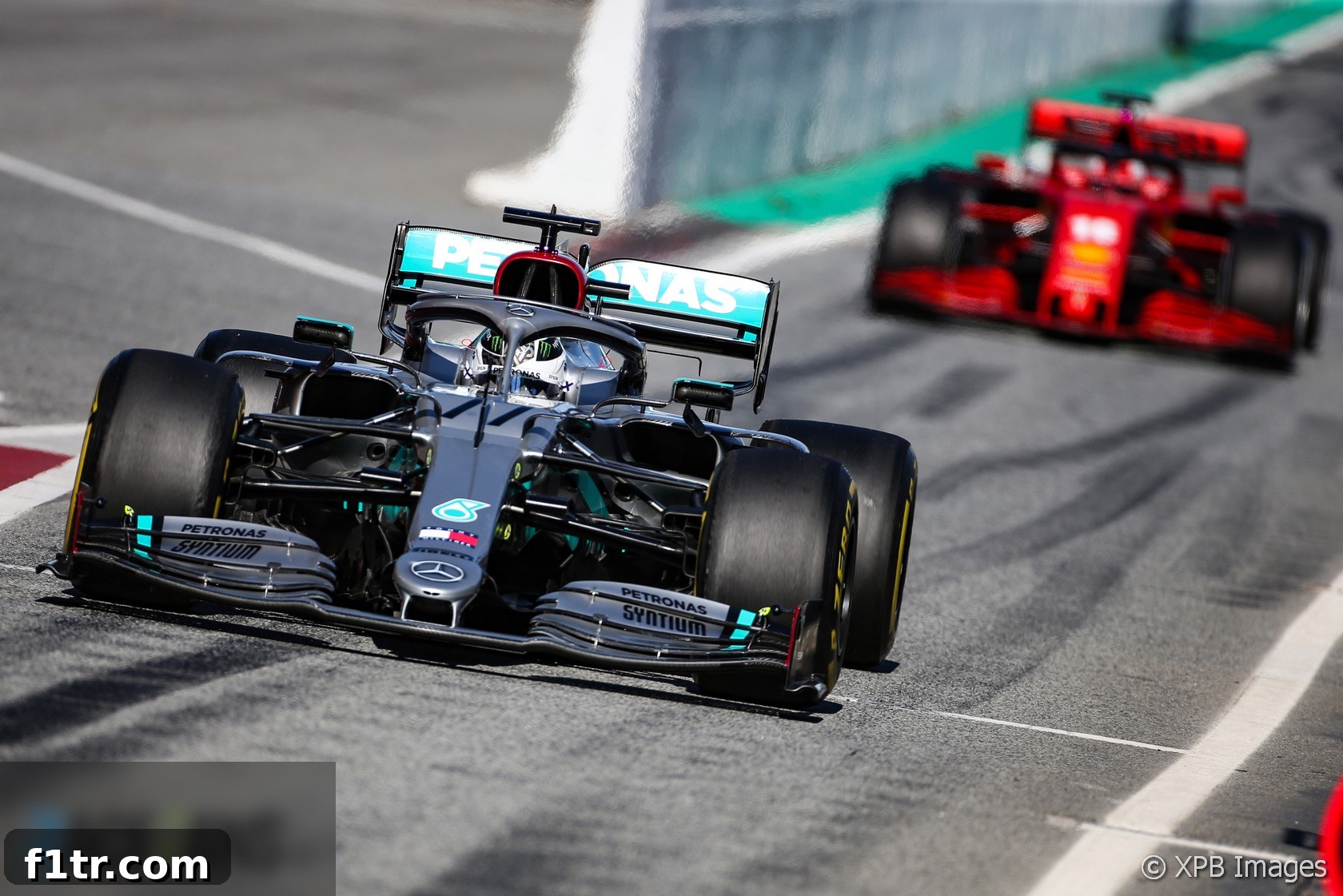
In a surprising revelation that sent ripples through the Formula 1 paddock, Ferrari’s team principal, Mattia Binotto, disclosed that the legendary Scuderia had previously contemplated developing a system strikingly similar to Mercedes’ groundbreaking Dual Axis Steering (DAS). This innovative mechanism, which captivated the F1 world upon its public debut, allows drivers to subtly alter the toe angle of their front wheels by either pushing or pulling the steering wheel, a concept that sparked immediate debate and competitive intrigue.
The DAS system first came under the spotlight when it was observed on Mercedes’ car during pre-season testing. The F1 community, ever-vigilant for technological advancements, quickly identified the novel steering input as a potential game-changer. However, Binotto’s comments suggested that the conceptual underpinnings of such a system were not entirely foreign to the minds within Ferrari’s Maranello headquarters, hinting at a shared pursuit of marginal gains that defines elite motorsport.
“The DAS system is something considered in the past, but we didn’t design and develop it,” Binotto explained, shedding light on Ferrari’s internal research and development processes. This admission underscores the relentless pursuit of innovation characteristic of Formula 1 teams, where engineers constantly explore every conceivable avenue to gain a competitive edge. Ferrari, it seems, had explored a similar mechanical solution, but ultimately chose not to pursue it beyond the initial conceptualization phase. Binotto further elaborated that the primary reasons for not progressing with the idea were multifaceted, with significant concerns revolving around the potential “legality” of such a device under the sport’s stringent technical regulations.
The question of legality is a perpetual shadow cast over radical innovations in Formula 1. Teams are constantly pushing the boundaries of what is permissible, often interpreting rules in ways that were perhaps not explicitly intended by the sport’s governing body, the FIA (Fédération Internationale de l’Automobile). Ferrari’s hesitation on DAS highlights this delicate balance between innovation and compliance. Developing a complex system only for it to be deemed illegal after significant investment of time and resources is a risk no team takes lightly. The financial and reputational costs can be substantial, making careful regulatory assessment a critical step in any new technological venture.
Beyond the legal quandary, Binotto also revealed that Ferrari harbored doubts about the system’s efficacy and suitability for their specific car concept. “We believed it [would] not work well at least for our car and for our car concept,” he stated. This insight provides a crucial look into the nuanced world of F1 car design. Each team develops a unique aerodynamic and mechanical philosophy, tailoring components and systems to integrate seamlessly with their overall package. A system that might offer significant advantages to one car’s design might be detrimental or simply ineffective when applied to another. Ferrari’s technical team, after their own analysis, concluded that the benefits offered by DAS might not align with the intrinsic characteristics of their chassis, suspension, or aerodynamic profile, making the considerable effort of development a questionable investment.
The DAS system itself is designed to allow drivers to adjust the toe angle – the angle at which the front wheels point inwards or outwards relative to the car’s longitudinal axis – while driving on the straights and through corners. The perceived advantages of such a system include better tire management, specifically quicker warm-up of the front tires and more even wear across their surface. By pulling the steering wheel, a driver could theoretically reduce the toe-in on the straights to minimize drag and improve straight-line speed. Pushing the wheel back in a corner could increase toe-out, potentially improving front-end grip and turning response. The precision and adaptability this offers drivers in real-time were seen as a significant potential performance differentiator, especially on tracks with varying corner characteristics or during critical tire warm-up phases.
Despite their earlier reservations and decision not to proceed, Binotto indicated that Ferrari has not entirely dismissed the possibility of developing their own iteration of the DAS system. “We are looking at what the others are doing,” he admitted, a typical F1 response underscoring the constant competitive surveillance among teams. The dynamic nature of F1 development means that a system initially deemed unsuitable or legally ambiguous could become a priority if its performance benefits are unequivocally proven by a competitor, and if the FIA provides clear guidance on its legality. “At the moment [it’s] really a question mark, not sure we’ll develop it,” Binotto concluded, leaving the door open for future development should the landscape change, or should Ferrari find a way to integrate the concept effectively into their car design without compromising other critical performance areas.
The ambiguity surrounding DAS’s precise mechanism also contributed to the ongoing debate. Binotto confessed to having “no idea” whether the system was purely hydraulic, electronically assisted, or a combination of both. This lack of detailed information is common in F1, where teams guard their technical secrets fiercely. Without a complete understanding of its inner workings, forming a definitive view on its compliance with regulations becomes challenging. However, Binotto expressed confidence in the sport’s governing body, stating, “We really think it’s difficult for us to judge. We don’t know the exact system. But I’m pretty sure FIA will made the right judgment.” This trust in the FIA’s regulatory oversight is crucial for the integrity of the sport, as they are ultimately responsible for interpreting and enforcing the technical rules to ensure fair competition.
The advent of DAS brought back memories of other innovative, and often controversial, solutions in F1 history, such as the double diffuser, the F-duct, or even active suspension systems. Each of these pushed the boundaries of regulation and forced the FIA to issue clarifications or outright bans. Such episodes highlight the cat-and-mouse game between ingenious engineers and the rule-makers, a dance that has always been central to Formula 1’s appeal as a pinnacle of technological advancement and sporting competition. For teams, the risk-reward calculation for implementing such radical innovations is complex: the potential for a significant performance boost must be weighed against the possibility of protest, rule changes, or even outright disqualification.
Ferrari’s cautious approach, considering legality and specific car concept suitability, reflects the immense pressures and strategic thinking involved in F1 development. While Mercedes ultimately proved the system’s effectiveness and its legality (at least for the season it was introduced, before being banned for subsequent years), Ferrari’s journey with a similar concept reveals that great minds often think alike in the relentless pursuit of speed. It also underscores that even brilliant ideas might not be universally applicable or justifiable given the unique constraints and philosophies of individual teams. The saga of DAS, from its initial discovery to its eventual clarification by the FIA, stands as a testament to Formula 1’s enduring spirit of innovation, where every millimeter and every degree of angle can translate into a tangible performance advantage on the racetrack.
Read more about DAS in today’s RacingLines column: Why Mercedes could still fight a legality fight after reinventing the steering wheel
Don’t miss anything new from RaceFans
Follow RaceFans on social media:
- Join RaceFans on Facebook
- Follow RaceFans on Twitter
- Get daily email updates from RaceFans
Advert | Become a RaceFans supporter andgo ad-free
2020 F1 season
- Grosjean to make F1 test return tomorrow for first time since Bahrain horror crash
- Pictures: Wrecked chassis from Grosjean’s Bahrain fireball crash to go on display
- Bottas vs Rosberg: Hamilton’s Mercedes team mates compared after 78 races each
- F1 revenues fell by $877 million in Covid-struck 2020 season
- Hamilton and Mercedes finally announce new deal for 2021 season
Browse all 2020 F1 season articles