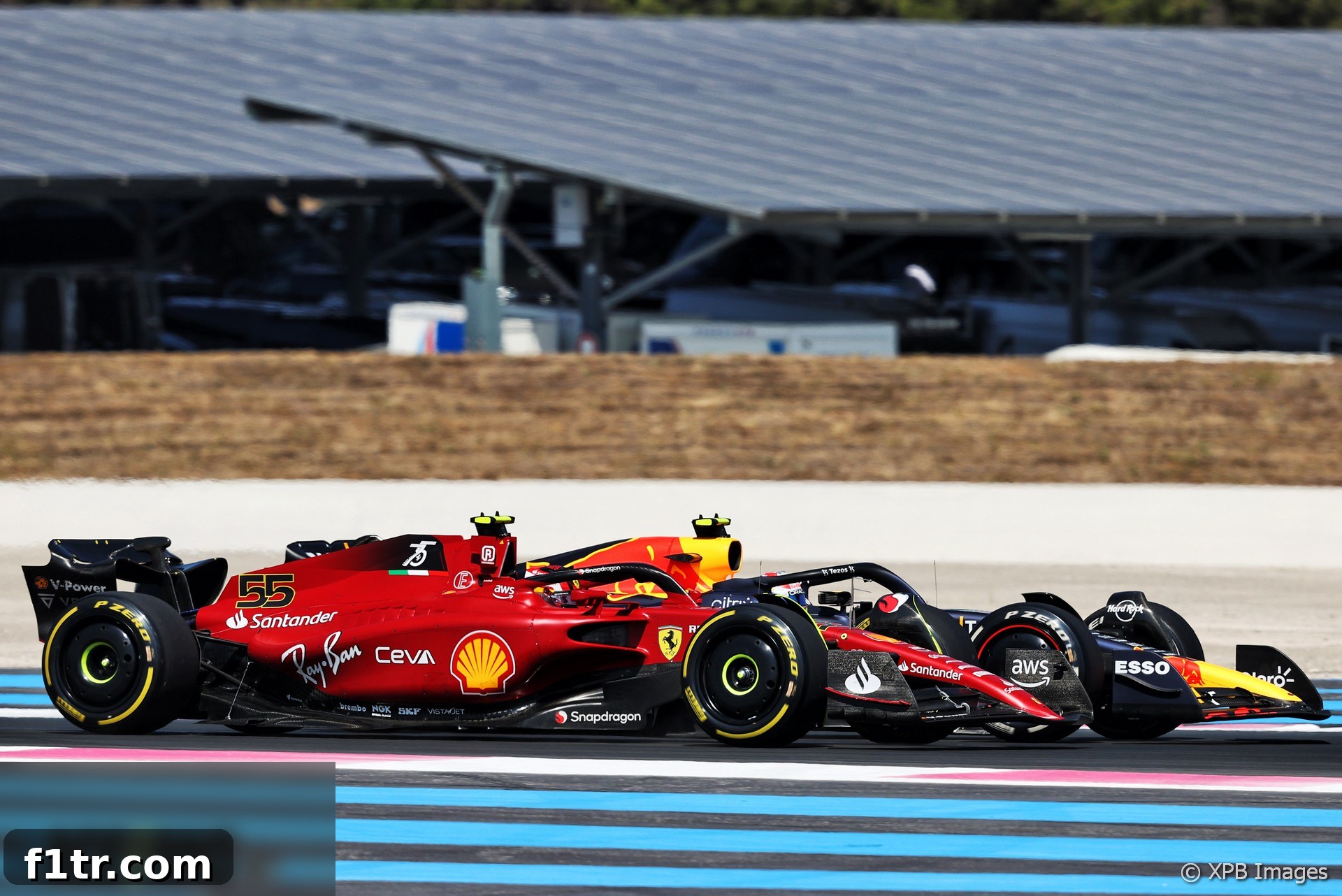
In the high-stakes world of Formula 1, every strategic call, every radio message, and every on-track maneuver is scrutinized. The 2022 French Grand Prix proved to be no exception, particularly for Scuderia Ferrari, whose race strategy for Carlos Sainz Jnr ignited a fierce debate among fans and pundits. Ferrari, however, firmly asserts that the broadcast of their radio messages created a significant misunderstanding, painting an inaccurate picture of the intricate strategic discussions unfolding on their pit wall.
The core of the controversy stemmed from a specific moment during the live television coverage. Viewers witnessed a radio exchange where Sainz appeared to refuse an instruction from his race engineer, Riccardo Adami, to make a second pit stop. This message was aired precisely as Sainz was engaged in a thrilling battle, successfully overtaking Sergio Perez for third place. The juxtaposition of the two events led many to believe that Ferrari was making a baffling call, asking their driver to pit at a crucial moment when he was gaining track position.
Ferrari was quick to clarify the situation, emphasizing a critical detail often overlooked in fast-paced F1 broadcasts: the inherent delay in live television feeds. The team explained that the radio message heard by viewers was not broadcast in real-time, creating a lag that distorted the perceived timing of their instruction. This delay, Ferrari argued, misled the audience into thinking they had called Sainz into the pits precisely when he was mid-overtake.
Inaki Rueda, Ferrari’s astute Head of Race Strategy, elaborated on this critical point in a detailed video analysis released by the team. “The way the television production feeds the data to the viewers has a delay in it,” Rueda explained. He meticulously recounted the actual sequence of events: “In this case, you saw Perez and Carlos were fighting on lap 41. We were talking to Carlos. We saw that Carlos could not overtake Perez on the back straight and in Turn 10 we actually called Carlos in.”
Rueda continued, shedding light on the driver’s perspective in the heat of battle. “Of course, he was fighting with Perez, he thought he would have him the lap after. And that’s why he decided to [say] ‘please don’t come in, not this lap’.” The crucial detail, as Rueda highlighted, was the timing of the broadcast: “Now, you were watching the television live, that call came on the television feed on Turn 15, right after the entry, which is nonsensical, because do we call the driver so late he cannot actually react to our call?” This discrepancy underscored Ferrari’s argument that the broadcast timing fundamentally misrepresented the team’s communication and strategic intent.
The ultimate outcome of Sainz’s final pit stop saw him drop from a provisional third place on track to eighth. Despite a valiant recovery drive, he could only regain fifth place by the chequered flag, fueling widespread criticism and assertions that Ferrari had committed yet another strategic misstep. However, Rueda robustly defended the decision, asserting that a second pit stop for Sainz was not merely an option but a critical necessity for safety and performance.
The underlying reason, Rueda explained, concerned the medium compound tyres Sainz had fitted during an earlier Safety Car period. These tyres, he revealed, were never intended to last the entire race distance. “The life expectancy of the tyre is around 25 laps,” Rueda stated, “and that stint after the Safety Car called for a 35-lap stint. So we would have been 10 laps short.” This significant shortfall presented a substantial risk. “In these cases when a driver goes past the life expectation of the type, he has to nurse that tyre, he has to drive very slowly, otherwise he potentially risks having a tyre failure.” The implications of such a failure are severe: “Having a tyre failure is potentially very dangerous because you will for sure end up with a car in the barrier.” This detailed explanation underscored the safety-first approach that often dictates strategic calls in F1, a factor frequently underappreciated by external observers.
Adding another layer of complexity to Ferrari’s decision-making was the five-second time penalty Sainz had incurred at his first pit stop. This penalty meant that even if he could have held off rivals like Sergio Perez and George Russell on track, he would still drop behind them once the penalty was applied post-race. Rueda articulated this clearly: “Even though Carlos still managed to overtake Russell and Perez he was never going to be able to open a five-second gap on them, having to nurse those medium tyres to the end.” With a looming penalty and rapidly degrading tyres, the strategic team saw no practical value in leaving Sainz out. Instead, they opted for a calculated move: “With this in mind, we decided to pit Carlos and make sure that he came back and got an extra point for the fastest lap.” This decision, while costing track position temporarily, secured a valuable championship point and mitigated the risk of a dangerous tyre failure, showcasing a pragmatic approach to a challenging race scenario.
The French Grand Prix also held significant “what if” scenarios for Sainz’s teammate, Charles Leclerc. Leclerc’s race tragically ended early when he crashed out at Beausset while being pursued by Max Verstappen, who had just made his first pit stop. The immediate aftermath sparked speculation about whether Verstappen would have eventually overtaken Leclerc even without the crash.
Red Bull team principal Christian Horner openly expressed his belief that Verstappen would have got ahead of Leclerc and maintained his lead once the Ferrari driver eventually made his pit stop. However, Ferrari held a contrasting and confident view. Their internal analysis suggested that Leclerc, had he remained on track, would have been able to gain a sufficient tyre advantage over the Dutchman to pass his championship rival and secure the win.
“Charles did an excellent job of keeping Verstappen behind the whole first stint and Verstappen came in and stopped very early,” Ferrari’s strategy chief reiterated. “We thought that would be the case, and Charles was ready to ignore Verstappen and concentrate on doing our optimum race. Unfortunately, Charles didn’t finish the race.” Rueda’s statement conveyed Ferrari’s conviction: “We were quite confident that had it going in another way Charles would have pitted five or six laps later and would have had the pace to come back at Verstappen and overtake him for the race win.” This assertion highlights the often-invisible layers of strategic planning that operate during an F1 race, where each team anticipates and counters the moves of their rivals with carefully planned sequences of laps and pit windows.
Ultimately, the 2022 French Grand Prix served as a stark reminder of the complexities inherent in Formula 1 strategy. Beyond the raw speed and audacious overtakes, success hinges on real-time data analysis, tyre degradation models, driver feedback, and the ability to adapt under immense pressure. Ferrari’s defense of their decisions for both Sainz and Leclerc underscores the internal logic guiding their pit wall, which is often lost in the delayed and condensed narrative presented to television audiences. While public perception can be swayed by isolated moments, the team’s detailed breakdown reveals a deeply considered and safety-conscious approach to race management, striving to optimize results within the ever-changing dynamics of a Grand Prix.
2022 French Grand Prix Analysis & Aftermath
- Ferrari’s season of missed chances led to “difficult” criticism for Binotto
- McLaren looking into why their starts are “more inconsistent” this year
- Mercedes expect Hungarian GP will ‘expose our qualifying weakness’
- Hamilton and Russell ‘out-performing a car that’s not good enough’ – Wolff
- “We need to decide now”: Inside Sainz and Ferrari’s French GP strategy dilemma
Browse all 2022 French Grand Prix articles