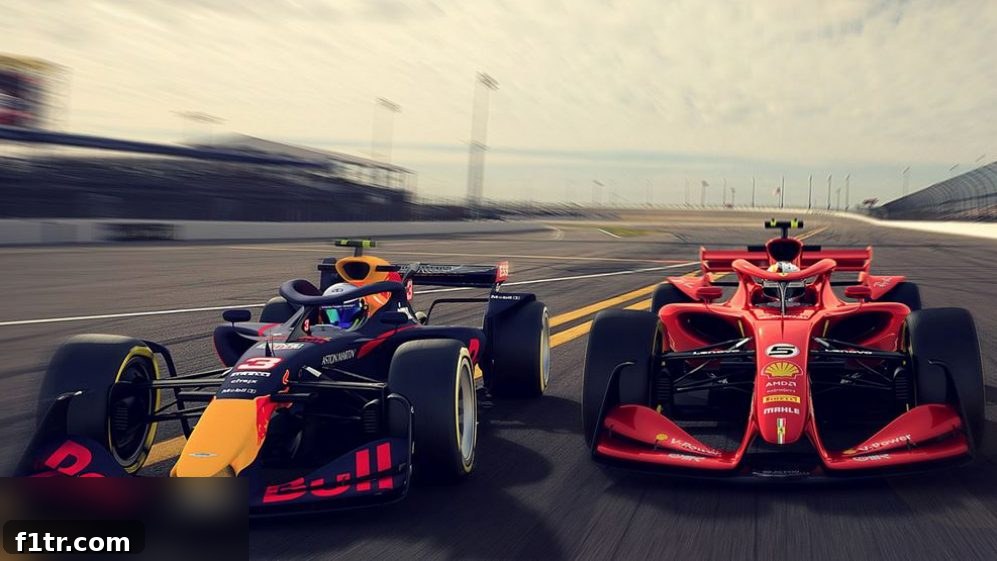
Ferrari’s Bold Critique: F1’s 2021 Concept Car Design Deemed “Underwhelming”
The unveiling of Formula 1’s preliminary concept car designs for the anticipated 2021 season sparked a wave of discussions and mixed reactions across the paddock. While some lauded the bold vision for the sport’s future, one of the most prominent voices in F1, Ferrari, expressed significant disappointment. The Italian powerhouse, through its then-team principal Maurizio Arrivabene, did not mince words, describing the proposed aesthetic changes as “underwhelming” and strikingly similar to older racing series models.
This candid assessment from Maranello, delivered during the official FIA press conference at the Singapore Grand Prix, immediately put a spotlight on the inherent challenges of redesigning a sport as iconic and technologically driven as Formula 1. It underscored the delicate balance between pushing boundaries for a more exciting spectacle and respecting the rich heritage and distinct identity of F1 machinery.
The Vision for 2021: A New Era for Formula 1
The push for radical changes in Formula 1’s technical regulations for the 2021 season was driven by a clear objective: to enhance the racing spectacle, improve car aesthetics, and ensure long-term sustainability for the teams. Ross Brawn, F1’s then-motorsport managing director, spearheaded this initiative. His team’s primary goal was to create cars that were not only visually appealing but also conducive to closer, more thrilling on-track battles. The intention was to simplify complex aerodynamics, reduce the impact of ‘dirty air’ on following cars, and potentially reintroduce ground effect principles to generate downforce, thereby allowing drivers to race in tighter proximity.
Aesthetics played a crucial role in this vision. Brawn and his team recognized that modern F1 cars, while engineering marvels, had become somewhat convoluted in their design due to the relentless pursuit of aerodynamic efficiency. The 2021 concepts aimed to strip away some of this complexity, proposing cleaner lines, more aggressive stances, and a futuristic appeal that would captivate a global audience. Three distinct concept designs were presented, each offering a slightly different interpretation of these overarching goals, showcasing various aerodynamic approaches and stylistic elements designed to signal a fresh chapter for the sport.
Ferrari’s Unflinching Critique: “Underwhelming” and “Like an Old Champ Car”
However, Ferrari’s reception to these forward-looking designs was far from enthusiastic. Maurizio Arrivabene, speaking directly to the media, relayed the sentiments of his engineering team. “I was looking at the car presented a couple of days ago by Ross,” he stated, acknowledging the effort. “It’s a good exercise.” Yet, the diplomatic opening quickly gave way to genuine dissatisfaction: “I was asking our engineers what they thought about this, they said it’s a bit underwhelming in their opinion and it looks like an old Champ Car.”
This comparison to a “Champ Car” was particularly pointed. The Champ Car series, which ceased racing in 2008, represented a different era of open-wheel motorsport, known for its powerful but aerodynamically less sophisticated cars, often employing a single-specification chassis like the Panoz DP01 in its final full season. For Ferrari, a constructor synonymous with cutting-edge technology and unparalleled design pedigree, associating F1’s future with a defunct series implied a perceived regression rather than progression. It suggested that F1’s proposed designs lacked the innovative spirit, the unique F1 identity, and the futuristic elegance that the sport’s premier team expected.

Arrivabene did not specify which of the three concept designs he was referring to, but his general dissatisfaction highlighted a fundamental philosophical clash. Ferrari has historically championed technical freedom and innovation, believing that competition in design and engineering is central to F1’s appeal. Any move towards more standardized or aesthetically constrained designs would naturally draw skepticism from a team whose identity is so deeply intertwined with engineering excellence and artistic flair in vehicle design.
Contrasting Perspectives: A Broader Embrace of Change
While Ferrari voiced its reservations, the initial reception from other key figures within the sport was largely more positive. Ross Brawn himself, the architect of these concepts, emphasized the importance of creating “better-looking cars” as a top priority. His belief was that the proposed changes would not only improve the racing but also restore a sense of visual grandeur that F1 cars perhaps lacked in their most aerodynamically extreme forms.
Notably, reigning world champion Lewis Hamilton and his Mercedes team principal Toto Wolff were among those who offered a positive first reaction to the revealed designs. Their endorsement suggested an openness to change, perhaps driven by a desire for closer competition or a genuine appreciation for the refreshed aesthetic. Mercedes, as a dominant force in the hybrid era, understood the need for evolution to maintain the sport’s excitement and appeal, even if it meant challenging the existing technical paradigm. Their perspective likely acknowledged the broader goals of the regulations: to create a more level playing field and a more engaging spectacle for fans.
Ferrari’s Own Vision: A History of Future Concepts
Ferrari’s critical stance on F1’s 2021 concepts was not merely reactive; it stemmed from its own proactive engagement with the future of Formula 1 car design. Three years prior to F1’s 2021 unveiling, in 2015, Ferrari themselves had presented their own radical vision for a future F1 car. This independent concept, developed entirely in-house, showcased a stunningly aggressive and futuristic design, characterized by sleek lines, larger rear wings, and a dramatic bodywork integration that pushed the boundaries of conventional F1 aesthetics.

The contrast between Ferrari’s 2015 concept and F1’s 2021 proposals was stark. Ferrari’s design emphasized extreme aerodynamic sculpting and a distinctly avant-garde appearance, reflecting a philosophy where performance and visual drama were intertwined in a uniquely F1 package. This internal benchmark likely contributed to their disappointment with the official F1 concepts, which they perhaps perceived as less innovative or less aligned with the pinnacle of motorsport design that Ferrari continually strives for.
The Enduring Debate: Aesthetics vs. Performance in Formula 1
The diverse reactions to the 2021 concept cars highlighted an enduring tension in Formula 1: the ongoing debate between aesthetic appeal and pure racing performance. While Ross Brawn’s team was striving for cars that looked better and raced closer, for a team like Ferrari, the “look” must always be a consequence of sophisticated engineering and uncompromising performance. Any design that sacrifices perceived technological superiority for a generalized aesthetic might be seen as diluting the very essence of F1.
Moreover, the political undercurrents of F1 regulations cannot be ignored. Major rule changes often represent power struggles between the sport’s governing bodies, commercial rights holders, and the established teams. Ferrari, with its historical veto power and deep-rooted influence, has always been a formidable voice in these discussions. Their vocal criticism served as a powerful statement, signaling that they would not passively accept changes that they felt did not align with their vision for Formula 1’s future, or that they believed might compromise the sport’s integrity or their own competitive advantage.
The Road to the Final 2021 Regulations
It’s important to remember that the designs presented in 2018 were merely concepts – initial ideas intended to provoke discussion and gather feedback. The journey to the final 2021 regulations involved extensive aerodynamic research, simulations, and consultations with all teams, engineers, and stakeholders. The initial reactions, especially Ferrari’s strong critique, played a vital role in shaping the iterative design process.
Ultimately, the final 2021 regulations, while incorporating many of the principles envisioned in the early concepts (such as simplified front wings, enhanced ground effect, and larger wheels), evolved significantly from the initial sketches. The input from teams like Ferrari, even if initially critical, contributed to a more refined and robust set of rules that aimed to deliver on the promise of better racing and more appealing cars, while still allowing for engineering creativity within a more constrained framework. The debate over the ideal F1 car design is perpetual, but the initial clash over the 2021 concepts vividly illustrated the passion and diverse philosophies that make Formula 1 the unique spectacle it is.