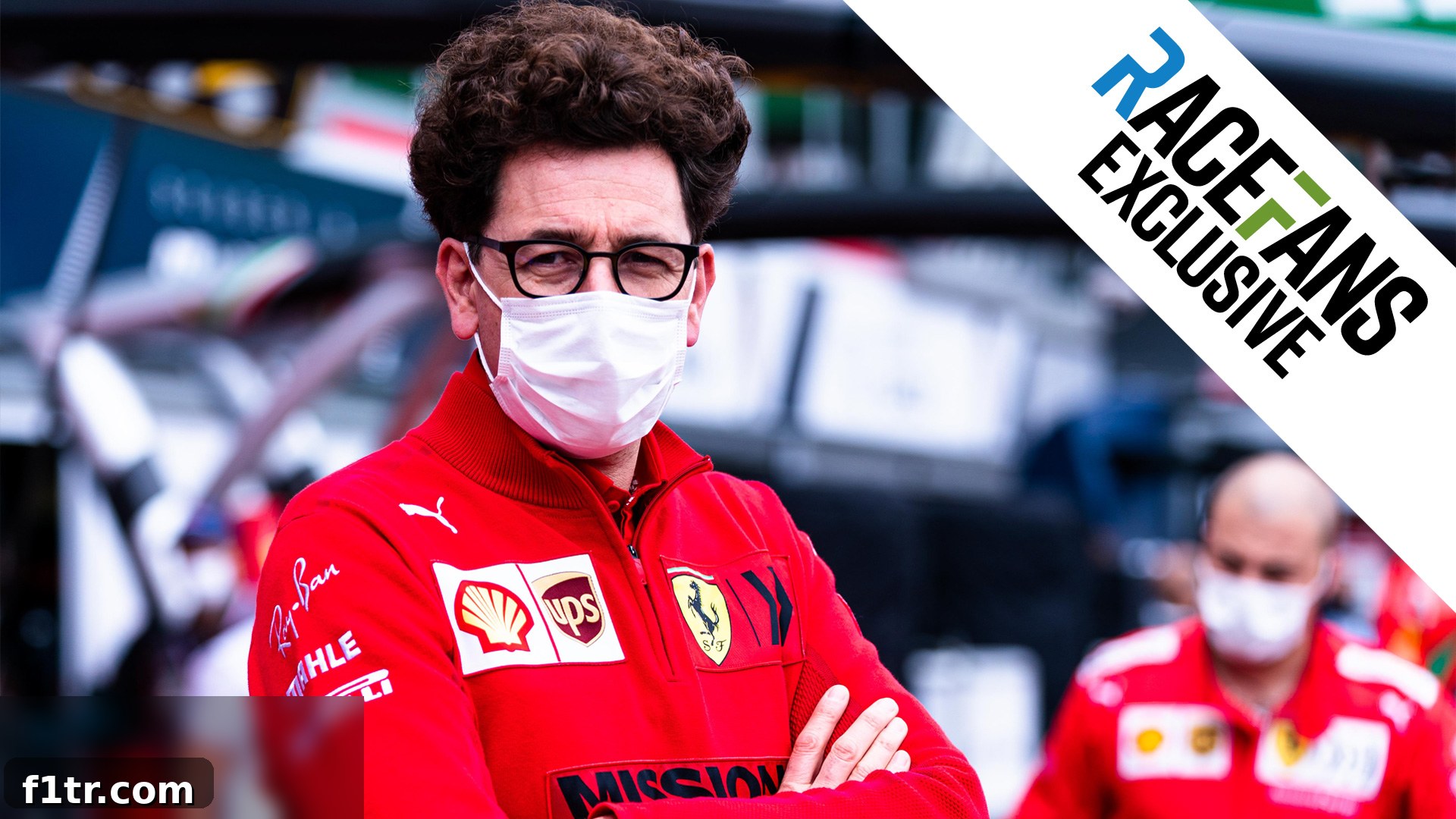
In the high-stakes world of Formula 1, where every millisecond counts, timing truly is everything – whether by design or serendipity. This exclusive interview with Scuderia Ferrari’s Managing Director and Team Principal, Mattia Binotto, unfolded at an incredibly opportune moment. Conducted just weeks before the iconic Monaco Grand Prix, and scheduled for a Friday morning in the principality, the timing gained an unexpected layer of significance when Ferrari’s two illustrious red cars impressively topped the time sheets during Thursday’s preliminary practice sessions.
Binotto, now in his third demanding season at the helm of the legendary Italian squad, greeted us on Zoom with his characteristic impeccable courtesy and professionalism. Yet, beneath his composed exterior, there was a distinctly more optimistic tone to his remarks compared to our previous conversation nearly a year prior. This newfound buoyancy was entirely understandable, given the immense pressures that the then-50-year-old had been shouldering at the time, navigating one of Ferrari’s most challenging periods in recent memory.
The conversation began with an acknowledgment of the Scuderia’s need to “rebuild” after a particularly sub-standard previous season. However, Binotto was quick to challenge this specific choice of word. He meticulously clarified that a full, root-and-branch “rebuild” was not the accurate term for the team’s ongoing efforts. Instead, he preferred to refer to the process as a crucial “regrouping” ahead of the current season. This distinction is vital in Formula 1; a rebuild suggests fundamental structural flaws, whereas a regrouping implies a strategic recalibration and renewed focus on existing strengths.
Navigating Leadership Transitions and Corporate Independence
The concept of “regrouping” gained further complexity with the abrupt departure of Ferrari president and CEO Louis Camilleri in December, a significant leadership void for which no successor had yet been publicly named. This raised questions about Ferrari’s decision-making processes, especially considering the extensive responsibilities of Ferrari chairman John Elkann. As the Agnelli scion and head of Exor – which controls the family’s vast holdings, including key interests in Ferrari and the newly formed automotive conglomerate Stellantis (a merger of Fiat-Chrysler and Peugeot-Citroen) – Elkann’s plate was undeniably full. Could such a complex corporate structure lead to convoluted decision-making within the F1 team, I inquired?
Binotto addressed this directly, explaining the foundational work laid under Camilleri’s tenure: “With Camilleri, we started the [current] journey; I think we invested a lot in our medium-to-long term future. The [signing of the] Concorde Agreement is one example, so I think a lot of work has been done to set the foundations.” He emphasized continuity rather than disruption. “John was already part of the time involved as chairman. I think today, it’s not a matter of rebuilding, it’s continuity from the past as Scuderia Ferrari and Gestione Sportiva (the sporting division), and obviously myself as managing director.”
Binotto was resolute in asserting his operational freedom. “I have got the full autonomy and daily delegations of power. If I need their support I have got their support as I had it in the past. I don’t think much has changed.” The pertinent question then became whether this structure and autonomy would persist once Elkann appointed Camilleri’s permanent replacement. Binotto expressed confidence in the current dynamic: “John Elkann is fully aware, fully involved and coming to some races; it’s a very positive and constructive collaboration that we’ve got. He is chairman and CEO, so I report to him whatever we are doing and the main [decisions]. I’m convinced that because Ferrari is a unique family, there will always be good, positive collaboration.”
Regarding the massive Stellantis merger, which created the world’s eighth-largest motor manufacturer encompassing an array of brands from Abarth to Vauxhall and employing 350,000 people, Binotto was equally clear on Ferrari’s independence. “No, Ferrari is independent from Stellantis, and I do not see any impact. Mr. Elkann is very fully committed to the Ferrari project. He has announced that we will have very soon another (Ferrari) CEO.” This distinction is crucial for a luxury brand like Ferrari, which maintains its exclusive identity and strategic direction, separate from the broader Stellantis portfolio.
Leading Through Adversity: The 2020 Season and Beyond
From a results perspective, the previous year stood as an unmitigated disaster for Ferrari. Finishing sixth in the Constructors’ Championship, with no wins and only three podium finishes, the pressure on Mattia Binotto was immense. The F1 paddock, ever a hotbed of speculation, buzzed with snide comments and innuendo about Ferrari’s infamous “revolving door” for team principals. It was a period that tested Binotto’s resolve. How did he manage to absorb such immense pressure and keep the Scuderia heading in a unified, forward direction?
“It was a very difficult season,” he admitted with a wry smile, “a lot of pressure on my shoulders. I certainly felt the responsibility. But I know that in such a difficult time the team was united. It would have been very easy internally for the team to blame each other, but it never happened. The team remained united, with the right winning spirit to move forward and demonstrate that we can do better.” This emphasis on internal unity in the face of external criticism highlights a crucial aspect of his leadership philosophy.
Binotto elaborated on his leadership approach during this critical period: “As a leader the most important thing is that the team is united, which means that you’ve got the right [next tier] leadership. For me it was important at the time to ensure that the pressures that I had were not reflected into the team.” His primary focus remained on maintaining a positive and constructive environment, shielding his team from the harsh glare of public scrutiny and internal doubts. “My focus was on that and not listening to rumours and putting blame on myself and on the team, keeping focusing on trying to improve.”
The intense scrutiny naturally led to questions about his internal support. Did he ever doubt the full confidence of John Elkann and Louis Camilleri? His earnest reply was immediate and firm: “Never doubt about either, because I know that I had that since the very start. As I said, I’m fully empowered and my responsibility, and, as I said, last year we invested a lot in our medium-to-long-term future and I think we made the right choices.”
Binotto underscored the long-term nature of success in Formula 1, a sport notoriously devoid of instant solutions. “Now it’s time to continue building, a matter of managing the expectations. There are no silver bullets in F1. If we look at ourselves at the start of the nineties to 2000 with Michael [Schumacher] and Jean Todt, it took time to build the team.” He drew parallels with other successful eras and teams: “It took time at Red Bull or Mercedes; even more, if you look to Red Bull, it’s a long time that they are not winning [championships]. But they are the passions without let me say no revolutions inside of the team. They are passionate, working hard and working well, but to build it takes time. I know I have the full trust, and I feel the responsibility and it’s my job to commit to the world.”
The Weight of the Prancing Horse
Accepting the role of Ferrari Team Principal is arguably the highest-profile, most scrutinized, and historically challenging position in Formula 1, often described as a poisoned chalice. Given the intense pressure and the historical turnover in the role, has he ever regretted taking on such a formidable responsibility?
Binotto’s response was immediate and emphatic, leaning forward slightly for emphasis: “I have never regretted it, because I enjoy the passion which is Formula 1, I enjoy the passion for the Cavallino. I’ve always been a fan. I know it’s a big challenge but overall I’m very keen to be part of the family and give my full support to whatever is the result of the future project.” His personal connection to Ferrari and the sport transcends the job title itself. “For me it’s more important to be part of the family rather than being team principal,” he continued. “Each person has got his own responsibility within the team and here is not one role which is more important. That’s my role today, I’ve been chosen to do it, I try to do my best.” This perspective underlines a deep-seated loyalty and commitment to the Ferrari ethos, viewing his role as an integral part of a larger, cherished institution.
Overcoming Operational Hurdles: A Lesson-Learned Approach
While the SF21 car demonstrated clear performance improvements – as evidenced by the promising Thursday practice results in Monaco – the team had historically been plagued by operational errors, including strategic slip-ups and reliability issues. Charles Leclerc’s unfortunate failure to start from pole position at his home Monaco Grand Prix, which tragically occurred after this interview, served as a stark, fresh example of these persistent challenges. For Ferrari to truly reclaim its front-running status, these operational flaws must be eradicated. How did Binotto envision overcoming these critical hurdles?
“That’s a good point, because as I said before, it’s a matter of time and passion. There are no silver bullets, so it’s a matter of approaching the mistakes as a lesson-learned approach, ensuring that each time a mistake is made it’s not a matter of blaming someone,” Binotto stated firmly. This ‘no-blame’ culture is fundamental to fostering a learning environment. “It’s a matter of understanding what were the reasons, why we came to that choice and that mistake, and ensuring that we put in place actions to avoid them in the future. Stability in the team is crucial as well, we’ve got the same persons doing strategies since many years, the pit crew is stable.”
He emphasized that consistent progress stems from continuous improvement and stability. “So, keeping stability and building a team that can improve time after time [is the objective], mistakes after mistakes is where we are putting our effort. If we look at the season we’ve had so far: solid race weekends; there have been difficult situations like in Imola, the weather, the rain, but I think we always made the right strategic choice and on the engineering side, the pit crew side it has been quite consistent. That’s important.”
Driver Line-up and Regulatory Advantages
One of the most significant changes since the previous season was the alteration of the driver line-up. The announcement of Carlos Sainz Jnr replacing four-time world champion Sebastian Vettel came even before the delayed 2020 season commenced. Why was Vettel’s contract not extended? Was this decision influenced by the highly publicized “moments” Vettel and Leclerc experienced during the 2019 season, particularly incidents involving team orders?
“No, no, no – what happened in 2019 was not the reason,” Binotto stated emphatically, dispelling any lingering speculation. “When we had the lockdown at the start of last year it was the time for us to decide [on our future driver line-up]. It was even more important to decide very soon simply out of full respect to ourselves, and to Sebastian to give him the opportunity to find another seat. The fact that today he’s driving for Aston Martin, I’m very happy with that.” This move demonstrated a pragmatic approach to future planning while respecting the career trajectories of their drivers.
Under the current sporting regulations, teams benefit from additional wind tunnel hours on a sliding scale, determined by their championship positions at both the start and mid-point of the season. Consequently, Ferrari gained an advantage from its sixth-place finish in 2020. How significant has this been in the development of next year’s car, particularly the crucial 2022 challenger?
“I don’t think it is much [but] certainly it’s better to add some extra hours than not,” Binotto acknowledged. However, he contextualized its impact: “But, if you look at the overall benefit it’s a couple of sessions on the wind tunnel. Normally a couple of sessions can give up to maybe a 10th second per lap, which can be significant when you are battling. It’s not a game changer.” While every marginal gain is valued in F1, he indicated it wouldn’t fundamentally reshape the competitive landscape.
Was Ferrari in favor of this ‘success ballast’ style measure when it was initially proposed? “I was in favour because [F1] was looking for tricks to help convergence, like balance of performance, where you add [weight] ballast during race weekends,” he explained. “I think this is a better, let me say, ‘trick’.” This indicates a pragmatic acceptance of measures aimed at promoting competitive parity across the grid.
Innovation, Budget Caps, and the Future of Automotive Power
Speaking of ‘tricks’, would the new budget cap inherently limit innovation by constraining available expenditure for F1 teams? Binotto offered a nuanced perspective: “As far as ‘is the budget cap limiting innovation?’ I’m not too sure. In F1 there are always regulations and what we are doing is pushing ourselves to the limit of the regulations in innovating within the framework of the regulations. We have technical, sporting regulation and now there are financial regulations, fair enough.”
He argued that the spirit of innovation would simply shift. “The spirit is to somehow try to innovate to the maximum. So there will still be innovations that matter but now we need to be more efficient and chase each single [inefficiency]. What we are doing as Ferrari and the other top teams at the moment is before we cut any opportunities for development is to ensure that we are efficient and chasing wastage.” The budget cap, therefore, becomes a catalyst for a new kind of innovation. “In that respect there is much that can be done, which means that the financial regulations will help F1 teams become more efficient in the future, which is good and which is also innovation. It’s not technical innovation, but it’s still innovation. Lean engineering is something which is becoming more and more important.” As a prime example, he cited simulation tools, calling them “the cheapest way of developing.”
Binotto sees a broader application for this shift. “There is so much which is so complex [in the wider automotive field] that you need good simulations, otherwise expenditure will be too significant,” he explained. “So F1 can become a platform for innovation in this respect.” This highlights the potential for F1 to contribute to the automotive industry beyond just powertrain development.
The current buzzwords in F1 and supercar circles are ‘biofuels’ and ‘synthetic fuels’, both of which are seen as potential pathways to make their respective products sustainable. Indeed, Porsche is actively pushing the development of such energy sources. Where does Ferrari, a brand synonymous with high-performance internal combustion engines, stand in this crucial debate?
“I don’t know if biofuel is the right definition, I would say renewable fuels,” commented the former head of Ferrari’s F1 engine department, highlighting the technical nuance. “That’s the way we should approach it, the technical specifications of it. I see that full electric is not the only solution for the future of the automotive. I think that hybrid engines are certainly an alternative.” This stance underscores Ferrari’s commitment to internal combustion engines, albeit in a more sustainable, hybridized form.
He continued to elaborate on the crucial role of design: “But the hybrid has to be with renewable fuels, with engines which are designed for the purpose of the electrification and the hybrid. That is not the case today, we’ve got engines where you’re plugging [in] electric parts. Now I think you’ve got an electric and you need to design the engines for the purpose of it.” This suggests a more integrated, purpose-built approach to hybrid powertrains. “I think the alternative to full electric is engines designed for the purpose of being hybrid, powered by renewable fuels. F1 has to remain an important innovation platform for the automotive [industry], and I think that deciding the new regulations is key in that respect.” Ferrari sees F1 as a vital testbed for developing these advanced, sustainable hybrid solutions, safeguarding the future of the internal combustion engine in a carbon-neutral world.
Binotto’s Vision for Ferrari’s New Era
Spearheading Ferrari’s Formula 1 program remains arguably the sport’s biggest and most daunting challenge. As Binotto himself pointed out, it took Jean Todt nearly seven years of tireless effort to return the Scuderia to championship-winning ways. And once that monumental turnaround was complete, the team proceeded to set records that stood for over two decades, achieved with annual budgets exceeding half a billion. This historical context frames the immense task Binotto faces.
In many aspects, Binotto’s calm, methodical approach to his role bears a striking resemblance to Todt’s leadership style – a demeanor that is undoubtedly his greatest asset as he guides Ferrari through its current “regrouping.” However, Binotto is also distinctly his own man, bringing a more profound technical understanding and background to the role than Todt possessed. As Formula 1 stands on the cusp of a “new era,” characterized by significant regulatory shifts, budget caps, and a heightened focus on sustainability, this deeply technical yet composed leadership approach could very well prove decisive in steering the Prancing Horse back to its rightful place at the pinnacle of motorsport.
RacingLines
- The year of sprints, ‘the show’ – and rising stock: A political review of the 2021 F1 season
- The problems of perception the FIA must address after the Abu Dhabi row
- Why the budget cap could be F1’s next battleground between Mercedes and Red Bull
- Todt defied expectations as president – now he plans to “disappear” from FIA
- Sir Frank Williams: A personal appreciation of a true racer
Browse all RacingLines columns