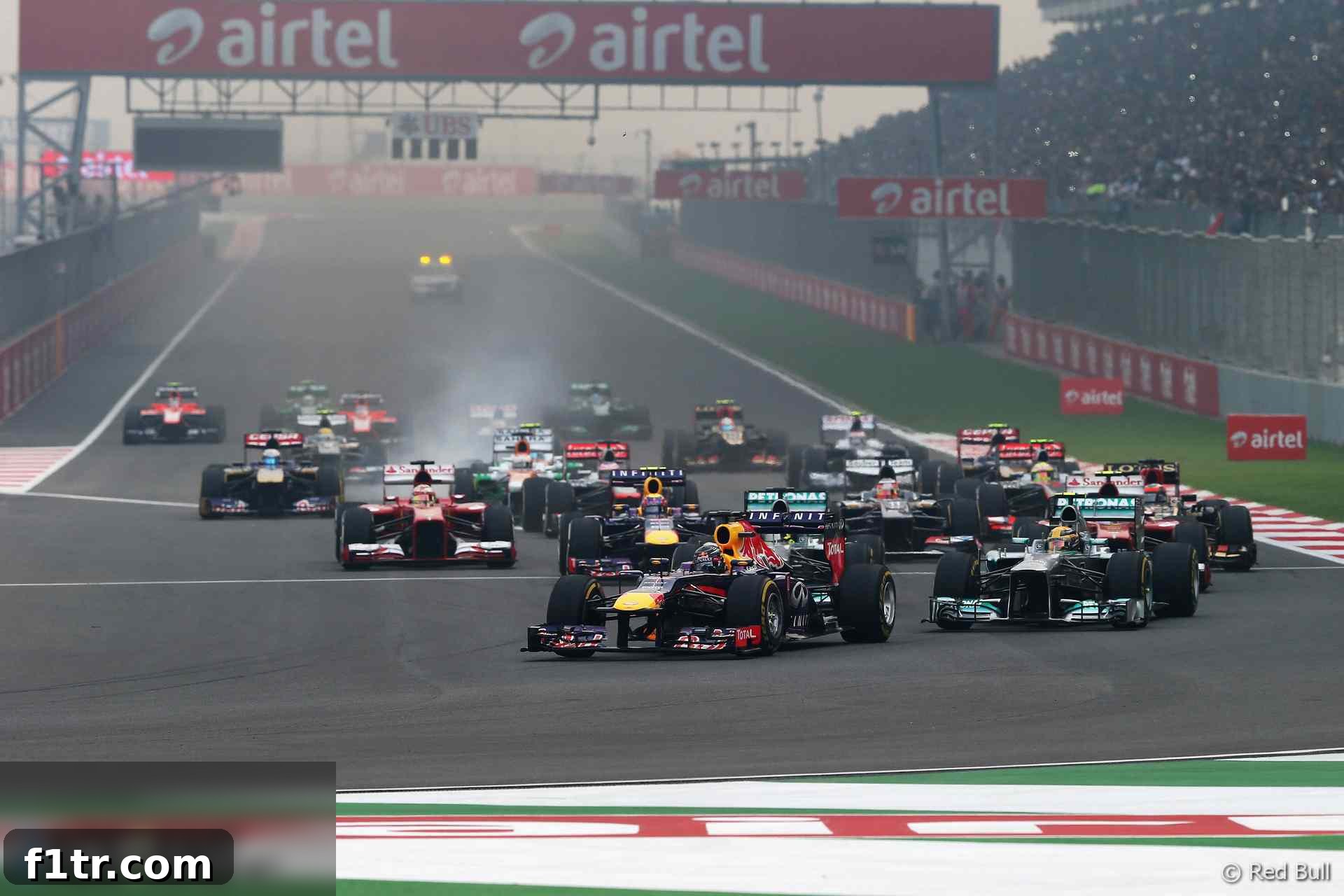
In a recent development that has stirred both excitement and skepticism among motorsport enthusiasts, India’s Minister for Sport, Mansukh Mandaviya, declared on Monday that Formula 1 would make its highly anticipated return to the country in 2027. The minister specifically named the Buddh International Circuit, located south-east of New Delhi, as the venue for this grand comeback, stating unequivocally, “First race will be at Buddh International Circuit.” This announcement, delivered with an air of certainty, instantly reignited hopes that have long flickered among Indian F1 fans.
However, the wave of optimism generated by Mandaviya’s statement was swiftly met with a dose of stark reality. A spokesperson for Formula 1 promptly issued a statement describing the prospect of an F1 race in India in 2027 as “highly unlikely.” This immediate rebuttal from the sport’s governing body poured cold water on the burgeoning enthusiasm, highlighting the significant hurdles that remain before F1 can truly consider a return to the subcontinent. The contrast between the minister’s confident pronouncement and F1’s cautious stance underscores a complex history of ambition, logistical challenges, and financial intricacies that have previously plagued motorsport events in India.
Advert | Become a Supporter & go ad-free
The Elusive Dream: F1’s Past in India and the Shadow of Disappointment
For F1 fans in India, the current situation feels like a familiar narrative. The Buddh International Circuit last hosted a Formula 1 Grand Prix in 2013, marking a brief but memorable three-year tenure on the global calendar. The circuit itself was a testament to a particular era of F1 expansion, characteristic of the new wave of purpose-built tracks that emerged during the latter years of Bernie Ecclestone’s stewardship and CVC Capital Partners’ control. Its design, boasting wide entries and challenging high-speed sections, was praised by drivers for its flow and technical demands, quickly earning a reputation as a modern classic. Spiritually, and in terms of its short longevity, Buddh shared similarities with circuits like the Korea International Circuit, which also enjoyed a fleeting presence on the F1 schedule, lasting just one year longer than India’s four.
The departure of Formula 1 from India over a decade ago was primarily attributed to complex taxation issues. The Indian government classified Formula 1 as ‘entertainment’ rather than ‘sport,’ which subjected the event to exorbitant tax rates and bureaucratic challenges that proved unsustainable for the promoters and the sport itself. This classification significantly increased the financial burden, making it economically unfeasible to continue hosting the Grand Prix. Mansukh Mandaviya has indicated that the government is actively working to address these taxation concerns and find solutions to ease the financial strain on Formula 1, should it decide to make a comeback. However, overcoming these deep-seated bureaucratic hurdles requires sustained political will and clear legislative reforms, which historically have been difficult to achieve in the Indian context.
Furthermore, the Formula 1 calendar for 2027 is already nearing capacity, with 23 rounds reportedly confirmed. With a growing number of venues around the world agreeing to long-term deals to continue hosting F1, the opportunities for new events, or even returning ones, to secure a slot on the highly coveted schedule are becoming increasingly scarce. This tight scheduling landscape presents a significant barrier for India, irrespective of local enthusiasm or even resolved tax issues. Securing a prime date on the global motorsport calendar requires not just financial commitment but also strategic alignment with Formula 1’s broader commercial interests and logistical considerations.
Moto GP’s Cautionary Tale: A Recent Parallel
The recent experience of Moto GP at the Buddh International Circuit serves as a stark reminder of the complexities involved in hosting international motorsport events in India. While few major championships expressed interest in the remote Korean circuit, the Buddh International Circuit managed to attract Moto GP, though its tenure proved even shorter and more tumultuous than F1’s. Moto GP successfully held its inaugural Indian Grand Prix in 2023, with the intention for it to be the first of many. Despite initial plans for a race in 2024 being cancelled, the series quickly announced a new three-year contract set to begin the following year, signaling a commitment to the Indian market.
Advert | Become a RaceFans supporter andgo ad-free
However, this renewed optimism was short-lived. Just a month after announcing the multi-year deal, Moto GP postponed its next Indian race until 2026. The situation deteriorated further when, in its latest calendar announcement, the Indian Grand Prix was conspicuously absent, effectively dropping it from the schedule entirely. This unfortunate sequence of events – initial excitement, contract announcements, followed by postponements and ultimate cancellation – mirrors the circumstances under which F1 originally left the venue over a decade ago. Bernie Ecclestone, then F1’s supremo, had similarly announced that the Indian Grand Prix would “skip a year” in 2014 but return in 2015. Over a decade later, Indian F1 fans are still waiting, highlighting a pattern of unfulfilled promises and logistical difficulties that plague major international motorsport ventures in the region. The Moto GP experience underscores that even with a refurbished track and seemingly renewed commitments, underlying issues can quickly derail ambitious plans, serving as a stark warning for any future F1 aspirations.
What’s Changed at Buddh Since F1’s Last Race? Revitalization and Adaptation
After Formula 1 departed in 2013, the Buddh International Circuit unfortunately fell into a state of considerable disrepair. Within a few years, the track surface deteriorated significantly, making it unsuitable for top-tier grand prix racing. Drivers competing in lower-tier series, such as the MRF Challenge 2000 in 2017 – which notably featured future F1 racer Mick Schumacher – encountered horrific bumps and undulations, particularly on the long back straight. These conditions highlighted the urgent need for substantial investment and maintenance to bring the circuit back to international standards.
Advert | Become a RaceFans supporter andgo ad-free
However, recognizing the potential for other major motorsport events, the track underwent a significant overhaul to prepare for Moto GP’s arrival. This refurbishment project was expertly handled by Driven International, a firm renowned for its work on motorsport venues. While the company made some alterations to the track’s configuration, these changes were not as drastic as those applied to other circuits, such as Yas Marina in 2021, which saw a radical redesign. The primary focus at Buddh was to tighten the entry points to some of the circuit’s slowest corners. In its original Formula 1 layout, several of Buddh’s corners featured extremely wide entries, reminiscent of the expansive Turn One at the Circuit of the Americas, designed to encourage multiple racing lines and overtaking opportunities.
The total number of corners was subtly reduced, mainly by easing some of the quicker switchback sections. Crucially, however, the original racing line utilized by F1 cars at Turn Five, and the circuit’s iconic high-speed right-hander towards the end of the lap, have largely been preserved. This means that if Formula 1 were to return, drivers would experience a version of the track that remains largely faithful to its original, highly acclaimed design. The comprehensive renovation undertaken for Moto GP demonstrates that the Buddh International Circuit is physically capable of hosting world-class motorsport once again, addressing previous concerns about its condition. The investment in track infrastructure highlights a commitment from local stakeholders to maintain the facility’s grand prix standard, a critical factor for any future F1 return.
F1’s Previous Races in India: A Brief Legacy
The Buddh International Circuit has a brief but significant history in Formula 1, having hosted three thrilling Indian Grand Prix events, all of which were dominated by Sebastian Vettel and Red Bull Racing.
- 2011 Indian Grand Prix review: Vettel extends his F1 domination in Indian Grand Prix
- 2012 Indian Grand Prix review: Vettel wins in India but Alonso limits the damage
- 2013 Indian Grand Prix review: Vettel seals 2013 title with crushing Indian GP victory
Advert | Become a RaceFans supporter andgo ad-free
Conclusion: Wishful Thinking or Future Reality?
The announcement from India’s Sports Minister regarding Formula 1’s return in 2027 has ignited a passionate debate, pitting fervent hope against the cold hard facts of logistical challenges and historical precedent. While the Buddh International Circuit has demonstrated its capacity to host top-tier motorsport through its recent refurbishment for Moto GP, the path for Formula 1 is fraught with familiar obstacles. The unresolved taxation issues, the already saturated global F1 calendar, and the recent cautionary tale of Moto GP’s aborted plans all contribute to Formula 1’s “highly unlikely” assessment. For now, the dream of seeing Formula 1 cars thunder around the Buddh International Circuit once again remains a testament to India’s enduring passion for motorsport, yet one that seems, for the immediate future, firmly rooted in wishful thinking rather than imminent reality. The onus is on local organizers and the Indian government to not only address the financial and bureaucratic hurdles but also to present a compelling and sustainable case that can genuinely compete for a coveted spot on the world’s premier motorsport calendar.
Formula 1 Insights
- One of F1’s greatest races happened 15 years ago today. Or did it?
- “Overtaking is overtaking”: Domenicali denies F1’s yo-yo racing is “artificial”
- The crashes F1 is trying to prevent may be rare – but the danger is obvious
- F1 returning to India soon after 2027 sounds like wishful thinking
- Verstappen loathes F1’s new generation of cars – but what do his rivals reckon?
Browse all Formula 1 articles