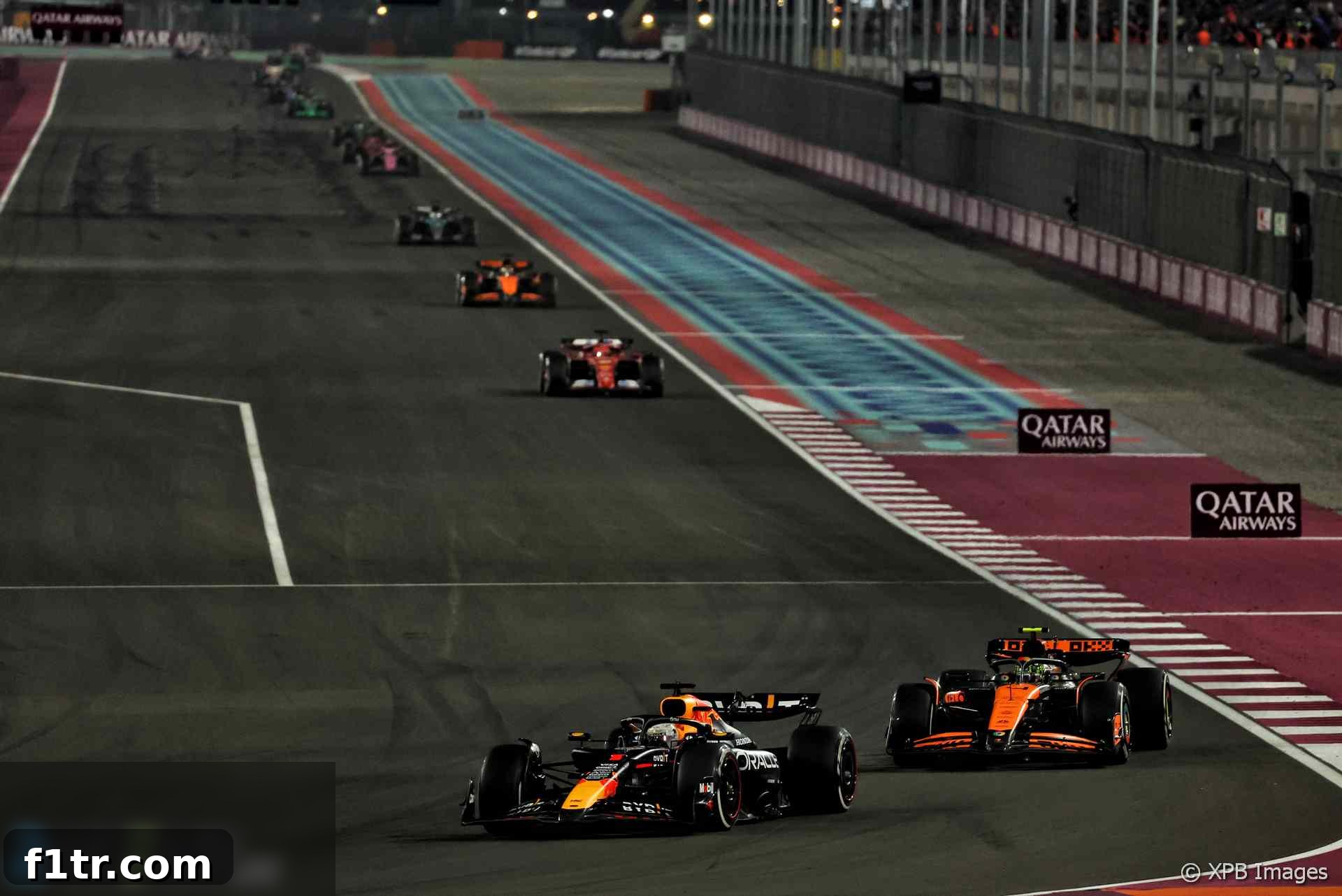
Formula 1 drivers are set to face a mandatory two-stop strategy during the highly anticipated Qatar Grand Prix, a decision underscored by Pirelli’s strict tyre usage regulations. The official tyre supplier has imposed a maximum stint length of just 25 laps for any set of tyres used throughout next week’s event at the demanding Losail International Circuit, a measure designed to prioritize safety and ensure optimal tyre integrity.
Advert | Become a Supporter & go ad-free
With the Qatar Grand Prix spanning 57 laps, the 25-lap limit translates directly into a requirement for drivers to make at least two pit stops during the main race. This proactive approach by Pirelli is not only a response to the unique challenges posed by the Losail circuit but also a precautionary measure based on historical data and recent tyre analyses. The event will also feature a 19-lap sprint race, which, while shorter, will still see its laps contribute to the cumulative total for each tyre set.
The Losail International Circuit stands out on the Formula 1 calendar as one of the most demanding venues for tyre performance. Its layout, characterized by numerous medium-to-high speed corners, subjects the tyres to immense lateral forces and sustained high temperatures. Even with Pirelli nominating the hardest compounds in its range for the event – the C1 (hard), C2 (medium), and C3 (soft) – concerns about structural fatigue and excessive wear persist. These robust compounds are specifically chosen to withstand the extreme conditions, yet the inherent abrasive nature of the track and the aggressive cornering loads mean that even these durable options have a finite lifespan.
Formula 1 has a documented history of tyre-related issues at the Losail circuit. During the inaugural Grand Prix held in 2021, several drivers experienced sudden tyre failures, raising immediate concerns about the track’s impact on tyre longevity. This initial experience highlighted the circuit’s aggressive characteristics and the severe stress it places on the tyre carcass and tread.
The situation escalated further upon F1’s return to Losail in 2023. During that weekend, Pirelli’s post-session analyses revealed alarming faults developing in the sidewalls of their tyres. These issues were attributed primarily to damage incurred from drivers repeatedly riding over the circuit’s pyramid-shaped kerbs, which, despite their design, proved to be overly aggressive on the delicate tyre structures. To mitigate the immediate risk, the FIA and Pirelli swiftly imposed an emergency limit of just 18 laps per stint, forcing teams into a mandatory three-stop strategy for the main race – an unprecedented measure at the time.
Following the 2023 incident, modifications were made to the Losail circuit’s kerbs, with engineers redesigning them and adding gravel strips to deter drivers from excessive kerb usage. While these changes successfully addressed the micro-lacerations in the sidewalls, Pirelli’s subsequent post-race inspections still indicated signs of severe wear on several tyres, particularly the left front. In an official statement, Pirelli noted, “Several tyres, particularly the left front, had reached the maximum wear level. These conditions, combined with the high lateral energy had increased the structural fatigue of the construction.” This persistent wear, distinct from the kerb damage, underscores the fundamental challenge of managing tyre integrity at Losail.
This 2024 directive marks the second time this year that Formula 1 has effectively mandated a two-stop race strategy. A similar one-off rule was implemented at the Monaco Grand Prix, where drivers were required to make two tyre changes, albeit for different reasons related to specific compound performance and strategic considerations in the principality. The recurrence of such mandatory pit stop rules highlights Pirelli’s unwavering commitment to driver safety and fair competition, ensuring that the spectacle of racing does not compromise the structural integrity of the tyres under extreme conditions.
Advert | Become a RaceFans supporter andgo ad-free
Statement from Pirelli
In Qatar, a critical limit will be introduced for the number of laps that each set of tyres can cover over the course of the entire race weekend. This significant decision, reached through collaborative agreement with the FIA and Formula 1 management, and following extensive discussions in regular technical meetings with all participating teams, has been formally confirmed today by Pirelli. The confirmation comes via the usual technical document outlining event-specific prescriptions, which is distributed two weeks prior to each Grand Prix.
Every single set of tyres supplied to the teams at the commencement of the race weekend can cumulatively cover a maximum of 25 laps on the Lusail track. This circuit is notoriously demanding on tyres across multiple parameters, including energy absorption, thermal stress management, and abrasive wear. It is crucial to note that these laps will be meticulously counted cumulatively across all track sessions throughout the weekend, encompassing practice, qualifying, the sprint shootout, and the sprint race, including any laps completed under Safety Car or Virtual Safety Car conditions.
For clarity, certain laps will be excluded from this cumulative count. These include laps completed on the way to the grid, during formation laps, and those driven after the chequered flag in both the sprint race and the Grand Prix itself. Given that the Qatar Grand Prix is contested over 57 laps, this 25-lap per-stint maximum unequivocally dictates that each driver will be required to change tyres at least twice during the main race. To assist teams in managing their tyre allocation and adherence to the rule, Pirelli will provide a comprehensive update before the start of the Grand Prix, informing each team of the exact number of laps remaining on every individual tyre set in their possession.
This precautionary measure has been deemed absolutely necessary following an in-depth analysis of the tyres used during the 2023 event in Qatar. Last year’s data revealed that several tyres, particularly those on the critical left front axle, had reached or even exceeded their maximum allowable wear level. These extreme conditions, exacerbated by the consistently high lateral energy exerted through the Losail corners, significantly increased the structural fatigue of the tyre construction, raising safety concerns for sustained high performance.
In previous attempts to reduce the overall number of pit stops, teams often focused intensely on advanced tyre degradation management strategies. While effective in limiting performance drop-off, this approach sometimes carried the inherent risk of extending a tyre’s stint beyond its useful and safe structural life. The new mandatory limit aims to remove this risk factor entirely, ensuring safety without compromising competitive integrity.
A similar, though not identical, precautionary measure had indeed been introduced at this very track in 2023. However, that specific intervention was implemented to address distinct problems related to kerb-induced micro-lacerations in the tyres’ sidewalls, issues which have since been resolved. Last year, the subsequent modification to the pyramid kerbs, along with the strategic addition of strips of gravel around them, successfully prevented a repetition of that particular sidewall damage scenario. The current 2024 regulation, therefore, targets a different, yet equally critical, aspect of tyre wear and structural integrity.
As previously announced, the Qatar Grand Prix weekend will see the deployment of the hardest compounds available in the Pirelli range: the C1 will serve as the hard compound, the C2 as the medium, and the C3 as the soft. Recognizing this is a sprint weekend format, each driver will be supplied with a specific allocation: two sets of the hard compound, four sets of the medium compound, and six sets of the soft compound, providing a balanced choice within the mandated stint limits.
Advert | Become a RaceFans supporter andgo ad-free
Miss nothing from RaceFans
Get a daily email with all our latest stories – and nothing else. No marketing, no ads. Sign up here:
Formula 1 Insights & Updates
- “Overtaking is overtaking”: Domenicali denies F1’s yo-yo racing is “artificial”
- The crashes F1 is trying to prevent may be rare – but the danger is obvious
- F1 returning to India soon after 2027 sounds like wishful thinking
- Verstappen loathes F1’s new generation of cars – but what do his rivals reckon?
- The ‘throwback weekend’ is back in fashion. But it’s a flawed concept – especially for F1
Browse all Formula 1 articles and news