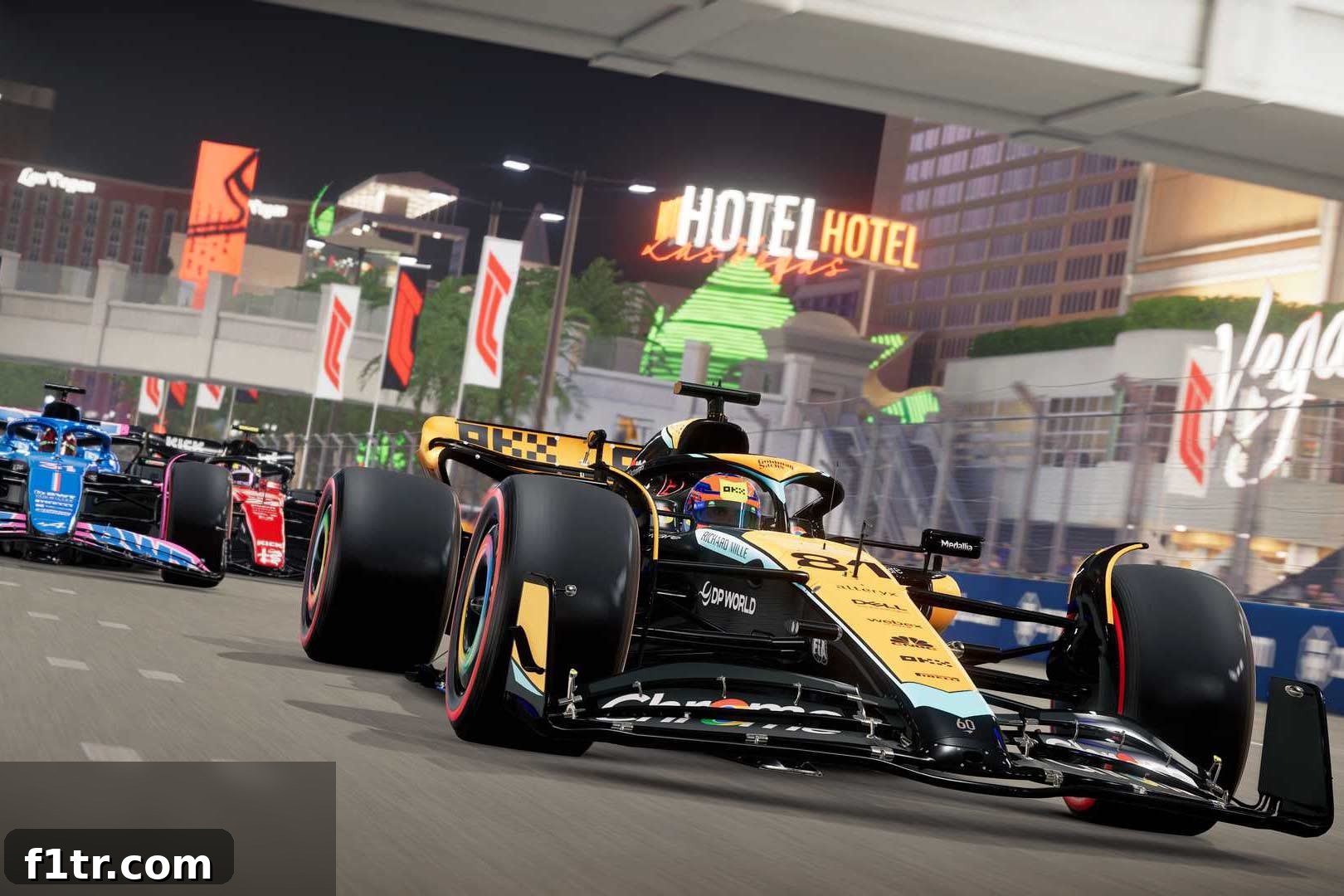
The official Formula 1 game series, meticulously crafted by Codemasters and published by EA, has firmly established itself as one of the most anticipated annual releases in the competitive sports gaming landscape. Every year, millions of fans eagerly await the chance to step into the virtual cockpit and experience the thrill of the fastest motorsport in the world.
Advert | Become a Supporter & go ad-free
While the F1 series undoubtedly ranks alongside titans like EAFC, NHL, or Madden as a reliable annual fixture on the gaming calendar, it possesses a unique characteristic that sets it apart from many other major sports franchises. Unlike the relative consistency found in soccer, American football, basketball, or ice hockey, Formula 1 undergoes substantial, often revolutionary, changes each season. These transformations, spanning from the global circuits that host Grands Prix to the intricate design and handling of the cutting-edge cars, traditionally provide compelling selling points for each new iteration of the official game. An F1 game typically demands far more than just a simple roster update; it necessitates a comprehensive overhaul to accurately reflect the dynamics of the new season, a stark contrast to games like Madden, which often rely on a consistent pool of 32 teams and largely unchanging fundamental rules.
However, as the 2024 F1 season approaches, the landscape appears remarkably static, almost a direct copy-and-paste from the previous year. For the first time in recent memory, every single driver who competed in the final round of last season in Abu Dhabi is set to race for the exact same team in the 2024 season-opener in Bahrain. Furthermore, while the 2024 calendar boasts 24 rounds, making it the longest season in the sport’s illustrious history, all 24 circuits – and even a few extra – were already faithfully recreated and included in last year’s game. The fundamental sporting and technical regulations remain largely untouched, with the only notable uncertainties revolving around potential tweaks to the sprint race format and the rebranding of Sauber and Red Bull’s second team, alongside any minor livery adjustments.
This absence of significant real-world changes presents a considerable challenge for F1 24. The game may also be unable to leverage some of the popular ‘gimmicks’ it has relied on in the past. For instance, the acclaimed ‘Braking Point’ story mode has historically operated on a two-year development cycle, with its latest installment appearing last year. This suggests that a third chapter in the dramatic sagas of Devon Butler, Callie Mayer, and Aiden Jackson might not be featured in F1 24, leaving a void for players who enjoy its narrative-driven experience. In light of these circumstances, the crucial question emerges: what truly enticing new angles or innovative features could Codemasters possibly introduce to F1 24 to ensure it remains a must-buy title for both dedicated fans and new players?
Considering the inherent constraints of developing a new game within a tight 12-month window, coupled with recent staff layoffs at Codemasters by EA, expectations must be tempered. Nevertheless, inspiration can be drawn from the broader racing game market. Here are five compelling elements, borrowed from existing racing game franchises, that could significantly enhance the official F1 racing game series and address the unique challenges facing F1 24.
Advert | Become a RaceFans supporter andgo ad-free
Moto GP 23 – Immersive Pre-Season Testing
While ‘F1 World’ and multiplayer modes offer their own brand of excitement, the career mode remains the heart of any F1 game, providing the deepest and most immersive experience. For years, players have enjoyed the ability to race as custom characters or even manage their own bespoke teams in MyTeam. However, both the traditional career mode and MyTeam have seen minimal evolution since F1 2020, leading to a sense of staleness that could benefit immensely from a fresh approach.
One ingenious method Codemasters could employ to revitalize these core experiences is to draw inspiration from Milestone’s Moto GP franchise. Despite occasional frustrations voiced by hardcore Moto GP enthusiasts, the series consistently delivers a high degree of authenticity and offers several commendable features. A standout example is its pre-season testing module. Once players reach the Moto GP level and secure a coveted contract with a team, they are granted access to an extensive pre-season test session, lasting up to two hours. During this period, players can complete an unlimited number of laps, experimenting with multiple specifications of their chosen bike. They can then ride both variants, critically evaluate their performance and feel, and ultimately decide which specification they prefer. This chosen spec then forms the fundamental basis of their machine for the entire season ahead.
Applying a similar concept to F1 24 would yield multiple benefits. Firstly, it would serve as an invaluable tool for players to thoroughly familiarize themselves with any new physics engine, car handling characteristics, and tire models introduced in the latest game, ensuring a smoother transition and more enjoyable initial experience. More profoundly, it would grant players unprecedented agency over their car’s initial development direction at the very start of the season. Imagine evaluating different aerodynamic packages, engine maps, or suspension setups during a simulated pre-season test, gathering crucial data, and making an informed choice that impacts your car’s performance trajectory. This feature would not only deepen player engagement but also infuse the career mode with an additional layer of authenticity, reflecting the critical decisions made by real-world F1 teams and drivers before a wheel is even turned in anger during the competitive season.
EA WRC – Empowering Builder Mode
Last year, EA took the reins of the official World Rally Championship license, a move that delivered a game with a mixed reception among fans. However, one groundbreaking feature introduced in EA WRC, and arguably a first for any mainstream motorsports racing game, was the innovative ability for players to design and construct their own custom competition car. While its initial implementation was relatively simple, offering a limited selection of pre-designed options for the front, side, and rear sections of the vehicle, along with minor interior customization, the concept holds immense potential for the F1 game series.
Naturally, due to stringent licensing agreements within Formula 1, such a comprehensive ‘builder mode’ would likely need to be confined to the ‘MyTeam’ game mode. Within this framework, however, it could dramatically enhance the immersion and personal connection players feel with their self-created team and car. Imagine being able to choose from a diverse range of wing designs, sidepod configurations, diffuser geometries, and even distinct steering wheel layouts. Each of these components could be imbued with unique performance attributes, affecting aerodynamics, cooling, or handling balance. To ensure a realistic progression, your nascent team could initially be restricted to the least sophisticated and most basic components if you opt to begin your MyTeam journey as a backmarker, gradually unlocking more advanced and performance-oriented parts as your team develops and gains recognition, rather than starting as an immediate championship contender. This dynamic progression would provide a tangible sense of growth and strategic depth, rewarding players for their efforts and decisions, and making the MyTeam experience truly feel like building an F1 empire from the ground up.
Advert | Become a RaceFans supporter andgo ad-free
Gran Turismo – The Highly Desired Livery Editor
While a comprehensive livery editor for F1 24 might seem like a distant dream, falling squarely into the category of “least likely features,” its desirability among the player base remains exceptionally high. For countless F1 game enthusiasts, a robust – or even just a largely functional – livery editor would represent a long-awaited and transformative addition, allowing for unparalleled creative expression and personalization.
No one would realistically expect an F1 game to rival the depth and sophistication of Gran Turismo 7’s legendary livery editor, complete with intricate scheme sharing and advanced decal upload functionalities. However, even the implementation of a more basic system – one that enables players to add fundamental shapes, apply diverse color palettes, and strategically place team logos onto their multiplayer cars – would represent an enormously popular and widely embraced revision. When one considers that EA’s own WRC title, the entire Moto GP series, virtually every NASCAR game franchise in history, Assetto Corsa Competizione, and indeed almost every other major racing game franchise features some form of livery editor, the conspicuous absence of such a feature in the official F1 game becomes even more glaring and perplexing.
The primary reason cited for this continued omission often revolves around its perceived conflict with the ‘Podium Pass’ system. For the past five iterations, the game’s monetization and progression have been heavily structured around this system, which offers pre-designed liveries unlockable through dedicated gameplay ‘grinding’ or direct purchase using ‘PitCoins.’ Introducing a free-form livery editor could potentially undermine the appeal and revenue generation of this established model. However, recent trends, such as the most recent Podium Pass seasons failing to include a single new livery, suggest a growing disconnect with player expectations. In such a scenario, it is entirely natural for players to crave more creative freedom and the ability to design the distinctive looks they desire for their cars, rather than being limited to pre-packaged options. A well-integrated livery editor could, in fact, coexist with a Podium Pass, offering both curated content and creative tools, thereby enriching the overall player experience significantly.
Forza Motorsport – Prioritizing Accessibility
The latest installment in the revered Forza Motorsport franchise, despite its pedigree, did not receive the most enthusiastic reception from players across Xbox and PC platforms. Consequently, there isn’t an extensive list of features from this particular title that would directly or obviously enhance a new F1 game – with one crucial exception: its exemplary suite of accessibility options. In recent years, both EA and Codemasters have commendably made significant strides towards making the F1 game more accessible to a broader audience, irrespective of their age, physical ability, or specific accessibility requirements. However, Microsoft, through its various studios including Turn 10 (developers of Forza Motorsport), has consistently invested considerably more than most in the gaming industry to ensure their titles are as inclusive and open to everyone as humanly possible.
The comprehensive range of accessibility options embedded within Forza Motorsport is truly deserving of widespread praise and serves as a blueprint that should be adopted and adapted by other games, particularly those within the mainstream sports simulation genre. These options span a wide spectrum, from innovative blind driving assists, which leverage audio cues and haptic feedback to guide visually impaired players, to customizable audio narration for menus and crucial in-game information, and granular text size adjustments to accommodate various visual impairments. Such thoughtful features transcend mere convenience; they are fundamental to creating an equitable and inclusive gaming environment.
As the pinnacle of global motorsport, Formula 1 naturally boasts an immense and diverse fan base, a significant portion of whom live with various disabilities. Many of these dedicated fans are also avid gamers who dream of experiencing the thrill of racing. While implementing extensive accessibility features might not directly benefit the majority of players, the moral and ethical imperative to make the official F1 game as open and welcoming as possible for all fans to live out their racing driver fantasies is no less worthwhile. It’s a testament to the sport’s global appeal and a reflection of a commitment to truly include everyone in the joy of racing, transforming virtual participation from a privilege into an accessible right for all.
Advert | Become a RaceFans supporter andgo ad-free
Assetto Corsa Competizione – A More Granular Driver Rating System
In recent years, Codemasters introduced a basic superlicence system for its multiplayer modes, aiming to categorize players based on their driving speed and their adherence to safety. The theoretical goal was to group the quickest racers with players of roughly comparable skill and to match those who meticulously avoid accidents with equally clean competitors. While a step in the right direction, this system often feels rudimentary and lacks the depth required to truly foster competitive and respectful online racing.
Assetto Corsa Competizione (ACC), widely regarded as a serious racing simulator, elevates the concept of player evaluation to an entirely different level through its far more detailed and pervasive ratings system. This sophisticated system meticulously tracks and analyzes virtually every action a player undertakes within the game, across every lap of every session. ACC scrutinizes performance metrics such as precise car control, the frequency of spins or off-track excursions, the consistency of lap times over a race distance, and critically, how closely and safely players can race their rivals without initiating contact or causing accidents. Each of these individual areas contributes to a dynamic rating that constantly adjusts based on a player’s performance. These granular ratings then feed into an overall driver rating, which, in turn, can intelligently limit the multiplayer lobbies and options available to a player, ensuring a more balanced and enjoyable experience for everyone.
For the official F1 game, implementing a similar, more comprehensive driver rating system would offer significant benefits. Such a system would not only help to cultivate a more respectful and sportsmanlike online community but also actively encourage players to approach every session with the mindset of a genuine racing driver, understanding that their reputation and progression are on the line. This detailed feedback mechanism could motivate players to be considerably more careful and strategic on track, reducing the prevalence of reckless driving. Crucially, it would also provide clear incentives and measurable goals for players to continuously improve their driving skills, master car control, and consistently strive for faster, cleaner lap times, thereby elevating the entire multiplayer experience and promoting a higher standard of racing within the F1 game franchise.
Over to you
With the unique challenges facing F1 24, innovation is key. We’ve explored several exciting possibilities drawn from the broader racing game universe, ranging from deep simulation to arcade experiences. Are there any other elements from these or other titles that you believe would be a game-changer for F1 24? Share your thoughts and suggestions in the comments section below – we’d love to hear your ideas for evolving the ultimate Formula 1 gaming experience.
Advert | Become a RaceFans supporter andgo ad-free
Motorsport Games
- “F1 Manager 24” reviewed – Does Create-a-Team make for a must-buy?
- F1 24 director Mather on anti-cheat measures and the last-gen tech debate
- F1 24 director Lee Mather on physics, in-race goals and revamped career mode
- Top ten fake and fictional racing drivers from gaming history
- New Create a Team mode confirmed for F1 Manager 24
Browse all Motorsport Games articles