For decades, the name Williams has been synonymous with Formula 1 excellence, a legendary independent constructor etched into the sport’s history books with multiple championships. However, winding back the clock to the last decade reveals a tumultuous period, marked by a startling lack of continuity at the highest levels of its engineering structure. Since 2009, the iconic British team has cycled through no fewer than three technical directors after Sam Michael’s departure in 2011, with Mike Coughlan, Pat Symonds, and Paddy Lowe successively taking the helm. Currently, the team grapples with a significant vacancy at the very top of its engineering hierarchy, a crucial role in modern Formula 1.
This rapid succession of technical leadership translates to an average tenure of roughly 2.5 years per individual, excluding any periods of ‘gardening leave’ often associated with such high-profile F1 roles. In an environment where Formula 1 car development is a relentless evolutionary process, and new technical directors typically overhaul existing designs to implement their unique philosophies, it’s hardly surprising that Williams has struggled to maintain consistency in its car design trajectory. This lack of a stable vision has, in turn, been glaringly reflected in the team’s precipitous performance decline over recent years.
The numbers paint a stark picture: Williams secured a commendable sixth place in the 2010 F1 Constructors’ Championship (powered by a customer Cosworth engine). However, this was followed by two ninth-place finishes, an eighth in 2013, then a brief resurgence to consecutive third places, succeeded by two fifth-place finishes. This period of relative stability, however, gave way to a dramatic slump, culminating in last place in the championship. In the current season, the team languishes in tenth position with a solitary point, a shadow of its former glory.
Advert | Become a Supporter & go ad-free
The Vicious Circle of Performance and Finance
While statistical analysis might average Williams’ performance over the decade to a respectable seventh place (6.8 to be precise), this academic figure does little to sway the perceptions of critical sponsors and passionate fans. Herein lies the cruel, self-perpetuating cycle of Formula 1: dwindling results translate directly into reduced revenues from both Formula 1’s central fund and corporate sponsors. This financial squeeze inevitably leads to a constrained budget for car development and performance upgrades, which in turn feeds into further disappointing results, perpetuating the revenue shortfall, and so on. It’s an exceptionally challenging spiral to escape, and one that is exacerbated by the arguably unprecedented turnover of technical directors at Williams.
Consider the titans of technical leadership in F1: Patrick Head, a director and shareholder, served as Williams’ technical director from 1978 to 2005, a period that encompassed the team’s most dominant era. Adrian Newey, another legendary figure who once worked for Williams, has been instrumental at Red Bull since 2006, following an eight-year stint at McLaren – shaping both teams into championship winners during their respective heydays. These examples underscore that continuity is paramount in fostering a winning culture and a consistent design philosophy.
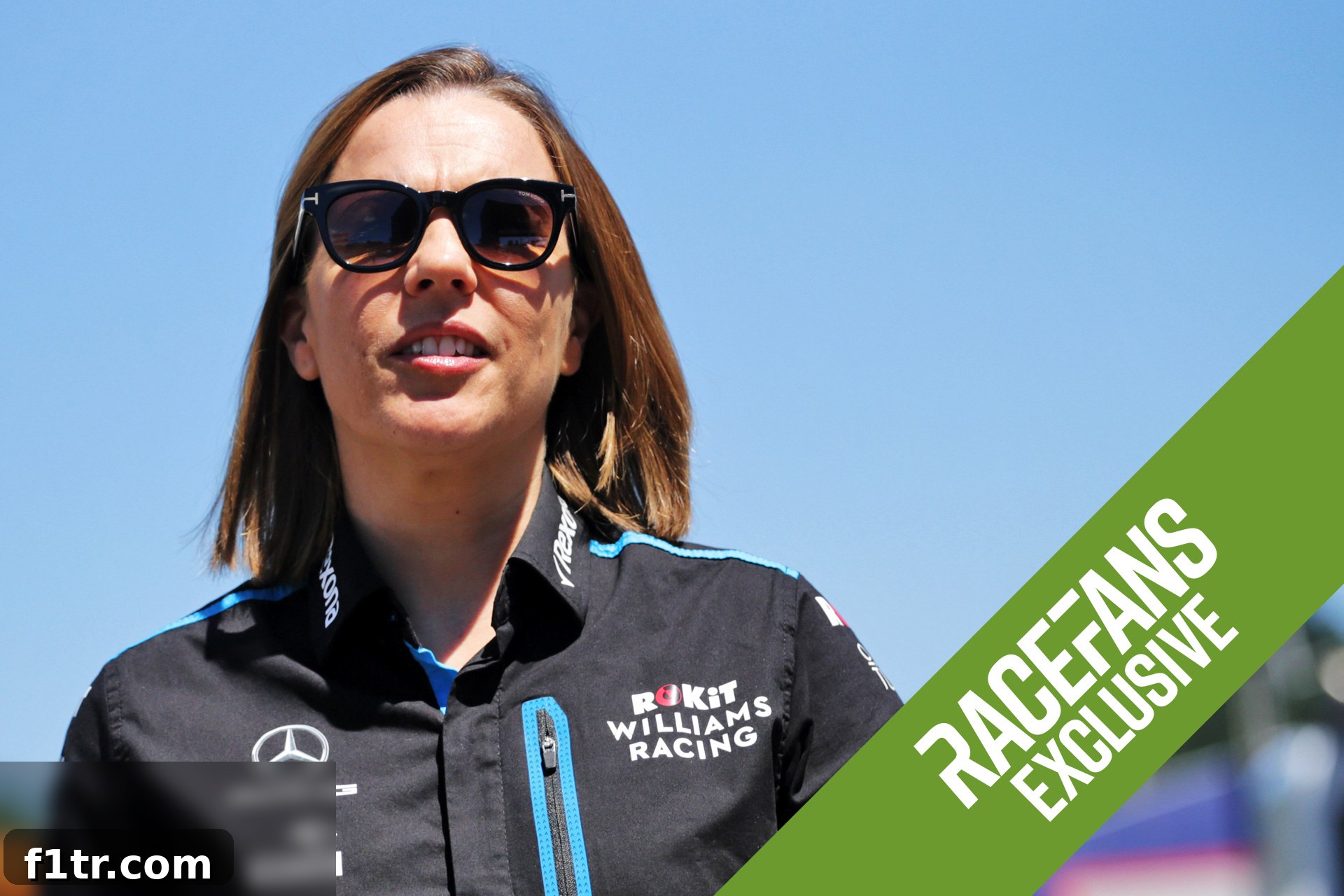
Yet, following a churn of four technical directors within a single decade, Williams currently operates without a singular head overseeing its technical activities. Instead, the team employs a flat management structure, with its heads of design (Doug McKiernan), vehicle engineering (Adam Carter), and trackside operations (David Robson) reporting directly to Claire Williams, the team’s de facto team principal. This strategic decision, Claire Williams explains, stems from a deliberate choice to operate in this manner rather than risk another “wrong hire” at the apex of their technical department, a nod to the past decade’s challenges.
Claire Williams’ Vision: Turning the Corner
Despite the recent setbacks and the current vacancy, Claire Williams maintains a steadfast belief in the team’s trajectory. “I do genuinely believe that Williams has turned a corner,” she stated during an exclusive interview in Hungary. Her conviction stems from the extensive, behind-the-scenes work that the public rarely witnesses. “I think the work that we have put in that people don’t get to see, because it is all behind-the-scenes stuff, then you want to believe that the work, the change that has gone on at Williams, which I am so proud of, that it’s all going to shape the future. And I’m really excited about this.”
Advert | Become a RaceFans supporter andgo ad-free
Williams speaks passionately about a “new culture that’s been created” within the Grove-based outfit, emphasizing internal promotions and the rise of a “new generation of leaders within our business.” These changes are not superficial but part of an intensive nine-month transformation program. “It was never going to be a quick-fix [to correct the spiral], because that’s just putting a plaster over stuff. We had to get to the root cause of all our problems and fix them. We feel that we have passed our point of return, we’re well down that path and we’ll start seeing the returns of that.”
The review process has led to comprehensive restructuring across most departments. Claire Williams highlights her increased understanding of the individuals who constitute Williams as a team, a company, and contribute to its unique culture. She stresses the importance of structural stability moving forward: “We’ll remain stable, from a structural perspective, moving forward, because I don’t think chopping and changing either is the best thing to do. You’ve got to make your change and then either believe in it and let it evolve and grow organically. And I think we have the right people now, doing the right jobs.” While largely confident in the current team, she acknowledges, “I think there are a couple of areas where we need some bolstering, maybe at a more senior level, and other levels across the organisation.” This statement subtly hints at the potential for a new technical director when the right candidate emerges.
Financial Discipline and Future Investment
The Williams group’s current headcount stands at approximately 550 for the F1 team, with an additional 75 supporting administrative and allied services. Sister company Williams Advanced Engineering employs another 325 individuals, bringing the total to nearly 1,000 people. This represents an astounding 58-fold increase since Sir Frank Williams founded the company in 1977 with just 17 staff members. Despite the looming budget cap in 2021, there remains sufficient financial headroom to strengthen individual departments. The ‘right’ technical director, for instance, remains a key recruitment target. Notably, exclusions in the financial regulations—such as administration, marketing, and hospitality costs—mean Williams F1 could potentially recruit another 100 people or so before hitting budget cap constraints, offering a glimmer of hope for future expansion and talent acquisition.
Addressing questions about the 2020 budget, particularly in light of the team’s disappointing on-track results, Claire Williams refutes suggestions of financial instability. “We’ve had a healthy racing budget now for many years,” she states. She believes Williams is sometimes unfairly singled out: “I think that people quite like to have at least one team in this sport that they can use as a means by which they can talk about the negatives of this sport and this sport’s in trouble. I think that people are looking at Williams to use as that team at the moment.”
Advert | Become a RaceFans supporter andgo ad-free
As a publicly listed company, Williams’ financial results are transparent. “Everyone can see our results. We’ve had some really good years, made a profit over those years. 2020 and beyond are looking OK for us,” she assures. Acknowledging the inherent difficulties in securing substantial sponsorship, she adds, “This isn’t an easy environment to be in, trying to accrue huge amounts of sponsorship money to keep your racing team going, and so we’ve always had to be slightly creative when it comes to how we generate our income.”
The interviewer pressed on the apparent conflict between a listed company’s need for profit and a race team’s imperative to invest every spare penny into performance. Williams expertly counters, “On your balance sheets you don’t actually have to talk about it, what you’re actually going to be investing. It’s all about the previous year. So you could actually put a little line on your annual results to say, ‘We’ve made that 10 million pounds profit and in the following year we are going to be spending on X, Y and Z.’” This highlights the intricate balance Williams must strike between financial prudence and competitive ambition.
Despite impressive financial discipline and regular profits, critical questions remain regarding the team’s investment in crucial infrastructure. Williams, for instance, remains the only team on the grid still employing a wholly aluminium gearbox casing, while its composites department is reportedly in dire need of significant investment. “We’re trying to,” Claire Williams asserts, acknowledging the challenges. “When you have a budget the size of ours, capital expenditure is something that is difficult to figure out. You always have priorities when you’ve got a budget the size of ours.” She candidly concedes that “prior to that [2013, when she and CEO Mike O’Driscoll took over the reins of the group] there was not the investment that needed to be made. You’ve got to prioritise.”
The Promise of 2021 Regulations
It is abundantly clear that Williams is pinning significant hopes on the comprehensive regulatory overhaul slated for 2021. This package of changes includes a critical cost cap, new prize fund distribution, and revised technical regulations, all designed to foster a more level playing field in Formula 1. “In 2021, from a cost cap and prize fund distribution perspective, it can be very positive for us as the first years start playing out,” Claire Williams optimistically notes. These changes are vital for independent teams like Williams, which historically operate on significantly smaller budgets than the manufacturer-backed giants.
However, the immediate challenge lies in simply surviving until 2021. Williams relies heavily on its partners for support during this transitional period. “We are very lucky with the partners that we do have and that they are incredibly supportive. I haven’t had any complaints from any of our partners this year about our performance, and I think that probably says a lot and is testament to the work that our marketing group do to deliver value in other ways, other than just what’s going on on the race track.” A key vote of confidence came from title sponsor Rokit, who joined the team in winter despite their last-place finish the previous season. “It’s not an insignificant partnership, it’s a big partnership and as everybody has seen they’ve just extended that partnership for another two years, which is great.”
The Specter of Dilution and Regulatory Integrity
Like many independent outfits, Williams harbors significant concerns that the eagerly awaited 2021 regulations – encompassing financial, sporting, and technical aspects – might be diluted before their implementation. This fear largely stems from potential pressure exerted by the sport’s ‘Big Guns,’ often wielding threats and, in Ferrari’s unique case, even a veto power. When asked about these concerns, Claire Williams responds without hesitation: “Yes, I am.”
Go ad-free for just £1 per month>> Find out more and sign up
“I was advocating that we signed the financial regulations. The sporting and technical weren’t where they needed to be. But I didn’t quite understand why we didn’t sign those [financial regulations]. They were ready as far as I was concerned. Of course I have concerns that, you know, four months in Formula One is a long time to allow people to potentially get things changed. I hope they don’t, because I think [it’s crucial] for the future sustainability of this sport, or at least for some teams within it.”
Ultimately, her focus remains on the core product of F1: the racing and the fans. “So all I hope for is that we produce a set of technical regulations that allow better racing and therefore create a better sport and therefore a better show for our fans. Because at the end of the day the fans are really all that matter, because if we don’t have them, we don’t have a sport and we don’t have racing teams and we don’t have our jobs.”
Regarding the 2021 technical regulations and their impact on Williams’ business model – that of a fully-fledged independent constructor rather than an assembler of customer parts – Williams expresses cautious optimism. The discussion around ‘standardization’ and ‘prescription parts’ has been contentious. “Yes, they do,” she says concerning the regulations being favorable to their model, though she adds the caveat: “We haven’t seen them in their entirety yet so it’s difficult to actually judge whether they do or not. But we’re thinking about standardisation, we’re thinking about the prescription parts…”
“We obviously want to see, as an independent constructor, anything that is a performance differentiator [as being included in the list of parts we need to design ourselves], because that’s the DNA of our sport.” For standardized parts, she believes: “When it comes to standardisation, I think [where] it makes sense financially and the teams currently may or may not do these [parts] themselves, as long as it is not detrimental financially to a team, I think that’s a good thing. With standardisation and standard parts we can go and buy off the shelf, if they’re not performance differentiators, then it doesn’t make sense to spend hundreds of thousands or millions on certain components in our race cars. So, I think if there’s sensibility around those four [parts categories], then I think that we would be happy.” This stance perfectly encapsulates Williams’ ambition to retain its core engineering identity while embracing cost-saving measures for non-performance critical components.
F1’s Environmental Responsibility: A Call for Recognition
Beyond the immediate challenges of competitive performance and financial stability, Williams is acutely aware of Formula 1’s broader environmental impact and the sport’s responsibility to address it. “We need to be very careful moving forwards with some decisions that we take,” Claire Williams opens, highlighting a deeper concern for sustainability.
She laments the sport’s failure to adequately communicate its positive environmental advancements. “We don’t talk enough about what we have done to make this sport greener. That is the image, isn’t it? It’s people thinking Formula 1 is a gas-guzzling sport, and we haven’t done enough to stamp out that image and actually talk up the real positive steps forward that we’ve made, particularly [with] these new power units. Hundreds of millions of dollars have been invested into them, the technologies within them will filter down into the road manufacturers. We don’t talk about them and we should.” This perspective underscores the innovative potential of F1 as a testbed for sustainable technologies that can benefit the wider automotive industry.
She offers a timely example of policy choices that contradict these environmental efforts: “One of the conversations on the table at the moment is refuelling. I don’t see how that does not completely contradict and take us 10 steps backwards from what we are looking at trying to promote this sport and the virtues of F1 from an environmental perspective.” Reintroducing refuelling would increase fuel consumption, transport logistics, and overall carbon footprint, directly conflicting with a greener image.
An Unwavering Family Commitment to the Future
Despite the formidable challenges, Claire Williams’ belief in the future of her family’s team remains absolute. Whether as a publicly listed company or a private entity, the core ethos endures. “The Williams family have never taken any profit out of our racing team; it all goes back into it. Every single penny that we have goes into F1, and it’s our mission now, moving forward, to ensure that we tackle those areas potentially that we have across the business that we need to improve.” This unwavering commitment to reinvestment speaks volumes about the deep-rooted passion and dedication that defines the Williams legacy.
Indeed, recent glimmers of improved performance offer tangible encouragement. George Russell’s bravura performance in Hungary, delivering qualifying results that belied the car’s true pace, and Robert Kubica’s breakthrough point the week prior, albeit under unusual circumstances, suggest that the foundational changes within Williams are perhaps beginning to bear fruit. These small victories are crucial for morale and provide early evidence that the team is indeed turning a corner, piece by piece, towards a more competitive future in Formula 1.
RacingLines
- The year of sprints, ‘the show’ – and rising stock: A political review of the 2021 F1 season
- The problems of perception the FIA must address after the Abu Dhabi row
- Why the budget cap could be F1’s next battleground between Mercedes and Red Bull
- Todt defied expectations as president – now he plans to “disappear” from FIA
- Sir Frank Williams: A personal appreciation of a true racer
Browse all RacingLines columns