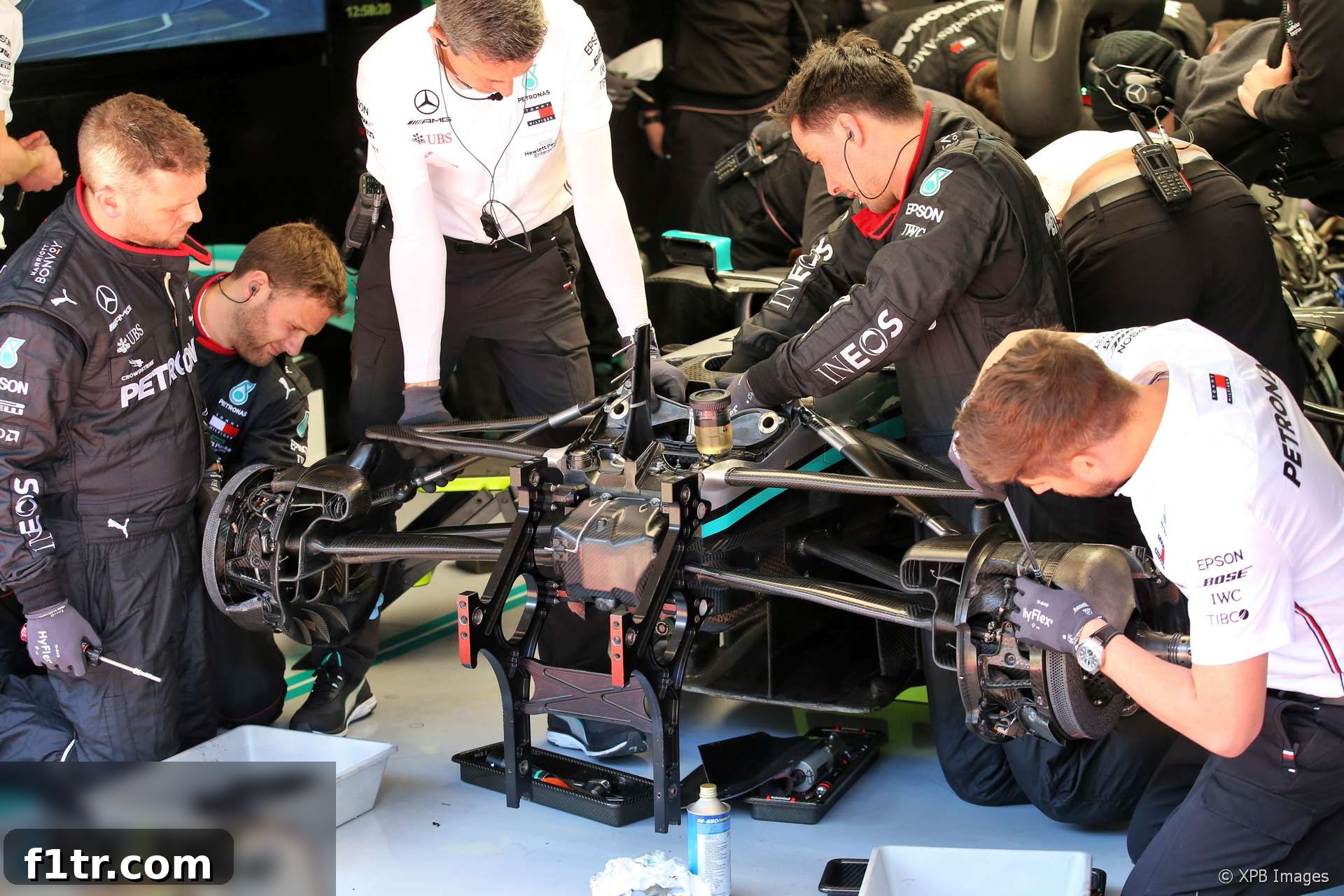
The unveiling of Mercedes-AMG Petronas F1 Team’s Dual Axis Steering (DAS) system during the 2020 pre-season testing immediately sent shockwaves through the Formula 1 paddock. This ingenious technical innovation, observed on the W11 chassis, allowed drivers to adjust the toe angle of the front wheels by pushing or pulling the steering wheel. While generating significant intrigue and debate, the consensus among experts quickly emerged: this groundbreaking design would likely be permitted for the 2020 season only, as the stringent new technical regulations slated for 2021 were expected to render it illegal.
The system, first prominently showcased on onboard footage during testing, instantly caught the attention of rival teams. Ferrari, a perennial competitor, was among those who expressed particular interest. Mattia Binotto, then team principal of the Scuderia, indicated that his team would seek a formal “clarification” from the FIA regarding the legality of the device. Despite their inquiry, Binotto affirmed Ferrari’s commitment to accepting whatever decision the sport’s governing body ultimately rendered, a stance that underscored the FIA’s authority in such technical matters.
In the immediate aftermath of its discovery, the FIA had already provided an initial assessment, suggesting that the Dual Axis Steering system appeared to be compliant with the existing 2020 technical regulations, based on the comprehensive information supplied by Mercedes. This provisional green light allowed Mercedes to proceed with DAS for the upcoming season, albeit under intense scrutiny and with the full knowledge that future regulatory changes loomed large on the horizon.
The core of the impending ban lay within the precise wording of the 2021 technical regulations, which introduced significant revisions aimed at simplifying car designs, reducing costs, and fostering closer racing. A key piece of text within these updated rules specifically stated that any “re-alignment of the steered wheels” must unequivocally be a “function of the rotational position of a single steering wheel.” This critical clause directly addressed and effectively outlawed the mechanism employed by Mercedes’ DAS, which allowed the front wheels to be adjusted via the linear movement (forwards and backwards) of the steering wheel, rather than solely through its conventional rotational input.
Despite the clear implications of the 2021 regulatory text, Michael Masi, the FIA race director at the time, adopted a cautious and neutral tone when questioned about the matter during a press conference. He refrained from explicitly confirming that the regulations change was specifically intended to outlaw DAS. Instead, Masi emphasized the ongoing dynamic between rule-makers and innovators, stating, “We’ll see what teams can come up with within those boundaries of what the regulations are written for 2021.” This perspective highlighted the FIA’s philosophy of defining the regulatory framework and allowing teams to innovate within those confines, rather than pre-emptively shutting down specific concepts.
Masi further underscored the FIA’s policy of confidentiality regarding individual team designs and queries. “From our side [it’s] very simple: We don’t discuss individual teams’ technical elements,” he explained. “When we’ve got a query from a respective team that we deal with them one on one on that basis.” This approach ensures a fair and private dialogue between the governing body and constructors, preventing public speculation from impacting the regulatory process.
Beyond the intricacies of technical legality, Masi also stressed the FIA’s overarching concern: safety. For any innovation or technical solution introduced into Formula 1, safety remains the paramount consideration. “Anything from an FIA perspective, at the end of the day, safety is our number one element. So if there’s any questions regarding the safety side of it, rest assured that that is the highest priority from our side.” While DAS itself was not deemed an immediate safety risk in 2020, the FIA’s commitment to preemptively addressing potential hazards through future regulations is a constant feature of the sport’s technical evolution. Any system that introduces complex, non-rotational steering input could potentially be a safety concern if it were to malfunction or distract the driver under extreme racing conditions, justifying a clear definition of acceptable steering mechanisms.
Advert | Become a RaceFans supporter andgo ad-free
The Genius Behind DAS: A Deeper Dive into its Functionality and Purpose
To truly appreciate the significance of Mercedes’ Dual Axis Steering system, one must understand its engineering brilliance and the competitive advantages it sought to deliver. At its core, DAS allowed the driver to subtly alter the toe angle of the front wheels during specific phases of a lap. By pushing the steering wheel forward, the wheels would toe out (point slightly away from each other), and by pulling it back, they would toe in (point slightly towards each other).
The primary benefit of this adjustment lay in tire management, a crucial aspect of modern Formula 1 racing. During straights, particularly on cooler days or during warm-up laps, toe-out typically increases drag and can lead to increased tire wear. By enabling the driver to pull the wheel back, reducing toe-out, Mercedes could potentially minimize drag on the straights, improve straight-line speed, and crucially, maintain optimal tire temperature across the entire tire surface. Conventional steering systems lock the toe angle, meaning the driver cannot make such dynamic adjustments.
Conversely, for cornering performance, some degree of toe-out can be beneficial, aiding in turn-in response and helping to generate heat more quickly in the outer edge of the tire. With DAS, Mercedes drivers could engage a specific toe setting for corner entry and then revert to a more parallel alignment for straights. This flexibility offered a nuanced control over tire heating, cooling, and wear patterns, potentially leading to increased grip, better consistency over a stint, and a broader operating window for their Pirelli tires. The system was a testament to Mercedes’ relentless pursuit of performance and their ability to extract even marginal gains through sophisticated engineering.
The Wider Implications: Innovation, Legality, and the Future of F1
The DAS controversy was not an isolated incident in Formula 1 history. The sport has a rich tradition of teams pushing the boundaries of technical regulations, often leading to ingenious solutions that are subsequently banned or restricted. Examples range from Brabham’s fan car and Tyrrell’s six-wheeler to active suspension, F-ducts, and double diffusers. Each innovation, while initially legal under the prevailing rules, eventually triggered a regulatory response designed to maintain a competitive balance, improve safety, or control costs.
The 2021 regulations, under which DAS was outlawed, represented one of the most significant overhauls in modern F1 history. The primary goals were to make racing closer by reducing the aerodynamic dependence of cars on those ahead, make the sport more sustainable, and introduce a budget cap to level the financial playing field. The specific amendment to the steering wheel regulation was a direct consequence of designs like DAS, ensuring that core operational mechanisms remain within defined parameters that do not introduce excessive complexity or potential for rapid, unforeseen performance gains through steering geometry adjustments.
Mercedes’ ability to conceive, design, and implement DAS showcased their engineering superiority and meticulous attention to detail. It demonstrated that even in a sport with highly refined technical regulations, there are still avenues for groundbreaking innovation if teams are clever enough to find them. The quick regulatory response from the FIA, however, also highlighted the governing body’s proactive stance in preventing a “technology arms race” that could spiral out of control and undermine the fundamental objectives of the sport’s new era.
While DAS had a relatively short life, its impact was significant. It sparked global discussions about F1 technology, driver skill, and the ever-evolving nature of competition. It cemented Mercedes’ reputation as a technical powerhouse and served as a potent reminder that in Formula 1, ingenuity is often met with admiration, but sometimes also with a swift change of rules.
2020 F1 Season: Related Articles & Insights
- Grosjean to make F1 test return tomorrow for first time since Bahrain horror crash
- Pictures: Wrecked chassis from Grosjean’s Bahrain fireball crash to go on display
- Bottas vs Rosberg: Hamilton’s Mercedes team mates compared after 78 races each
- F1 revenues fell by $877 million in Covid-struck 2020 season
- Hamilton and Mercedes finally announce new deal for 2021 season
Browse all 2020 F1 season articles