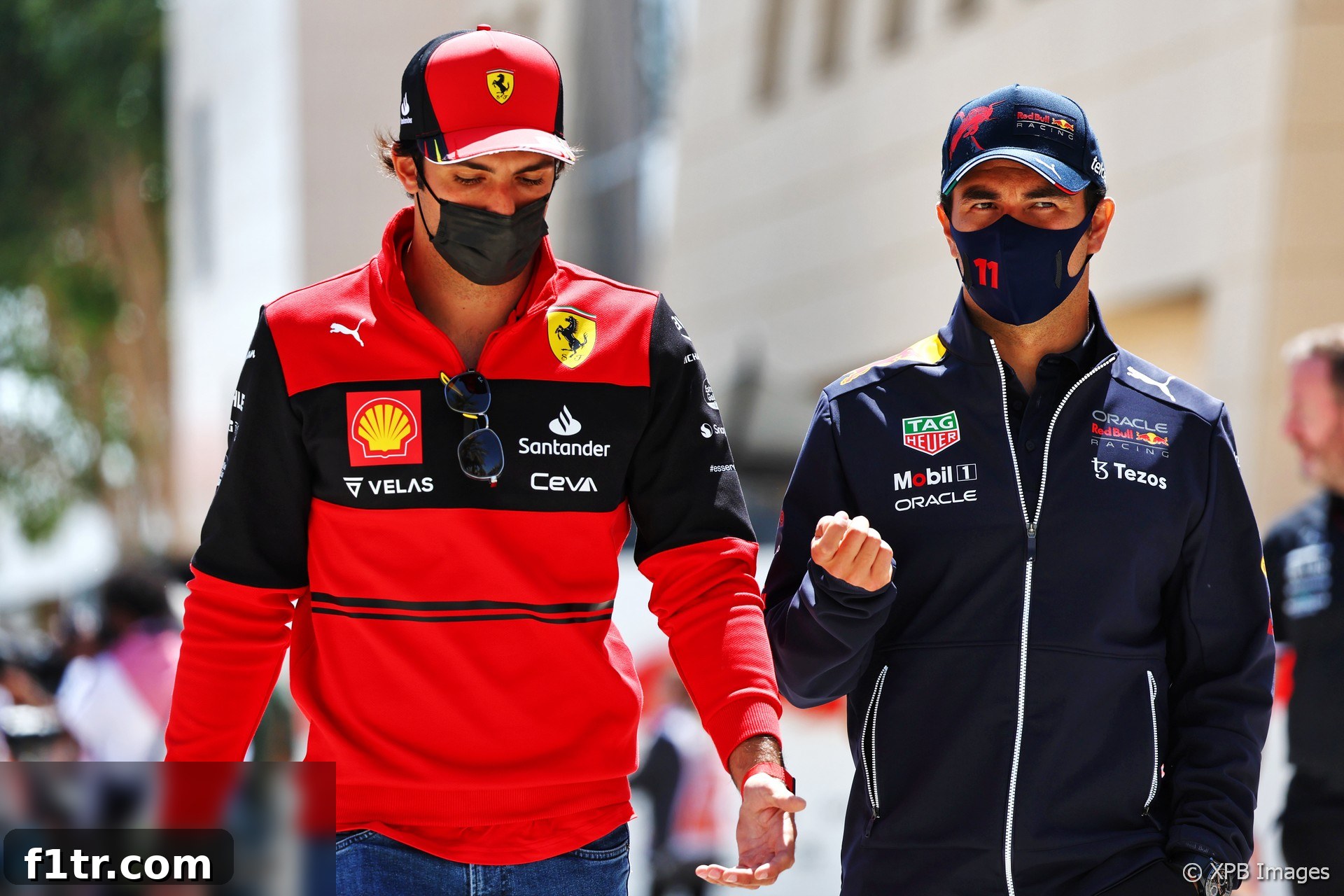
Formula 1 drivers Sergio Perez, Valtteri Bottas, and Carlos Sainz Jnr have voiced a compelling argument for a significant shift in Formula 1’s Covid-19 protocols, advocating for greater autonomy for drivers to compete even after testing positive for the virus. Their collective sentiment highlights a growing belief that the sport’s current, highly restrictive policies are increasingly at odds with evolving global approaches to managing Covid-19, particularly given advancements in vaccination and understanding of the virus.
Under the current stringent regulations enforced by Formula 1, any individual within the paddock who receives a positive Covid-19 test result is immediately required to isolate until a negative test is confirmed. This protocol has already led to several high-profile absences, directly impacting crucial moments in the championship. Recently, the opening rounds of the season saw two drivers sidelined within a single week due to positive tests, underscoring the immediate and tangible impact of these rules.
McLaren’s Daniel Ricciardo was notably absent from the entirety of the second pre-season test after contracting the virus. While Ricciardo himself admitted he did not feel well enough to drive, his absence severely limited his preparation time for the season ahead. Shortly thereafter, Aston Martin driver Sebastian Vettel was compelled to miss a race after testing positive, with Nico Hulkenberg stepping in as his replacement. These incidents serve as poignant reminders of how quickly the established rules can disrupt a driver’s campaign and a team’s strategy, often regardless of the severity of the driver’s symptoms.
Sergio Perez, who has personal experience with the existing regulations, having missed two crucial races at Silverstone in 2020 after testing positive for Covid-19, has emerged as a vocal proponent for change. Perez contends that the virus has evolved considerably since the initial pandemic phase, and with widespread vaccination and a better understanding of symptoms, drivers should be entrusted with the ultimate decision regarding their fitness to race. He believes that the driver himself is the most reliable judge of their physical condition and ability to compete safely.
“I think Covid has evolved so much that I think the best judge will be ourselves to know,” Perez articulated. He drew a parallel with Daniel Ricciardo’s situation, suggesting that while Ricciardo genuinely felt unable to race, other drivers might experience milder symptoms that do not impede their performance. Perez pointed out that in many countries, life has largely returned to normal, with restrictive measures being lifted, yet Formula 1 continues to operate under highly cautious conditions. “You see with some countries as well, it feels like the world is fully open, but Formula 1 is still very restrictive with the Covid thing,” he observed, arguing that this disparity calls for a re-evaluation of the sport’s stance.
Perez elaborated on the inherent ability of professional athletes to gauge their own bodies and limits. “I think we all have raced once in our lives while feeling really bad health-wise and we are the judges to say, ‘okay, we can race the way we are at the moment,’ or we can simply not,” he stated. For Perez, if a driver feels perfectly capable and comfortable to race despite a positive test, it should not present a problem, especially as “the world seems to have moved up from it.” This perspective champions driver agency and a more pragmatic approach to managing the virus within the F1 ecosystem, acknowledging that isolation for asymptomatic or mildly symptomatic individuals might no longer be the most appropriate or necessary course of action.
Carlos Sainz Jnr echoed Perez’s sentiments, adding a unique dimension to the argument by highlighting the inherent characteristics of Formula 1 that could make it a safer environment for positive individuals compared to many other sports. Sainz posits that the very nature of F1, with its individualized cockpits and highly controlled operational bubbles, minimizes direct contact and thus the risk of viral transmission during actual competition. Unlike contact sports or team sports where close interaction is unavoidable, an F1 driver operates within their own isolated sphere.
“If there is a sport that I think you can compete without spreading the virus too much or at least zero, I think it is Formula 1,” Sainz confidently asserted. He outlined a hypothetical scenario where a driver testing positive could still participate with minimal risk to others: “I think you could do all the meetings back in your hotel room, arrive to the paddock 15 minutes before the session with your suit and your helmet on, jump in the car and go.” This vision suggests that with careful planning and strict adherence to specific personal protocols, the risk of a positive driver spreading the virus could be significantly mitigated. This argument underscores the potential for bespoke solutions tailored to F1’s unique operational framework, rather than a blanket approach.
Sainz further emphasized the immense pressure and competitive drive that F1 competitors face, especially during a championship battle. He admitted that he would personally find it extremely difficult to accept missing a race if he felt physically well and perfectly capable of competing, regardless of a positive test. “If I get Covid and you’re in the middle of a championship fight or very important thing, I would struggle to accept missing a race if I’m feeling well and I’m feeling perfectly fit,” he revealed. However, he maintained that if he truly felt unwell, he would be the first to step aside, allowing a reserve driver to take his place. This balanced view advocates for driver discretion based on genuine health status rather than a mandatory blanket ban based solely on a test result. “I think it’s an interesting case that we should investigate because I think our sport gives us that opportunity to maybe be a bit more protected and less spread. And yes, I think it should be up for the driver to decide,” Sainz concluded, calling for a thorough review of the current policies.
Valtteri Bottas largely concurred with his colleagues, supporting the idea of empowering drivers to race if they test positive. However, Bottas introduced a crucial caveat, stressing that such freedom must be exercised only under meticulously controlled measures designed to prevent further transmission of the virus within the highly sensitive paddock environment. His perspective acknowledges both the evolving nature of the pandemic and the ongoing responsibility to protect the health and safety of the broader F1 community.
“I also feel like it should be a call for the driver,” Bottas stated. “I would vote for yes, it should be allowed, but only in a way that it can be made sure that there’s no risk of spreading it further.” This condition highlights a potential pathway forward: allowing driver discretion but coupling it with stringent, perhaps even more rigorous, individual protocols for a positive driver. Such measures could include enhanced masking, separate facilities, and minimized contact with team personnel. Bottas wisely pointed out that symptoms can vary widely between individuals, meaning the risk profile also changes. “I think maybe then for someone who has Covid, there should be definitely an extra protocol to make sure no other team member gets affected, because obviously with every person, the symptoms can be different – for some, less risky, for some more risky. So I think that’s the question mark,” he elaborated, emphasizing the need for personalized risk assessment and protective strategies.
Despite his advocacy for greater driver freedom, Bottas also expressed a degree of “uncomfortableness” regarding the increasing proximity drivers are experiencing with fans in the paddock, many of whom are not wearing masks. He articulated a concern that while the sport is beginning to “live with” the virus, common sense and caution remain paramount, especially in crowded public areas. “I think it’s good to see that we’re starting to, in a way, live with it, but obviously it’s still around, and I think in the end it’s a lot about common sense,” he explained. His observation about maskless fans taking selfies in close proximity underscores a potential inconsistency: while F1 maintains strict internal protocols, the external environment interacting with drivers is becoming less regulated, creating new challenges for infection control. “The only concern for me, like today, arriving at the paddock and there was quite a bit of fans who were taking selfies and none of them wear a mask and they get pretty close. So then I feel uncomfortable. So for sure I keep my distance, but it’s a lot of common sense. In the end, we need to live with it,” Bottas concluded, underscoring the ongoing need for individual vigilance.
The collective call from these prominent F1 drivers represents a significant push for Formula 1 to re-evaluate its Covid-19 strategy. Their arguments are rooted in personal experience, the unique characteristics of the sport, and a recognition of the evolving global public health landscape. While the initial stringent measures were crucial for navigating the early stages of the pandemic, the drivers now advocate for a more nuanced, flexible approach that balances health safety with competitive integrity and driver autonomy. The debate underscores the complex challenge of adapting health protocols in a high-stakes, international sporting environment as the world continues to move towards endemic management of Covid-19.
Become a RaceFans supporter
2022 Bahrain Grand Prix
- How “class act” Hulkenberg’s reserve outings showed his readiness for an F1 return
- Alfa Romeo working on fix for Bottas and Zhou’s “very poor” starts
- China is first country to score points on its debut since the championship began
- “I don’t hold back”: Verstappen’s full radio transcript from his luckless Bahrain GP
- Mercedes’ straight-line speed deficit due to drag levels, not power unit – Wolff
Browse all 2022 Bahrain Grand Prix articles