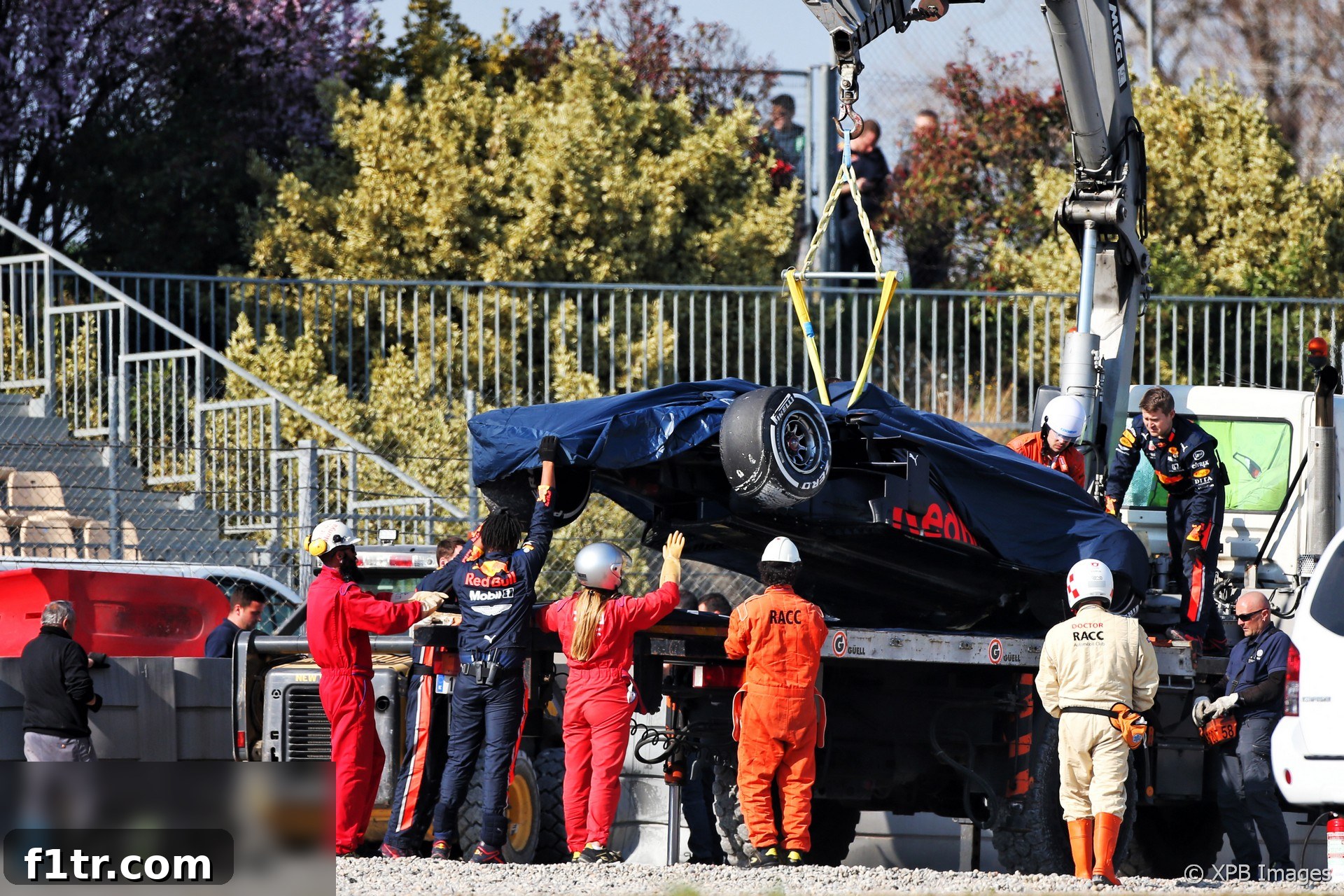
Pierre Gasly Takes Responsibility for Major Pre-Season Testing Crash, Urges Team Focus
Barcelona, Spain – Red Bull Racing driver Pierre Gasly has candidly admitted responsibility for the heavy crash he suffered at Turn 9 during a critical day of pre-season testing at the Circuit de Barcelona-Catalunya. The incident, which saw his RB15 make significant contact with the barriers, brought his final day of testing to an abrupt and dramatic halt, leaving the Red Bull garage with an intensive overnight repair job.
The highly anticipated 2019 Formula 1 season is on the horizon, and every moment of pre-season testing is invaluable for teams to fine-tune their new machinery and gather crucial data. For Gasly, who transitioned to Red Bull Racing this year from sister team Toro Rosso, these sessions are particularly important as he adapts to a new environment and shoulders the immense expectations placed upon a driver at a front-running team. His significant accident on track underscored the fine margins and inherent risks involved in pushing these cutting-edge machines to their limits.
The Incident: A Costly Error at Turn 9
The crash occurred at Turn 9, a high-speed corner known for challenging drivers. Video footage of the incident suggested that Gasly’s RB15 momentarily touched the grass on the entry to the corner. This slight misjudgment, combined with the extreme grip levels and delicate balance of an F1 car, proved decisive. As he turned into the corner, the car lost control, veering sharply into the protective barriers with considerable force. The impact was substantial, resulting in significant damage to the Red Bull chassis and components.
Immediately after the incident, Gasly was quick to acknowledge his error. Speaking to the media, he explained, “I made a mistake in Turn 9, basically lost the car. Really big crash. One of the biggest crashes I had.” This admission of fault is a testament to the young Frenchman’s character, demonstrating a willingness to take responsibility even under immense pressure. Such incidents are an inherent part of motor racing, especially during testing where drivers are continually exploring the boundaries of their cars and tracks.
An Apology and a Race Against Time for the Mechanics
The aftermath of such a crash extends far beyond the driver. While Gasly emerged physically unscathed, the immediate concern shifted to the Red Bull mechanics. Gasly offered a heartfelt apology to his team, fully understanding the arduous task that lay ahead for them. “It’s a long night for the mechanics now. I’m sorry for that,” he stated, emphasizing his regret over the additional workload his mistake had created.
The primary goal for Red Bull Racing following the incident is to ensure that the car is fully repaired and ready for Max Verstappen to complete his final day of testing. Verstappen, the team’s lead driver and a key figure in their championship aspirations, needs every possible lap to finalize preparations for the upcoming Australian Grand Prix. Losing valuable track time due to repairs could potentially set back the team’s development program, making the mechanics’ efforts overnight incredibly crucial. Their ability to swiftly and effectively reconstruct the car will directly influence the team’s readiness for the season opener in Melbourne.
“What’s important is we can get Max in the car tomorrow and then we’ll focus on the positives,” Gasly added, highlighting the team-first mentality required in Formula 1. The focus now shifts from the momentary setback to maximizing the remaining test time and drawing valuable insights from the data already gathered.
Gasly’s Overall Assessment of the RB15: Performance and Reliability
Despite the dramatic conclusion to his pre-season testing, Pierre Gasly remained optimistic about the Red Bull RB15’s potential. He had completed a significant amount of running prior to the crash, gathering essential feedback on the new package, which includes the highly anticipated Honda power unit. Gasly expressed encouragement regarding both the performance and the reliability demonstrated by the car over his allocated test days.
“I think the car, the package we have at the moment – the chassis, the engine – made a good step,” Gasly remarked. This positive assessment of the new Honda engine is particularly significant, as the partnership with the Japanese manufacturer is seen as a pivotal move for Red Bull Racing, aiming to challenge the dominance of Mercedes and Ferrari. The initial signs of good reliability from the Honda unit are a crucial positive, as power unit issues have plagued teams in the past, often derailing championship campaigns.
Gasly further elaborated on the car’s potential: “The reliability was good overall. We have good performance.” This indicates that the fundamental design of the RB15 and the integration of the Honda power unit are performing as expected, laying a solid foundation for the season. However, he also acknowledged that there is still work to be done to unlock the car’s full potential.
Maximizing the Package for Melbourne
While the initial feedback is positive, Gasly maintained a realistic perspective regarding Red Bull’s immediate standing against their formidable competitors. “We just need to understand how to maximise the package we have so we might not be the favourite or the fastest at the moment but we’ll work out for Melbourne and try to come there with the best car we have.”
This statement underscores the intensive development process that continues right up to the first race. Pre-season testing is not just about raw pace but also about understanding the car’s characteristics, optimizing its setup, and ensuring the drivers are comfortable pushing it to its limits. Red Bull’s engineers will now delve deep into the vast amounts of data collected, analyzing everything from aerodynamic efficiency to tire degradation, in an effort to squeeze every ounce of performance out of the RB15.
The goal for Melbourne is clear: arrive with the most competitive package possible. While they may not start the season as the outright favorites, Red Bull’s history of strong in-season development suggests they will be a force to be reckoned with. The team’s ability to adapt and refine their car will be key to challenging for race wins and potentially the championship.
The Crucial Role of Pre-Season Testing
Gasly’s crash serves as a stark reminder of the challenges and inherent risks of Formula 1 pre-season testing. These sessions are far more than just shakedowns; they are critical periods of intense development and validation. Teams utilize these days to:
- Validate Design Concepts: Ensure that theoretical designs translate into real-world performance.
- Optimize Setups: Experiment with various aerodynamic configurations, suspension settings, and brake biases to find the optimal balance for different tracks.
- Test Reliability: Push components to their limits to identify potential weaknesses before the season starts.
- Gather Data: Collect an immense amount of sensor data to understand the car’s behavior under various conditions.
- Driver Adaptation: Allow drivers to acclimatize to the new car, understand its nuances, and build confidence.
- Team Cohesion: Enhance communication and workflow between drivers, engineers, and mechanics.
An incident like Gasly’s crash, while regrettable, provides invaluable real-world data on impact resistance and structural integrity, though it comes at the cost of lost track time. The challenge for Red Bull now is to mitigate the impact of this lost time and ensure their preparation for the 2019 F1 season remains on track.
Looking Ahead to the 2019 F1 Season
With pre-season testing drawing to a close, all eyes will soon turn to the opening round of the 2019 Formula 1 season: the Australian Grand Prix in Melbourne. Red Bull Racing, with their new Honda power partnership, enters the season with renewed optimism and a strong desire to return to consistent race-winning form. Pierre Gasly, despite his testing mishap, is expected to play a crucial role alongside Max Verstappen in challenging the established order.
The incident at Turn 9, while a setback, is likely to be a minor blip in what Red Bull hopes will be a competitive and successful season. The team’s resilience, combined with the promising initial feedback on the RB15 and Honda engine, suggests they are well-positioned to be strong contenders. The focus now remains on meticulous preparation, leveraging all gathered data, and arriving in Melbourne ready to fight at the front of the grid.
2019 F1 Season Insights and Related Articles
- Crying in the Melbourne car park at 2019 grand prix was my career low – Ocon
- McLaren Racing reports reduced £71 million loss in 2019
- Kvyat: Hockenheim podium last year was “my biggest achievement” so far
- How the FIA’s new encrypted fuel flow meter targets Ferrari’s suspected ‘aliasing’ trick
- “He smashed my office door”: 23 must-see moments from ‘Drive to Survive’ season two
Browse all 2019 F1 season articles