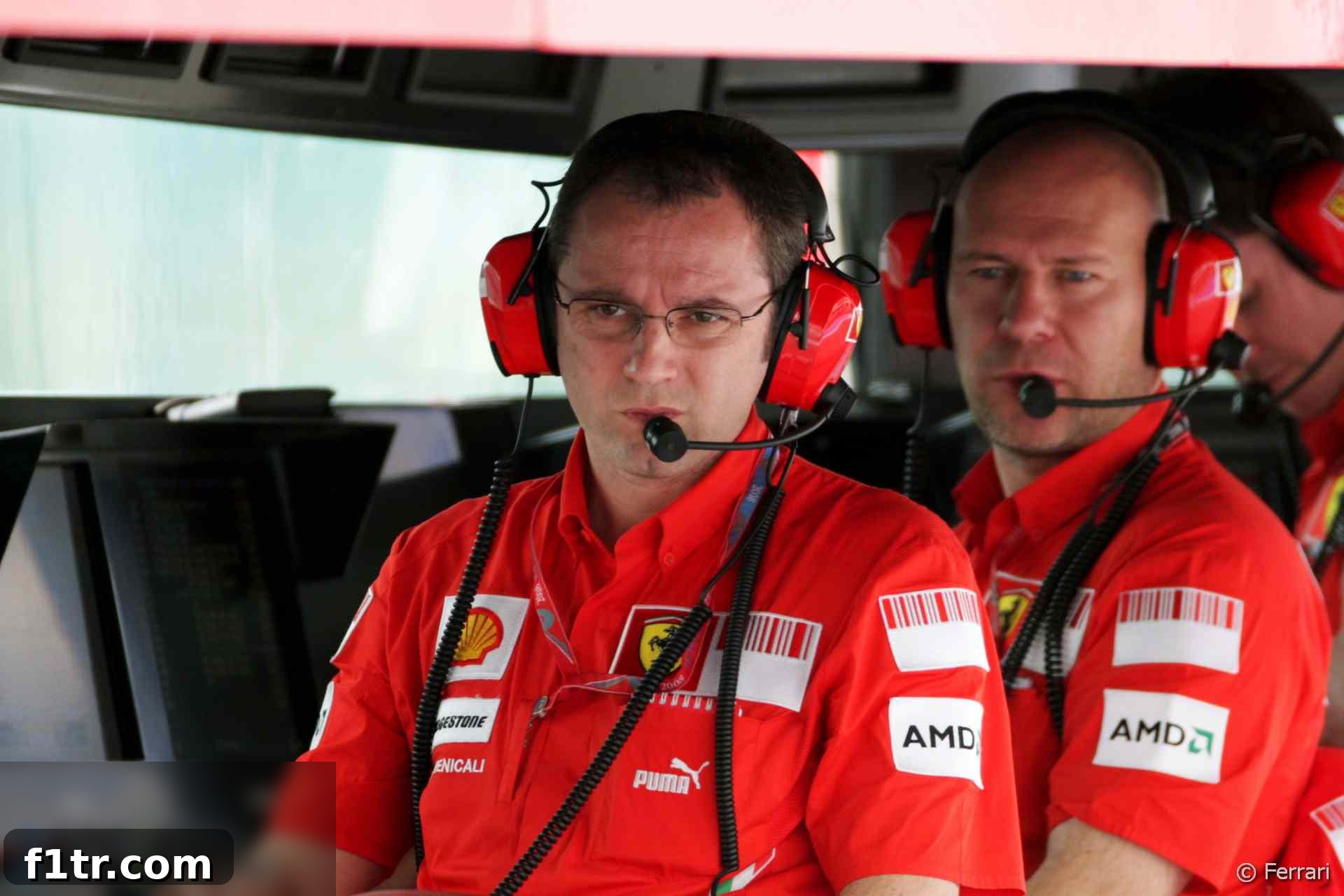
In a significant development that sent ripples across the Formula 1 world, Scuderia Ferrari has confirmed the resignation of Stefano Domenicali from his pivotal role as Team Principal. The announcement, made in the wake of Ferrari’s deeply uncompetitive start to the 2014 season, signals a definitive shift in leadership for the iconic Italian racing outfit. Following just three races, where the Maranello squad struggled to match the pace of its rivals, the immense pressure on Domenicali reached a critical point, prompting his departure from the team he had served for over two decades.
Taking the helm immediately is Marco Mattiacci, who has been swiftly promoted to oversee Ferrari’s racing operations. Mattiacci, previously the president and CEO of Ferrari North America, steps into one of the most demanding positions in international motorsport, tasked with steering the Prancing Horse through a challenging period and restoring its championship-winning pedigree. This change at the top reflects a bold move by Ferrari’s hierarchy to inject new energy and perspective into the team as it grapples with fundamental performance issues.
In a poignant statement reflecting on his decision, Stefano Domenicali expressed the profound weight of his choice: “There are special moments that come along in everyone’s professional life, when one needs courage to take difficult and very agonising decisions.” His words underscored the immense personal and professional sacrifice involved in stepping down from a role he had held with unwavering dedication since 2008.
Domenicali continued, articulating his rationale for the change: “It is time for a significant change. As the boss, I take responsibility, as I have always done, for our current situation. This decision has been taken with the aim of doing something to shake things up and for the good of this group of people that I feel very close to.” This acceptance of responsibility, a hallmark of his leadership, aimed to protect his team and stimulate a necessary re-evaluation of Ferrari’s approach. It was a gesture of humility and genuine care for the future of the Scuderia.
His farewell was heartfelt, extending gratitude to all those who had been part of his journey: “With all my heart, I thank all the men and women in the team, the drivers and the partners for the wonderful relationship we have enjoyed over all these years. I hope that very soon, Ferrari will be back where it deserves to be. My final words of thanks go to our president, for having always supported me and to all our fans. I only regret that we have been unable to harvest what we worked so hard to sow in recent years.” This sense of unfinished business, of effort not fully rewarded, resonated deeply with the Tifosi and highlighted the continuous struggle Ferrari faced in translating tireless work into championship success.
Domenicali’s Era: A Legacy of Near Misses and Unyielding Pressure
Stefano Domenicali’s journey with Ferrari began in 1991, a testament to his long-standing commitment to Maranello. After graduating from the University of Bologna, he steadily climbed the ranks, eventually succeeding the revered Jean Todt as team principal in 2008. His appointment came at a high point for the team; Ferrari had just clinched the Constructors’ Championship that year, and Felipe Massa narrowly missed out on the drivers’ title to McLaren’s Lewis Hamilton in a dramatic season finale. The expectation was that Domenicali would build on this foundation, continuing Ferrari’s legacy of dominance.
However, the years that followed proved to be an arduous test of endurance and resilience. Despite the immense talent of drivers like Fernando Alonso, who came agonisingly close to the drivers’ championship on two separate occasions, Ferrari’s ultimate goal of reclaiming the top spot remained elusive. Domenicali, a figure of calm and measured demeanour, found himself at the forefront of a team under constant scrutiny, fighting against an increasingly competitive field.
The 2010 season exemplified the heartbreak of Domenicali’s tenure. Alonso arrived at the final race in Abu Dhabi leading the points standings, only for a critical tactical error during the race to cost him the crown, which ultimately went to Sebastian Vettel. This strategic misstep led to significant internal restructuring, with strategist Chris Dyer, a key architect of the team’s success during the Michael Schumacher years, being moved aside over the winter in a clear indication of the pressure to perform.
The pattern of near misses continued. A disappointing start to the 2011 season prompted further significant changes, with Aldo Costa replaced as technical director. Despite these efforts, the team ended the year with a solitary victory, a stark reminder of the challenges they faced. Yet, Domenicali and his team displayed characteristic resilience, bouncing back from a poor start to 2012, with Alonso once again arriving at the season finale with a real chance of claiming the title. In a cruel twist of fate, history repeated itself, and he lost out to Vettel once more, underscoring the formidable challenge posed by Red Bull’s continued dominance.
The 2013 season saw Domenicali’s focus shift towards long-term investment, with resources channelled into upgrading and improving the technical facilities at Maranello. While this was a crucial step for future competitiveness, it meant that on-track, Ferrari offered little resistance to Red Bull’s unbroken run of dominance, further highlighting the team’s ongoing struggle to find an immediate competitive edge.
The Tipping Point: A Dismal Start to the 2014 Season
The 2014 Formula 1 season brought with it a significant overhaul of regulations, particularly concerning power units. With the introduction of complex V6 turbo-hybrid engines, many hoped that this new era would play to Ferrari’s traditional strength in engine development. There was a palpable sense of optimism that the Scuderia could leverage its engineering prowess to regain a competitive advantage. However, the reality of the first three races proved devastatingly different.
Ferrari found itself well off the pace of Mercedes, whose new power unit package proved to be in a league of its own. The F14 T, with its new engine, suffered from a combination of insufficient power, poor energy recovery, and handling issues that left both Fernando Alonso and Kimi Raikkonen struggling to compete for top positions. The lack of performance was stark, and the dream of a resurgent Ferrari quickly turned into a grim battle for points.
The Bahrain Grand Prix proved to be the ultimate catalyst for change. Ferrari President Luca di Montezemolo made his first race visit of the season, a rare appearance that underscored the severity of the team’s predicament. What he witnessed was deeply disheartening: his team’s cars were repeatedly overtaken, lacking the pace and race craft to defend their positions. Montezemolo, visibly frustrated, left the circuit before Alonso and Raikkonen crossed the finish line at the foot of the points positions, a symbolic moment reflecting the depths to which the team had fallen. Currently, Ferrari languishes in fifth place in the Constructors’ Championship, trailing not only Mercedes but also Force India, McLaren, and Red Bull.
Montezemolo’s Endorsement and Mattiacci’s Challenging Ascent
Ferrari president Luca di Montezemolo, a figure synonymous with the Scuderia’s modern era, acknowledged Stefano Domenicali’s tenure with a blend of gratitude and respect. He publicly thanked Domenicali “for his constant dedication and effort, but also for the great sense of responsibility he has shown, even today, in always putting the interests of Ferrari above all else.” Montezemolo’s words held particular significance given his past support for Domenicali. As recently as September of the previous year, Montezemolo had publicly defended his team principal, telling media that it was not Domenicali’s fault the team had failed to win championships in 2010 and 2012. This public endorsement made Domenicali’s subsequent resignation all the more impactful, signifying that even Montezemolo recognised the need for a drastic change.
“I hold Domenicali in esteem and I have watched him grow professionally over the twenty-three years we have worked together, I now wish him every success for the future,” Montezemolo added, underscoring the personal connection and mutual respect between the two men, despite the difficult circumstances.
Turning to the future, Montezemolo expressed his confidence in the newly appointed team principal: “I also want to wish all the best to Marco Mattiacci, whom I know to be a highly regarded manager and who knows the company well. He has accepted this challenge with enthusiasm.” Mattiacci’s background is primarily in the commercial and brand side of Ferrari, leading their North American operations. His appointment as team principal, a role traditionally held by individuals with deep roots in racing operations, represents a departure from the norm. This choice suggests a desire within Ferrari to bring a fresh, business-oriented perspective to the racing team, hoping that a new vision and leadership style can unlock the performance that has been so elusive.
Mattiacci faces an immediate and formidable task. He must quickly adapt to the intense, high-pressure environment of Formula 1 racing, understand the complex technical challenges plaguing the F14 T, and motivate a team that has been repeatedly tested by unfulfilled aspirations. His ability to rally the engineering departments, streamline decision-making processes, and foster a culture of innovation will be critical in determining whether Ferrari can claw its way back to the top of the sport. The eyes of the entire Formula 1 community, and especially the passionate Tifosi, will be fixed on Maranello as Mattiacci embarks on this daunting but potentially transformative journey.
The departure of Stefano Domenicali marks the end of an era for Scuderia Ferrari, characterised by unwavering loyalty, immense effort, and the constant pursuit of elusive championship glory. His resignation, driven by a commitment to the team’s ultimate good, paves the way for Marco Mattiacci to take the reins. As Ferrari navigates the turbulent waters of the 2014 season and beyond, the weight of expectation on Mattiacci’s shoulders will be immense. The immediate challenge is to stabilise performance, address the fundamental issues with the F14 T, and reignite the competitive spirit that defines Ferrari. Only time will tell if this bold leadership change will be the catalyst needed to bring the Prancing Horse back to its rightful place at the pinnacle of Formula 1.
Advert | Become a RaceFans supporter andgo ad-free
Go ad-free for just £1 per month>> Find out more and sign up
2014 F1 season
- Which was F1’s best down-to-the-wire title fight?
- Fear of rules change led Mercedes to run dominant 2014 engine in “idle mode”
- Mercedes’ Bahrain battle “too dangerous” – Warwick
- Streiff’s comments on Bianchi crash investigation prompts legal action from FIA
- Is stewarding improving? Analysing 2014’s penalties
Browse all 2014 F1 season articles