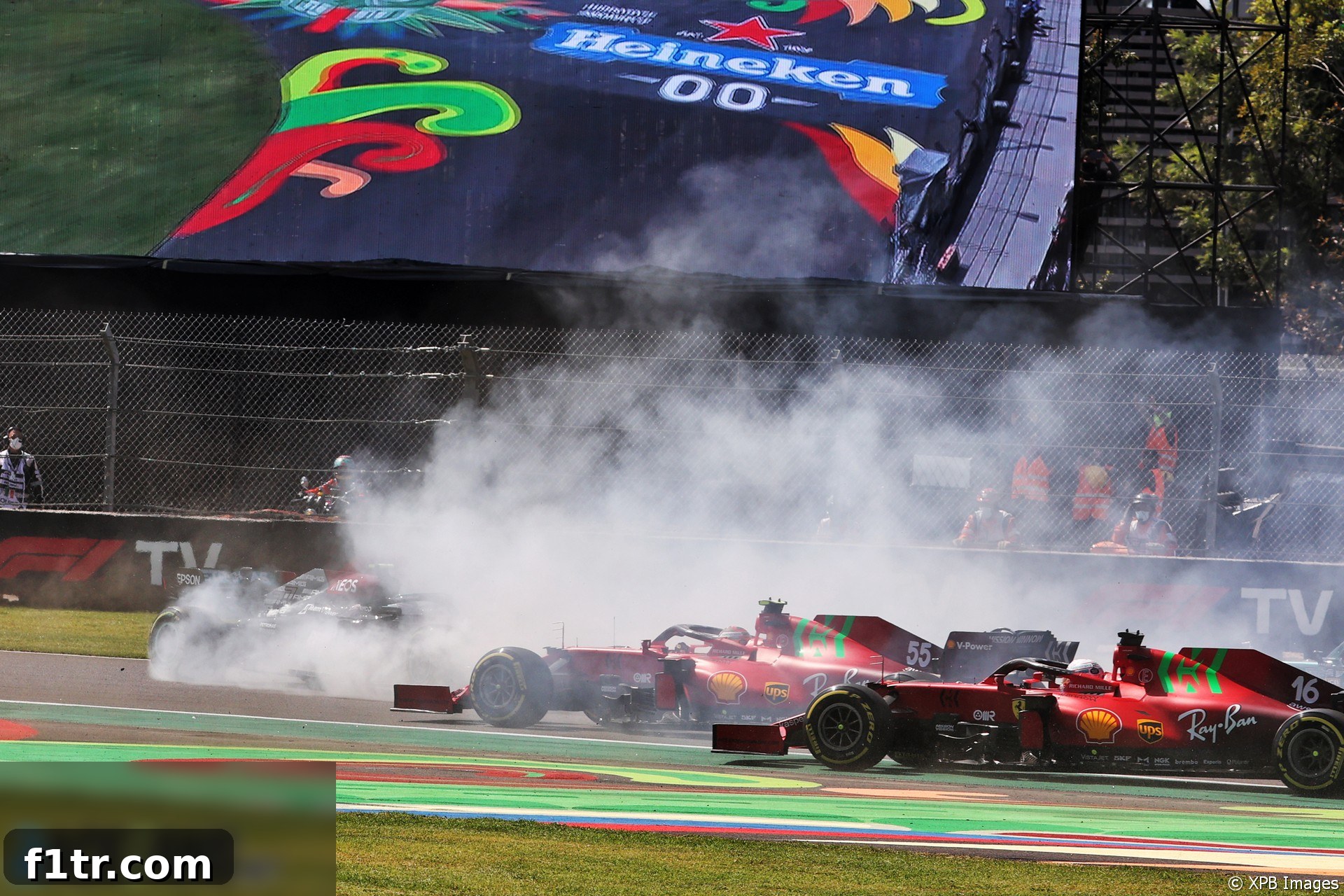
The exhilarating start of any Formula 1 Grand Prix often holds the potential for drama, and the 2021 Mexico City Grand Prix was no exception. What began as a fierce battle for supremacy into Turn 1 quickly devolved into a controversial tangle involving two prominent drivers: Daniel Ricciardo and Valtteri Bottas. Their collision, which saw Bottas spinning out of contention, was ultimately deemed a “no investigation necessary” incident by the race stewards. This decision sparked considerable debate among fans, pundits, and drivers alike, raising fundamental questions about the consistency of F1 stewarding and the definition of a ‘racing incident’ on the chaotic opening lap. Was the lack of action truly the correct call, or did it overlook a potential breach of racing etiquette?
The Tumultuous First Lap: Ricciardo and Bottas Collide in Mexico
Unpacking the Incident: Turn 1 Chaos at the Autódromo Hermanos Rodríguez
The stage was set for an explosive start at the high-altitude Mexico City circuit. Valtteri Bottas, starting from a hard-earned pole position, found himself immediately under immense pressure from the Red Bull of Max Verstappen and his Mercedes teammate Lewis Hamilton. As the lights went out and the field surged towards the tight, crucial Turn 1, Bottas was sandwiched between his rivals. While Verstappen and Hamilton carved their way into the lead, Bottas held his line, positioning himself to turn into the corner in third place.
Meanwhile, Daniel Ricciardo, having started seventh on the grid, enjoyed a strong launch. Sensing an opportunity to gain positions, he steered his McLaren towards the inside line for Turn 1. This aggressive approach, while common in the opening moments of a race, carried inherent risks. As Ricciardo braked for the corner, his front-right wheel locked up. This critical error compromised his braking point and trajectory, causing his car to understeer. Unable to sufficiently slow down or alter his line, Ricciardo made unavoidable contact with Bottas, nudging the Mercedes and sending it into a helpless spin.
The immediate aftermath of the contact was a chaotic scene. Bottas’s car rotated dramatically in the middle of the track, effectively bringing his hard work on Saturday to an abrupt and unfortunate halt. While both Ricciardo and Bottas managed to continue racing, albeit with Bottas now at the very back of the pack and Ricciardo reporting potential damage, the incident had ripple effects further down the field. Two other drivers, Esteban Ocon and Yuki Tsunoda, along with Mick Schumacher, were caught up in separate collisions behind the initial tangle. Both Schumacher and Tsunoda retired on the spot with significant damage, highlighting the domino effect of first-lap incidents.
A Frame-by-Frame Look at the Crucial Moments
Driver Reactions: Voices from the Cockpit and Paddock
The raw emotions and immediate assessments of the drivers involved provide crucial insight into the incident. Their comments, both during the race and post-race, reveal differing perspectives on what transpired.
In the Heat of the Moment: Radio Communications
As his car spun, Valtteri Bottas’s frustration was palpable over the team radio. “Somebody hit me and caused me to spin,” he reported. “Can you see who hit me from further behind? Nothing I could do.” His words conveyed a sense of helplessness and clear belief that he was the innocent party in a collision caused by another driver’s misjudgment.
Daniel Ricciardo, assessing his car for potential damage, was more succinct. “I think I have damage,” he radioed, his focus immediately shifting to the integrity of his McLaren after the contact.
Sergio Perez, the local hero, who skillfully took evasive action to avoid the spinning Mercedes, was vocal in his critique. “Who was the idiot who crashed into Bottas? He nearly took me out as well,” he exclaimed, his frustration evident as he navigated the chaos. Perez’s remark underscores the danger and disruption caused by the incident to multiple drivers.
Post-Race Reflections: Ricciardo’s Perspective
I had a good launch, so I had a slipstream and we were looking pretty good. I was alongside, I think, Perez into one.
And I locked [up] initially and then I collected it […] I locked before kind of the entry point, and then I gathered it up again. And I think it just looks like we’ve – obviously Valtteri has come to kind of close the apex and then hits me, I think Perez, and there’s basically not enough room for all of us. So it was actually a lot smaller hit than I thought.
Daniel Ricciardo
Ricciardo’s detailed explanation suggests a complex scenario. He acknowledged the initial lock-up, an admission of his own error, but also implied that Bottas’s line into the apex contributed to the lack of space. His statement, “there’s basically not enough room for all of us,” hints at a ‘racing incident’ mentality, where multiple cars converge with limited track space. However, the critical element remains his initial braking mistake and subsequent lock-up, which initiated the chain of events.
The Official Verdict: No Investigation Necessary
Despite the significant impact on Bottas’s race and the chaotic scenes that followed, the race stewards swiftly reviewed the incident. Their official announcement was brief and decisive: “Lap one turns one-two incident, no investigation necessary.” This ruling, or lack thereof, essentially categorized the collision as a ‘racing incident’ – an unavoidable consequence of competitive racing where no single driver is deemed wholly at fault for deserving a penalty.
This decision, while quick, inevitably fueled the debate. For many, a driver locking a wheel and hitting another car, especially one on the racing line, warrants scrutiny. However, first-lap incidents are often viewed with a degree of leniency by stewards, recognizing the intense pressure, close proximity of cars, and the inherent unpredictability of the opening moments of a Grand Prix. The challenge for stewards lies in distinguishing between an aggressive but legitimate maneuver gone wrong, and a clear misjudgment or reckless act.
Contextualizing the Decision: Recent F1 Stewarding Precedents
To fully understand the weight of the stewards’ decision, it’s crucial to look at similar incidents and the penalties imposed in the recent past. The perceived inconsistency in stewarding decisions is a frequent point of contention in Formula 1, and comparing the Ricciardo-Bottas case to other first-lap collisions can highlight this.
- **Pierre Gasly’s Penalty (Turkish Grand Prix):** Just weeks prior, Pierre Gasly received a five-second time penalty for a first-lap collision with Fernando Alonso at the Turkish Grand Prix. In that instance, Gasly ran wide at Turn 1, then cut back across the track, making contact with Alonso. The key difference was arguably Gasly’s deviation from his line after running wide, which was deemed an unsafe re-entry or aggressive rejoin.
- **Bottas and Stroll Penalties (Hungarian Grand Prix):** Valtteri Bottas himself, and Lance Stroll, were both handed five-place grid penalties for multiple first-lap collisions at the Hungarian Grand Prix. Bottas triggered a multi-car pile-up by misjudging his braking point in wet conditions, collecting Lando Norris and others. Stroll also caused a separate incident by locking up and hitting Charles Leclerc. In these cases, the scale of the incident and the clear misjudgment of braking, leading to significant damage and retirements for multiple cars, led to undeniable penalties.
The Mexico City incident, while not as destructive as the Hungary crash, involved a clear braking error from Ricciardo leading to contact with a car on the racing line. The critical question then becomes: why was Gasly penalized for a similar, if contextually different, first-lap error, while Ricciardo escaped punishment? The ‘racing incident’ umbrella often covers collisions where drivers are genuinely fighting for position and contact is an unfortunate consequence of close wheel-to-wheel action, but a locked wheel and direct impact on a car that has already committed to the corner typically falls outside this lenient interpretation.
Implications and Aftermath for the Championship Battle
While Daniel Ricciardo’s race was relatively unaffected in terms of outcome, Valtteri Bottas’s spin had significant implications. Starting from pole, he was in a prime position to challenge for the race win and potentially deny Max Verstappen crucial championship points. Instead, he was relegated to the back, spending the rest of the race attempting an uphill recovery. Although he eventually scored a point for the fastest lap, the incident severely hampered Mercedes’ strategic options and their ability to double-team Verstappen. In a tightly contested championship, every point and every strategic advantage counts, making the impact of Bottas’s spin far greater than just a singular moment of contact.
Your Verdict: The Fan Perspective on Stewarding Decisions
The stewards’ decision to take no action against Daniel Ricciardo for his collision with Valtteri Bottas at the Mexico City Grand Prix provoked strong opinions among the Formula 1 community. RaceFans conducted a poll to gauge whether fans agreed with the ‘no investigation necessary’ verdict.
Do you agree Daniel Ricciardo should have been penalised for his collision with Valtteri Bottas?
The poll, which gathered 159 votes, revealed a clear division among voters, indicating the contentious nature of the incident:
- Strongly disagree: 23% (voters believed Ricciardo should NOT have been penalized)
- Slightly disagree: 12%
- Neither agree nor disagree: 6%
- Slightly agree: 31% (voters believed Ricciardo SHOULD have been penalized)
- Strongly agree: 27%
- No opinion: 1%
Combining the ‘Slightly agree’ and ‘Strongly agree’ responses, a majority of 58% of voters felt that Daniel Ricciardo should have received a penalty. Conversely, 35% disagreed with a penalty, indicating a substantial minority. This divergence of opinion underscores the subjective nature of racing incidents and the difficulty stewards face in making calls that satisfy everyone. The incident continues to be a point of discussion whenever first-lap tangles occur.
This poll was conducted using a RaceFans account voting system, allowing registered users to cast their verdict on the stewarding decision.
Related Formula 1 Debates and Polls
- What must Formula 1 fix with its new rules – and what should it leave unchanged?
- ADUO: Do F1 teams who fall behind deserve to get help to catch up?
- F1 is considering doubling its sprint races. Do you want more or fewer?
- Will this be a fight or a rout? 20 questions for the 2026 Formula 1 season
- Which Formula 1 team has the best-looking car – and the worst – for the 2026 season?
Browse all debates and polls