The Singapore Grand Prix: Lando Norris, Fastest Lap Intrigue, and McLaren’s Strategic Crossroads
The thrilling conclusion to the Singapore Grand Prix saw Lando Norris’s impressive drive to victory almost perfectly capped by an attempt at the fastest lap, only for his hopes of maximum points to be controversially snatched away by Daniel Ricciardo in the dying moments of the race. This incident ignited fierce debate and cast a spotlight on the intricate strategic battles unfolding beneath the dazzling lights of Marina Bay. While Norris celebrated a monumental win, the single point for the fastest lap, crucial in a tightly contested championship, became a point of contention and strategic analysis.
Speculation quickly mounted regarding the motivation behind Ricciardo’s late pit stop and subsequent blistering lap. Whispers suggested that Red Bull, keen to protect Max Verstappen’s championship lead, had instructed their sister team, RB, to deploy Ricciardo to deprive Verstappen’s closest rival of a valuable point. This scenario raised questions not only about the nature of team alliances in Formula 1 but also whether McLaren, Norris’s team, might have missed a crucial opportunity to render such efforts irrelevant through their own strategic foresight.
Norris’s Relentless Pursuit: Pushing the Limits at Marina Bay
The Singapore Grand Prix is renowned as one of Formula 1’s most physically demanding and unforgiving races. Its tight street circuit, high humidity, and lack of run-off areas push drivers to their absolute limits. Lando Norris, delivering a masterclass in controlled aggression, openly admitted to pushing his McLaren to the very edge, even brushing the unforgiving walls of the circuit on two occasions during his charge to victory. This demonstrated his unwavering commitment and the sheer intensity required to win at Marina Bay.
Following the race, Norris candidly shared his strategy, revealing his intent to create a sufficient gap to his nearest competitor to allow for a late pit stop. This strategic move would have enabled him to switch to a fresh set of soft tyres, specifically for a shot at the fastest lap point – an increasingly important element in the modern F1 championship. “I was flat out,” he stated, emphasizing the intensity of his driving. “I was probably pushing a bit too hard, it was definitely not like I was cruising.” He further elaborated on his goal: “I was pushing to open up a gap, and at one point I wanted to try and open up a pit window to give myself an opportunity to maybe box at the end of the race for quickest lap if I needed to try and achieve that. Daniel stole that away from me at the end of the race.” This sentiment encapsulated his frustration and the razor-thin margins at play in top-tier motorsport.
The Elusive Pit Window: A Risky Gamble for McLaren
The mathematics of securing a fastest lap at the end of a Grand Prix are precise and fraught with risk. At the Marina Bay Street Circuit, a typical pit stop costs a driver approximately 30 seconds. For Norris to have safely pitted for soft tyres without losing his hard-fought position, he would have needed a comfortable margin over the car behind him, usually around 31-32 seconds to account for any unforeseen delays during the stop. Norris came tantalizingly close to achieving this target, with his lead over Max Verstappen peaking at 29.1 seconds on laps 53-54.
However, McLaren’s strategists faced a critical dilemma. While a 29.1-second lead is close to the required pit stop time, the potential cost of even a slightly slower stop – a stuck wheel nut, a fumbled tyre change, or a minor delay exiting the pit box – could have seen Norris emerge behind Verstappen, jeopardizing his race win. Given these high stakes, the team would undoubtedly have preferred a more substantial margin, perhaps an additional second or two, to execute such a high-risk strategy with confidence. The inherent danger of the circuit and the crucial championship points at stake likely contributed to McLaren’s cautious approach.
The irony of the situation was amplified by the performance data. Had Norris been given the opportunity to complete a lap on fresh soft tyres, he would likely not have needed to push nearly as hard as Daniel Ricciardo did. Ricciardo’s fastest lap on softs was a mere two-tenths of a second quicker than what Norris had already managed on an 18-lap-old set of hard compound tyres. This small margin underscores how attainable the bonus point was for Norris, had the strategic window and team confidence aligned.
The Strategic Crossroads: McLaren’s Caution vs. Aggression
As the race neared its conclusion, Max Verstappen began to eat into Norris’s lead, narrowing the gap to 20 seconds by the chequered flag. A significant portion of this lost time occurred in the final laps as Norris meticulously navigated a three-car train consisting of Nico Hulkenberg, Sergio Perez, and Franco Colapinto. Managing traffic on a street circuit like Singapore is a delicate art, demanding precision and caution to avoid incidents that could ruin a race-winning performance.
This raises the pertinent question: Was there an earlier opportunity for Norris to build the necessary lead for that fastest lap attempt? Norris’s quickest lap of the race came on lap 48, by which point his lead stood at 26 seconds. This suggests that prior to this, he was driving with a degree of margin, perhaps conserving his tyres or managing other aspects of his race. Had he pushed harder on his tyres earlier in the stint, the crucial pit window might have opened up. However, this carries its own risks, potentially compromising tyre life and overall race pace.
McLaren’s decision-making was also heavily influenced by their own operational challenges. The team had suffered a problem during a practice pit stop on Friday, which resulted in delays for Oscar Piastri’s start to the first session of the weekend. Such an incident, even in practice, can instill a degree of caution within a team, especially when a race win is on the line. In such circumstances, a driver like Norris might have needed to exert considerable persuasion to convince his team to take the risk, akin to how Max Verstappen successfully convinced Red Bull to allow him a fastest lap attempt in Austria the previous year, famously telling them, “Don’t f*** it up!” McLaren, it seems, opted for prudence, prioritizing the securement of a valuable victory over the pursuit of an additional point.
The Daniel Ricciardo Factor: An RB Intervention?
The narrative surrounding Daniel Ricciardo’s late pit stop and fastest lap was perhaps the most controversial element of the Singapore Grand Prix. With Red Bull’s primary driver, Max Verstappen, locked in a fierce championship battle, the potential for a rival to gain an extra point for the fastest lap holds significant weight. The speculation that Red Bull influenced their sister team, RB, to deploy Ricciardo specifically to deprive Lando Norris of this point, added a layer of strategic intrigue to the race.
While team orders and strategic interventions are not uncommon in Formula 1, the explicit use of a ‘B-team’ to directly impact the championship hopes of a rival is a contentious issue. Ricciardo’s move, on fresh soft tyres, allowed him to set a lap time just quick enough to snatch the bonus point. Whether this was a pre-meditated tactical instruction from Red Bull or a genuine attempt by RB to maximize their own performance (albeit having no bearing on their points finish), the outcome served Red Bull’s interests directly. This incident reignited discussions about the competitive fairness and ethical boundaries within a sport where multi-team structures are becoming increasingly prevalent.
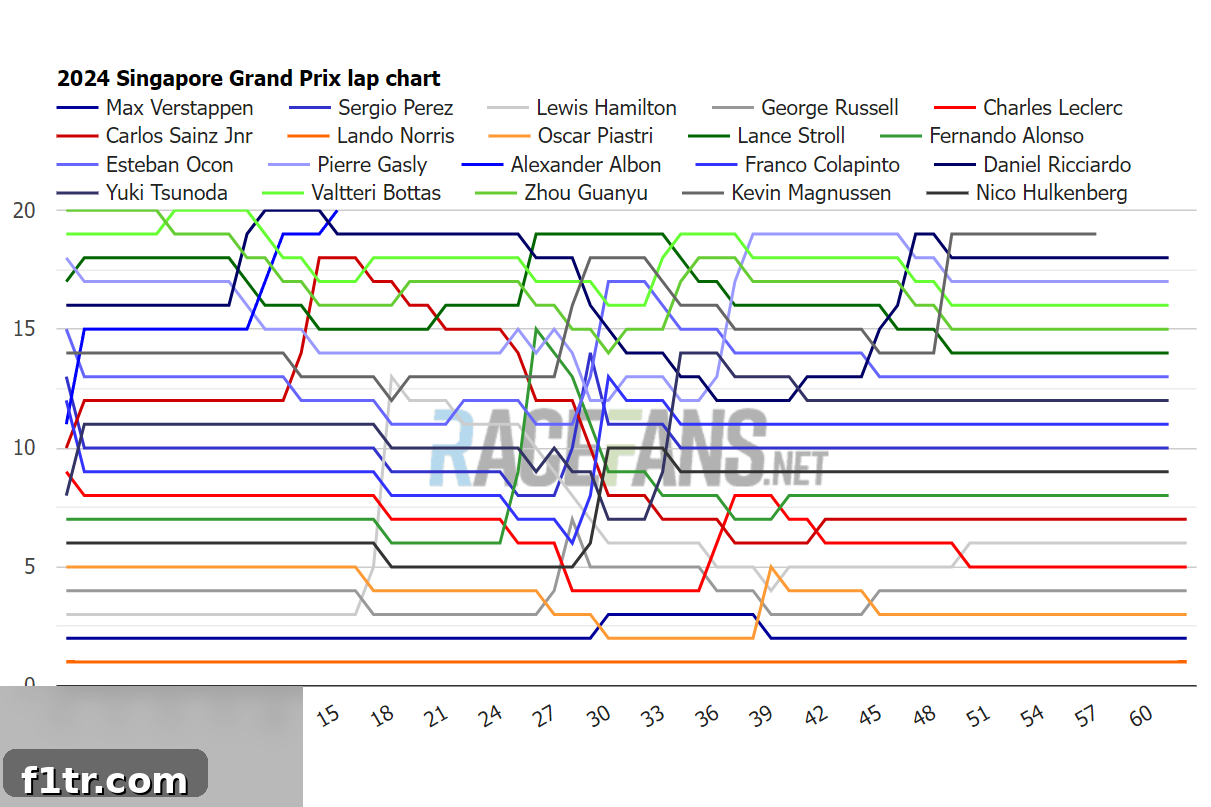
2024 Singapore Grand Prix Lap Chart Overview
While dynamic lap charts provide detailed visual representations of driver positions throughout a race, a textual overview highlights key movements. The Singapore Grand Prix saw significant strategic fluctuations due to safety car periods and tyre degradation. Drivers often found themselves in different battles across the 62 laps, with traffic management proving critical, particularly in the closing stages as demonstrated by Norris’s encounter with the three-car train of Hulkenberg, Perez, and Colapinto. Positions frequently shifted among the midfield, showcasing the tight competition.
2024 Singapore Grand Prix Race Chart Dynamics
Race charts illustrate the gaps between drivers relative to the leader’s average lap time, offering insights into pace differentials and strategic effectiveness. In Singapore, these charts would have revealed how Lando Norris established and maintained a controlled lead for much of the race, skillfully managing his tyres and pace. They would also show Max Verstappen’s steady closing pace in the latter stages and how some drivers in the midfield struggled with tyre wear or traffic, leading to expanding gaps.
2024 Singapore Grand Prix Lap Times Analysis
Individual lap times are the raw data reflecting driver and car performance. A detailed analysis of the Singapore GP lap times would show Lando Norris’s consistent pace at the front, interspersed with his push to create a pit window. It would also highlight the surprising late burst of speed from Daniel Ricciardo on fresh softs, as well as the varying strategies and tyre degradation experienced by the entire field on a circuit notorious for its demanding nature on rubber. Very slow laps, often indicative of pit stops or incidents, would also be apparent.
2024 Singapore Grand Prix Fastest Laps
The fastest lap point, though just one point, can be incredibly significant in a championship fight. Here’s a breakdown of the fastest laps set during the 2024 Singapore Grand Prix, illustrating the raw pace demonstrated by various drivers, particularly Daniel Ricciardo’s decisive late charge:
| Rank | # | Driver | Car | Lap time | Gap | Avg. speed (kph) | Lap no. |
|---|---|---|---|---|---|---|---|
| 1 | 3 | Daniel Ricciardo | RB-Honda RBPT | 1’34.486 | 188.22 | 60 | |
| 2 | 20 | Kevin Magnussen | Haas-Ferrari | 1’34.754 | 0.268 | 187.69 | 51 |
| 3 | 4 | Lando Norris | McLaren-Mercedes | 1’34.925 | 0.439 | 187.35 | 48 |
| 4 | 16 | Charles Leclerc | Ferrari | 1’35.371 | 0.885 | 186.47 | 46 |
| 5 | 81 | Oscar Piastri | McLaren-Mercedes | 1’35.745 | 1.259 | 185.74 | 48 |
| 6 | 1 | Max Verstappen | Red Bull-Honda RBPT | 1’35.967 | 1.481 | 185.31 | 59 |
| 7 | 22 | Yuki Tsunoda | RB-Honda RBPT | 1’36.393 | 1.907 | 184.49 | 53 |
| 8 | 55 | Carlos Sainz Jnr | Ferrari | 1’36.561 | 2.075 | 184.17 | 15 |
| 9 | 23 | Alexander Albon | Williams-Mercedes | 1’36.888 | 2.402 | 183.55 | 13 |
| 10 | 10 | Pierre Gasly | Alpine-Renault | 1’36.927 | 2.441 | 183.48 | 46 |
| 11 | 63 | George Russell | Mercedes | 1’37.047 | 2.561 | 183.25 | 30 |
| 12 | 43 | Franco Colapinto | Williams-Mercedes | 1’37.262 | 2.776 | 182.85 | 35 |
| 13 | 44 | Lewis Hamilton | Mercedes | 1’37.393 | 2.907 | 182.6 | 43 |
| 14 | 24 | Zhou Guanyu | Sauber-Ferrari | 1’37.461 | 2.975 | 182.47 | 47 |
| 15 | 27 | Nico Hulkenberg | Haas-Ferrari | 1’37.470 | 2.984 | 182.46 | 35 |
| 16 | 11 | Sergio Perez | Red Bull-Honda RBPT | 1’37.477 | 2.991 | 182.44 | 33 |
| 17 | 77 | Valtteri Bottas | Sauber-Ferrari | 1’37.524 | 3.038 | 182.36 | 46 |
| 18 | 14 | Fernando Alonso | Aston Martin-Mercedes | 1’37.741 | 3.255 | 181.95 | 54 |
| 19 | 18 | Lance Stroll | Aston Martin-Mercedes | 1’37.851 | 3.365 | 181.75 | 36 |
| 20 | 31 | Esteban Ocon | Alpine-Renault | 1’37.964 | 3.478 | 181.54 | 48 |
NB. Magnussen’s fastest lap time was deleted for a track limits infringement.
2024 Singapore Grand Prix Tyre Strategies
Tyre strategy is paramount at the Singapore Grand Prix, a race often punctuated by safety cars and high degradation. A comprehensive tyre strategy chart would detail each driver’s compound choices and pit stop timings, showcasing the diverse approaches teams took to manage the race. Some opted for aggressive early stops, others tried to extend stints. The impact of the safety car on the strategic landscape would be a key element, forcing many teams to react and adapt. Ultimately, the successful management of tyre life proved crucial for maintaining pace and position on the demanding street circuit.
2024 Singapore Grand Prix Pit Stop Times
Pit stop efficiency is a cornerstone of modern Formula 1, where fractions of a second can determine race outcomes. The Singapore Grand Prix pit stop times highlight the performance of each team in the crucial moments in the pit lane. While Mercedes and Red Bull consistently deliver rapid stops, McLaren also demonstrated strong performance, with Lando Norris’s stop being particularly swift. The table below details how long each driver’s pit stops took, offering a glimpse into the operational excellence (or challenges) of the teams:
| Rank | # | Driver | Team | Complete stop time (s) | Gap to best (s) | Stop no. | Lap no. |
|---|---|---|---|---|---|---|---|
| 1 | 63 | George Russell | Mercedes | 28.739 | 1 | 27 | |
| 2 | 11 | Sergio Perez | Red Bull | 28.99 | 0.251 | 1 | 28 |
| 3 | 16 | Charles Leclerc | Ferrari | 29.042 | 0.303 | 1 | 36 |
| 4 | 3 | Daniel Ricciardo | RB | 29.066 | 0.327 | 2 | 46 |
| 5 | 4 | Lando Norris | McLaren | 29.091 | 0.352 | 1 | 30 |
| 6 | 23 | Alexander Albon | Williams | 29.126 | 0.387 | 1 | 11 |
| 7 | 81 | Oscar Piastri | McLaren | 29.152 | 0.413 | 1 | 38 |
| 8 | 14 | Fernando Alonso | Aston Martin | 29.251 | 0.512 | 1 | 25 |
| 9 | 44 | Lewis Hamilton | Mercedes | 29.272 | 0.533 | 1 | 17 |
| 10 | 24 | Zhou Guanyu | Sauber | 29.36 | 0.621 | 1 | 34 |
| 11 | 55 | Carlos Sainz Jnr | Ferrari | 29.385 | 0.646 | 1 | 13 |
| 12 | 31 | Esteban Ocon | Alpine | 29.601 | 0.862 | 1 | 29 |
| 13 | 3 | Daniel Ricciardo | RB | 29.653 | 0.914 | 3 | 58 |
| 14 | 1 | Max Verstappen | Red Bull | 29.655 | 0.916 | 1 | 29 |
| 15 | 22 | Yuki Tsunoda | RB | 29.662 | 0.923 | 1 | 33 |
| 16 | 20 | Kevin Magnussen | Haas | 29.707 | 0.968 | 1 | 28 |
| 17 | 43 | Franco Colapinto | Williams | 29.772 | 1.033 | 1 | 29 |
| 18 | 27 | Nico Hulkenberg | Haas | 29.808 | 1.069 | 1 | 29 |
| 19 | 18 | Lance Stroll | Aston Martin | 29.816 | 1.077 | 1 | 26 |
| 20 | 3 | Daniel Ricciardo | RB | 30.316 | 1.577 | 1 | 10 |
| 21 | 77 | Valtteri Bottas | Sauber | 30.423 | 1.684 | 1 | 33 |
| 22 | 20 | Kevin Magnussen | Haas | 31.291 | 2.552 | 2 | 49 |
| 23 | 10 | Pierre Gasly | Alpine | 31.509 | 2.77 | 1 | 37 |
Related 2024 Singapore Grand Prix Articles
- Ricciardo’s brake woe and why Perez thought he had an engine problem: Singapore GP radio
- ‘Perez is only quicker when he has DRS’: How Hulkenberg’s Haas beat a Red Bull – again
- Mercedes explain “clear mistake” strategy call which left Hamilton “so angry”
- “Sometimes I wonder why I do this”: How Hamilton endured a slog to sixth in Singapore
- F1’s rules need surgery as well as sticking plaster after fastest lap controversy
Browse all 2024 Singapore Grand Prix articles