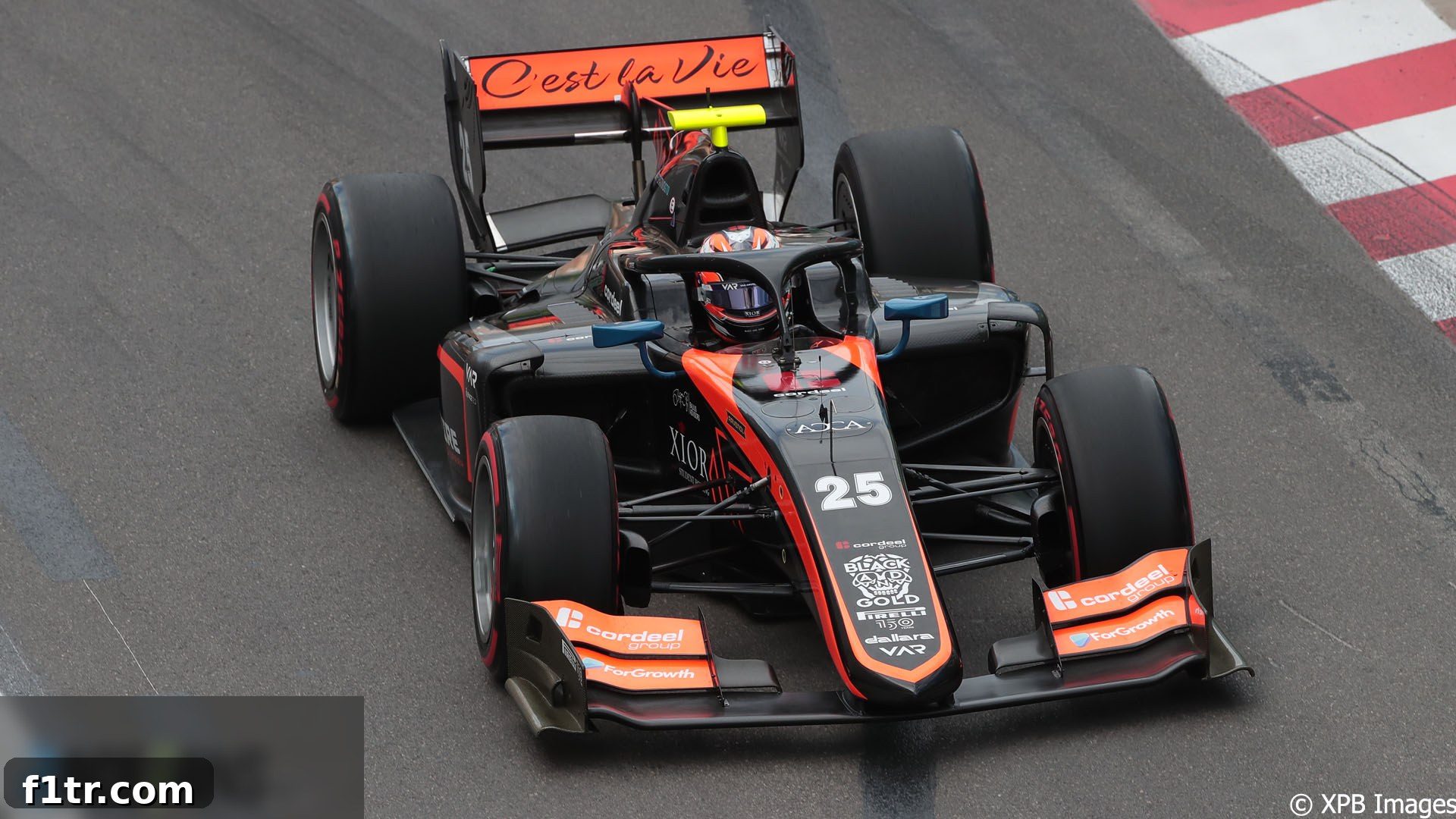
In a significant development for the FIA Formula 2 Championship, Amaury Cordeel, the promising driver for Van Amersfoort Racing, has received an automatic ban from the upcoming round at Silverstone. This suspension comes as Cordeel accumulated the maximum threshold of 12 penalty points on his racing licence, a critical limit under the stringent regulations governing motorsport safety and conduct.
The accumulation of penalty points is a system designed to ensure fair play and adherence to racing rules across all FIA-sanctioned series. Drivers who repeatedly infringe upon these regulations face escalating penalties, with the ultimate consequence being a race ban. For Cordeel, this unfortunate milestone was reached during the recent Azerbaijan Feature Race in Baku, where a collision with Campos Racing’s Olli Caldwell triggered the decisive penalty point.
Advert | Become a Supporter & go ad-free
Cordeel had been walking a tightrope with 11 penalty points on his licence following the Barcelona round just three weeks prior. He managed to navigate the notoriously challenging streets of Monaco without further incident, a feat that bought him a temporary reprieve. However, the high-octane environment of Baku’s street circuit proved to be his undoing, bringing an abrupt halt to his immediate championship aspirations.
The journey to 12 penalty points for the young Belgian driver has been marked by a series of infractions across various race weekends. His penalty point tally began to climb due to incidents such as failing to slow sufficiently for yellow and red flags during the Jeddah event, a crucial safety regulation that emphasizes driver and marshal well-being. Subsequently, he was penalised for repeatedly ignoring track limits in Imola, a rule enforced to maintain fair competition and prevent drivers from gaining an unfair advantage by exceeding the defined boundaries of the circuit. Furthermore, an infringement for failing to be in the correct grid order during the formation lap in Barcelona added to his growing list of disciplinary actions.
The specific incident that sealed Cordeel’s fate unfolded in the dramatic closing moments of the Baku feature race. The clash with Olli Caldwell occurred between turns three and four, leading to yellow flags on the final lap and ultimately, both cars retiring from the race. The stewards meticulously reviewed the footage and circumstances surrounding the contact. Their investigation concluded that “car 14 [Caldwell] was behind car 25 [Cordeel] between turns three and four. Car 14 chose an outside line and was alongside car 25 on the straight approaching turn four.” The ruling further detailed: “Car 25 was focussed on the cars ahead and did not see car 14 on his left. Car 25 moved across to the left making contact with car 14 and forcing them both into the wall. Both cars retired. Car 25 was deemed to be wholly at fault for causing the collision.”
This single penalty point, issued as a result of the Baku incident, immediately triggered the mandatory ban. The stewards’ official document unequivocally stated: “In accordance with Article 39.3 of the FIA Formula 2 Sporting Regulations, as the driver of car 25 has accumulated 12 penalty points (see Document 50), the driver of car 25 is suspended for the event following the round six Baku event.” This confirms Cordeel’s absence from the highly anticipated double-header at Silverstone, a significant blow to both the driver and his Van Amersfoort Racing team.
The FIA Formula 2 penalty point system serves as a vital tool for promoting safe and disciplined racing. Each infraction, depending on its severity, carries a certain number of penalty points. These points remain on a driver’s licence for a rolling 12-month period. Once a driver accumulates 12 points, an automatic one-race ban is imposed. This system mirrors the one used in Formula 1, albeit with slightly different thresholds and specifics, underscoring the FIA’s commitment to consistent standards of driver conduct across its premier single-seater categories. The primary goal is to deter dangerous driving, enforce respect for race officials’ instructions, and ensure an equitable playing field where skill and strategy prevail over reckless manoeuvres.
Missing the Silverstone round represents a substantial setback for Amaury Cordeel. Silverstone, the home of British motorsport, is a high-profile circuit where drivers can earn crucial championship points and demonstrate their capabilities to an international audience. For a young driver still finding his footing in the competitive F2 ladder, every race is an opportunity to impress, gain experience, and advance his career. Being sidelined will not only cost him potential points but also disrupt his rhythm and potentially affect his confidence. Van Amersfoort Racing will now face the challenge of finding a suitable replacement for the British round, a task that can be complicated and impactful on team dynamics and performance.
Beyond Cordeel’s ban, the Baku weekend saw several other penalties and incidents that highlighted the intense competition and the stewards’ diligent oversight. Carlin’s Roy Nissany and Hitech Grand Prix’s Jack Doohan were both found culpable for their respective collisions. Nissany was penalised for contact with Charouz Racing System’s Cem Bolukbasi, while Doohan was involved in an incident with Hitech teammate Liam Lawson. Both Nissany and Doohan were issued three-grid-place penalties for the next race and one penalty point each, reinforcing the message that aggressive driving leading to avoidable contact will not be tolerated. Interestingly, another incident involving Hitech teammates Marcus Armstrong and Jüri Vips resulted in no further action, indicating that the stewards deemed it a racing incident where neither driver was solely to blame, or the contact was minor and inconsequential.
However, the disciplinary actions from Baku extended beyond on-track incidents. A more unusual and potentially serious situation unfolded involving Roy Nissany and Cem Bolukbasi in the paddock after their on-track clash. Both drivers, along with their respective teams, were summoned to the stewards over an alleged incident. The summons read that “Alleged breach of Article 12.2.1.c of the FIA International Sporting Code – family of car 23 [Bolukbasi] allegedly caused a commotion with the driver of car 16 [Nissany] – deemed to be potentially an act prejudicial to the interests of any competition or to the interests of motor sport generally.” Article 12.2.1.c of the FIA International Sporting Code is broad, covering “Any fraudulent conduct or any act prejudicial to the interests of any competition or to the interests of motor sport generally.” This highlights the FIA’s commitment to maintaining decorum and sportsmanship not just on the track, but throughout the entire race event environment. Such an alleged incident, if proven, could lead to significant repercussions, as it undermines the professional image and integrity of motorsport.
Even teams were not exempt from penalties, with Campos Racing receiving a €2,000 (£1,700) fine for an administrative infraction: having too many personnel on its pit wall during the feature race. Regulations are precise about the number of individuals allowed on the pit wall for safety reasons and to maintain order, and any deviation, even seemingly minor, can lead to financial penalties for the team.
These numerous penalties from a single race weekend underscore the multi-faceted role of race stewards in motorsport. Their responsibilities extend from meticulously reviewing on-track incidents to upholding the integrity of the sport in the paddock and ensuring compliance with all operational regulations. Their decisions, though sometimes controversial, are fundamental to maintaining safety, fairness, and the competitive spirit that defines Formula 2 and the broader world of motorsport. The consistent application of these rules ensures that drivers and teams are held accountable for their actions, fostering a professional and disciplined environment essential for developing future Formula 1 stars.
As the Formula 2 season progresses, the focus will now shift to how Amaury Cordeel responds to this enforced break and how he manages his penalty points upon his return. For the championship as a whole, Baku served as a stark reminder of the tightrope drivers walk between aggressive racing and maintaining disciplinary standards, ensuring that every move on and off the track has potential consequences for their championship aspirations and long-term careers.
Advert | Become a RaceFans supporter andgo ad-free
Formula 2
- Formula 2 to debut in Miami and Montreal after Iran war cancellations
- Ex-McLaren junior Dunne’s move to Alpine finally confirmed
- Schumacher says his IndyCar feels like ‘an F2 car, just with better tyres’
- The Formula 2 team with an older driver line-up than almost half the F1 grid
- FIA to award more F1 superlicence points to IndyCar drivers from 2026
Browse all Formula 2 articles