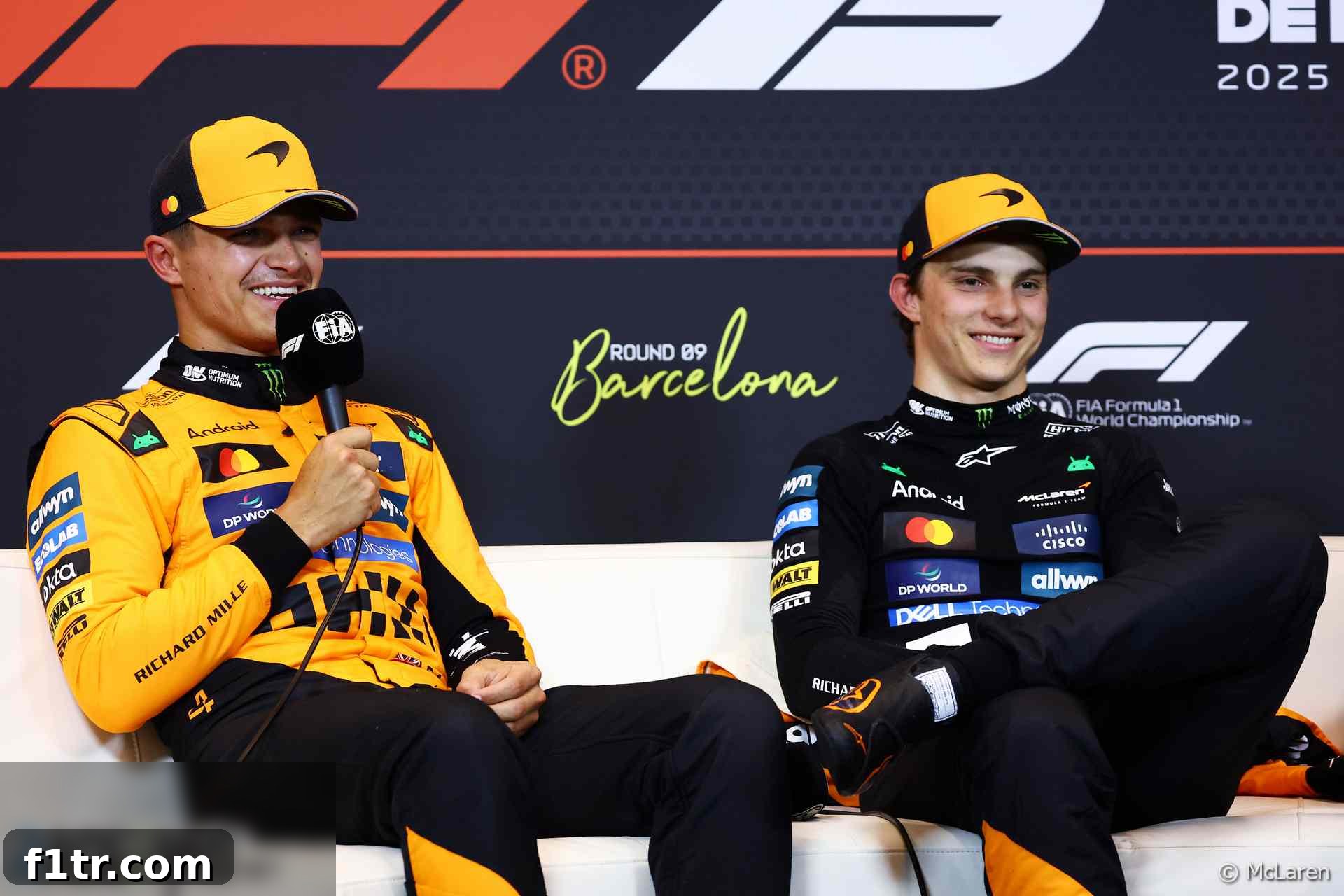
McLaren Duo Norris and Piastri Address Barcelona Slipstream Incident in Tense Qualifying
The exhilarating qualifying session for the Spanish Grand Prix at the Circuit de Barcelona-Catalunya delivered its usual dose of drama, with the McLaren F1 team finding themselves at the centre of an unexpected intra-team discussion. Lando Norris and Oscar Piastri, two of Formula 1’s most promising talents, engaged in a brief radio exchange after a crucial slipstream moment in Q3, prompting immediate clarification from both drivers.
During the intense final segment of qualifying, designed to determine grid positions for Sunday’s main race, Norris found himself benefiting from a tow behind his teammate Piastri. This aerodynamic advantage, commonly referred to as a slipstream, allows a trailing car to experience less drag, potentially leading to higher top speeds and faster lap times, especially on long straights. Piastri, having just completed his first timed run, communicated his “cheeky” observation over the team radio as Norris, starting his own flying lap, passed him on the pit straight, seemingly gaining a slight but potentially critical boost.
The Unintentional Tow: Norris’s Perspective
However, Norris was quick to dismiss any suggestion of a premeditated manoeuvre to gain an unfair advantage from his teammate. Speaking after the session, the British driver explained that the timing was purely coincidental, stressing that he had not specifically targeted Piastri’s car for a slipstream. “I didn’t know Oscar was going out first, to be honest,” Norris stated, clarifying the circumstances. “I tried to get a slipstream from someone. I think I was unlucky that it was Oscar, it was just a coincidence.”
He elaborated on the chaotic nature of the pit lane during the final stages of qualifying, where drivers jockey for position and clear track space, often waiting for minutes before initiating their runs. “I was tenth or something in the queue, I don’t know who I’m going to get a slipstream from because you’re waiting for two minutes in the pit lane. So yeah, it was just a coincidence,” Norris reiterated, emphasizing the element of chance rather than strategic intent. This explanation underscores the unpredictable environment of F1 qualifying, where split-second decisions and track positioning can profoundly impact a driver’s lap time.
The impact of this unintentional tow was immediately evident. Despite having been slightly slower than Piastri for much of the preceding qualifying segments, Norris’s lap, aided by the slipstream, initially propelled him into a provisional pole position. This dramatic shift highlighted the significant performance gains that can be achieved through effective use of a slipstream, even a brief one. While Norris later improved his time on his final attempt, it wasn’t enough to hold off his Australian teammate, who ultimately secured the coveted pole position, underlining the razor-thin margins at the pinnacle of motorsport.
Reflecting on Performance and Missed Pole
While second place was a strong result, Norris acknowledged that the potential for pole position was within reach. “The speed was easily there today,” he admitted, reflecting on his performance. “Sometimes you just don’t put the laps in.” His qualifying journey in Barcelona saw him gradually build momentum, overcoming an initial deficit to Piastri in the early stages of the session. “Today was good. I think I was a little bit behind at the start of qualifying and I caught up nicely.”
Pinpointing the exact moment where pole slipped away, Norris candidly admitted, “I know where I lost that time on the final lap. It was just trying a little bit too much and just not being quite tidy enough.” The Circuit de Barcelona-Catalunya is notoriously demanding, offering a true test of a car’s aerodynamic balance and a driver’s precision. Even the smallest error can have a cascading effect, as Norris explained: “Especially around a lap like Barcelona: one little oversteer in Turn one, Turn two, you already know it’s going to be a tricky rest of the lap.” Despite the disappointment of narrowly missing pole, Norris maintained a positive outlook, stating, “It’s still good. I still feel fine. I’m happy with second, especially in Barcelona – it’s not the end of the world.” His pragmatic view underscores the long F1 season and the importance of consistent high performance.
Piastri’s Acceptance and Team Harmony
Piastri, for his part, appeared satisfied with Norris’s explanation, quickly diffusing any potential tension. “I went out very early for the first run of Q3 and I think it was just coincidence that Lando ended up behind me opening the lap,” he confirmed, echoing Norris’s sentiments. While the initial feeling of being towed by a competitor, especially a teammate, might be unsettling, Piastri expressed confidence in their team’s dynamic. “Of course, when you cross the line to start your lap, it’s maybe not the nicest feeling, but we’ll discuss it. There was nothing untoward going on.”
The Australian driver even injected a dose of humour into the situation, playfully challenging Norris. “Unless Lando’s going to spill his master plan that him and Will [Joseph, his race engineer] had,” he joked, before concluding, “But I think it was just coincidence.” This lighthearted exchange underscores the generally healthy and competitive relationship between the two McLaren drivers, suggesting that such incidents, while requiring clarification, are handled maturely within the team structure. Their ability to openly communicate and resolve such minor issues bodes well for McLaren’s collaborative efforts throughout the Formula 1 season.
McLaren’s Resurgent Form and Barcelona Challenge
The qualifying results in Barcelona underscore McLaren’s impressive resurgence in the current F1 season. The team has consistently demonstrated strong pace, particularly in recent races, positioning themselves as genuine contenders for podium finishes and challenging the front-runners. The close battle between Norris and Piastri for pole position is a testament to the significant advancements made by the Woking-based outfit in developing a highly competitive car. Their performance at the Circuit de Barcelona-Catalunya, a track known for revealing the true aerodynamic strengths and weaknesses of a car, is particularly encouraging for the team and its fans.
Barcelona’s circuit layout, with its mix of high-speed corners and a lengthy main straight, places significant demands on both the car’s aerodynamics and engine power, making optimal car setup and driver precision absolutely crucial. A strong qualifying performance here is often a harbinger of a good race result due to the challenging nature of overtaking. Securing the front row of the grid provides McLaren with an excellent strategic advantage, allowing them to dictate race pace and manage tyre degradation more effectively, minimizing exposure to the turbulent air of following cars.
As the Formula 1 circus prepares for Sunday’s Spanish Grand Prix, all eyes will be on the McLaren garage. The competitive dynamic between Norris and Piastri, though occasionally leading to minor on-track moments like the slipstream incident, ultimately fuels their individual performances and, by extension, the team’s overall success. With both drivers starting from the front row, McLaren is in a prime position to convert their qualifying pace into a substantial points haul, further solidifying their status as a formidable force in the ongoing championship battle.
The incident, quickly resolved and understood, highlights the intense pressure and split-second decisions that define Formula 1 qualifying. More importantly, it showcased the professionalism and mutual respect between Lando Norris and Oscar Piastri, two teammates pushing each other to the absolute limit for the benefit of the McLaren F1 Team.