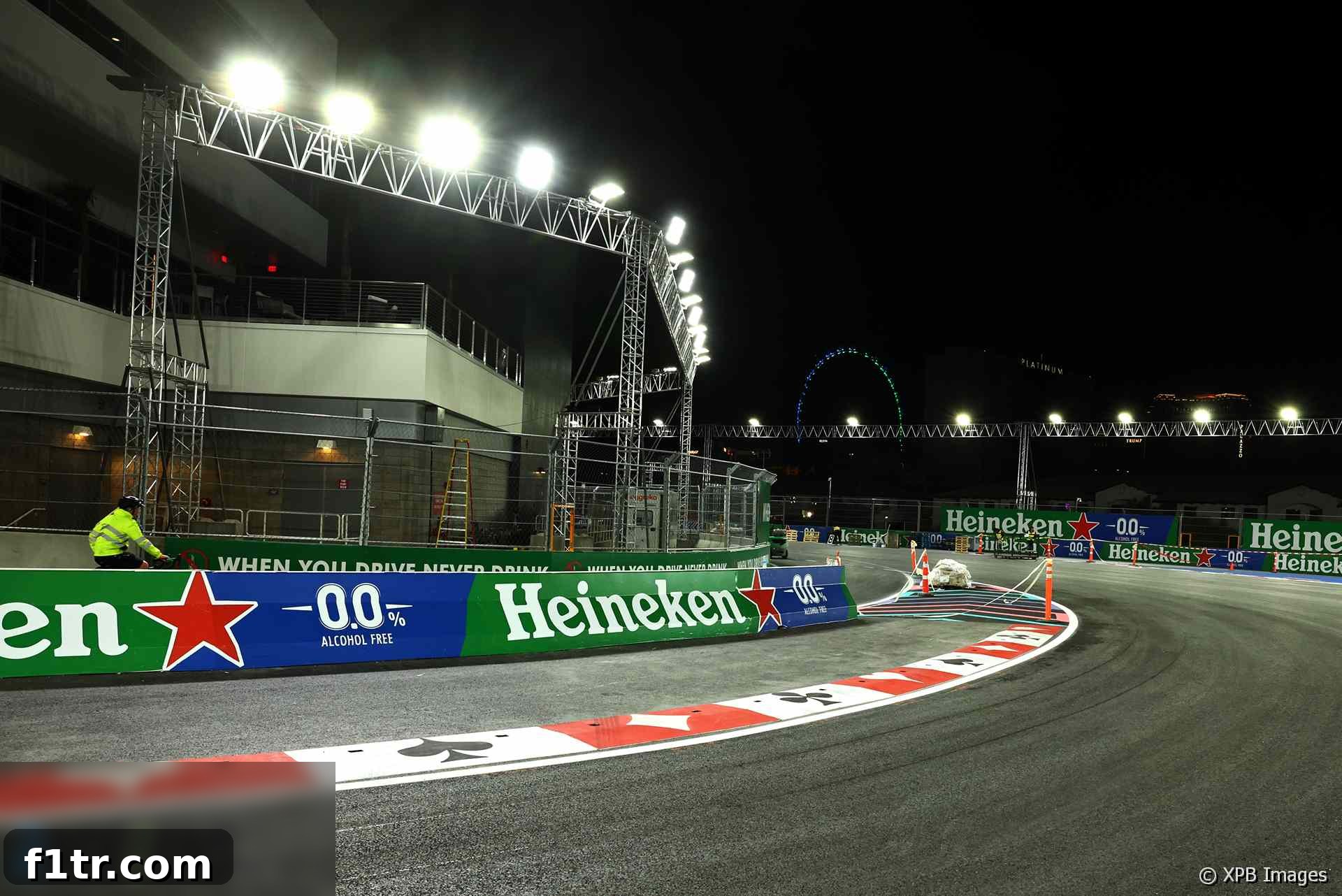
The highly anticipated Las Vegas Strip Circuit has quickly established itself as one jewel in Formula 1’s crown, offering a spectacular and unique challenge to drivers and teams alike. Spanning an impressive 6.2 kilometers, this street circuit weaves through the heart of Las Vegas, utilizing the city’s iconic roads alongside a purpose-built section meticulously crafted to house the pit lane, paddock, and crucial opening corners. With 17 corners to navigate, the circuit is not just a test of speed but also a demanding blend of technical precision and bravery.
Clocking in as the second-longest Formula 1 track on the calendar, trailing only the legendary Spa-Francorchamps, the Las Vegas Strip Circuit promises high-speed thrills under the dazzling lights of one of the world’s most vibrant cities. It is also one of eight anti-clockwise venues in F1, a characteristic that presents unique physical demands on drivers, particularly concerning neck muscles. Notably, five of these anti-clockwise tracks are dynamic street circuits, and the season often concludes with a demanding triple-header of anti-clockwise races, putting drivers’ endurance to the ultimate test.
The circuit officially features 11 left-hand and six right-hand corners, creating a predominantly left-biased challenge. One of the most talked-about elements of the track is the breathtaking 1.9-kilometer flat-out section down the city’s famous Strip, strategically positioned between turns 12 and 14. This magnificent straight stands as the second-longest full-throttle section in F1, surpassing the 1.875km blast from the exit of La Source to the braking zone for Les Combes at Spa. While incredibly fast, it slightly trails the monumental 2-kilometer-plus full-throttle run from the exit of turn 16 to turn one on the 20-corner Baku circuit, showcasing Las Vegas’s commitment to delivering unparalleled high-speed action.
High speeds are a hallmark of modern Formula 1, and the Las Vegas Strip Circuit is no exception. While Alfa Romeo’s Valtteri Bottas set the season’s highest speed trap figure at 361.9kph during the Mexican Grand Prix, initial team predictions for Las Vegas varied. Most expect speeds comfortably exceeding 350kph, pushing the limits of the cars and drivers. While matching the 359kph of Monza or the high-altitude 361kph of Mexico City might be a tough ask, the Strip’s lengthy straight provides ample opportunity for drivers to reach blistering velocities, making it a thrilling spectacle for fans.
Aerodynamic and engine performance will be crucial, with estimates suggesting that drivers will spend approximately 4.84 kilometers of the lap at full throttle, equating to roughly 66% of the lap time. This places the Las Vegas Strip Circuit among the elite in terms of full-throttle distance, trailing only Jeddah, Bahrain, and Monza. However, when considering the proportion of lap time spent flat-out, eight other circuits demand a greater commitment to sustained acceleration, highlighting the unique balance of high-speed sections and technical corners in Las Vegas. The circuit demands a precise car setup, balancing straight-line speed with the need for strong braking and good traction out of the slower turns.
The circuit features five distinct braking zones throughout the lap, though only three are anticipated to be significant, demanding heavy deceleration from the drivers. These key braking points will be crucial for overtaking opportunities and managing tire wear, especially with the cool desert nights potentially affecting tire temperatures and grip levels. Mastering these zones will be vital for any driver hoping to conquer the dazzling Las Vegas track.
Start/Finish Area: The Grand Entrance
The Start/Finish area of the Las Vegas Strip Circuit marks the beginning of the bespoke track section, a dedicated expanse of land that was transformed from a barren landscape into a state-of-the-art Formula 1 facility after a substantial investment. This segment houses the essential pit lane, which runs parallel on the left, continuing its path into the critical turns one and two before rejoining the main track. The wide grid promises a thrilling start under the bright lights of Vegas, with drivers vying for position into the first heavy braking zone.
Turns One and Two: A Challenging Opening
Turn one, a key feature of the Las Vegas Strip Circuit, serves as the first of three significant heavy braking zones on the lap. It is a tight hairpin, demanding maximum deceleration and precise steering from drivers immediately after the start. This challenging left-hander transitions directly into the subtle direction change of turn two, a less severe corner that drivers will quickly power out of. The short burst of acceleration between turn two and turn three emphasizes the importance of a strong exit from this opening complex, crucial for carrying momentum into the next phase of the lap. The hairpin offers a potential, albeit difficult, overtaking opportunity if a driver can get a strong run from the main straight.
Pit Exit: A High-Stakes Blend Zone
The pit exit presents a unique challenge and a potential hazard on the Las Vegas Strip Circuit. As drivers increase their speed into the flowing sequence of turns three and four, they are incentivized to hug the right-hand barrier. This isn’t merely for optimal line-taking through the continuous right-hander; it’s also a defensive measure. The pit exit is strategically located on the left, between turns two and three. A wide turn-in from a driver already on track could lead to an unsighted collision with a car emerging from the pits, making awareness and precise positioning paramount for both pit-exiting and racing drivers. This design element adds another layer of strategic consideration during a race.
Turn Three: A Swift Transition
Turn three stands out as one of the few relatively quick corners on the Las Vegas Strip Circuit, offering a brief respite from the heavier braking zones. It’s a corner that initially appears challenging but rapidly opens up at its exit, allowing drivers to carry significant speed. The key here is maintaining momentum and achieving a clean, fast exit to prepare for the subsequent acceleration zone. While not a primary overtaking spot, a strong performance through turn three is vital for setting up the long straight that follows and for maintaining lap time consistency.
Koval Lane Straight: Power and Preparation
Emerging from turn four, drivers are greeted by the first truly long straight of the lap: Koval Lane. This extended flat-out section provides a crucial opportunity for cars to stretch their legs and build significant speed. It’s a prime area where engine power and aerodynamic efficiency come to the fore, allowing for potential DRS-assisted overtakes. However, its primary function is to serve as a high-speed approach to the next major challenge: the heavy braking zone of turn five. Drivers will need to perfectly judge their braking point after this long acceleration, as any error could compromise their entry into the technical Sphere section.
Turn Five: Entering the Sphere’s Embrace
Turn five marks a significant shift in the circuit’s character, guiding drivers into the unique section that gracefully sweeps around Madison Square Garden’s recently opened, visually stunning Sphere. Originally, the circuit designers had envisioned turn five as a sweeping 180-degree corner, echoing the design of turn four at the Sochi Autodrom. However, a strategic decision led to the adoption of a slower, more conventional 90-degree right-hander instead. This design choice aims to create a more impactful braking zone and potentially enhance overtaking opportunities as drivers manage the transition into the technical, low-speed sequence that encircles the Sphere. The slower entry means drivers must be precise with their apex and exit, setting them up for the crucial turns that follow.
Turn Six: The Sphere’s First Arc
Following the significant braking of turn five, drivers encounter turn six, which forms the first half of what was initially planned as a continuous left-hander. This corner guides the cars around approximately one-quarter of the Sphere’s massive circumference. It’s a section where the focus shifts from outright speed to precision and car control. The relatively slow speed demands good mechanical grip and a stable platform, allowing drivers to accurately place their cars and set up for the subsequent tight, slow-speed section that further hugs the iconic structure. The visual spectacle of cars racing around the illuminated Sphere adds an unparalleled atmosphere to this part of the track.
Turns Seven, Eight, and Nine: Technical Sphere Traverse
The sequence of turns seven, eight, and nine completes the challenging traverse around the Sphere, demanding intricate car control and a sensitive throttle foot. This segment begins with a sharp left-hander, immediately followed by a quick right-hander, necessitating rapid direction changes from the drivers. From this complex, the track quickly leads into turn nine. Initially a tight corner, turn nine progressively widens as it straightens out, ushering drivers onto Sands Avenue. This transition from a slow, technical section to a more open, accelerating zone highlights the importance of a smooth exit from turn nine to maximize speed onto the subsequent straight, showcasing the nuanced design of this part of the Las Vegas Strip Circuit.
Turns 10 and 11: Sands Avenue Flow
After navigating the Sphere section, the Las Vegas Strip Circuit transitions onto Sands Avenue, where turns 10 and 11 await. This section features a flowing right-left snake, allowing drivers to build increasing speed as they progress. Under the circuit’s original design concept, these corners would have been tackled at much higher velocities, presenting a different kind of challenge. However, in its current iteration, while still offering a sense of flow, drivers must carefully manage their entry and exit to maintain momentum. The increasing speed through these corners is crucial for setting up the approaching high-speed segment, underscoring their importance in the overall lap time and rhythm of the Las Vegas Grand Prix.
Turn 12: The Gateway to the Strip
Turn 12 is a critical left-hander on the Las Vegas Strip Circuit, approached at considerable speed, necessitating a decent amount of run-off. Its strategic importance cannot be overstated, as it serves as the crucial gateway to the circuit’s longest and most exhilarating section. A perfect exit from turn 12 is paramount, as it slingshots drivers around the iconic Venetian Resort and directly onto the world-famous Las Vegas Strip. This is the very road that the entire circuit was designed to incorporate, a stretch synonymous with speed and spectacle. The Strip itself is one of the most extended full-throttle sections on the entire F1 calendar, making turn 12 arguably one of the most vital corners for achieving a competitive lap time and maximizing performance on this unique street circuit.
The Strip: Unrivaled Spectacle and Speed
The Las Vegas Strip is undoubtedly the crown jewel of the circuit, transforming one of the world’s most recognizable boulevards into an F1 playground. As drivers unleash the full power of their machines, they hurtle past an astonishing array of iconic casinos and landmarks. This includes the historic Caesars Palace hotel, a site F1 previously raced in its car park during 1981 and 1982. The Bellagio fountains provide a magnificent backdrop, while the replica Eiffel Tower at Paris Las Vegas adds to the surreal and opulent atmosphere. This 1.9-kilometer full-throttle blast is not just a test of engine power but also a sensory overload, immersing drivers and fans in the heart of Las Vegas’s vibrant energy, creating an unparalleled racing experience under the city’s brilliant lights.
Turn 13: The Subtle Kink of the Strip
Nestled within the high-speed expanse of The Strip is turn 13, a subtle yet critical high-speed kink. This corner is designed to be taken at full throttle, adding a nuanced challenge to the flat-out section without requiring significant braking. Arguably, the more significant challenge immediately follows: the track barriers abruptly shift to the right mid-straight, effectively channeling drivers into narrower lanes on what is typically a very wide road. This funneling effect demands pinpoint accuracy and unwavering commitment from drivers, as they must transition from a wide, open road to a more constricted racing line while maintaining maximum speed. It’s a testament to the unique engineering required for a street circuit of this magnitude, maximizing the thrill while ensuring a demanding test of skill.
Turns 14, 15, and 16: The Chicane Challenge
After an exhilarating 1.9 kilometers of ever-increasing speeds along the Strip, drivers encounter the third major heavy braking zone of the lap. This crucial deceleration leads into a complex left-right-left chicane, guiding cars onto E Harmon Avenue. This sequence of corners demands intense focus and precision, as drivers must scrub off immense speed and navigate the quick changes in direction. Emerging from the chicane, they blast past the familiar Planet Hollywood resort, signaling their exit from the dazzling, high-speed Strip section and transitioning back into the more conventional, but still demanding, street circuit layout. This chicane provides another potential hotspot for overtaking and demands careful tire management.
Turn 17: The Final Gambit
The final corner of the Las Vegas Strip Circuit, Turn 17, is a high-speed left-hander following a rapid sprint along E Harmon Avenue. This corner features a distinctive change in asphalt, marking the transition back onto the newly built section of the track. A unique design element of this circuit is the strategic placement of the pit entrance at the very apex of turn 17. This means drivers planning a pit stop must secure the inside line if battling other cars and execute a demanding heavy braking maneuver precisely as they enter the pit lane. This challenging integration of the pit entrance with the final corner adds a layer of strategic complexity and potential for last-lap drama. The timing line is situated just beyond the exit of turn 17, making this corner the ultimate determinant of lap time and race finish.
The Las Vegas Strip Circuit is more than just a race track; it’s a spectacle, a challenge, and a bold statement in the world of Formula 1. Its blend of high-speed straights, intricate street sections, and iconic backdrops ensures a racing experience unlike any other, demanding the utmost from both machinery and man.
2023 Las Vegas Grand Prix Insights
- Tost Blames Track Inspection Oversight for Sainz’s Damage in Las Vegas
- Hard to Repeat “Rare” Combination of Factors Behind Vegas Shunt – Norris
- Las Vegas Grand Prix “Got a Lot More Hate Than It Deserved” – Sargeant
- Williams’ “Incredible” Vegas Qualifying Made Us “Poor” in Race – Vowles
- Piastri is First Rookie to Take Two Fastest Laps in a Season Since Hamilton
Browse All 2023 Las Vegas Grand Prix Articles