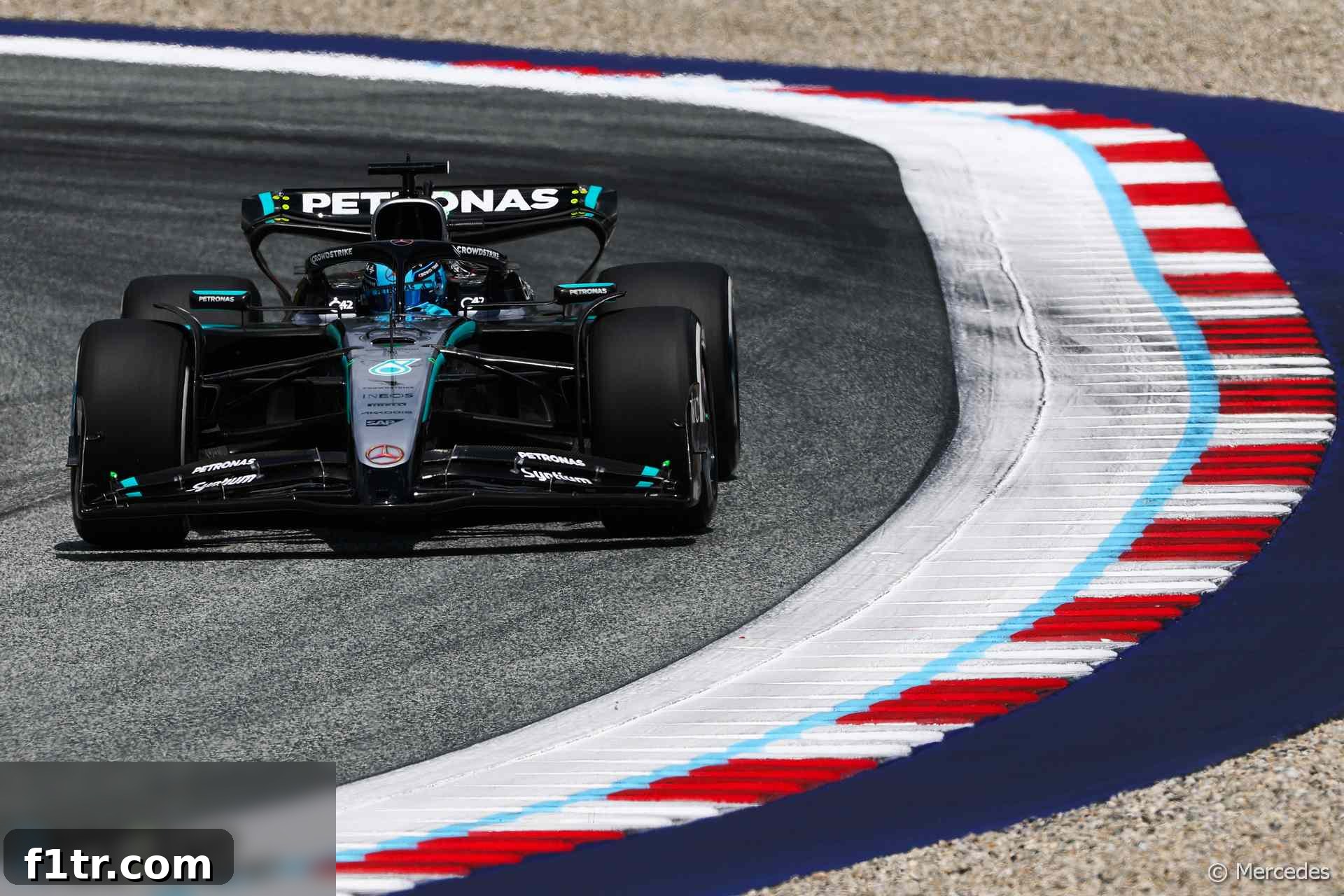
George Russell, the talented Mercedes-AMG Petronas Formula 1 driver, has successfully navigated a potential setback, avoiding a severe grid drop penalty following an investigation into a pit lane infringement during a tense qualifying session. The incident, which occurred amidst the high-stakes environment of F1 qualifying, could have significantly hampered his starting position for Sunday’s main race. Instead, a swift decision from the race stewards saw Russell receive an official warning, allowing him to retain his hard-won fifth place on the grid.
Advert | Become a Supporter & go ad-free
The Pit Lane Incident: A Close Call for Russell
The core of the investigation revolved around Russell’s re-entry into the fast lane of the pit complex. During a critical phase of qualifying, the Mercedes driver was observed joining the fast lane directly in front of other cars, a maneuver that directly contravened specific instructions issued by the race director to all teams and drivers. Pit lane regulations are among the strictest in Formula 1, designed to ensure the safety of personnel and fairness among competitors. Any deviation can lead to serious consequences, ranging from warnings to grid penalties or even disqualification, depending on the severity and intent.
Russell’s Explanation and Stewards’ Findings
Facing the stewards, Russell provided his account of the event, explaining that the infringement was entirely accidental. He stated that his clutch had inadvertently slipped while he was attempting to accurately judge the opportune moment to merge into the queue of approaching cars in the fast lane. This momentary lapse, he argued, led to his car moving forward unexpectedly, placing him in a position that contravened the established guidelines.
The stewards’ official notes corroborated aspects of Russell’s narrative, detailing their understanding of the incident: “Car 63 tried to enter the fast lane after exiting its garage when other cars were approaching in the fast lane and therefore had to stop at an angle preventing the driver from seeing the other cars approaching in the fast lane.” They further noted the communication breakdown: “The driver tried to radio the team but, in doing so, accidentally slipped the clutch, causing the car to jump forward.” This combination of factors painted a picture of an unintentional error rather than a deliberate disregard for regulations. Crucially, the Mercedes team representative acknowledged their part, admitting that “the team could have done a better job in managing the situation,” highlighting the shared responsibility in such intricate operational scenarios.
The Stewards’ Verdict: Warning for Russell, Reprimand for Mercedes
Following their thorough review and consideration of the evidence and explanations, the stewards decided against imposing a more severe grid penalty. Instead, George Russell was issued an official warning for “entering the fast lane without a suitable gap.” This outcome is a significant relief for Russell, as a grid drop could have pushed him further down the starting order, making his race on Sunday considerably more challenging. An official warning, while recorded, does not directly impact his championship points or starting position for the immediate race.
Concurrently, the Mercedes-AMG Petronas team received a formal reprimand. This distinction between the driver’s warning and the team’s reprimand underscores the dual responsibility in Formula 1. While Russell’s actions were the immediate cause, the team’s admission of inadequate management during the pit exit procedure meant they too bore a share of the accountability. A team reprimand is a formal caution from the FIA, signaling that their conduct fell short of the expected standards, urging them to improve their operational procedures for future events.
Implications: No Grid Drop, No Penalty Points
The most immediate and critical outcome of this decision is that George Russell will retain his fifth-place starting position for Sunday’s race. This means he avoids the strategic disadvantage of starting further back, preserving his qualifying effort. Furthermore, and equally important for his season-long record, Russell did not incur any additional penalty points on his Super Licence. F1 drivers accumulate penalty points for various infringements throughout the season, and reaching 12 points within a 12-month period results in an automatic one-race ban. Avoiding these points is always a priority for drivers, making this decision a doubly positive result for the young Briton.
Russell’s Perspective: Reflecting on Qualifying and Car Performance
Despite having clinched pole position and a memorable victory in the previous round, Russell displayed a pragmatic and mature attitude regarding his fifth-place qualifying result this weekend, clearly unfazed by the pit lane scare or the outcome of the investigation. Speaking to Sky Sports after the session, he articulated his measured approach: “I won’t be celebrating tonight but I won’t really be losing much sleep. It’s the way F1 goes.”
His comments offered valuable insight into the fluctuating fortunes of Formula 1 teams based on track characteristics and environmental conditions. He elaborated on Mercedes’ performance profile: “We know the strengths of our car. We had a really strong weekend in Canada but coming here we knew we weren’t going to be that competitive with the [higher] temperatures and with the high-speed corners. The Tarmac is very abrasive so the tyres are just having a hard time and that’s when McLaren come into their own and we fall back.” This analysis highlights the dynamic nature of F1, where a car perfectly suited to one circuit (like Canada with its lower-speed sections and smoother track) can struggle at another (such as a high-downforce, high-temperature, abrasive circuit like the Red Bull Ring).
Russell’s assessment underscores Mercedes’ current challenges with tire management and aerodynamic efficiency in specific conditions. The ‘abrasive tarmac’ exacerbates tire degradation and overheating, an area where some competitors, notably McLaren with their recent performance resurgence, appear to have a better handle. This self-awareness from Russell and the team about their car’s limitations under certain conditions is crucial for strategizing and future development, even if it means sacrificing some immediate performance.
The Intricacies of F1 Pit Lane Regulations
The pit lane is one of the most dangerous and strictly regulated areas in Formula 1. Its rules are designed to prevent accidents involving drivers, mechanics, and other personnel, as well as to ensure fair play during sessions. Key regulations include speed limits, designated entry and exit procedures, and rules regarding driver conduct. The fast lane, in particular, is an area where cars move at a higher speed within the pit lane, making clear judgment and adherence to guidelines paramount. Race directors often issue specific instructions for particular events or track layouts to enhance safety and efficiency, as was the case with the directive Russell was found to have contravened. Mercedes’ admission regarding team management points to the constant challenge for teams to perfectly coordinate driver actions with live track conditions and steward directives, especially under the pressure of qualifying.
George Russell Penalty Points Overview
While Russell avoided penalty points in this incident, his record does show past infringements. The cumulative nature of penalty points makes every steward decision significant for a driver’s season. The table below outlines his recent penalty points:
| Date | Event | Session | Infringement | Points |
|---|---|---|---|---|
| 1/12/2024 | Qatar Grand Prix | Grand prix | ‘The driver of Car 63 failed to maintain a 10 car-length distance behind the Safety Car’ | 1 |
Advert | Become a RaceFans supporter andgo ad-free
Miss nothing from RaceFans
Get a daily email with all our latest stories – and nothing else. No marketing, no ads. Sign up here:
Looking Ahead to the Race
With the pit lane incident now officially closed, George Russell can fully concentrate on Sunday’s race from his fifth-place starting position. While Mercedes might not be in their strongest form at this particular circuit, Russell’s ability to maintain a top-five start, coupled with his resilient mindset, suggests he remains a strong contender for valuable points. The nuances of tire management on the abrasive track and the battle against faster rivals like McLaren will be key determinants of his success. The incident serves as a stark reminder of the precision and vigilance required at every moment in Formula 1, both from drivers and their teams, but for Russell, it concludes with a sigh of relief and a clear path to fight for a strong finish.
2025 Austrian Grand Prix Related Articles
- Wiping Verstappen out in Austria wasn’t as bad as Monza debut crash – Antonelli
- Piastri explains “f*** me up” radio message after third run-in with an Alpine at Austrian GP
- Bortoleto admits he made a “mistake” in fight with “very smart” Alonso at Austrian GP
- Tsunoda on longest point-less run for a Red Bull driver in 16 years: Austrian GP stats
- “Confused” Russell couldn’t tell if Leclerc was “trying to help me or Lewis” at start
Browse all 2025 Austrian Grand Prix articles