Charles Leclerc’s Explosive 2019 Season: Reshaping Ferrari’s Future
The annals of Scuderia Ferrari are rich with legendary drivers, yet it is incredibly rare for the illustrious Italian team to entrust one of their coveted seats to a young talent after just a single season in Formula 1. This was precisely the leap of faith taken with Charles Leclerc for the 2019 campaign. By the end of that transformative year, any initial skepticism regarding this bold decision had been utterly vanquished. Leclerc’s performance was nothing short of sensational, not only validating Ferrari’s belief but also fundamentally altering the team’s internal dynamic – a shift that undoubtedly presented a formidable challenge to his four-time world champion teammate, Sebastian Vettel, whom Leclerc consistently outshone throughout the season.
A Daring Debut: Ferrari’s Calculated Risk on a Rising Star
Leclerc’s arrival at Ferrari was heralded with immense anticipation and pressure. His meteoric rise through the junior categories and a highly impressive rookie season with Sauber (now Alfa Romeo) had marked him as a generational talent. However, stepping into the fiercely competitive environment of Ferrari, alongside a revered champion like Vettel, was an entirely different challenge. The team initially sought to manage expectations and maintain stability, publicly designating Vettel as their lead driver and stating that he would receive preferential treatment in any “50-50 situations” that might arise between the two. The underlying assumption was that Leclerc would require a significant period of acclimatization before truly challenging the established hierarchy. This assumption, as events swiftly proved, was a profound misjudgment.
From the very first race, Leclerc displayed an undeniable pace and a ruthless ambition that immediately put pressure on Ferrari’s carefully constructed pecking order. The dynamic quickly evolved from a mentorship into a full-blown rivalry, setting the stage for one of the most compelling intra-team battles in recent F1 history. Ferrari’s daring decision to back the young Monegasque driver was not without its internal challenges, but the raw talent and sheer determination Leclerc displayed served as a powerful validation of their unconventional strategy.
The Intense Intra-Team Battle: Leclerc vs. Vettel
The 2019 season was punctuated by numerous instances of tension and fierce competition between the two red cars, vividly illustrating the shifting power dynamics within the team. In their inaugural race as teammates in Australia, Leclerc found himself rapidly closing on Vettel, whose tires were heavily degraded. Demonstrating remarkable team discipline, Leclerc radioed for permission to overtake, only to be instructed to hold position. He reluctantly obeyed, but the message was clear: his pace was superior, and he was not content to merely follow.
The very next Grand Prix in Bahrain saw a dramatic replay of this scenario. Early in the race, Leclerc was once again told to maintain his position behind Vettel. However, this time, after just a couple of laps, Leclerc decisively asserted his speed, executing a clean and commanding overtake on his teammate. His scintillating performance subsequently put him in a commanding lead, only for a cruel power unit issue in the closing stages to deny him a maiden F1 victory – a win that would have been a staggering achievement in just his second start for Ferrari.
The pattern of team orders and driver defiance continued throughout the year. In China, Leclerc was again asked to let Vettel through, a strategic call whose benefits remained questionable. Yet, as the season progressed and Leclerc’s star continued to rise, the roles reversed. When Vettel was asked to yield to Leclerc later in the year, he unequivocally refused. The rivalry reached its volatile peak in Brazil, where a brilliant overtake by Leclerc on Vettel was followed by an aggressive retaliatory move from the German. The ensuing contact forced both Ferrari drivers into retirement, a stark and public testament to the unmanageable friction that had developed between them. These incidents underscored how profoundly Leclerc’s ascent had rattled Vettel, transforming what was intended as a harmonious partnership into a fervent, often controversial, battle for supremacy.
Strategic Missteps and Unleashed Potential
Despite the persistent internal challenges and a series of questionable strategic decisions from the Ferrari pit wall, Leclerc’s performance remained remarkably consistent, allowing him to outscore his more experienced teammate. This achievement is magnified when one considers the multitude of opportunities that Ferrari’s strategy department arguably squandered, directly impacting Leclerc’s potential wins. Key races like Bahrain, Monaco, Mexico, and Singapore stand out as painful examples where strategic errors, rather than a lack of pace from Leclerc, determined his ultimate result.
In Monaco, a miscalculation in qualifying strategy saw him eliminated prematurely, forcing him to start out of position on his home circuit. In Mexico, a hasty and ill-judged two-stop strategy call prematurely dropped him out of a strong podium contention. However, it was the Singapore Grand Prix that ignited the most significant controversy. Here, a perplexing pit stop sequence resulted in Ferrari effectively swapping the running order of their drivers, inadvertently—or, as some speculated, intentionally—favoring Vettel, who then secured the victory. This move stood in stark contrast to the meticulous approach of rivals like Mercedes, who in the same race went to considerable lengths to ensure their pit stop timings did not inadvertently favor one driver over the other.
Ferrari’s Singapore decision fueled widespread debate: was it a reflection of Leclerc’s still-subordinate status within the team, or was it a form of ‘payback’ for Leclerc’s failure to provide Vettel with a crucial slipstream during the decisive Q3 session at Monza, an incident that itself had generated significant internal friction? Regardless of the motive, these strategic blunders highlighted a significant area of improvement needed within the team, frequently robbing Leclerc of deserved victories and points.
Leclerc’s Personal Evolution: From Prodigy to Polished Racer
Beyond the politics and strategy, Charles Leclerc’s personal development as a racing driver throughout 2019 was truly exceptional. An early season incident in Baku, where he crashed in Q2 despite showing immense pace, proved to be a pivotal moment. This error prompted a period of deep self-reflection, from which Leclerc emerged with a noticeably more refined and consistent approach to qualifying. The transformation was immediate and astounding: he proceeded to out-qualify Vettel for an incredible nine consecutive races. While two of these occasions were partially aided by technical issues on Vettel’s car, the streak was overwhelmingly a testament to Leclerc’s newfound qualifying mastery and composure under pressure.
The summer break also marked a significant turning point in his race craft. After a dramatic crash in Germany cost him a strong result, and a subsequent overtake by Vettel in Hungary, Leclerc intensified his focus on race management and consistency. This renewed dedication finally culminated in the breakthrough race performances that his raw talent had long promised. His evolution was palpable, transforming him from an undeniably fast but occasionally erratic talent into a more complete, consistent, and formidable F1 competitor. The maturity displayed, particularly after setbacks, underscored his potential to become a future world champion.
Charles Leclerc: 2019 Season Key Statistics |
|
|---|---|
| Beat team mate in qualifying | 11/20 |
| Beat team mate in race (classified) | 7/17 |
| Races finished | 18/21 |
| Laps spent ahead of team mate | 571/1078 |
| Qualifying margin vs. team mate | -0.07s |
| Championship Points | 264 |
Triumph Amidst Adversity: Breakthrough Victories in Spa and Monza
The emotional apex of Leclerc’s 2019 season arrived with his maiden Grand Prix victory at Spa-Francorchamps. On a weekend tragically overshadowed by the death of his friend and fellow racer Anthoine Hubert, Leclerc demonstrated extraordinary composure and mental strength. He delivered a supremely classy performance, expertly managing his tires and fending off a relentless late charge from Lewis Hamilton to claim his first Formula 1 win. It was a poignant and deeply moving moment, transcending the sport itself and highlighting his profound resilience in the face of immense grief.
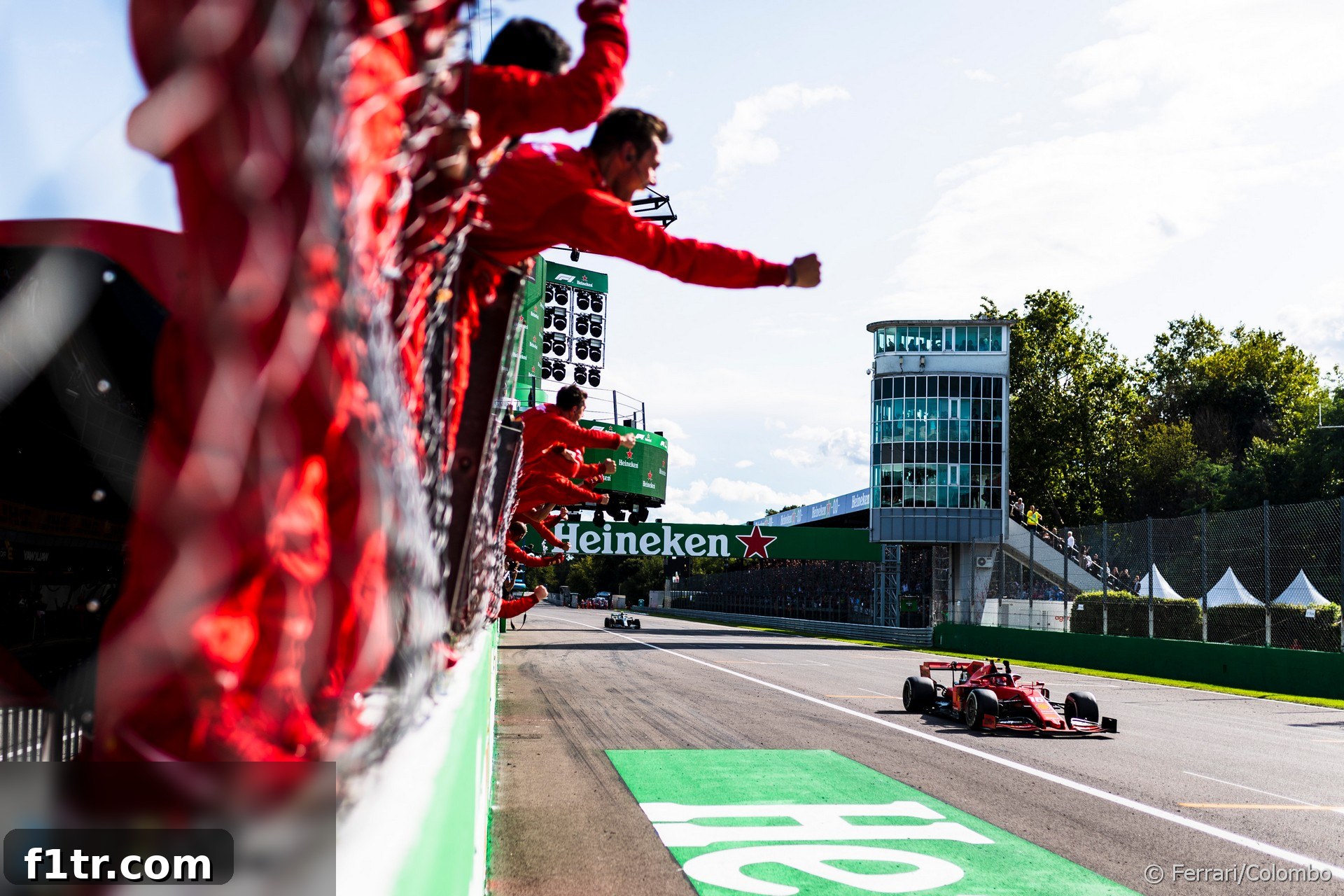
Just one week later, under even more intense pressure at Ferrari’s home race in Monza, Leclerc delivered an equally, if not more, heroic performance. In front of the passionate Tifosi, he displayed incredible mettle in a thrilling wheel-to-wheel battle with Lewis Hamilton, navigating the legendary high-speed circuit with breathtaking precision and audacious defensive driving. As he crossed the finish line first, securing Ferrari’s first home victory since 2010, the roar of the crowd was deafening. This was the kind of robust, unyielding driving that many believed could have secured him victory earlier in the season in Austria, where he was arguably outmaneuvered by Max Verstappen in the closing laps (the pair later engaged in another thrilling duel at Silverstone). With improved luck and more astute strategic calls, Spa and Monza could have potentially been part of an even more impressive four-race winning streak, extending to Singapore and Russia, where an unfortunately timed Safety Car period cruelly denied him victory to Hamilton in Sochi.
Cementing His Status: A Future Leader Emerges at Ferrari
The latter stages of the 2019 season saw Vettel attempt to reclaim his dominance, applying greater pressure on Leclerc in subsequent races. While Leclerc wasn’t entirely immune to errors, such as the incident at Suzuka where he made contact with Verstappen, his overall trajectory remained firmly on an upward curve. He led the Mexican Grand Prix before Ferrari’s strategic miscalculation on a two-stop plan ultimately cost him a well-deserved podium finish. Nevertheless, in the season finale, Leclerc emphatically out-performed Vettel, solidifying his position as the leading Ferrari driver in the championship standings – an extraordinary accomplishment for a driver in only his second Formula 1 season and his first with the Prancing Horse.
Reflecting on the 2019 campaign, it is unequivocally clear that Charles Leclerc’s season was a remarkable display of raw speed, resilience, and rapid development. Despite the cumulative effect of missed opportunities, stemming from both team strategy and occasional driver errors, Leclerc could realistically have finished even higher in the Drivers’ Championship. His undeniable pace, combined with an ever-improving race craft and a mental fortitude far beyond his years, has given Ferrari immense reason for optimism regarding his future. The 2019 season was not merely a debut year at Ferrari; it was a powerful declaration of intent from a generational talent, signaling the dawn of a new era for the Prancing Horse with Charles Leclerc firmly at its helm, poised to contend for future world championships.