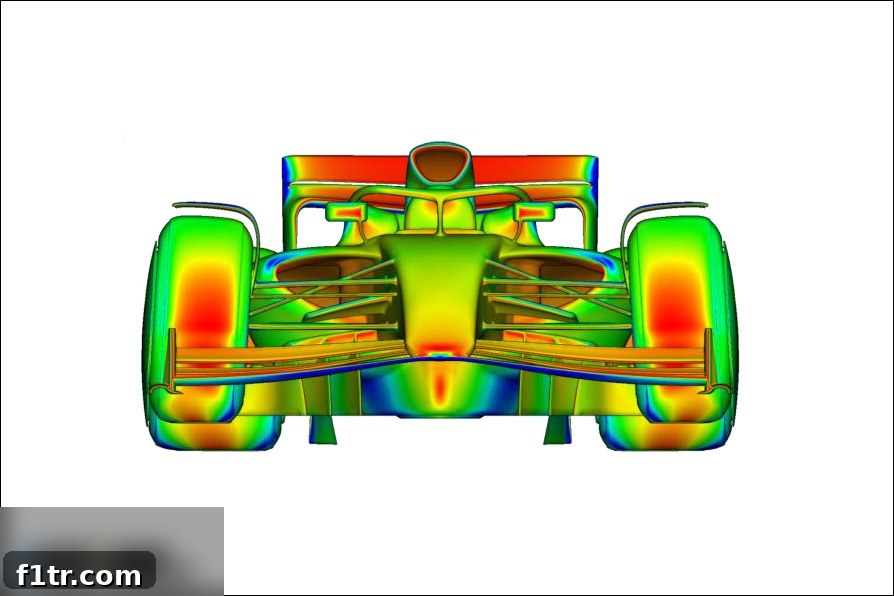
Formula 1’s Everlasting Quest: Overcoming Aerodynamic Hurdles for Closer Racing
The exhilarating world of Formula 1 has long grappled with a fundamental challenge: enabling cars to race in close proximity without significant performance degradation. This pursuit of better on-track action has been a driving force behind numerous regulation changes, and for good reason. The inherent design of modern F1 cars, optimized for maximum downforce, creates a complex aerodynamic wake often referred to as “dirty air.” This turbulent air severely compromises the performance of a following car, making overtakes exceptionally difficult. However, insights from prominent figures like Nico Hulkenberg and Lewis Hamilton suggest that the sport might finally be on the cusp of a groundbreaking solution.
Nico Hulkenberg, a seasoned F1 competitor, has expressed considerable optimism regarding the sport’s future direction, particularly concerning the critical aerodynamic challenges. His insights come directly from the heart of the decision-making process, having accompanied Lewis Hamilton to a crucial FIA meeting where the ambitious plans for the 2021 season were unveiled. Central to these discussions were drastic revisions to car aerodynamics, meticulously designed with the singular goal of fostering more competitive and exciting wheel-to-wheel racing. “I have faith that on the aero side, which is the most important, that will be corrected and adjusted in the right side,” Hulkenberg confidently remarked, reflecting a positive sentiment among drivers about the proposed technical roadmap.
Advert | Become a Supporter & go ad-free
Hulkenberg’s conviction is rooted in firsthand experience. He recounted a particularly frustrating scenario from the 2019 French Grand Prix, a race that vividly underscored the limitations imposed by current car designs. During a significant portion of Sunday’s event, he found himself inextricably stuck behind Kimi Raikkonen’s Alfa Romeo. Despite possessing superior pace, the aerodynamic characteristics of his Renault prevented him from launching a meaningful overtaking attempt. This experience at Circuit Paul Ricard, with its predominantly high-speed, third and fourth-gear corners, amplified the detrimental effects of dirty air, making it one of the most challenging tracks for close following.
“[These cars] are fast and they are spectacular,” Hulkenberg acknowledged, celebrating the sheer performance of contemporary F1 machinery. Yet, he quickly pivoted to the core issue: “The problem is that you can’t get close to a car and this is one of the worst tracks for it because it’s always third or fourth gear. The speeds are quite high and the aero effect is just massive. I mean that’s what I did just spending one and a half [hours] I was experiencing that shit.” This candid reflection highlights the profound frustration drivers feel when their ability to race is hampered by aerodynamic turbulence. The expectation for the 2021 regulations, which would eventually be implemented in 2022 due to pandemic-related delays, was to fundamentally reshape this dynamic. “But I think for the 2021 rules that hopefully will be addressed properly that you know we can have a track like this but with much better racing,” he added, articulating a shared hope for a future where technical ingenuity translates directly into enhanced spectacle.
Lewis Hamilton, a multiple world champion and a powerful voice within the sport, echoed Hulkenberg’s encouragement regarding the technical direction. He expressed particular confidence in the efforts of F1 managing director Ross Brawn and his team. Brawn, a veteran engineer with a storied career, was tasked with orchestrating a new era of Formula 1. “Ross and his team are working – for the first time – on a real aero package that hopefully will have an impact on following,” Hamilton noted. This statement underscores the significance of the 2021 (and later 2022) regulations, which represented a paradigm shift from previous approaches. Instead of merely tweaking existing rules, Brawn’s team undertook a holistic redesign, emphasizing ground effect aerodynamics and simplified aero components to minimize dirty air and promote closer racing.
The aerodynamic overhaul aimed to achieve several key objectives. Firstly, by reducing the reliance on complex wing elements and focusing more on underbody ground effect, the intention was to create a cleaner wake behind the cars. This would allow following cars to retain more of their own downforce, thereby mitigating the performance penalty associated with dirty air. Secondly, simplified front wings and revised bargeboard areas were designed to control the turbulent airflow more effectively, reducing its disruptive impact on cars behind. These changes were a direct response to years of escalating downforce, which, while making cars incredibly fast in isolation, paradoxically made racing them in proximity a frustrating experience for drivers and a less thrilling spectacle for fans.
However, Hamilton’s encouragement was tempered with a significant word of caution. While commending the aerodynamic advancements, he voiced strong concerns about other facets of F1’s 2021 plans. Specifically, he highlighted the contentious issue of car weight, which was projected to undergo a further increase. “One of the issues that we have is that our cars are too heavy and so the brakes are beyond the limit, they’re always overheating and they’re talking about going heavier in 2021 which is the wrong. I promise you is the wrong direction,” Hamilton asserted with conviction. This commentary from one of the most successful drivers in F1 history carries considerable weight, pointing to a potential conflict between different regulatory objectives.
The increasing weight of Formula 1 cars has been a growing concern among drivers and fans alike. Over the years, the minimum weight has steadily crept up, driven by factors such as enhanced safety structures, hybrid power units, and complex electronic systems. Hamilton’s argument is multi-faceted: heavier cars put immense strain on braking systems, leading to overheating, reduced performance, and increased wear. This not only impacts a driver’s ability to attack effectively but also raises questions about reliability and safety. Furthermore, heavier cars are inherently less agile, potentially compromising the dynamic and nimble characteristics that define Formula 1. The challenge for regulators lies in balancing the imperative for safety and technological advancement with the desire to maintain lightweight, responsive racing machines that push the boundaries of driver skill and engineering.
Advert | Become a RaceFans supporter andgo ad-free
The discussions surrounding the 2021 regulations (and their eventual 2022 implementation) encapsulated the continuous tension within Formula 1: the desire for unparalleled technological sophistication clashing with the foundational need for thrilling, competitive racing. The insights from drivers like Hulkenberg and Hamilton are invaluable, as they are the ultimate arbiters of how effectively these regulations translate into on-track action. While the aerodynamic solutions promised a brighter future for close racing, the debate over car weight highlighted the complexities of crafting a comprehensive regulatory framework that satisfies all stakeholders. The sport’s journey to optimize the balance between raw speed, safety, and raceability is an ongoing narrative, one that continues to evolve with every season and every regulation cycle.
Ultimately, the objective remains clear: to create a Formula 1 where drivers can push their machines to the absolute limit, engaging in fierce, fair, and frequent battles for position. The 2021 discussions, as illuminated by Hulkenberg and Hamilton, represent a crucial juncture in this quest, showcasing both the innovative spirit driving the sport forward and the perennial challenges that must be overcome to maintain its status as the pinnacle of motorsport.
2021 F1 Season Insights and Related Articles
Delve deeper into the discussions, impacts, and legacy of the pivotal 2021 Formula 1 season. From technical debates to championship battles, the decisions made during this period profoundly shaped the sport’s trajectory.
- Masi ‘basically gifted the championship’ to Verstappen says 2021 FIA steward Sullivan
- Las Vegas race backers looking to extend F1 deal beyond 2025
- Why Mercedes put ‘a reminder of joy and pain’ on display in their factory lobby
- Verdict on error in GT race suggests Mercedes would have lost 2021 Abu Dhabi GP appeal
- Title ‘stolen’ from Mercedes made us ‘underdogs people cheer for’ – Wolff
Browse all 2021 F1 season articles