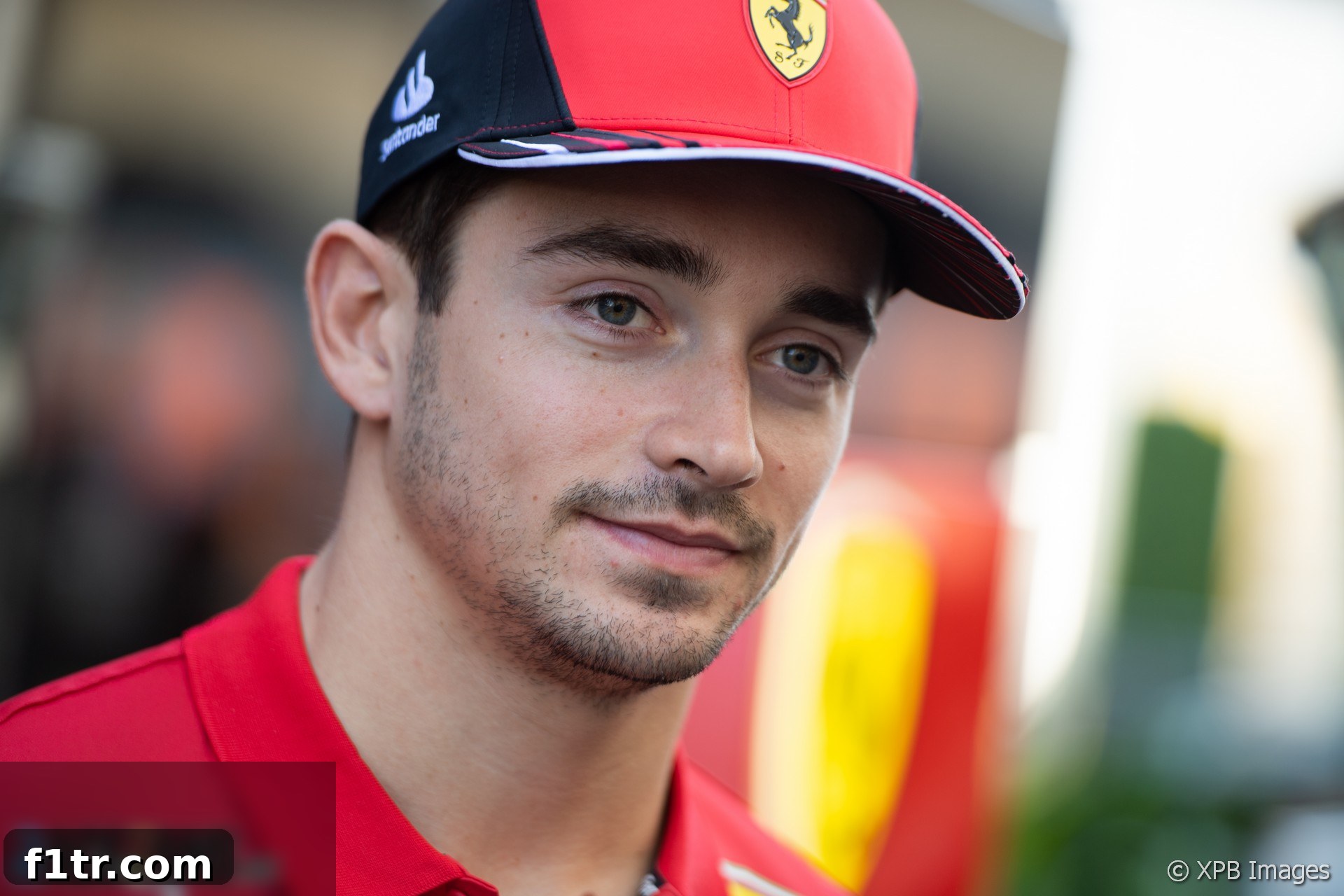
Charles Leclerc’s 2022 F1 Season: A Tale of Promise, Heartbreak, and Unyielding Spirit
In the high-octane world of Formula 1, the distinction between triumph and tragedy can often be razor-thin. While securing second place in the Drivers’ Championship is an extraordinary achievement for many, for a driver of Charles Leclerc’s caliber, especially after such a rollercoaster season, it carries a bittersweet undertone. The 2022 Formula 1 season promised so much for the Monegasque driver and his iconic Ferrari team, igniting hopes of a genuine title challenge against the formidable Max Verstappen and Red Bull Racing. Yet, as Leclerc collected his runner-up trophy at the FIA Gala, his subdued demeanor spoke volumes about a campaign that, despite its moments of brilliance, ultimately ended in profound disappointment.
The season began with an electrifying surge of optimism for Ferrari and Charles Leclerc. Arriving at the Bahrain International Circuit, Ferrari’s new F1-75 challenger immediately demonstrated its potent capabilities, suggesting a legitimate shot at the championship. Leclerc wasted no time capitalizing on this potential, expertly snatching the first pole position of the season from reigning world champion Max Verstappen. The race itself was a captivating spectacle, with Leclerc engaging in a relentless, wheel-to-wheel duel with Verstappen – a battle marked by aggressive yet fair racing. Before Verstappen’s late-race retirement due to mechanical issues, Leclerc had more than earned his opening victory, not only ending Ferrari’s prolonged win drought but also firmly establishing them as the early favorites for the 2022 Formula 1 Drivers’ and Constructors’ Championships. This emphatic start instantly positioned Leclerc as a leading contender, brimming with confidence and the raw speed to match.
A mere week later, the intensity continued in Jeddah, where another enthralling duel with Max Verstappen unfolded. Though Leclerc ultimately had to settle for second place in Saudi Arabia, his performance underscored Ferrari’s competitive edge. The true statement of dominance, however, came in Melbourne. At the Australian Grand Prix, Leclerc was simply untouchable. He stormed to pole position with a commanding margin of nearly three-tenths of a second and meticulously controlled the entire race, leading every single lap from start to finish to secure his second victory in just three races. Suddenly, Charles Leclerc found himself sitting comfortably atop the drivers’ championship standings, boasting almost double the points haul of any other competitor and a substantial lead over his primary rival, Max Verstappen. The dream of a maiden Formula 1 world title seemed more tangible than ever for the young Ferrari star.
However, despite such a commanding early position, the inherent unpredictability of Formula 1 and the immense pressure of a title fight soon began to reveal cracks. The subsequent round at Imola served as a stark reminder that even the most brilliant drivers are not infallible. After a hard-fought sprint race where he made Verstappen work tirelessly for the win, Leclerc’s Grand Prix started with a setback, dropping two places to third behind Sergio Perez. Then, in a desperate attempt to chase down the second Red Bull and regain ground, he pushed the limits too far, losing control at the Variante Alta chicane and skidding into the barriers. While he fortunately managed to continue, his front wing required immediate repair, costing him valuable time and positions. He eventually recovered to a sixth-place finish, but the incident proved costly, allowing Verstappen to leapfrog into second place in the championship and significantly reduce Leclerc’s lead. This mistake, though minor in its direct consequence, marked a psychological shift, hinting at the immense pressure Leclerc was operating under.
The Crushing Blows: Reliability, Strategy, and Unforced Errors
The Spanish Grand Prix in Barcelona represented perhaps the most painful turning point in Charles Leclerc’s 2022 F1 campaign. Having bounced back from Imola with a strong pole position in Miami – only to be outpaced by Verstappen in the race – Leclerc arrived in Spain looking unstoppable. He was the fastest driver in every single session, culminating in his fourth pole position in just six rounds, an incredible feat even after a spin on his first Q3 attempt. After expertly beating Verstappen to Turn 1 at the start, Leclerc looked utterly comfortable out front, dictating the pace and building a healthy lead. Then, without any prior warning, disaster struck on lap 27: his turbo unit suddenly exploded, forcing a heartbreaking retirement. Zero points from a race he was dominating unequivocally confirmed that the championship momentum was swinging away from Ferrari. This mechanical failure was not only a cruel blow to Leclerc’s points tally but also a significant psychological scar, eroding confidence in the reliability of the Ferrari F1-75.
Heading to his home Grand Prix in Monaco, Charles Leclerc found himself trailing Max Verstappen in the championship standings for the very first time in 2022. Yet again, he delivered a brilliant pole position, and unlike the previous year, he actually managed to start from it. However, if his car had betrayed him in Barcelona, it was Ferrari’s pit wall that orchestrated the ruin of his race in Monte Carlo. A series of baffling strategy calls during the crucial switch to slick tires left him hopelessly mired in fourth place, entirely unable to improve his position around the notoriously cramped and unforgiving street circuit. This strategic blunder was a glaring indictment of the team’s operational execution, robbing Leclerc of a potential home victory and further compounding his frustration.
The woes continued in Baku, at the Azerbaijan Grand Prix, where Leclerc suffered yet another devastating setback. His fourth consecutive pole position was a testament to his sheer, unadulterated speed, particularly when compared to his teammate Carlos Sainz Jnr. However, a second power unit failure while leading a race within just three events escalated the frustration to unbearable levels. This succession of mechanical unreliability issues forced him to take a back-of-the-grid power unit penalty at the Canadian Grand Prix in Montreal. Despite starting from the rear, Leclerc showcased his fighting spirit, skillfully recovering to an impressive fifth place by the checkered flag, minimizing the damage but not erasing the concerns.
At the British Grand Prix at Silverstone, another opportunity for victory slipped away due to questionable team strategy. When the Safety Car was deployed late in the race, Leclerc was left out on old, hard tires, while his competitors, including his teammate Sainz, pitted for fresh, softer rubber. Powerless to defend, Leclerc watched as Sainz passed him for the lead, and despite a valiant fight against Sergio Perez and Lewis Hamilton, he ultimately fell to fourth place. Leaving Britain, Charles Leclerc’s deficit to Max Verstappen had ballooned to 45 points – an astonishing reversal compared to his dominant position after the first three races. This significant swing in the championship was largely a result of circumstances beyond Leclerc’s control, whether mechanical failures or strategic missteps, highlighting the immense challenges he faced.
A Glimmer of Hope and the Final Decline
By a curious twist of fate, Charles Leclerc’s luck briefly turned at a circuit named for his rivals: the Red Bull Ring in Austria. Though he narrowly missed out on pole position to Verstappen and had to fend off Sainz in the sprint race, on Sunday, Leclerc was absolutely unstoppable. He executed three magnificent overtakes on Max Verstappen for the race lead and then bravely overcame a partially sticking throttle in the closing laps to clinch his third victory of the season. This triumph at the Austrian Grand Prix momentarily reignited his championship aspirations, proving that when the car and strategy aligned, he possessed the pace and tenacity to challenge Verstappen directly. It was a crucial victory that breathed temporary life back into Ferrari’s title challenge.
Following up on this momentum in France would be paramount for Leclerc to carry much-needed confidence into the summer break. He appeared to be firmly on track, comprehensively taking pole position at Paul Ricard, aided by a strategic tow from his teammate. For the first time since the early races, Charles Leclerc found himself locked in a head-to-head battle against Max Verstappen once more, successfully fending off his rival’s early attacks. But in a heart-wrenching moment that would ultimately define his season, after Verstappen pitted and Leclerc was pushing hard on older tires, he lost control of his car at the Beausset corner, spinning into the barriers. This was his third retirement from the lead of a race in the season, but crucially, it was the first for which he was entirely to blame. The French Grand Prix crash was a devastating blow, not just in terms of points lost, but in extinguishing the last embers of his championship challenge.
The relentless series of unfortunate events continued to plague Charles Leclerc. Another inexplicable strategy decision by Ferrari at the Hungaroring left him in a dismal sixth place, pushing his deficit to Verstappen to a staggering 80 points. At this stage, any realistic hopes of Leclerc clawing himself back into contention for the 2022 F1 championship were all but dead. His bad luck persisted at Spa-Francorchamps when a tear-off visor became lodged in his brake duct early in the Belgian Grand Prix, forcing an unscheduled early pit stop. Later, an ill-fated attempt at securing the fastest lap point backfired comically when he broke the pit lane speed limit, costing him a valuable position for absolutely no gain. These incidents, a mix of team errors, bad fortune, and minor driver misjudgments, perfectly encapsulated the struggles of his season.
By this point in the 2022 Formula 1 season, Max Verstappen and Red Bull Racing had become an unstoppable force, marching inexorably towards the championship title. While the main prize was out of reach, Charles Leclerc at least consistently maintained the upper hand over his teammate, Carlos Sainz. Back-to-back pole positions at Ferrari’s home race in Monza and then in Singapore helped to pad his impressive qualifying statistics. However, Ferrari had reportedly exhausted their development budget by this crucial stage, allowing rival teams, particularly Mercedes, to begin closing the performance gap. Leclerc, ever the fighter, continued to battle hard on race days, often pushing the envelope to its absolute limit. This was vividly demonstrated in the final lap at Suzuka, where he was demoted to third behind Sergio Perez after missing the final chicane. That single incident decisively sealed the championship in Max Verstappen’s favor with four races still remaining, a testament to how every point mattered.
As Ferrari visibly struggled to keep pace with the dominant Red Bulls towards the conclusion of the season, Carlos Sainz began to occasionally out-qualify and even beat his teammate to the checkered flag for the first time that year. Adding to Leclerc’s frustrations, his team seemed to offer him no favors; a bizarre strategic call in Q3 at Interlagos saw him sent out on intermediate tires on a still-drying track, only for a belated and ill-timed switch back to slicks to ruin his qualifying session. These strategic missteps were a recurring theme, further underscoring the challenges faced by the Ferrari team throughout the crucial second half of the championship battle.
However, in the season finale at Abu Dhabi, with the championship long decided and nothing left to race for but the ‘honour’ of finishing ahead of a relentless Sergio Perez for second in the drivers’ standings, Charles Leclerc delivered one of his finest drives of the latter half of the season. He pushed himself and his Pirelli tires to their absolute limit, making a daring one-stop strategy work flawlessly. He masterfully kept just out of reach of the pursuing Perez, holding onto second place at the finish line. It was a fitting, if somewhat poignant, end to a season that mirrored much of Leclerc’s campaign: he toiled with immense effort, displayed incredible skill, but was ultimately rewarded with very little in terms of the ultimate prize.
Charles Leclerc’s 2022 Formula 1 season, arguably his most successful statistically with Ferrari, was simultaneously his most frustrating and emotionally taxing. His early dreams of fighting for a maiden world title vanished like smoke from the rear of his car, often through circumstances beyond his control. Yet, for at least the initial part of the season, Leclerc unequivocally demonstrated that he possesses the steely nerve, the prodigious talent, and the unwavering determination required to challenge a world champion of Max Verstappen’s caliber on an equal footing. With his former Sauber team principal, Frederic Vasseur, now at the helm of Ferrari for the 2023 season, Charles Leclerc knows he can head into the upcoming campaign with renewed confidence in his own brilliant abilities and the hope that the team can finally provide him with the consistent support and flawless execution needed to turn promise into championship glory.
2022 F1 season review
- Records smashed and winning runs wrecked: The 2022 F1 season in stats
- Helmet rows, hot mics and more forgotten motorsport stories from 2022
- The RaceFans Caption Competition winners of 2022
- Verstappen voted 2022 Driver of the Year by RaceFans readers
- 22 telling stats on every driver to race in the 2022 F1 season
Browse all 2022 F1 season review articles