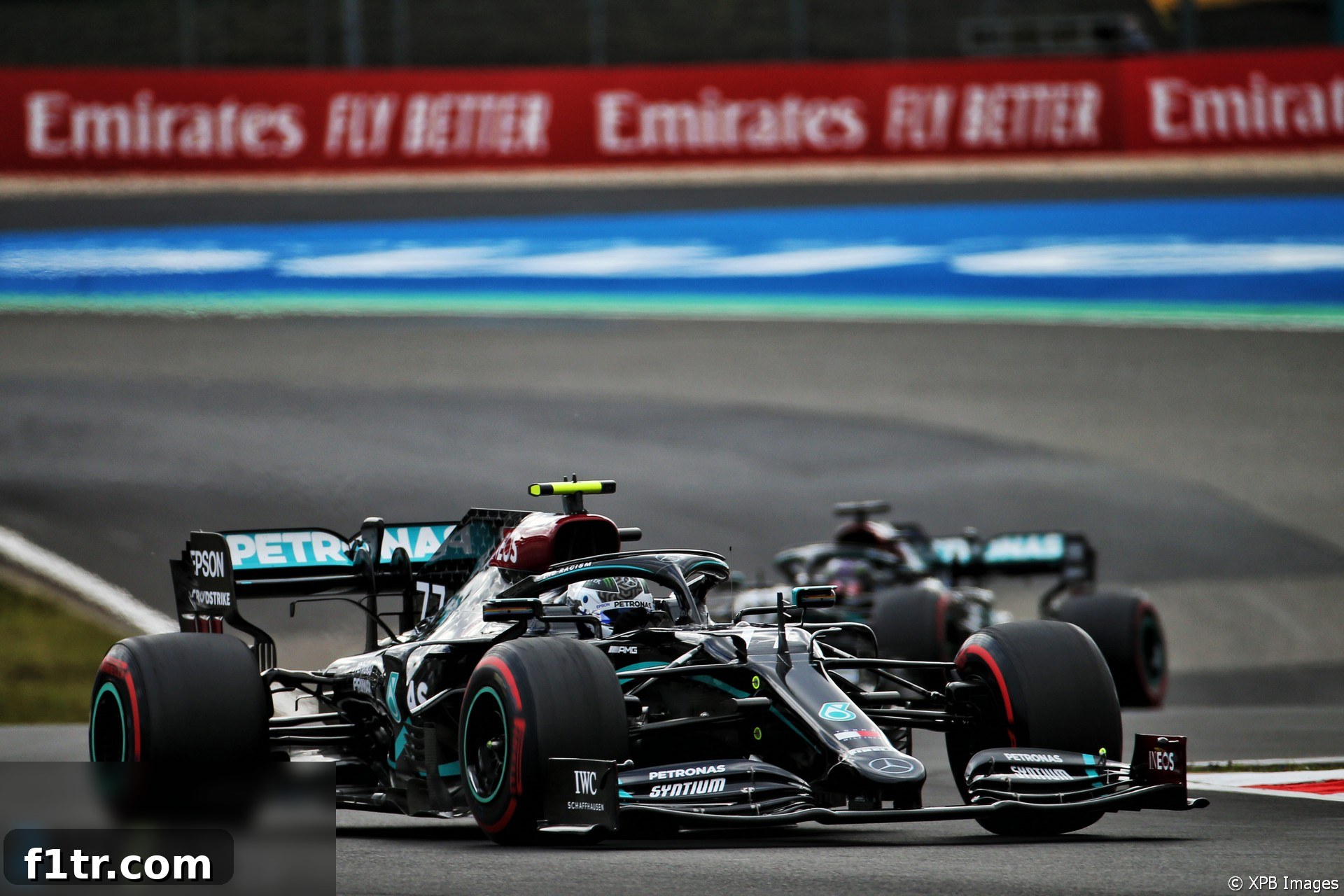
Valtteri Bottas’s Eifel Grand Prix Misfortune: A Battle Lost to Unseen Forces
The 2020 Formula 1 season was a dominant affair for Mercedes-AMG Petronas, yet even within such an era of supremacy, moments of drama and disappointment were inevitable. One such pivotal moment unfolded at the Eifel Grand Prix at the iconic Nürburgring, where Valtteri Bottas, starting from pole position, was poised for a fierce challenge against his teammate, Lewis Hamilton. However, a cruel twist of fate in the form of a power unit problem prematurely ended his race, extinguishing his hopes of reclaiming the lead and significantly impacting his championship aspirations.
This race, held under challenging cool and damp conditions, highlighted the fine margins in Formula 1 and the devastating impact a technical failure can have on a driver’s weekend, especially when battling at the very front of the grid. Bottas’s retirement was not merely an exit from a race; it was a significant blow to his morale and his increasingly distant dream of challenging Hamilton for the Drivers’ Championship title.
The Pole Position and the Intense Opening Battle
Valtteri Bottas arrived at the Nürburgring with a point to prove. Having secured pole position with a stellar qualifying lap, he was in the strongest possible position to convert it into a much-needed victory. The start of the Eifel Grand Prix was nothing short of electrifying. Bottas launched his Mercedes W11 perfectly, immediately coming under pressure from Hamilton. What ensued was a breathtaking wheel-to-wheel battle between the two teammates, showcasing the intensity of their rivalry and Bottas’s determination to hold onto his hard-earned lead.
For several laps, Bottas expertly defended his position, demonstrating resilience and aggressive driving. He made it clear that he wasn’t going to make it easy for Hamilton, deploying all his skill to keep the championship leader at bay. This initial phase of the race was a display of Bottas at his best, matching Hamilton’s pace and defending robustly. The early exchanges hinted at a potential classic battle for victory, one that Bottas desperately needed to inject life back into his championship campaign.
A Slip of Grip: The Lock-up at Turn One
The delicate balance of the race shifted dramatically on lap 13. A light rain shower began to fall, making the already cool Nürburgring track even more treacherous. Approaching Turn 1, a critical braking zone, Bottas experienced a moment that would fundamentally alter his race. He locked up his front tires, causing his car to run wide and allowing Hamilton a crucial opening. In a move characteristic of a seven-time world champion, Hamilton seized the opportunity, sweeping past Bottas to take the lead.
This single error, amplified by the challenging conditions, proved costly. Bottas, having lost the lead and flat-spotted his tires, was forced into an early pit stop. This unexpected stop put him on a different strategy to Hamilton, who continued on his original tires for longer. While an early stop sometimes presents an opportunity for an undercut, in this instance, it primarily meant losing track position and needing to fight his way back through traffic, a scenario Bottas had hoped to avoid by maintaining the lead.
The Undercut Attempt and Fleeting Hope
Despite the setback of the lock-up and early pit stop, Valtteri Bottas remained optimistic and focused. Emerging from the pits on fresh medium compound tires, he immediately demonstrated impressive pace, setting a string of fastest sector times. This rapid pace fueled his belief that an “undercut” strategy was viable, potentially allowing him to regain the lead from Hamilton once his teammate made his own pit stop. The new tires were “starting to feel pretty good,” as Bottas later remarked, giving him renewed hope.
His charge, however, was not without its own challenges. Before he could truly exploit the full potential of his fresh rubber to build a significant gap, he encountered Daniel Ricciardo, who was running a strong race in his Renault. The time lost battling Ricciardo, albeit briefly, was precious in the context of an undercut strategy against a driver of Hamilton’s caliber. Every tenth of a second counts when vying for position against a teammate on a differing strategy, and this brief skirmish, while successfully navigated, chipped away at Bottas’s strategic advantage.
The Cruel Hand of Fate: Power Unit Failure During VSC
Just as Bottas was starting to feel confident about his race recovery, fate intervened with a brutal and unexpected blow. A Virtual Safety Car (VSC) period was deployed due to Lando Norris’s McLaren stopping on track. During this VSC, which should have been a relatively calm period, Bottas’s car began to lose power dramatically. “Just during the VSC I started to lose power and it never recovered,” Bottas recounted with palpable frustration. The loss was significant and immediate, making it clear that his race was in jeopardy.
Mercedes quickly identified the problem as a suspected MGU-H fault within the power unit. The MGU-H (Motor Generator Unit – Heat) is a critical component of Formula 1’s hybrid power units, responsible for recovering energy from the exhaust gases. A failure here is catastrophic, leading to a profound loss of engine power and often necessitating retirement. Bottas was forced to pull over, bringing his promising race to an abrupt and disheartening end. The timing couldn’t have been worse; not only was he battling for the lead, but Hamilton had also pitted during the VSC, effectively gaining a ‘free’ pit stop and maintaining his advantage, making Bottas’s technical failure even more poignant.
Unpacking the MGU-H Failure: A Technical Glitch at the Worst Time
The MGU-H is one of the most complex and technologically advanced components within a modern Formula 1 power unit. Its primary function is to convert heat energy from the turbocharger’s exhaust gases into electrical energy, which can then be deployed for extra power or stored in the battery. A malfunction in this unit not only reduces the engine’s overall power output but also compromises the entire hybrid system’s efficiency, rendering the car uncompetitive and often unsafe to continue.
For Mercedes, a team renowned for its engineering prowess and exceptional reliability, such a failure was a rare occurrence and undoubtedly a cause for concern. While individual components can fail, the W11 had been a fortress of dependability throughout the 2020 season. The immediate aftermath involved a thorough investigation by Mercedes engineers to understand the root cause of the MGU-H fault, aiming to prevent any recurrence for either Valtteri Bottas or Lewis Hamilton in future races. Such technical issues are a stark reminder that even the most advanced machinery can be susceptible to unforeseen problems, especially under the extreme stresses of Formula 1 racing.
Championship Hopes Dented: The Broader Picture
The retirement from the Eifel Grand Prix was more than just a missed opportunity for a race win; it was a significant blow to Valtteri Bottas’s already slim chances in the 2020 Drivers’ Championship. With Hamilton going on to win the race, the points gap between the two Mercedes drivers widened further, making Bottas’s task of overturning his teammate’s lead even more monumental. As one related article aptly put it, Bottas “needs a miracle” to overcome Hamilton’s advantage, and incidents like this MGU-H failure only serve to underscore the difficulty of that challenge.
Throughout his career at Mercedes, Bottas has often shown flashes of brilliance, particularly in qualifying, but has struggled to maintain a consistent challenge against Hamilton over a full season. Technical failures, while not common, contribute to this narrative, robbing him of crucial points and momentum. The psychological impact of such a retirement, especially when leading or fighting for the lead, can be immense, requiring strong mental fortitude to bounce back in subsequent races. The Eifel Grand Prix ultimately became another chapter in Bottas’s season defined by moments of potential overshadowed by misfortune.
The Eifel Grand Prix: A Race of What-Ifs for Bottas
For Valtteri Bottas, the 2020 Eifel Grand Prix will forever be remembered as a race of “what-ifs.” What if he hadn’t locked up at Turn 1? What if the rain hadn’t started? What if his power unit had held together? He had demonstrated the pace, the determination, and the strategy to fight for victory, making his eventual retirement all the more bitter. His frustration was evident, encapsulating the raw emotions of a racing driver whose efforts are undone by circumstances beyond his control. Despite his resilience, this particular setback was a heavy one.
In the high-stakes world of Formula 1, where technology, strategy, and driver skill converge, moments of misfortune are an inherent part of the sport. While Hamilton celebrated another dominant victory, Bottas was left to ponder what might have been. The Eifel Grand Prix served as a poignant reminder of the fine line between triumph and despair in Grand Prix racing, solidifying its place as a crucial and unfortunate turning point in Bottas’s 2020 season.
Related Coverage from the 2020 Eifel Grand Prix
- Renault “not scared of anywhere” in remaining races
- Bottas “needs a miracle” to overturn Hamilton’s 69-point lead
- 2020 Eifel Grand Prix Star Performers
- Leclerc sees ‘quite a few positives’ in Ferrari’s Nurburgring weekend
- Mercedes relied on DAS “more than ever” at cold Nurburgring
Browse all 2020 Eifel Grand Prix articles