The Critical Seconds: Bottas’s Pivotal Role in Mercedes’ Monaco GP Double-Stack Drama
In the high-stakes environment of Formula 1, where every millisecond can dictate victory or defeat, the 2019 Monaco Grand Prix provided a vivid illustration of how intricate strategies, driver execution, and unforeseen circumstances converge. During a crucial Safety Car period, Mercedes faced the daunting task of pitting both their lead drivers, Lewis Hamilton and Valtteri Bottas, in a challenging double-stack pit stop. Mercedes later confirmed that Bottas executed his role flawlessly, doing everything within his power to maintain position and ensure the team’s strategy unfolded as planned, despite a series of events that ultimately led to a dramatic and costly incident.
The streets of Monte Carlo are renowned for their unforgiving nature, and the demand for precision extends beyond the track into the pit lane. With a Safety Car deployed, Mercedes found themselves in a common but precarious situation: both Hamilton, leading the race, and Bottas, running second, needed fresh tyres. A ‘double stack’ pit stop, where two cars from the same team pit consecutively, is one of the most stressful operations in Formula 1. It requires impeccable timing from the drivers, crystal-clear communication from the pit wall, and lightning-fast work from the pit crew. The key to a successful double stack lies in the second driver creating a sufficient gap to the first, allowing enough time for the leading car to be serviced and depart before the second car enters its pit box.
Valtteri Bottas’s Masterful Gap Creation and Team Strategy
As the Safety Car circulated and the Mercedes W10s approached the pit entry, Valtteri Bottas, keenly aware of the strategic imperative, began to manage his pace with meticulous care. His objective was clear: slow down just enough to allow Hamilton’s pit stop to be completed without encroaching on his own allocated time. This delicate balancing act involves maintaining a safe delta time to the Safety Car while simultaneously creating a buffer to the car ahead. Mercedes’ motorsport strategy director, James Vowles, later lauded Bottas’s execution, stating, “When you come in for a ‘double stack’ Safety Car [pit stop], what’s really important is making a gap between your cars so that the first car can be serviced in the pit lane and the second one can slot straight in. And Valtteri did that perfectly on track.”
The team radio exchanges during this critical phase further underscore the pressure and precision involved. Bottas was constantly updated on his delta time and the gap to Hamilton, receiving precise instructions to adjust his pace. This real-time communication enabled him to sculpt the exact distance required for the intricate pit stop operation. Bottas successfully widened the gap, transforming a potentially chaotic double stop into a meticulously planned sequence for Hamilton’s tyre change. This strategic slowdown, while perfectly legitimate, also highlights the razor-thin margins and the strategic thinking required by drivers and teams to maximize every opportunity under Safety Car conditions.
The Unforeseen Obstacle: A Fraction of a Second, A World of Difference
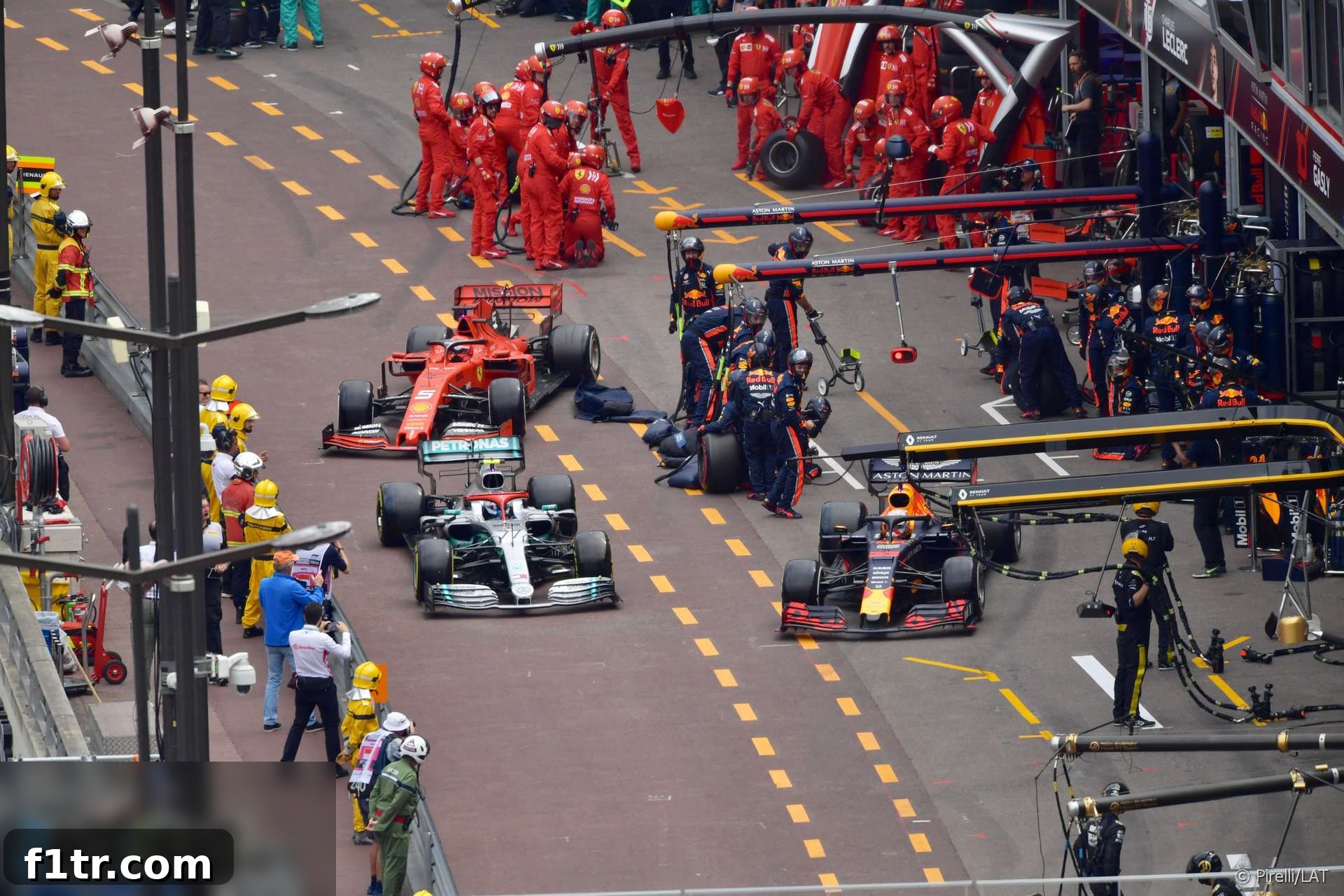
However, even the most perfectly orchestrated plans can be derailed by the smallest of incidents. As Lewis Hamilton concluded his tyre change and surged out of his pit box, a minor misjudgment occurred. Mercedes’ James Vowles revealed the pivotal moment: “Lewis had his pit stop, drove out and you would’ve seen Valtteri came straight back in again. And now it’s a straight race between Vettel, Verstappen and Valtteri for a pit stop. Unfortunately as Lewis left, he clipped one of the guns and it took just a few seconds for them to reset properly and the cost to us was a couple of tenths. That’s it, but that’s all you need.”
This seemingly innocuous contact between Hamilton’s car and a wheel gun had cascading effects. The pit crew, in their frantic effort to reset the equipment and prepare for Bottas’s arrival, lost a crucial “couple of tenths” of a second. In Formula 1, where races are won and lost by margins invisible to the naked eye, a few tenths can be the difference between retaining a position and losing multiple places. This minuscule delay proved to be catastrophic for Bottas, creating an opening that rival Max Verstappen and Red Bull Racing were poised to exploit, turning a potential double-podium into a battle for survival.
The Red Bull Counter-Attack and Pit Lane Collision at Monaco
While Mercedes grappled with their unexpected setback, Red Bull executed an exceptional pit stop for Max Verstappen. Their crew delivered one of their fastest performances of the season, a testament to their readiness and efficiency, particularly under such high-pressure circumstances. This superb pit stop, combined with Mercedes’ fractional delay, created a dangerous scenario as Bottas was released from his pit box. The convergence of these factors meant that Verstappen was suddenly alongside Bottas as both cars exited the pit lane, battling fiercely for track position even before they rejoined the main circuit. The narrow confines of the Monaco pit lane exacerbate such confrontations, leaving minimal room for error or evasive action.
The proximity inevitably led to contact. Vowles recounted the incident, explaining, “We had a couple of tenths loss on Valtteri’s pit stop, Red Bull had a very, very good pit stop. One of the best of the year for them. Those extremes meant that as the cars went out and were in the pit lane, Verstappen came alongside, hit the left-hand side of Valtteri’s car, pushing the right-hand side into the wall and damaging that front-right wheel.” The collision resulted in significant damage to Bottas’s front-right wheel, forcing him to make a second unscheduled pit stop to replace the compromised tyre. This incident effectively dashed any hopes Bottas had of challenging for victory or a podium finish, transforming a meticulously planned strategy into a damage limitation exercise and highlighting the brutal consequences of even the slightest mistake in Formula 1.
Stewards’ Ruling on Slow Driving and Strategic Precedent
Following the race, the stewards reviewed Bottas’s driving under the Safety Car, particularly his reduced pace as he approached the pit lane entrance. Ultimately, they concluded that Bottas had not breached regulations by driving “unnecessarily slowly.” This decision aligned with a common, albeit controversial, tactic employed by drivers to create crucial pit stop gaps. Another notable instance from the same event involved Williams driver George Russell, who also significantly reduced his speed near the pit lane entrance while his team deliberated on their pit strategy. Such actions, while designed to benefit the team, always walk a fine line with the regulations concerning maintaining a consistent pace under Safety Car conditions, which prioritize safety and fairness.
The rules governing driver conduct under Safety Car state that drivers must maintain a reasonable pace, but also allow for strategic spacing. Bottas’s deliberate slowing was a calculated move, sanctioned by his team, to optimize the double-stack. The stewards’ decision confirmed that his actions, while on the aggressive side of strategic interpretations, remained within the bounds of fair play, highlighting the nuanced understanding required for such regulations in the dynamic environment of Formula 1 racing. This ruling provided clarity on what is permissible, but also underscored the inherent tension between maximizing strategic advantage and adhering strictly to the spirit of the rules.
Valtteri Bottas’s Team Radio from the Safety Car Deployment
| Team Radio Transcript (Safety Car Period) | |
|---|---|
| To Bottas: | Safety Car, Safety Car, so box, box, box. |
| Bottas: | OK. |
| To Bottas: | So stay positive on delta. We are stacking. |
| To Bottas: | Very safe on delta. |
| To Bottas: | Lewis half a second ahead. |
| To Bottas: | Lewis one second. |
| To Bottas: | Lewis 1.5. |
| To Bottas: | Let’s go more safe on that delta, please. |
| To Bottas: | Two and a half, three seconds. |
| To Bottas: | Two and a half, more please. Three and a half. Four seconds. |
| To Bottas: | That’s good, Valtteri. |
The Aftermath and Broader Implications for F1 Strategy
The events of the 2019 Monaco Grand Prix pit lane serve as a powerful reminder of the relentless pressure and incredibly fine margins that define Formula 1. Valtteri Bottas’s exemplary execution of the gap-creation strategy was a testament to his skill and discipline, yet it was undermined by an unforeseen, minor technicality. The “couple of tenths” lost due to a wheel gun clipping highlight how a fraction of a second can unravel a meticulously crafted plan and alter a driver’s race outcome, and potentially, championship aspirations. This incident remains a key case study in F1 strategy, illustrating the fragile balance between precision and the unpredictable nature of live racing conditions.
For Mercedes, the incident underscored the inherent risks of a double-stack pit stop, even for a team known for its precision and efficiency. It also demonstrated the competitive ferocity of their rivals, with Red Bull capitalizing on every opportunity. Ultimately, Lewis Hamilton went on to win the race, but Bottas’s result was severely compromised, shifting the dynamic of the drivers’ championship battle for the 2019 season. This single incident encapsulated the essence of Formula 1: a complex dance of human skill, strategic foresight, technological prowess, and the unpredictable nature of racing at its absolute limit, where even the smallest detail can have monumental consequences.
2019 F1 Season Related Articles
- Crying in the Melbourne car park at 2019 grand prix was my career low – Ocon
- McLaren Racing reports reduced £71 million loss in 2019
- Kvyat: Hockenheim podium last year was “my biggest achievement” so far
- How the FIA’s new encrypted fuel flow meter targets Ferrari’s suspected ‘aliasing’ trick
- “He smashed my office door”: 23 must-see moments from ‘Drive to Survive’ season two
Browse all 2019 F1 season articles