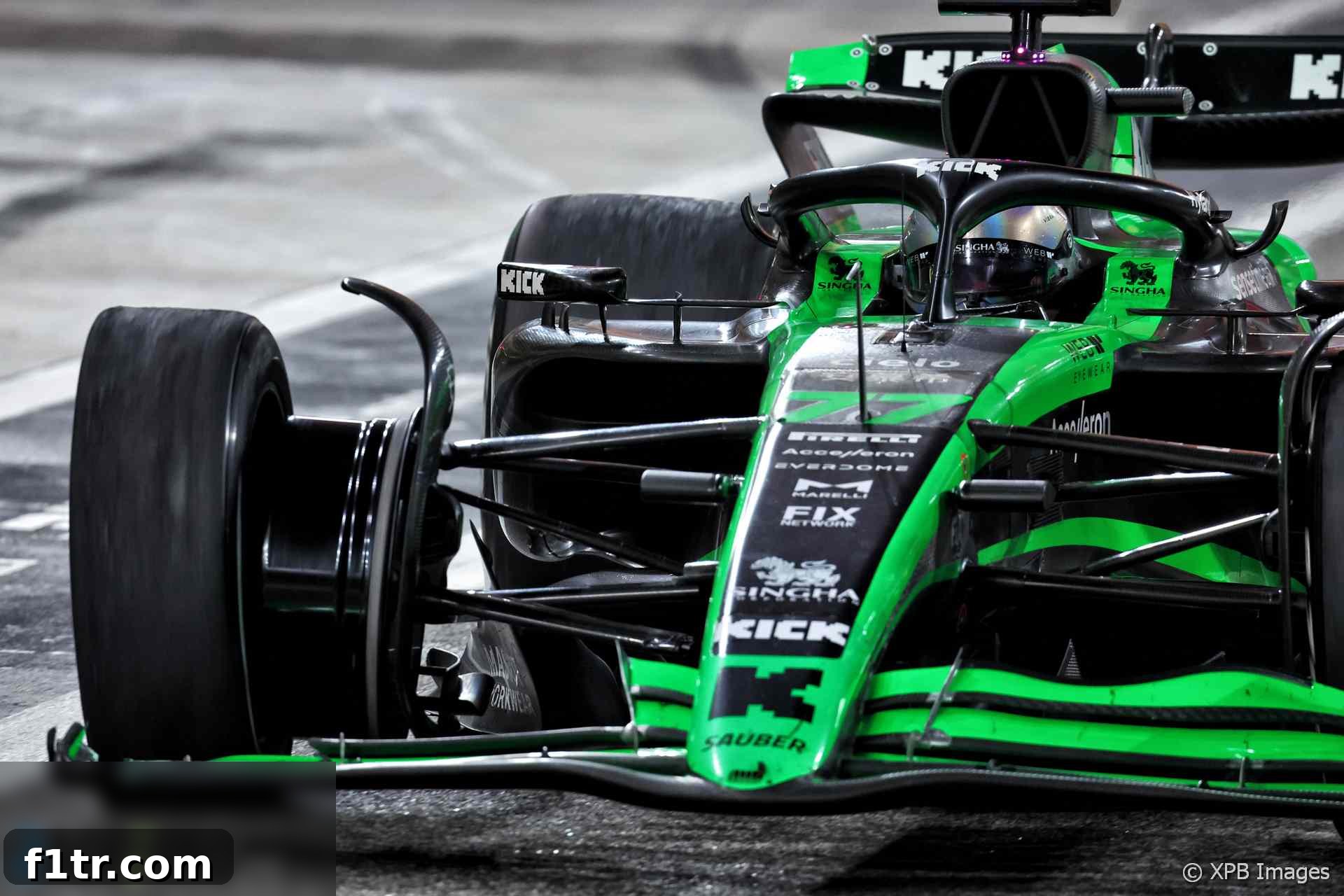
Valtteri Bottas Faces Unprecedented Grid Penalty After Controversial Abu Dhabi Grand Prix Exit
The closing race of the Formula 1 season in Abu Dhabi proved to be a weekend fraught with challenges for Valtteri Bottas, culminating in a significant five-place grid penalty issued by the stewards. However, this sanction carries an unusual caveat: given Bottas’s current contractual status, there’s a distinct possibility he may never actually serve it. This unique situation casts a shadow of uncertainty over a turbulent season finale for the Finnish driver and raises questions about the intricate regulations of Formula 1 penalties when a driver’s future in the sport is unclear.
A Tumultuous Season Finale for Bottas
The Abu Dhabi Grand Prix, traditionally a celebratory conclusion to the F1 calendar, turned into a scene of misjudgment and unfortunate incidents for Bottas. Driving for Sauber, he was involved in not one but two separate collisions during the race, both of which drew the attention of the race stewards. The second of these incidents, a tangle with Haas driver Kevin Magnussen, ultimately forced Bottas to retire from the Grand Prix prematurely, marking a disappointing end to what could be his final race in Formula 1 for the foreseeable future.
Following a thorough investigation, the stewards determined that Bottas was squarely at fault for the incident with Magnussen. Their official ruling stated: “Car 77 [Bottas] was on the inside of car 20 [Magnussen] on the approach to turn six, misjudged his braking significantly and collided with car 20 which was entering the corner on the regular racing line.” This critical assessment highlighted a clear error in judgment on Bottas’s part, leading to an unavoidable impact that compromised both drivers’ races.
Double Collisions Lead to Dual Penalties
As a direct consequence of the collision with Magnussen, the stewards handed Bottas a five-place grid penalty, which would ordinarily apply to his next race outing. This type of penalty means the driver would start five positions lower than where they qualified for the subsequent event. Given that Bottas had already retired from the Abu Dhabi Grand Prix, the stewards clarified that this grid drop was deemed “the equivalent of a drive-through penalty,” signifying a substantial on-track sanction. In addition to the grid penalty, Bottas was also assessed three penalty points on his Super Licence, a crucial aspect of F1’s disciplinary system. The stewards explicitly cited the “significant misjudgment of the driver” as the basis for these penalties, underscoring the severity of the infraction.
Reflecting on the incident shortly after his retirement, Bottas was candid in his admission of responsibility. “It was my bad,” he conceded, taking full accountability for the contact. He explained the challenging circumstances that contributed to the error: “I was defending with old tyres and I tried to brake as late as I could but I just couldn’t stop the car.” This explanation offers a glimpse into the razor-thin margins and intense pressures drivers face, even in a race where tyre wear can significantly alter braking performance and overall car control.
The First Incident: Tangling with Sergio Perez
Trouble for Bottas, however, had begun much earlier in the race, specifically on the very first lap. A separate incident saw him tangling with Red Bull Racing’s Sergio Perez. The stewards once again held Bottas entirely responsible for this initial contact. Their ruling detailed the sequence of events: Bottas “attempted to overtake car 11 [Perez] on the inside into turn six, but ran over the inside kerb and hit the rear left wheel of car 11.” This first-lap misadventure set a difficult tone for Bottas’s entire race, indicating a day where his judgments were consistently off-kilter.
For the collision with Perez, Bottas received an additional two penalty points. This meant that within the span of a single Grand Prix, a driver who had previously held a clean sheet went from zero to a cumulative total of five penalty points on his Super Licence. This rapid accumulation is a notable concern, as drivers who accrue 12 penalty points within a 12-month period face an automatic one-race ban. While Bottas’s five points were still well below this threshold, earning half that number in a single event highlights a particularly challenging and error-prone performance.
The Unserved Penalty: A Question Mark Over Bottas’s F1 Future
The core of the unprecedented situation lies in Bottas’s contractual circumstances. As the Abu Dhabi Grand Prix marked his final race for Sauber, and critically, as he currently holds no confirmed race contract for the 2025 Formula 1 season, the five-place grid penalty issued to him enters a peculiar limbo. Formula 1 regulations typically stipulate that unserved grid penalties carry over to the driver’s next competitive outing. This means that if Bottas were to secure a drive with another team for the 2025 season or beyond, he would be required to serve this penalty at the first Grand Prix he participates in.
However, the highly competitive nature of the F1 driver market means that securing a seat is far from guaranteed. If Bottas is unable to find a drive for 2025, or indeed for any subsequent season, then the grid penalty, in practical terms, may never be applied. This scenario creates an interesting precedent, where a sporting sanction is issued but its execution remains contingent on external career factors. It poses a unique dilemma for both the driver and the sport’s regulatory bodies, highlighting a rare intersection of sporting discipline and professional uncertainty. The prospect of Bottas, a multiple Grand Prix winner and former Mercedes driver, potentially leaving F1 with an unserved penalty hanging over him, adds a layer of bittersweet irony to his current situation.
Valtteri Bottas’s Reflections on a Challenging Weekend
Beyond the technicalities of the penalties, Bottas’s personal reflections painted a clear picture of frustration and disappointment. His earlier admission of responsibility for the Magnussen incident was followed by a broader sentiment about his entire race weekend. “It’s definitely not the ideal finish but these things happen,” Bottas stated, acknowledging the harsh reality of motor racing. He continued, “It’s racing, it’s not the first time. Everything just went wrong since lap one.” This poignant summary encapsulates a race that spiraled out of his control almost from the moment the lights went out, transforming what should have been a standard season closer into a series of unfortunate events.
For a driver of Bottas’s experience, who has competed at the pinnacle of motorsport for over a decade, such a challenging and penalty-laden race is undoubtedly a difficult pill to swallow, especially as it coincided with a period of significant career uncertainty. The psychological impact of a race where “everything just went wrong” can be profound, particularly when one’s future in the sport hangs in the balance. It underscores the immense mental fortitude required by Formula 1 drivers to rebound from adversity and maintain focus amidst intense pressure and scrutiny.
Understanding Formula 1 Penalties: Grid Drops and Penalty Points
To fully grasp the implications of Bottas’s situation, it’s helpful to understand the nuances of Formula 1’s penalty system. A “grid penalty” is one of the most common and direct forms of sporting sanctions. When a driver incurs a grid penalty, they are required to start a specified number of positions lower on the starting grid for the subsequent race. For instance, a five-place grid penalty means a driver who qualifies in P10 would start from P15. These penalties are typically issued for infringements such as causing a collision, unsafe releases from the pit lane, or exceeding power unit component allocations.
Separately, “penalty points” are a critical component of the F1 Super Licence system, designed to enforce consistent driving standards and deter dangerous behavior. When a driver commits an offense, penalty points are added to their Super Licence. These points remain on the licence for a rolling period of 12 months. As mentioned, accumulating 12 penalty points within this 12-month window automatically triggers a one-race ban. This system ensures that repeat offenders face severe consequences, reinforcing driver responsibility on track. While Bottas’s five points were far from a ban, they represent a significant tally for a single event, highlighting the stewards’ view of the seriousness of his actions.
The Road Ahead for Valtteri Bottas
Valtteri Bottas’s career trajectory in Formula 1 has been one of significant highs and challenging lows. From his formative years at Williams to his five successful seasons as Lewis Hamilton’s teammate at Mercedes, where he clinched 10 Grand Prix victories, Bottas has proven his capability at the highest level. His move to Sauber (now Stake F1 Team Kick Sauber) marked a new chapter, taking on a leadership role and guiding a team through a transitional period. However, the last two seasons have seen the team struggle for competitiveness, often battling at the back of the grid.
The uncertain prospect of a 2025 contract adds a layer of poignancy to his Abu Dhabi Grand Prix performance. In a sport where every result, every incident, and every decision is scrutinized, a penalty-laden final race, particularly one where the penalties may go unserved, is not the legacy any driver desires. The F1 driver market is notoriously brutal, with talented young drivers constantly vying for limited seats. Bottas’s experience and past successes will undoubtedly be factors in any potential future discussions, but the competitive landscape remains incredibly challenging. This particular finale could, therefore, represent a significant inflection point in his illustrious, yet occasionally turbulent, Formula 1 career.
Conclusion: A Bitter End to an F1 Chapter?
The five-place grid penalty handed to Valtteri Bottas in the wake of the Abu Dhabi Grand Prix stands as a curious footnote to the 2024 Formula 1 season. It encapsulates a race weekend where misjudgments led to significant consequences, both for Bottas and his fellow competitors. More uniquely, it places an official sporting sanction into a state of suspended animation, contingent entirely on the highly speculative future of a veteran driver in the sport.
Whether Bottas ultimately returns to the F1 grid and serves his penalty, or if it quietly expires as he transitions into a new phase of his career, remains to be seen. Regardless of its eventual application, the incident serves as a stark reminder of the unforgiving nature of Formula 1, where split-second decisions can have far-reaching implications, and where the line between a triumphant finish and a controversial exit can be incredibly fine.