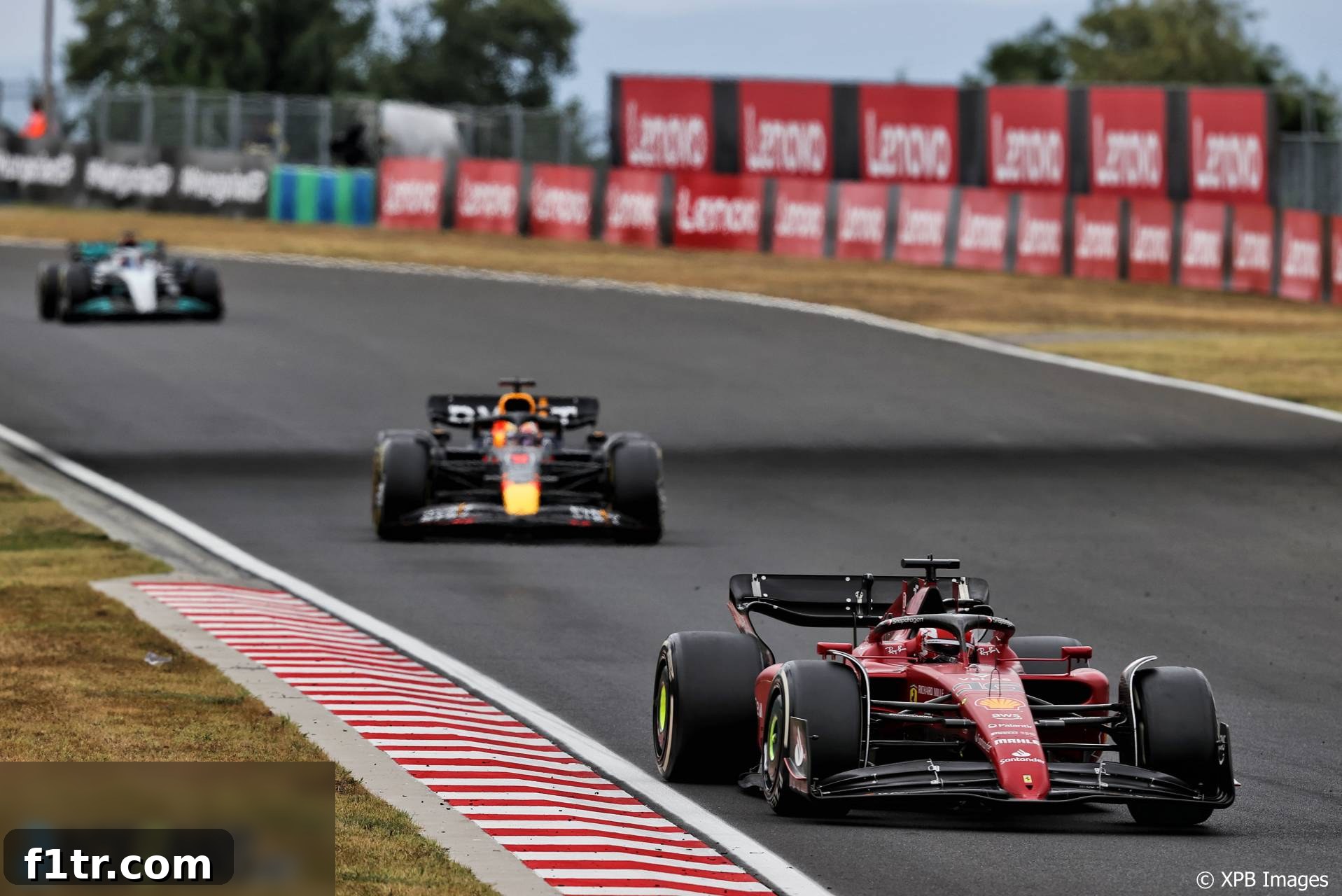
The 2022 Hungarian Grand Prix proved to be a pivotal and frustrating turning point for Scuderia Ferrari, as their championship aspirations took another significant hit. Following a race where strategic missteps and unexpected performance drops plagued their lead driver, Charles Leclerc, team principal Mattia Binotto was quick to offer his analysis. Binotto firmly asserted that Ferrari’s defeat at the Hungaroring was primarily attributable to an unforeseen lack of raw pace from their F1-75 challenger, rather than a failure of the team’s strategic calls, particularly the contentious decision to fit hard compound tyres on Leclerc’s car.
Ferrari’s Hungarian GP Puzzle: Binotto Blames Pace, Not Pit Wall Strategy
In the aftermath of a disappointing Hungarian Grand Prix, where Charles Leclerc saw a promising lead evaporate, Ferrari team principal Mattia Binotto delivered a forthright assessment, deflecting blame from the pit wall’s strategic decisions. According to Binotto, the fundamental issue that cost Ferrari victory was not the choice of tyre compound or the timing of pit stops, but rather a perplexing and sudden shortfall in the car’s inherent speed and performance on race day. This unexpected dip in competitive edge left the team struggling to match their rivals, leading to a sixth-place finish for Leclerc and Carlos Sainz Jr. dropping from second to fourth.
The High Stakes of the 2022 Hungarian Grand Prix
Heading into the Hungarian Grand Prix, Ferrari was under immense pressure to capitalize on any opportunity to close the gap on Red Bull in the Constructors’ Championship and to revive Charles Leclerc’s challenge for the Drivers’ title. The Hungaroring, with its twisty, technical layout, often rewards strong aerodynamic performance and nimble handling, characteristics that the Ferrari F1-75 had demonstrated at various points throughout the season. Friday practice sessions had painted a positive picture for the Italian squad, with both Leclerc and Sainz appearing competitive and the car seemingly well-balanced in hotter conditions. Hopes were high that Ferrari could convert their qualifying pace into a dominant race performance, especially after a challenging few races that had seen strategic blunders and reliability issues erode their earlier championship lead.
Leclerc’s Race: A Promising Start, a Disastrous Finish
Charles Leclerc started the race with determination, quickly establishing himself as a formidable contender. After a strong initial stint, he executed a superb on-track overtake on Mercedes’ George Russell to seize the lead, showcasing the F1-75’s potential and Leclerc’s driving prowess. At this point, victory seemed firmly within Ferrari’s grasp. However, the crucial second pit stop on lap 39 marked the beginning of a rapid and irreversible decline for Leclerc. The decision was made to switch him to a set of hard compound Pirelli tyres. This tyre choice, intended to provide durable performance for a long final stint, instead proved catastrophic. Almost immediately, Leclerc reported a lack of grip and pace, struggling to generate the necessary temperature in the cooler track conditions. Max Verstappen, who was on medium tyres and had started tenth due to a qualifying issue, swiftly capitalised on Ferrari’s predicament, easily passing Leclerc who became a sitting duck. The hard tyres simply refused to switch on, and Leclerc’s performance plummeted so dramatically that Ferrari was forced to make an unscheduled third pit stop for a set of soft tyres, consigning him to a distant sixth place at the chequered flag and effectively ending his realistic chances of a championship challenge.
Mattia Binotto’s Unwavering Stance: A Question of Raw Speed
In his post-race debrief, Mattia Binotto was resolute in his assessment, arguing forcefully that the team’s lack of outright speed was the primary culprit, not the much-criticized tyre strategy. “What we were lacking today was really speed and pace,” he stated, countering suggestions that the hard tyre choice alone sealed their fate. Binotto emphasized that for the first time in 13 races, Ferrari’s car simply did not possess the necessary speed to contend for victory, regardless of the tyre compound. This unexpected performance deficit became the focal point of his explanation. He highlighted the need for a thorough investigation into why the car underperformed, believing that a complete understanding of this issue would also shed light on why certain tyre compounds, particularly the hard, proved so uncooperative. The Ferrari chief’s insistence on a fundamental pace issue suggested a deeper, more concerning problem than merely a strategic misjudgment on a single Sunday.
The Hard Tyre Conundrum: A Strategy Gone Awry or a Symptom of Deeper Issues?
The decision to put Charles Leclerc on hard tyres drew immediate criticism and became the subject of intense scrutiny from fans and pundits alike. Binotto acknowledged that the hard tyre choice certainly amplified their problems but insisted it was a calculated risk based on their simulations. Ferrari’s pre-race data suggested that while the hard tyres would require a challenging warm-up period of a couple of laps and initially be slower than mediums for about 10 to 11 laps, they would eventually come alive and offer superior performance towards the end of what was planned as a 30-lap stint. The objective was to protect Leclerc’s track position against Max Verstappen, who was running on mediums, knowing that a long stint on softs would have been unsustainable. However, reality dramatically diverged from simulation. The hard tyres failed to deliver on their promise, never reaching their optimal operating window and leaving Leclerc vulnerable. Binotto also noted that other teams, such as Alpine, experienced similar difficulties with the hard compound, suggesting a broader issue with the tyre in the cooler Hungaroring conditions. This further fueled his argument that while the hard tyres exacerbated the situation, they were merely a symptom of a deeper-rooted lack of performance that day.
The Hungarian Conditions: A Factor in Ferrari’s Underperformance?
A significant shift in track conditions from Friday to Sunday was identified by Binotto as a potential factor in Ferrari’s struggles. Friday practice had been conducted in significantly hotter temperatures, where the F1-75 appeared to be strong, particularly during race simulations. However, race day brought considerably cooler conditions, which, according to Binotto, played a crucial role in altering the car’s performance characteristics. “The car today was not working as expected and we didn’t have the speed we were hoping for,” he explained, contrasting it with their strong Friday pace. Cooler ambient and track temperatures can drastically affect how tyres behave, making it harder to generate and maintain optimal operating temperatures, especially for harder compounds. This challenge can lead to reduced grip, increased sliding, and accelerated degradation if drivers are pushing too hard to compensate for the lack of grip. Ferrari’s car, which seemed to thrive in hotter conditions, evidently struggled to adapt, suggesting a narrow operating window or a sensitivity to temperature changes that became critically exposed on race day. This environmental variable, Binotto implied, contributed significantly to the car’s overall lack of speed, irrespective of the specific tyre chosen.
Carlos Sainz’s Race: Independent Evidence of Performance Gaps
Further supporting Binotto’s claim that the issue transcended a simple tyre strategy error was the performance of the other Ferrari, driven by Carlos Sainz Jr. Sainz completed the race without using the hard compound tyres, yet he also failed to convert his strong starting position into a podium finish, falling from second to fourth place. His race strategy was nearly identical to that of Lewis Hamilton, who started behind Sainz but ultimately finished a comfortable 10 seconds ahead. This comparison, according to Binotto, provided compelling evidence that the F1-75 was fundamentally underperforming. “Carlos was on exactly the same strategy of Lewis [Hamilton]. He was starting ahead but finishing behind and Lewis finished 10 seconds [ahead],” Binotto noted. This stark contrast highlighted that even on theoretically optimal tyre choices, the Ferrari lacked the necessary pace to compete with its closest rivals. Binotto concluded, “If the car is not performing then it doesn’t make the tyres working as well as they should, and certainly not the hard tyres.” This underscored his belief that the car’s inherent lack of speed was the root cause, making any tyre choice appear suboptimal.
Reflecting on a Missed Opportunity: Implications for Ferrari’s Championship Bid
The Hungarian Grand Prix was a significant blow to Ferrari’s championship aspirations. What began as a promising season, with Leclerc leading the Drivers’ standings, had steadily unraveled due to a combination of reliability issues, strategic missteps, and now, an unexpected dip in car performance. The lost points in Hungary allowed Max Verstappen and Red Bull to further extend their commanding lead in both championships, making Ferrari’s path to redemption increasingly arduous. Binotto’s emphasis on pace suggests a critical self-reflection is needed within the team. While strategic calls are always under scrutiny in F1, a fundamental lack of speed, especially when unexpected, points to deeper analytical or operational issues. The team needs to understand why their car’s characteristics seemed to shift so dramatically between practice and race day, and how to ensure consistent performance across varying conditions. This race served as a stark reminder that in the hyper-competitive world of Formula 1, even slight deviations from optimal performance can have profound consequences for championship hopes.
Looking Ahead: Ferrari’s Path to Redemption
As the Formula 1 season progressed beyond Hungary, Ferrari faced the daunting task of thoroughly analyzing their performance data to pinpoint the precise reasons for their unexpected struggles. The immediate focus would be on understanding the car’s sensitivity to cooler track conditions and how to optimize tyre performance across a wider range of temperatures. Adjustments to car setup, aerodynamic configuration, or even a deeper dive into tyre compound interactions would be imperative. For Binotto and his team, the challenge was not only to rectify the technical issues but also to restore confidence and cohesion within the Scuderia. The championship battle demanded unwavering performance and strategic brilliance, and Hungary highlighted areas where significant improvement was still needed. Ferrari’s legendary history is built on resilience, and the coming races would test their ability to rebound from adversity and demonstrate if their F1-75 truly possessed the inherent championship-winning speed that had been elusive on that fateful Sunday in Budapest.
2022 Hungarian Grand Prix Further Reading
- How many victory chances did Hamilton have in his first winless F1 season?
- Aston Martin expect rivals will copy novel rear wing by Singapore GP
- Transcript: Why Ferrari told Leclerc ‘the hard is worse than expected’ but still used it
- What made Verstappen’s 10th-to-first win in Hungary a rare achievement
- Gasly pleased FIA is considering “different options” for track limits policing in 2023
Browse all 2022 Hungarian Grand Prix articles