In the high-stakes world of Formula 1, every strategic decision is scrutinized, especially when made by a team with the storied history and championship aspirations of Ferrari. Following the 2022 Belgian Grand Prix at the iconic Spa-Francorchamps circuit, Team Principal Mattia Binotto found himself once again defending Ferrari’s race strategy, adamantly rejecting claims of significant errors despite a series of questionable calls that have plagued the Scuderia’s season.
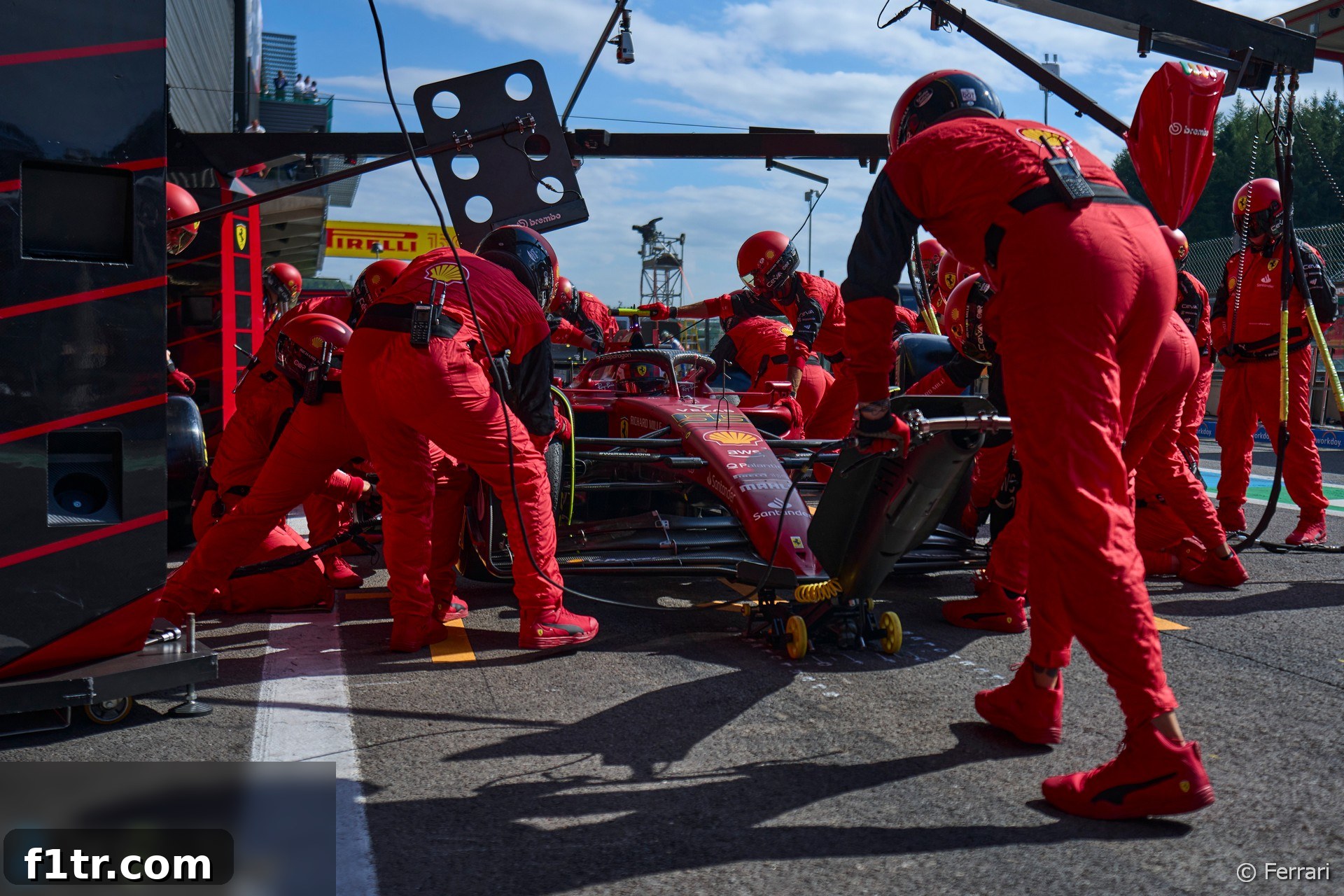
The latest incident that ignited debate involved Charles Leclerc’s late-race pit stop. With only a few laps remaining in Sunday’s Grand Prix, Ferrari opted to bring Leclerc in for a fresh set of soft tires, a move intended to secure the fastest lap of the race and the crucial bonus point that accompanies it. However, what seemed like a calculated risk ultimately backfired, costing the Monegasque driver precious track position and points.
The Controversial Belgian GP Pit Stop: A Gamble Gone Wrong
Ferrari’s decision to pit Leclerc in the closing stages of the Belgian Grand Prix was met with immediate skepticism, both from observers and, subtly, from Leclerc himself. The team’s objective was clear: to leverage fresh rubber to snatch the fastest lap from Max Verstappen, who had dominated the race. Yet, the execution and immediate aftermath of this strategy proved costly.
Upon rejoining the circuit from his pit stop, Leclerc found himself behind the veteran Fernando Alonso. While Leclerc, armed with fresher tires, was eventually able to repass the Alpine driver, the time lost in doing so, particularly at the beginning of his final lap, was critical. More damagingly, Leclerc was then assessed a five-second penalty for speeding in the pit lane – a minor infraction with major consequences, as it dropped him back behind Alonso in the final standings. This sequence of events meant Ferrari’s audacious attempt to gain a single bonus point resulted in a net loss of two championship points for Leclerc.
The fallout was swift, with Alonso, no stranger to expressing his views, publicly questioning Ferrari’s strategic acumen. “Ferrari has been doing strange things, so that was another strange thing,” he remarked, his comments echoing a growing sentiment within the F1 paddock and among fans about the Italian team’s tactical approach throughout the season.
A Season Marred by Strategic Debates and Missed Opportunities
Alonso’s candid observation was not an isolated critique; it highlighted a recurring pattern that has undeniably impacted Leclerc’s championship challenge. The Belgian Grand Prix incident was merely the latest in a series of strategic decisions that have drawn significant criticism and, arguably, cost Ferrari and Leclerc valuable points in their pursuit of the Constructors’ and Drivers’ Championships.
Retrospective analysis reveals several key races where Ferrari’s strategy raised eyebrows and directly compromised Leclerc’s performance:
- Monaco Grand Prix: A perplexing call saw Leclerc, who started from pole position and was seemingly in control, switched onto intermediate tires at a crucial juncture. This decision saw him lose significant track position and ultimately fall out of contention for a home victory.
- British Grand Prix: During a late Safety Car period, Ferrari opted not to pit Leclerc for fresh tires, leaving him vulnerable against rivals who did take the opportunity. This strategic gamble again saw him lose potential positions on track as the race resumed.
- Hungarian Grand Prix: Another crucial misstep occurred when the team fitted hard compound tires on Leclerc’s car during a pit stop. These tires proved to be the entirely wrong choice for the conditions and the car’s setup, severely hampering his pace and allowing competitors to pull away.
Each of these instances, culminating in the Spa-Francorchamps misadventure, painted a picture of a team struggling with consistent, effective race strategy, putting immense pressure on Mattia Binotto and his operational team.
Binotto’s Resolute Defense: “Perception vs. Reality”
Despite the mounting evidence and public critique, Mattia Binotto remains steadfast in his belief that Ferrari’s approach to strategy does not require a fundamental overhaul. He asserts that many perceived errors are, in fact, either calculated risks or misunderstandings from external observers, rather than genuine strategic blunders.
“Obviously there is always a need to improve and there are lessons learned on which we are looking and reflecting,” Binotto conceded, acknowledging the continuous pursuit of perfection inherent in Formula 1. However, he quickly tempered this by stating, “But if I look back at the season, I think there is a lot of perception from outside compared to what are the truth and the reality. I think sometimes we’re not doing these things that may have been perceived as mistakes.” This statement encapsulates his core argument: that the nuances of F1 decision-making are often lost on those outside the team, leading to unfair judgments.
Justifying the Spa Pit Stop
Binotto specifically defended the decision to pit Leclerc at the end of the Belgian Grand Prix, labeling it “the right call.” His justification hinged on the concept of bravery and seizing opportunities in F1.
“You need to be brave in F1. If there is an opportunity to try to get the fast lap and there was the margin on Fernando to stop on that and try to go for it, I think it was the right decision,” he explained. He elaborated that while it was known Leclerc would rejoin very close to Alonso, the advantage of fresher tires would facilitate a swift overtake, aided by DRS and superior top speed on the main straight. “So once again, I think it was the right decisions,” Binotto reiterated, emphasizing the calculated rationale behind the move.
Unforeseen Circumstances: The Pit Lane Speeding Penalty
Further compounding the issue for Leclerc in Belgium was the pit lane speeding penalty. Ferrari attributed this not to driver error or strategic miscalculation, but to an unforeseen technical glitch. Binotto revealed that a sensor on the front-right corner of Leclerc’s car was damaged by overheating earlier in the race. This damage was triggered when the brake duct ingested a visor tear-off, which had been discarded by Max Verstappen on lap one. The damaged sensor meant the team lacked accurate wheel speed data, making it difficult to precisely monitor and control pit lane speed.
“That’s the type of risk you always have,” Binotto admitted, framing the incident as an unfortunate consequence of racing, rather than a preventable strategic flaw. This explanation aimed to mitigate the perception of error, shifting blame to an external, unpredictable factor.
Red Bull’s Unmatched Dominance: A Broader Context
While strategic discussions dominated the post-race narrative surrounding Leclerc, the performance of Carlos Sainz Jnr also warranted attention. Despite starting from pole position, Sainz finished a distant third, a staggering 26 seconds behind race winner Max Verstappen. This significant performance gap led Binotto to contextualize Ferrari’s overall pace at Spa, suggesting that even flawless strategy might not have altered the outcome due to Red Bull’s sheer superiority.
“Red Bull this weekend was certainly stronger and significantly stronger to win anyhow,” Binotto stated unequivocally. He argued that the early Safety Car period, which some believed might have disadvantaged Sainz by preventing him from fully capitalizing on his soft starting tires, ultimately had little bearing on the final result. “So I don’t think it has affected the final result,” he affirmed.
Binotto further explained that while Sainz was on soft tires and competitors like Sergio Perez were on mediums, an early Safety Car could paradoxically assist with managing the thermal degradation of soft tires. “When you’ve got a Safety Car very soon in the race it may somehow as well help a slow introduction of soft tyres in terms of thermal management, et cetera,” he noted. His conclusion remained firm: “So I would say no, I don’t think that the Safety Car has affected the results. Red Bull has simply been much stronger this weekend.”
Looking Ahead: The Imperative for Consistency
Ferrari’s performance at the Belgian Grand Prix, marked by strategic controversy and a significant pace deficit to Red Bull, underscored the challenges facing the team. While Mattia Binotto consistently defends his team’s strategic calls, the recurring theme of questionable decisions continues to fuel debate and, more importantly, impacts their championship aspirations.
The “perception vs. reality” argument, though valid in some contexts, becomes harder to maintain when results are consistently compromised by choices made on the pit wall. For Ferrari to truly challenge for future titles, an unwavering focus on flawless execution, robust data analysis, and perhaps a more conservative approach when risks outweigh potential rewards, will be paramount. The passionate Tifosi and the entire Formula 1 world will be watching closely to see if Ferrari can translate their undeniable car speed into consistent, strategically sound race victories.
2022 Belgian Grand Prix Related Articles
- How many victory chances did Hamilton have in his first winless F1 season?
- Sainz doesn’t believe Red Bull’s huge Spa advantage is here to stay
- Alonso: Hamilton’s nationality explains “huge” media reaction to radio comment
- “Big question marks” remain over policing of Formula 1’s budget cap – Ferrari
- Williams: Points-scoring Belgian GP pace not just due to straight line speed
Browse all 2022 Belgian Grand Prix articles